









- What Does a Global Traffic Ecosystem Service Provider Do? What Are the Differences from a Single Advertising AgencyJul 16, 2026View details
- What should you focus on in the latest enterprise SaaS report? From renewal rates and delivery costs to overseas growth opportunitiesJul 12, 2026View details
- What signals are worth paying attention to in a cross-border marketing trend report? B2B companies should look at these 6 signalsJul 11, 2026View details
- How to Read a Cross-Border Marketing Trends Report? Five Key Dimensions for Evaluating Channel OpportunitiesJul 11, 2026View details
- Which channel has the highest ROI in the global traffic ecosystem? Comparative analysis of search, social media, and advertisingJul 10, 2026View details
- What multilingual website services are available in Sanya? Which model is more suitable for local businesses going global?Jul 08, 2026View details
- How to view the complete list of China SaaS companies in the top 100? Practical methods for screening website-building and marketing service providersJul 08, 2026View details
- How to view pricing in the global traffic ecosystem? Cost comparison of search, social media, and content channel advertisingJul 06, 2026View details
Where Do External Trade B2B Website Development Quotes Differ Significantly?
Why Do B2B Website Development Quotes for Export Businesses Vary So Much
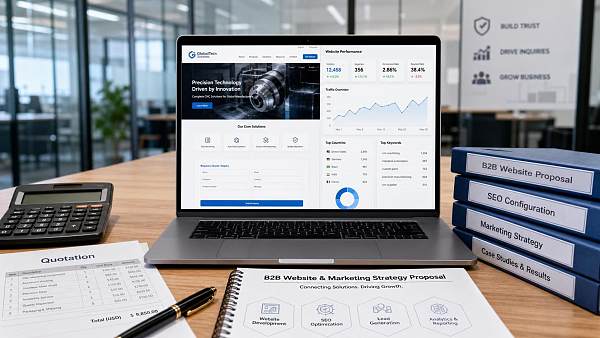
B2B website development quotes for export businesses can vary significantly. On the surface, the difference may appear to be the number of pages, but the real differences often lie deeper. For example, whether the backend is easy to maintain, whether multiple languages are supported, whether the website has a solid SEO foundation, and whether it can support ongoing promotion.
At first glance, many projects may differ by several thousand or even tens of thousands in price, or more. What truly creates the gap is not how attractive the homepage looks, but whether the website can be found by search engines, handle incoming traffic, and continuously generate inquiries after launch.
In an integrated website and marketing service context, B2B website development quotes for export businesses generally include two parts: the delivery cost of website development and the prebuilt cost of future growth capabilities. The former is easy to see, while the latter is more likely to be overlooked.
Is the Difference Between Low-Cost and High-Cost Plans Really the Number of Pages
Not entirely. The number of pages is simply the easiest item to list, but it is not the most important one. More commonly, even websites with a dozen or more pages can have completely different underlying capabilities depending on the service provider.
A low-cost plan may only solve the problem of having a usable website. A relatively complete plan solves the problems of having a website that exists, can be indexed, can be promoted, and can convert visitors. Both types of projects are called website development, but their value structures are different.
The common differences in B2B website development quotes for export businesses are usually concentrated in the following areas.
- Whether the website has a marketing-oriented architecture rather than being purely for display.
- Whether it has SEO-friendly URLs, tags, sitemaps, and speed optimization.
- Whether multilingual support relies on manually switching pages or on system-level language management.
- Whether form tracking, inquiry attribution, and data analysis are included.
- Whether it can later support Google SEO, advertising, and social media traffic acquisition.
Simply put, the price of B2B website development for export businesses often depends on whether the website is a static business card or infrastructure capable of generating customers continuously.
Which Configurations Are Most Easily Overlooked but Have the Greatest Impact on the Final Cost
What is most easily overlooked is often not the design but the system-level configuration. These items may not be prominently listed in a quotation, but they directly determine whether rework will be required later.
Take multilingual support as an example. Many export-oriented websites do not end with an English version. They may later need to expand into Spanish-, Russian-, French-, or Arabic-speaking markets. If the language structure is not considered at the early stage, the cost of adding new languages later will increase significantly.
SEO fundamentals are another example. If title rules, page hierarchy, mobile speed, image compression, and indexing submissions are not properly handled when the website goes live, subsequent Google SEO work will often require the technical foundation to be rebuilt from scratch.
To see the differences between quotes more clearly, you can first refer to the evaluation table below.
When requesting quotes, comparing only the total price can be misleading. A more reliable approach is to examine these hidden configurations item by item.
How Should You Evaluate a Website Development Quote If You Also Plan to Run Promotions Later
This is a crucial question. Many websites may appear to save budget when they first go live, but once they enter the promotion stage, it becomes clear that their page structure is unsuitable for advertising, SEO, or conversions. The total cost then ends up being higher.
If a B2B website development quote for an export business covers only design and front-end production, it often cannot support long-term customer acquisition. Google SEO and advertising in particular have clear requirements for landing page speed, form paths, and content structure.
In practical applications, what deserves more attention is whether website development and marketing are integrated. A service provider that understands both website development and overseas marketing will usually consider search indexing, keyword planning, advertising conversion paths, and the user experience across different regions from the project initiation stage.
This is why integrated solutions for B2B website development in export businesses often have somewhat higher quotes. They do not simply create a few additional pages; they build the growth capabilities that may be needed over the next several years into the website’s underlying architecture in advance.
Platform-based service providers such as EasyYingbao, which provide long-term services for companies expanding overseas, usually view intelligent website development, SEO optimization, advertising, and social media marketing as part of the same growth logic. For budget evaluation, this is closer to the actual investment than looking only at the website development item.
Which Expenditures in a B2B Website Development Quote for an Export Business Provide Better Value
Not every high-priced option is worthwhile, and not every low-priced option is unsuitable. The key is where the budget is allocated. If most of the budget is spent on eye-catching visual effects rather than on content architecture, technical SEO, and inquiry paths, the return on investment is usually unsatisfactory.
The areas that are relatively more worthwhile to invest in usually share several characteristics.
- A backend that supports the continuous addition of products, case studies, and industry content.
- Navigation structures and content templates that match overseas search habits.
- Underlying support for multilingual and multi-region user experiences.
- Conversion-focused design details for forms, buttons, and inquiry pages.
- Data interfaces that can later support SEO, advertising, and social media traffic campaigns.
Conversely, if a quote is very low but treats a template-based website, basic translation, and a simple form as a complete delivery, you should be alert to additional costs later. The money saved initially may have to be paid again in the form of redesigns, additional work, and ineffective promotion.
What Should You Ask When Requesting a Quote to Determine Whether It Is Reliable
Many quotations look similar at first glance. The real differences can only be identified through questions. The more specific the questions, the easier it is to determine whether a B2B website development quote for an export business contains inflated costs or omits key items.
The following types of questions should be confirmed as a priority.
- Does it include basic SEO setup, and which specific items are covered?
- Is multilingual support provided through independent websites, a directory structure, or simple page duplication?
- Can the backend be used to update products, news, case studies, and landing pages independently?
- Does it support tracking implementation, conversion measurement, and source analysis?
- Will secondary development be required later for Google SEO or advertising?
- How are maintenance, content updates, redesigns, and additional languages charged?
What needs to be confirmed in advance is that a quotation is not more valuable simply because it looks more detailed; its value lies in how clearly it defines the delivery scope. If a proposal only states “one corporate website development project” without specifying technical, content, language, and marketing support, there may be considerable disputes later.
How Can You Make the Final Evaluation Without Falling into the Low-Price Trap
When evaluating B2B website development quotes for export businesses, it is best not to look only at the one-time cost. A more reasonable approach is to divide the project into four parts—launch costs, promotion preparation costs, future expansion costs, and maintenance costs—and then assess whether the total investment is worthwhile.
If the website is intended only for short-term presentation and the budget is limited, a basic plan may still be suitable. However, if the goals include overseas inquiries, search indexing, multilingual expansion, or advertising, priority should be given to system capabilities and marketing integration rather than focusing first on the lowest price.
Over the past decade or more, the requirements of companies expanding overseas have shifted from “building a website” to “building a website capable of growth.” This is also why many platform-based service providers continue to invest in AI website development, SEO/GEO optimization, and data-driven operations. A solid foundation is essential for efficient promotion later.
The genuinely useful approach is to first clarify the target markets, languages, content volume, and customer acquisition methods, and then use the same requirements checklist to compare different solutions. Evaluating B2B website development quotes for export businesses in this way prevents surface-level prices from misleading you and makes it easier to choose a website solution suitable for long-term operation.
Related Articles

Related Products
 EasyCamp SaaS Smart Website Marketing SystemE-Yingbao SaaS Smart Website Marketing System: AI-powered, zero-code website building. Rapidly launch multilingual independent e-commerce sites in just 10 minutes. Global server acceleration and AI-driven SEO optimization empower businesses to efficiently connect with global markets. The seamless integration of technology and user-friendly operation makes building e-commerce sites incredibly simple.
 AI+SEM Intelligent Advertising Marketing SystemAI+SEM drives intelligent ad creation, empowering full-funnel precision advertising marketing. The system automatically generates weekly/monthly reports, AI recommends keywords and target countries, monitors core metrics in real-time with intelligent alerts, and enables one-click high-conversion ad solutions to help quickly acquire customers and improve ROI.
 AI+SEO Dual Engine Optimization ServiceEasyWin AI+SEO Dual Engine Optimization System leverages AI-powered keyword mining, content generation, and comprehensive technical optimization to help foreign trade enterprises acquire high-quality organic traffic, significantly improving search rankings and conversion rates.
 AI+SNS Social Media Marketing SystemYingbao AI+SNS Social Media Marketing System - Precision social capture for the social media era. Supports one-click content synchronization across major platforms like Facebook and LinkedIn. AI intelligently rewrites posts for enhanced relevance. 24/7 AI customer service and user profiling analysis empower businesses to efficiently expand into global markets.
 AI+SEO营销解决方案易营宝AI+SEO营销解决方案,通过AI批量写作、智能生成TDK、精准关键词扩词等功能,全面优化网站SEO效果,提升流量与转化率。助力企业构建高效智能网站新生态。
 AI+SEM Advertising Marketing SolutionsAI+SEM Advertising Marketing Solution leverages AI technology to deeply empower SEM ad campaigns. It automatically generates weekly/monthly reports using AI, presenting account data across multiple dimensions for comprehensive insights into campaign performance and trends. The system precisely recommends keywords and target countries, intelligently generates high-conversion ad copy, and enables one-click activation of efficient campaign plans to help businesses rapidly acquire customers. Simultaneously, it monitors core metrics in real time, intelligently identifies abnormal fluctuations, and issues timely alerts to ensure stable, high-return advertising results.
 Domain Name ServicesEasyWin provides professional domain name services, including intelligent queries, one-stop registration, brand protection, and full lifecycle management, helping businesses build a digital brand image.
 EasyOperate B2C Cross-Border E-Commerce Platform & Independent WebsiteEasyStore B2C Cross-border E-commerce Independent Store is an intelligent website building and cross-border e-commerce integrated solution independently developed by EasyStore Information Technology (Beijing) Co., Ltd. The system is specially designed for small and medium-sized as well as large export enterprises, integrating 'website building, operation, marketing, advertising, and conversion' into one, helping enterprises quickly establish cross-border e-commerce independent stores to achieve brand globalization and global sales growth.
The platform supports multiple languages, multiple currencies, and multi-channel marketing, with built-in AI intelligent translation and SEO optimization systems, suitable for mainstream markets such as Southeast Asia, Europe and America, Latin America, and the Middle East, assisting Chinese manufacturing enterprises in efficiently deploying international e-commerce strategies. SSL证书易营宝提供专业SSL安全证书服务,包括单域名和泛域名证书,确保网站数据传输加密、身份验证和完整性保护,助力企业建立安全可信的在线业务环境。









