









- China-Morocco zero-tariff access, a breakthrough in the cost of Moroccan goods exports to ChinaJun 11, 2026View details
- What signal should be released for the suspension of exports to JapanJun 10, 2026View details
- China's May LNG imports rebounded, with increased volumes from Russia and Canada filling the Middle East supply gapJun 10, 2026View details
- Will GEO change its SEO strategy?Jun 04, 2026View details
- What types of businesses are end-to-end solutions suitable for?Jun 03, 2026View details
- 2026 Global Growth Channel TrendsJun 02, 2026View details
- Changes in Search Engine Ranking Factors in 2026Jun 06, 2026View details
- Which stages is the brand visibility enhancement service suitable forMay 29, 2026View details
What Issues Can Be Identified Through Webmaster Tools SEO Analysis?
Webmaster tools SEO analysis can not only identify basic issues such as indexing, rankings, speed, and broken links, but also help businesses assess website structure, content quality, and search engine ranking optimization directions, providing a clear basis for developing subsequent website SEO optimization plans. For businesses, its value is not just in “looking at data,” but in quickly identifying exactly where the website is getting stuck: whether crawling is being affected by technical issues, whether content quality is insufficient, or whether keyword placement does not match user search intent. As long as these signals are properly understood, optimization priorities can be arranged more efficiently and ineffective investment can be reduced.
What key issues can webmaster tools SEO analysis actually reveal?
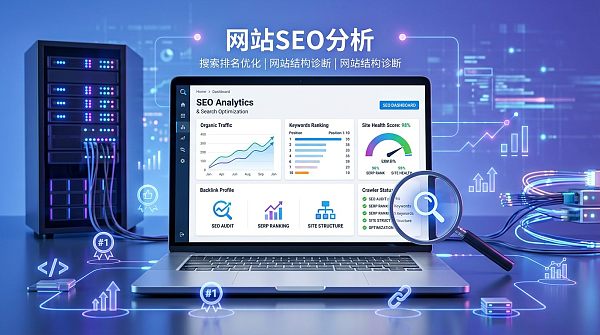
From an actual operations perspective, webmaster tools SEO analysis usually helps website operators, business decision-makers, and maintenance personnel identify the following core categories of issues:
- Indexing abnormalities: Pages have clearly been published, yet they are still not indexed by search engines for a long time, which may indicate problems with page quality, link structure, or crawl entry points.
- Keyword ranking fluctuations: When certain keywords suddenly drop, it often means reduced page relevance, stronger competitors, or technical issues on the website itself.
- Website speed is too slow: Slow loading speed not only affects user experience, but also impacts search engine crawling efficiency and ranking performance.
- Too many broken links and error pages: 404s, redirect errors, and invalid links weaken the overall quality of the website and affect user retention and search engine evaluation.
- Unreasonable title, description, and keyword placement: Even if a page is indexed, it may still fail to achieve ideal rankings because the SEO basic settings are not properly standardized.
- Unclear website structure: Confusing navigation, excessive depth, and weak internal linking can all make it difficult for search engines to understand page priorities.
- Insufficient mobile adaptation: If the website displays abnormally on mobile devices, it often directly affects conversion rates and search performance.
This is also why many businesses, when doing website SEO optimization, do not blindly start by publishing articles, but first use webmaster tools SEO analysis to locate problems. Because only after clearly understanding “where the problem lies” do subsequent optimization actions become meaningful.
What businesses encounter most often is not a lack of traffic, but not understanding where the problem is
Many business websites appear on the surface to “open properly, have content, and have been online for a long time,” yet traffic remains unstable and inquiries are not ideal. The value of webmaster tools SEO analysis lies in making these seemingly vague problems concrete.
For example:
- There are many website pages, but very few are actually indexed, indicating that the content may be repetitive, the page value may be low, or there may be problems with the crawl path.
- Brand terms can be found, but industry terms cannot, indicating insufficient industry keyword placement and inadequate content coverage.
- The homepage ranks, but inner pages show no performance, indicating that the website structure and topical content development are incomplete.
- There is traffic but no conversion, indicating that the page content may not truly align with user search intent.
For business decision-makers, what matters most is usually not a single SEO metric itself, but what these data points mean behind the scenes: Is the website worth continued optimization investment? Can the problem be fixed in the short term, or does it require restructuring? How long after investing in SEO can results be seen?
For executors and maintenance personnel, webmaster tools provide an entry point for troubleshooting. They cannot replace a complete strategy, but they can quickly tell you: which pages should be fixed first, which sections need more content, and which technical details are holding the site back.
Through webmaster tools, it is usually possible to determine what stage a website’s SEO is in
An experienced operator usually does not look at just one metric, but instead judges the stage of the website through a combination of several core data points.
Stage 1: Weak foundation period
Common signs include low indexing, few pages, duplicate titles, slow speed, and many broken links. For this type of website, the first priority is to solve technical and structural issues rather than rushing to pursue rankings for highly competitive keywords.
Stage 2: Content exists but shows no performance
There are already quite a few pages, but keyword rankings are not obvious. This may be because the content does not match search intent well, or because the thematic distinctions between pages are unclear, making it difficult for search engines to judge the core value.
Stage 3: Rankings exist but growth is slow
These websites usually have a decent SEO foundation, but insufficient keyword expansion, weak topic pages, and weak backlinks and brand signals cause growth to hit a bottleneck.
Stage 4: Traffic exists but conversion is insufficient
At this point, the problem often lies not only in SEO itself, but also in landing page design, persuasive content, page structure, and the commercial conversion path. In other words, SEO analysis is no longer just about looking at rankings, but also at “traffic quality.”
From this perspective, webmaster tools SEO analysis is not only a technical diagnostic tool, but also an important supporting basis for businesses to evaluate website marketing maturity.
Which analysis results are most worth prioritizing? Don’t waste time on secondary metrics
Many people doing SEO easily fall into a state of “there is a lot of data, but I don’t know what to do first.” In fact, the items truly worth prioritizing usually fall into only a few categories:
- Indexing and crawling issues
If pages cannot enter the search engine index at all, then even the best content and keyword placement will be difficult to make effective. - Website loading speed and stability
Slow speed directly affects bounce rate, crawler access efficiency, and mobile experience, making it a foundation among foundations. - Relevance between page titles and content
No matter how “SEO-like” a title is written, if it is inconsistent with the main topic of the content, stable rankings will still be difficult to achieve. - Optimization order for high-value pages
Do not optimize all pages equally. Product pages, service pages, core category pages, and high-potential content pages should be prioritized. - Cleanup of broken links, duplicate pages, and invalid pages
These issues dilute website authority and affect overall quality assessment.
For businesses, the biggest fear in SEO optimization is “working on it for a long time, but without effective accumulation.” Identifying high-priority issues through webmaster tools can significantly improve optimization efficiency and also help management evaluate SEO return on investment more clearly.
If a website wants to expand into overseas or niche markets, SEO analysis must also examine localization issues
Many businesses have some experience in optimizing domestic websites, but once they enter overseas markets, especially regions like the Middle East where language and usage habits differ greatly, traditional SEO troubleshooting methods are often not enough. At this point, in addition to basic analysis of indexing, speed, and structure, the following issues also need special attention:
- Whether the website language is truly localized rather than simply machine-translated
- Whether the page layout adapts to Arabic right-to-left reading habits
- Whether the domain, server, and certificate configuration are conducive to the access experience in the target market
- Whether the keyword strategy matches local search habits rather than directly copying Chinese or English terms
- Whether on-site content and advertising campaigns can work in coordination
For businesses hoping to expand into the Middle East market, website development and SEO analysis should take localized marketing logic into account at the same time. If a business is planning to build an Arabic website, an integrated solution that combines website development, translation, maintenance, and keyword optimization is often more effective. For example, Arabic industry website development and marketing solutions are better suited for businesses that need to balance Arabic website development, RTL layout, localized translation, maintenance support, and Google Ads Arabic keyword optimization. The advantage of this type of solution is not that it has “more functions,” but that it can reduce the communication and execution costs caused by businesses piecing together resources on their own.
How can you tell whether SEO analysis results have real business value? The key lies in these evaluation criteria
Many reports can list a pile of problems, but SEO analysis that is truly useful for businesses should be able to answer the following questions:
- Does the problem affect traffic acquisition? For example, indexing abnormalities, missing keywords, blocked crawling, etc.
- Does the problem affect user conversion? For example, slow page loading, poor mobile experience, content that does not match needs, etc.
- Can the problem be fixed in the short term? Issues such as broken links, title optimization, and basic tag adjustments usually show results faster.
- Does the problem require long-term development? For example, content systems, industry keyword coverage, and topic page layout usually belong to medium- to long-term work.
- Is there a clear expected return after the fix? This determines whether a business is willing to continue investing.
In other words, webmaster tools SEO analysis should not remain at the level of “listing data,” but should be transformed into actionable judgments: which issues must be handled now, which can be postponed, and which require cross-department collaboration to complete.
Conclusion: The real value of webmaster tools SEO analysis is helping you identify the obstacles blocking website growth
Returning to the core question: What problems can webmaster tools SEO analysis reveal? The answer is that it can not only reveal surface-level issues such as indexing, rankings, speed, broken links, structure, and title settings, but more importantly, it can help businesses identify the real reasons behind slow website traffic growth and determine where the next round of optimization should begin.
For execution teams, it is the starting point for troubleshooting and optimization; for management, it is an important basis for judging whether the website has the ability to continuously acquire customers; for businesses that want to expand into overseas markets, it can also help uncover hidden weaknesses in localized website development and marketing.
If you want SEO to truly serve business growth rather than remain at the data level, then understanding webmaster tools SEO analysis results is more important than simply watching a few ranking numbers. Only by accurately identifying problems and setting the right priorities can website optimization continue to generate value.
Related Articles



Related Products
 EasyCamp SaaS Smart Website Marketing SystemE-Yingbao SaaS Smart Website Marketing System: AI-powered, zero-code website building. Rapidly launch multilingual independent e-commerce sites in just 10 minutes. Global server acceleration and AI-driven SEO optimization empower businesses to efficiently connect with global markets. The seamless integration of technology and user-friendly operation makes building e-commerce sites incredibly simple.
 AI+SEM Intelligent Advertising Marketing SystemAI+SEM drives intelligent ad creation, empowering full-funnel precision advertising marketing. The system automatically generates weekly/monthly reports, AI recommends keywords and target countries, monitors core metrics in real-time with intelligent alerts, and enables one-click high-conversion ad solutions to help quickly acquire customers and improve ROI.
 AI+SEO Dual Engine Optimization ServiceEasyWin AI+SEO Dual Engine Optimization System leverages AI-powered keyword mining, content generation, and comprehensive technical optimization to help foreign trade enterprises acquire high-quality organic traffic, significantly improving search rankings and conversion rates.
 AI+SNS Social Media Marketing SystemYingbao AI+SNS Social Media Marketing System - Precision social capture for the social media era. Supports one-click content synchronization across major platforms like Facebook and LinkedIn. AI intelligently rewrites posts for enhanced relevance. 24/7 AI customer service and user profiling analysis empower businesses to efficiently expand into global markets.
 AI+SEO营销解决方案易营宝AI+SEO营销解决方案,通过AI批量写作、智能生成TDK、精准关键词扩词等功能,全面优化网站SEO效果,提升流量与转化率。助力企业构建高效智能网站新生态。
 AI+SEM Advertising Marketing SolutionsAI+SEM Advertising Marketing Solution leverages AI technology to deeply empower SEM ad campaigns. It automatically generates weekly/monthly reports using AI, presenting account data across multiple dimensions for comprehensive insights into campaign performance and trends. The system precisely recommends keywords and target countries, intelligently generates high-conversion ad copy, and enables one-click activation of efficient campaign plans to help businesses rapidly acquire customers. Simultaneously, it monitors core metrics in real time, intelligently identifies abnormal fluctuations, and issues timely alerts to ensure stable, high-return advertising results.
 Domain Name ServicesEasyWin provides professional domain name services, including intelligent queries, one-stop registration, brand protection, and full lifecycle management, helping businesses build a digital brand image.
 EasyOperate B2C Cross-Border E-Commerce Platform & Independent WebsiteEasyStore B2C Cross-border E-commerce Independent Store is an intelligent website building and cross-border e-commerce integrated solution independently developed by EasyStore Information Technology (Beijing) Co., Ltd. The system is specially designed for small and medium-sized as well as large export enterprises, integrating 'website building, operation, marketing, advertising, and conversion' into one, helping enterprises quickly establish cross-border e-commerce independent stores to achieve brand globalization and global sales growth.
The platform supports multiple languages, multiple currencies, and multi-channel marketing, with built-in AI intelligent translation and SEO optimization systems, suitable for mainstream markets such as Southeast Asia, Europe and America, Latin America, and the Middle East, assisting Chinese manufacturing enterprises in efficiently deploying international e-commerce strategies. SSL证书易营宝提供专业SSL安全证书服务,包括单域名和泛域名证书,确保网站数据传输加密、身份验证和完整性保护,助力企业建立安全可信的在线业务环境。









