









- What should you focus on in the latest enterprise SaaS report? From renewal rates and delivery costs to overseas growth opportunitiesJul 12, 2026View details
- What signals are worth paying attention to in a cross-border marketing trend report? B2B companies should look at these 6 signalsJul 11, 2026View details
- How to Read a Cross-Border Marketing Trends Report? Five Key Dimensions for Evaluating Channel OpportunitiesJul 11, 2026View details
- Which channel has the highest ROI in the global traffic ecosystem? Comparative analysis of search, social media, and advertisingJul 10, 2026View details
- What multilingual website services are available in Sanya? Which model is more suitable for local businesses going global?Jul 08, 2026View details
- How to view the complete list of China SaaS companies in the top 100? Practical methods for screening website-building and marketing service providersJul 08, 2026View details
- How to view pricing in the global traffic ecosystem? Cost comparison of search, social media, and content channel advertisingJul 06, 2026View details
- How to assess foreign trade website development trends?Looking at 2026 changes from multilingual,AI content to conversion pathsJul 04, 2026View details
Which goals should be clarified before a website design redesign
A website design revamp should not begin with changing the style,but with clarifying goals for growth,conversion and brand communication。For project managers,only when the goals are clear can subsequent requirements,budget,timeline and performance evaluation be truly controllable。
In an integrated website + marketing service scenario,a revamp is never simply a page redraw,but a systematic project involving business processes,customer acquisition paths,content organization and data tracking。Especially for engineering project leaders,once the goals of website design are vague,problems such as repeated requirement changes,extended schedules,unbalanced investment and difficult acceptance are likely to occur。
Since its establishment in 2013,Eyingbao Information Technology(Beijing)Co., Ltd. has continued to provide full-chain services around intelligent website building,SEO optimization,social media marketing and advertising placement。For teams preparing to revamp a corporate official website,marketing website or overseas independent website,clearly explaining “why to revamp,who the revamp is for,and what results are expected” is often more important than first discussing colors,sections and animations。
Set goals first,then discuss the scope of the website design revamp
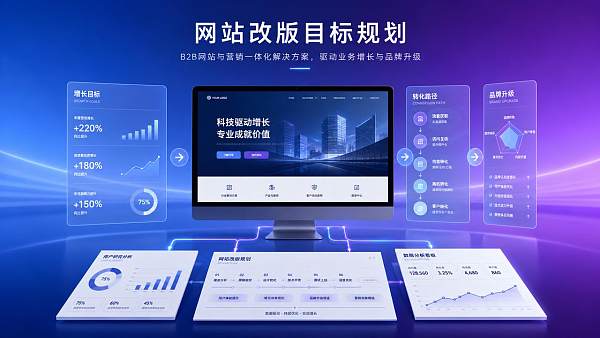
When project managers promote a website design revamp,the most common deviation is to treat “visual upgrade” as the main task。In fact,a mature website revamp goal usually covers at least 3 dimensions:growth goals,conversion goals and brand goals。If any one of these dimensions is missing,subsequent requirements will be difficult to converge。
Why goal-first planning can reduce rework
The cycle for a standard corporate website revamp is usually 2 weeks to 8 weeks,and if it involves multiple languages,multiple product lines,or integration with CRM,forms and advertising accounts,the cycle may extend to more than 10 weeks。When goals are unclear,the number of design draft confirmation rounds often increases from 2 rounds to more than 5 rounds,directly affecting the budget and launch window。
From a management perspective,the goals of a website design revamp should be quantifiable,such as increasing average monthly qualified inquiries by 20% to 50%,reducing page bounce rate by 10% to 25%,and improving the conversion rate of core landing pages by 1 to 3 percentage points。Only when goals can be measured will acceptance not remain at “looks good”。
4 types of core questions that must be aligned before project kickoff
- What is the biggest problem with the current website:insufficient traffic,low conversion,brand aging,or poor mobile experience。
- What is the top priority of this website design:customer acquisition,partner recruitment,talent recruitment,channel enablement or overseas promotion。
- Who are the main visitors:procurement managers,technical evaluators,partners or end customers。
- Which metrics will be used to evaluate results after launch:number of inquiries,form submission rate,time on site,keyword coverage,etc。
To make cross-department communication more efficient,it is recommended to create a one-page revamp goal sheet during the project initiation stage。The table below is suitable for project managers,marketing leaders and service providers to align directly at the kickoff meeting。
As can be seen from the table,website design goals are not single-point optimization,but the concrete implementation of business goals on a digital interface。If a company wants to improve brand trust while also considering customer acquisition and conversion,the page structure,content hierarchy and technical deployment must be designed in sync,rather than working in silos。
Misconceptions engineering project leaders should be most alert to
First,focusing only on the homepage while neglecting product pages,solution pages and case pages。B2B conversions usually happen on deep pages within 3 levels,rather than through a single-point display on the homepage。Second,doing only a visual revamp without content restructuring,which causes the updated website design to still fail to receive search and advertising traffic effectively。
Third,understanding the revamp as a one-time delivery while ignoring data reviews at 30 days,60 days and 90 days after launch。Truly effective website design often requires at least 1 round of post-launch optimization to adjust user paths,form fields and CTA positions to a more reasonable state。
Only by clarifying the audience and conversion path can website design create business value
When project managers define revamp goals,the second key action is to confirm whom the website serves。For integrated website + marketing services,different customer groups have very different decision-making paths after entering the website,so website design must be built around real user tasks rather than arranging sections according to the company’s internal organizational structure。
3 common types of visitors to B2B websites
The first type is decision-makers,who focus on service capabilities,risk control,delivery speed and budget range;the second type is the execution level,who mainly look at cases,functions,processes and collaboration methods;the third type is technical or operations personnel,who care more about backend ease of use,data integration,tracking tags and subsequent maintenance efficiency。
Therefore,an effective website design usually needs to plan at least 4 types of key pages:the homepage builds awareness,service pages explain capabilities,solution pages respond to scenarios,and case pages enhance trust。If the company also has overseas promotion needs,multilingual pages,localized content and form tracking mechanisms should also be included simultaneously。
The conversion path should move from “seeing” to “inquiry”
Many website design failures are not because the pages are unattractive,but because users still cannot find the next action after 2 to 3 clicks。For example,phone contact entries that are too deeply buried,forms with more than 8 fields,and inconspicuous mobile buttons can all cause potential customers to drop off at critical points。
It is recommended to break the conversion path into 5 steps:entering the page,understanding the service,building trust,triggering action,and submitting information。Each step should have clear supporting elements,such as a value proposition above the fold,case evidence,FAQ,appointment buttons,downloadable materials or online consultation components。
If a company is in the stage of digital upgrading,it can also improve internal decision-making logic with management research materials。For example,when discussing industrial upgrading,policy impact and business strategies,you can further refer to Research on Green Taxation Supporting Enterprise Innovation and Industrial Upgrading,helping the team understand the relationship between website upgrading and growth system building from a broader business perspective。
The table below is suitable for sorting out page demands from different audiences,helping reduce the problem of “many sections but unclear focus” during the website design stage。
This type of sorting can help companies upgrade website design from a “content placement problem” to a “business path design problem”。For companies that need to balance domestic and overseas customer acquisition,standards should be set in advance for multi-device adaptation,page loading speed,on-site search and lead attribution。
Budget,timeline and acceptance criteria must be locked before the revamp
After clarifying the goals,the third step is to formulate the implementation framework。Many website design projects are difficult to advance not because the service provider lacks execution capability,but because Party A has not defined budget boundaries,milestone nodes and acceptance conditions in the early stage,resulting in continuous addition of new requirements midway。
It is recommended to adopt a 3-stage advancement method
- Strategy stage:use 3 to 7 days to complete goal sorting,competitor scanning,section restructuring and confirmation of keyword layout direction。
- Production stage:use 10 to 25 days to complete prototypes,visual design,front-end development,content launch and basic tracking tag deployment。
- Optimization stage:conduct a data review 15 to 30 days after launch,and make secondary adjustments for high-bounce pages and low-conversion nodes。
Budget is not only about the number of pages
When purchasing website design services,you should not judge only by “how much for several pages”。What truly affects the investment is often the depth of content restructuring,whether multiple languages are required,whether CRM or marketing automation needs to be connected,whether basic SEO optimization is done at the same time,and whether subsequent operation and maintenance support is included。
Taking a B2B official website as an example,if it is only a basic display-type revamp,the work may focus on 5 to 15 pages;if it involves a marketing website,campaign pages,a content system and an advertising traffic receiving chain,the workload will increase significantly。Project leaders should prioritize comparing “whether the delivery scope is clear” rather than simply looking at the quotation level。
At least 6 items should be checked during acceptance
- Whether the main pages on PC and mobile are fully adapted,and whether key buttons are clickable。
- Whether page loading speed is stable,and whether images and scripts have undergone basic compression。
- Whether forms,phone calls,online consultation and download buttons can all be triggered normally。
- Whether titles,descriptions,section paths and internal anchor text have room for subsequent optimization。
- Whether analytics codes,conversion tracking tags and source identification have been properly deployed。
- Whether the backend supports non-technical personnel completing routine content updates within 10 minutes。
For companies hoping to reduce communication costs,choosing a service team with collaborative capabilities in website building,SEO,social media and advertising is more advantageous。Because once website design is separated from subsequent promotion,landing pages,keywords,ad materials and data attribution will be difficult to unify,and the result is often that the site is launched,but the growth chain has not been connected。
A revamp decision checklist suitable for project managers
To make website design projects more stable,project managers can complete an internal check before the project initiation meeting。This action usually takes only 1 to 2 working days,but can significantly reduce the probability of repeated later revisions。
Checklist items that can be used directly before the revamp
- Whether the primary goal and secondary goal of this revamp have been clearly defined。
- Whether the target customers’ industries,positions and visit scenarios have been confirmed。
- Whether existing high-value content has been accumulated,such as cases,white papers,product materials and FAQ。
- Whether a single project leader has been designated to avoid multi-headed decision-making among marketing,sales and technology teams。
- Whether a requirement freeze time has been agreed,such as no longer adding core modules after prototype confirmation。
- Whether a data review meeting 30 days after launch has been planned in advance。
Practical criteria for evaluating service providers
When reviewing a proposal,you may first ask 4 questions:whether business goals can be translated into page structures;whether the logic of keywords and content layout can be explained;whether conversion components and tracking tag rules can be defined;whether a collaboration checklist for 2 to 3 stages can be provided。Teams that can clearly answer these questions are usually more suitable for complex B2B projects。
For teams like Eyingbao that have been deeply engaged for more than ten years and cover both intelligent website building and digital marketing services,their value lies not only in building the website,but also in helping companies place website design into a complete growth chain,taking into account brand display,search traffic reception,advertising conversion and subsequent iteration efficiency。
For project managers,the most important thing in a website design revamp is not to determine the page style first,but to lock the goals,audience,path,budget and acceptance criteria first。The clearer the goals,the more stable the requirements;the clearer the path,the more the revamp can be converted into business results。If you are planning a new round of official website upgrade,marketing website construction or overseas site revamp,it is recommended to sort out the requirements list as early as possible and obtain a customized plan,further understand solutions that better match your company’s current growth demands,and contact us now。
Related Articles


Related Products
 EasyCamp SaaS Smart Website Marketing SystemE-Yingbao SaaS Smart Website Marketing System: AI-powered, zero-code website building. Rapidly launch multilingual independent e-commerce sites in just 10 minutes. Global server acceleration and AI-driven SEO optimization empower businesses to efficiently connect with global markets. The seamless integration of technology and user-friendly operation makes building e-commerce sites incredibly simple.
 AI+SEM Intelligent Advertising Marketing SystemAI+SEM drives intelligent ad creation, empowering full-funnel precision advertising marketing. The system automatically generates weekly/monthly reports, AI recommends keywords and target countries, monitors core metrics in real-time with intelligent alerts, and enables one-click high-conversion ad solutions to help quickly acquire customers and improve ROI.
 AI+SEO Dual Engine Optimization ServiceEasyWin AI+SEO Dual Engine Optimization System leverages AI-powered keyword mining, content generation, and comprehensive technical optimization to help foreign trade enterprises acquire high-quality organic traffic, significantly improving search rankings and conversion rates.
 AI+SNS Social Media Marketing SystemYingbao AI+SNS Social Media Marketing System - Precision social capture for the social media era. Supports one-click content synchronization across major platforms like Facebook and LinkedIn. AI intelligently rewrites posts for enhanced relevance. 24/7 AI customer service and user profiling analysis empower businesses to efficiently expand into global markets.
 AI+SEO营销解决方案易营宝AI+SEO营销解决方案,通过AI批量写作、智能生成TDK、精准关键词扩词等功能,全面优化网站SEO效果,提升流量与转化率。助力企业构建高效智能网站新生态。
 AI+SEM Advertising Marketing SolutionsAI+SEM Advertising Marketing Solution leverages AI technology to deeply empower SEM ad campaigns. It automatically generates weekly/monthly reports using AI, presenting account data across multiple dimensions for comprehensive insights into campaign performance and trends. The system precisely recommends keywords and target countries, intelligently generates high-conversion ad copy, and enables one-click activation of efficient campaign plans to help businesses rapidly acquire customers. Simultaneously, it monitors core metrics in real time, intelligently identifies abnormal fluctuations, and issues timely alerts to ensure stable, high-return advertising results.
 Domain Name ServicesEasyWin provides professional domain name services, including intelligent queries, one-stop registration, brand protection, and full lifecycle management, helping businesses build a digital brand image.
 EasyOperate B2C Cross-Border E-Commerce Platform & Independent WebsiteEasyStore B2C Cross-border E-commerce Independent Store is an intelligent website building and cross-border e-commerce integrated solution independently developed by EasyStore Information Technology (Beijing) Co., Ltd. The system is specially designed for small and medium-sized as well as large export enterprises, integrating 'website building, operation, marketing, advertising, and conversion' into one, helping enterprises quickly establish cross-border e-commerce independent stores to achieve brand globalization and global sales growth.
The platform supports multiple languages, multiple currencies, and multi-channel marketing, with built-in AI intelligent translation and SEO optimization systems, suitable for mainstream markets such as Southeast Asia, Europe and America, Latin America, and the Middle East, assisting Chinese manufacturing enterprises in efficiently deploying international e-commerce strategies. SSL证书易营宝提供专业SSL安全证书服务,包括单域名和泛域名证书,确保网站数据传输加密、身份验证和完整性保护,助力企业建立安全可信的在线业务环境。









