









- What multilingual website services are available in Sanya? Which model is more suitable for local businesses going global?Jul 08, 2026View details
- How to view the complete list of China SaaS companies in the top 100? Practical methods for screening website-building and marketing service providersJul 08, 2026View details
- How to view pricing in the global traffic ecosystem? Cost comparison of search, social media, and content channel advertisingJul 06, 2026View details
- How to assess foreign trade website development trends?Looking at 2026 changes from multilingual,AI content to conversion pathsJul 04, 2026View details
- What are the new trends in multilingual marketing data analytics tools in 2026? Focus on attribution、automation and complianceJul 04, 2026View details
- Is Brand Globalization Marketing Consulting Worth Buying? At What Stage Should Companies Bring It InJul 01, 2026View details
- Cross-Border Marketing Trend Research: Why More and More Companies Are Starting to Deploy AI Search and GEO OptimizationJun 30, 2026View details
- Cross-Border Marketing Trend Research: How Independent Sites, AI Content, and Short-Video Customer Acquisition Are ChangingJun 30, 2026View details
Website Design Case Study Analysis: Features of High-Converting Pages
How to Determine Whether a Website Design Case Has High Conversion Potential
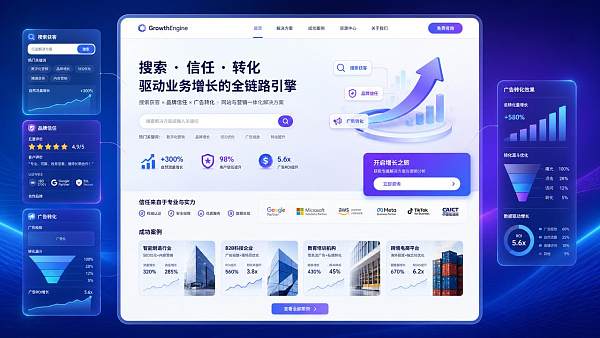
By reviewing high-quality website design cases, you can more quickly identify whether a page design truly supports business growth. For integrated website + marketing service projects, a page is not just a display interface, but also a core touchpoint for capturing traffic, building trust, driving inquiries, and enabling conversions.
High-converting pages usually feature a clear path, explicit value points, and a stable data loop. Based on the many years of service experience of Yiyingbao Information Technology (Beijing) Co., Ltd., website development, SEO optimization, social media marketing, and advertising can only truly amplify traffic value when they are unified and effectively connected at the page level.
This article focuses on website design cases and breaks down the characteristics of high-converting pages from scenario evaluation, visual hierarchy, conversion actions, and marketing strategy, helping you assess design solutions more accurately in terms of business value and implementation feasibility.
Why the Evaluation Criteria for Website Design Cases Differ Across Business Scenarios
Not all website design cases can be directly reused. Brand exposure pages focus more on visual memorability and content depth; lead generation and conversion pages place greater emphasis on above-the-fold messaging, form efficiency, and trust reinforcement; multi-channel advertising pages must also account for loading speed, keyword alignment, and consistency with the ad landing experience.
Therefore, when evaluating website design cases, the first step is not to judge whether they “look good,” but whether the page fits the actual marketing scenario. An excellent case should align its design logic with customer acquisition goals, traffic sources, and decision-making cycles.
Driven by artificial intelligence and big data, Yiyingbao Information Technology (Beijing) Co., Ltd. has long provided end-to-end services including intelligent website building, SEO optimization, social media marketing, and advertising. Its project experience shows that truly effective website design cases are often not the most visually complex, but the ones with the smoothest conversion path.
Typical Scenario 1: Search Acquisition Pages Prioritize Above-the-Fold Messaging and Keyword Relevance
In SEO and search advertising scenarios, the core criterion for evaluating a website design case is whether the page can effectively respond to the search intent of users who arrive with questions. The headline, above-the-fold copy, button copy, and content structure must quickly address user needs to avoid bounce caused by “clicking in but not finding the answer.”
High-converting pages usually accomplish three things above the fold: explain what they do, why they are trustworthy, and where the visitor should click next. If the first screen contains only large visuals and vague slogans, then even refined design will still struggle to generate effective conversions.
Core Evaluation Points
- Whether keywords appear naturally in the headline, subheadline, and near buttons.
- Whether the above-the-fold section communicates the value proposition within 5 seconds.
- Whether there is a single and clear conversion entry point.
- Whether the page content supports ongoing SEO expansion later.
Typical Scenario 2: Brand Trust Pages Rely More on Case Evidence and Layered Messaging
When the business decision-making cycle is longer, a website design case cannot simply present functions, but must also establish trust. Common approaches include customer cases, service processes, qualification endorsements, data results, and industry experience displays. The focus of this type of page is to continuously reduce visitor hesitation throughout the browsing process.
A strong website design case presents evidence in the order users browse. It first explains core capabilities, then actual results, and then provides cooperation methods and consultation entry points. The clearer the visual hierarchy, the easier it is for users to follow the intended path and make decisions.
For example, appropriately adding research-oriented content to a service introduction can also help enhance professionalism. Some project pages naturally extend to policy, finance, or management topics, such as Research on Measures to Improve the Budget Execution Rate of Public Institutions. This type of content is suitable for inclusion in knowledge support or resource extension modules to strengthen the depth of page information.
Typical Scenario 3: Advertising Landing Pages Must Shorten the Decision Chain
Visitors usually spend less time on advertising landing pages, so in this scenario, the key focus of a website design case is to reduce information that distracts attention. Too much navigation, overly deep click paths, and lengthy stacked content all directly affect conversion efficiency.
High-converting advertising pages often use a combination of strong-contrast headlines, concise selling points, case results, common objections, and fixed buttons. Every module is built around “why act now,” trying to avoid making visitors stop and reconsider.
Common Effective Practices
- Keep the above-the-fold button fixed to one primary action.
- Add real data and customer feedback in the middle section.
- Repeat the conversion entry point at the bottom to reduce the cost of returning to find it.
- Prioritize mobile design to ensure buttons are easy to tap and forms are short.
Across Different Scenarios, Which Dimensions Can Be Used to Compare Differences in Website Design Cases
Practical Adaptation Recommendations for Evaluating Website Design Cases
When facing different project requirements, it is recommended to break website design cases into three layers for review: “traffic source—page task—conversion action.” This makes it easier to identify whether a design remains only at the presentation level without reaching the business level.
- First confirm whether visitors enter through search, social media, or advertising, and then determine content density.
- Prioritize checking the above-the-fold value expression, and do not hide key information further down the page.
- Keep only one core action on each page to avoid placing multiple primary buttons side by side.
- Place cases, qualifications, and reviews near points where users are likely to hesitate.
- Align the SEO structure before design to avoid repeated rework later.
If the page also carries a content marketing function, you can extend topic-based resources in the resource module as well, but they must remain relevant to the core business. For example, when introducing content such as Research on Measures to Improve the Budget Execution Rate of Public Institutions again, it should serve to strengthen professionalism rather than interrupt the conversion path.
Common Misjudgment: Why Some Website Design Cases Look Great but Do Not Convert
The first type of misjudgment is treating visual style as everything. A refined page does not equal an effective page. What truly affects conversion is whether the information order, trust evidence, and action guidance are reasonable.
The second type of misjudgment is ignoring channel differences. Users on social media communication pages and search acquisition pages have completely different mindsets. If the same website design case is applied directly, it often results in a mismatch between content and scenario.
The third type of misjudgment is the lack of data validation. Without support from heatmap analysis, form data, dwell time, and source analysis, even the best design judgments can easily remain at a subjective level.
How to Use Website Design Cases to Guide Project Implementation in the Next Step
In actual projects, you can first collect 3 to 5 website design cases, categorize them by scenario, and then compare their above-the-fold messaging, content paths, evidence modules, and conversion settings item by item. This allows you to quickly identify the solutions that are truly suitable for your own business goals.
For projects that aim to balance website building, SEO, and marketing conversion, an integrated perspective should be adopted. Yiyingbao Information Technology (Beijing) Co., Ltd. has been deeply engaged in the industry for ten years. Driven by both technological innovation and localized services, it has helped more than 100,000 companies achieve global growth. When selecting website design cases, the same logic should be followed: do not only look at design, but also at the growth loop.
If you want to improve page conversion efficiency, it is recommended to start with four actions: above-the-fold restructuring, stronger case support, streamlined forms, and data monitoring. Optimize the parts that have the greatest impact on results first, and then continue refining them. This is often more stable and delivers better return on investment than making one large-scale overhaul at once.
Related Articles
 What multilingual website services are available in Sanya? Which model is more suitable for local businesses going global?
 How to view the complete list of China SaaS companies in the top 100? Practical methods for screening website-building and marketing service providers
 There are so many used heavy-duty construction machines for foreign trade. How exactly should we acquire customers?

Related Products
 EasyCamp SaaS Smart Website Marketing SystemE-Yingbao SaaS Smart Website Marketing System: AI-powered, zero-code website building. Rapidly launch multilingual independent e-commerce sites in just 10 minutes. Global server acceleration and AI-driven SEO optimization empower businesses to efficiently connect with global markets. The seamless integration of technology and user-friendly operation makes building e-commerce sites incredibly simple.
 AI+SEM Intelligent Advertising Marketing SystemAI+SEM drives intelligent ad creation, empowering full-funnel precision advertising marketing. The system automatically generates weekly/monthly reports, AI recommends keywords and target countries, monitors core metrics in real-time with intelligent alerts, and enables one-click high-conversion ad solutions to help quickly acquire customers and improve ROI.
 AI+SEO Dual Engine Optimization ServiceEasyWin AI+SEO Dual Engine Optimization System leverages AI-powered keyword mining, content generation, and comprehensive technical optimization to help foreign trade enterprises acquire high-quality organic traffic, significantly improving search rankings and conversion rates.
 AI+SNS Social Media Marketing SystemYingbao AI+SNS Social Media Marketing System - Precision social capture for the social media era. Supports one-click content synchronization across major platforms like Facebook and LinkedIn. AI intelligently rewrites posts for enhanced relevance. 24/7 AI customer service and user profiling analysis empower businesses to efficiently expand into global markets.
 AI+SEO营销解决方案易营宝AI+SEO营销解决方案,通过AI批量写作、智能生成TDK、精准关键词扩词等功能,全面优化网站SEO效果,提升流量与转化率。助力企业构建高效智能网站新生态。
 AI+SEM Advertising Marketing SolutionsAI+SEM Advertising Marketing Solution leverages AI technology to deeply empower SEM ad campaigns. It automatically generates weekly/monthly reports using AI, presenting account data across multiple dimensions for comprehensive insights into campaign performance and trends. The system precisely recommends keywords and target countries, intelligently generates high-conversion ad copy, and enables one-click activation of efficient campaign plans to help businesses rapidly acquire customers. Simultaneously, it monitors core metrics in real time, intelligently identifies abnormal fluctuations, and issues timely alerts to ensure stable, high-return advertising results.
 Domain Name ServicesEasyWin provides professional domain name services, including intelligent queries, one-stop registration, brand protection, and full lifecycle management, helping businesses build a digital brand image.
 EasyOperate B2C Cross-Border E-Commerce Platform & Independent WebsiteEasyStore B2C Cross-border E-commerce Independent Store is an intelligent website building and cross-border e-commerce integrated solution independently developed by EasyStore Information Technology (Beijing) Co., Ltd. The system is specially designed for small and medium-sized as well as large export enterprises, integrating 'website building, operation, marketing, advertising, and conversion' into one, helping enterprises quickly establish cross-border e-commerce independent stores to achieve brand globalization and global sales growth.
The platform supports multiple languages, multiple currencies, and multi-channel marketing, with built-in AI intelligent translation and SEO optimization systems, suitable for mainstream markets such as Southeast Asia, Europe and America, Latin America, and the Middle East, assisting Chinese manufacturing enterprises in efficiently deploying international e-commerce strategies. SSL证书易营宝提供专业SSL安全证书服务,包括单域名和泛域名证书,确保网站数据传输加密、身份验证和完整性保护,助力企业建立安全可信的在线业务环境。









