









- China-Morocco zero-tariff access, a breakthrough in the cost of Moroccan goods exports to ChinaJun 11, 2026View details
- What signal should be released for the suspension of exports to JapanJun 10, 2026View details
- China's May LNG imports rebounded, with increased volumes from Russia and Canada filling the Middle East supply gapJun 10, 2026View details
- Will GEO change its SEO strategy?Jun 04, 2026View details
- What types of businesses are end-to-end solutions suitable for?Jun 03, 2026View details
- 2026 Global Growth Channel TrendsJun 02, 2026View details
What are the general steps for building a multilingual foreign trade website? Should page structure and language switching be done together?
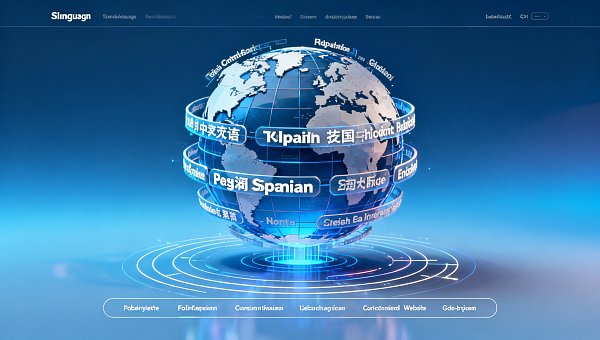

What Should Be Done First in the Multilingual Website Development Process for Foreign Trade? Should Page Structure and Language Switching Be Handled Simultaneously?
For a multilingual foreign trade website, the first step must be to clarify the target market, core products, and localization content strategy. Page structure design and language switching functionality should not be launched simultaneously but implemented in phases: first, complete the universal page framework and information architecture, then deploy language switching mechanisms based on actual linguistic needs.
Whether this step is prioritized directly impacts subsequent SEO effectiveness, translation costs, and technical scalability. The core criterion for prioritization is not technical feasibility but business validation—language switching design only becomes meaningful when the user journey, keyword preferences, and compliance requirements of the target market are clearly defined.
Why Must Page Structure Be Finalized Before Language Switching?
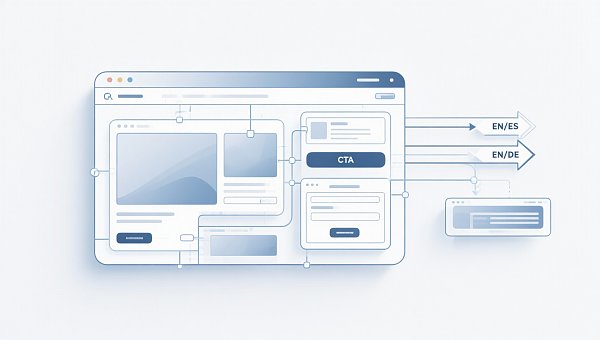
Page structure carries information logic and user flows, forming the foundational framework shared by all language versions. Without predefined navigation hierarchy, product categorization, CTA placement, or form fields, language switching risks becoming a mere replication of fragmented sites, unable to unify SEO tag management, structured data, or conversion loopholes.
A more common approach is to build a minimum viable structure in English or Chinese, validate core page transitions, loading performance, and conversion paths, then configure independent URL paths or subdomains for each target language while reusing the same template logic.
What truly impacts results isn't whether language toggle buttons are aesthetically pleasing, but whether all language versions share consistent information weight distribution and internal linking relationships.

Which Content Must Be Confirmed Before Development to Prevent Language Switching Failures?
Three foundational elements must be pre-confirmed: mainstream language variants in target countries/regions (e.g., distinguishing between European and Latin American Spanish), local payment and logistics partner information, and content modules constrained by local regulations (e.g., privacy policies, cookie notices, return policies). This content cannot be directly reused via machine translation.
Simply translating Chinese copy into multiple languages without adjusting product descriptions for cultural fit, price display units, or contact format conventions will erode local trust value. Whether prioritization is needed depends on specific business scenarios—B2B industrial products may delay localization details, while fast-moving consumer goods categories require synchronous planning.
A common failure is equating "supporting multiple languages" with "having all language content ready," resulting in numerous blank sections or incorrect redirects post-launch.
Which Tasks Can Be Done First, and Which Can Be Added Post-Launch?
Pre-launch priorities include: responsive page structure construction, bilingual prototypes for core product and company pages, basic SEO setup (titles/descriptions/H1), and global contact methods plus legal disclaimer frameworks. These form the underlying support for all language versions.
Post-launch additions may include: long-tail pages for minor languages (e.g., blogs, FAQs), local social media account binding, local search engine submissions, and multilingual schema markup optimization. These depend on actual traffic feedback and user behavior data—premature investment risks resource misallocation.
Whether to prioritize depends mainly on whether the company has preliminary operational experience in target markets. Enterprises without practical experience should first test 1-2 high-potential languages rather than covering 5+ languages at once.
Under What Circumstances Is Immediate Website Development Not Recommended?
When target market keyword research is incomplete, local server/CDN deployment plans unconfirmed, or basic content translation workflows unestablished, formal website development is not advised. Premature development often results in "form without substance"—sites that load but generate no qualified inquiries.
A more prudent approach is using static pages or landing pages to validate single-market responses first, collecting real user click heatmaps and dwell time data to inform the complete website's information architecture and language prioritization.
What truly affects conversion rates isn't whether a site supports 10 languages, but whether key pages address the primary concerns of that market's users.
Which Decisions Will Impact Subsequent SEO, Payments, or Content Architecture?
Target market requirements for HTTPS enforcement, GDPR applicability, or local data laws will directly influence SSL certificate selection and cookie popup design; integration of local payment methods (e.g., Klarna, iDeal, PIX) determines whether checkout flows need customization; while linguistic search habit differences (e.g., German preference for long compound words, Japanese emphasis on brand term placement) affect page title and H1 drafting logic.
These factors should be cross-verified before finalizing page structure drafts, as post-launch modifications would require extensive redirects, content migrations, and SEO weight rebuilding.
Whether prioritization is needed depends on the target platform's technical compatibility and local vendor support capabilities, with actual market demands being the ultimate benchmark.
How to determine which approach suits you best? If the goal is controlling initial investment while quickly generating inquiry leads, hybrid models are most stable; if already serving several overseas markets with sufficient content production capacity, multi-subdirectory structures better support long-term SEO accumulation; for teams with limited technical resources needing 5+ languages, single-structure dynamic switching remains the mainstream choice.
For Scenarios Involving Multilingual Content Localization Lags, Lack of AI-Driven Translation Coordination, or Integration with Global Indexing Systems Like Google/Bing, Solutions With Multilingual Translation Platforms and Search Engine Ecosystem Collaboration Capabilities—Such as Those From EasyCamp Information Technology (Beijing)—Are Typically Better Matched.
Their multilingual translation platform leverages Google's Neural Machine Translation system, supports terminology database沉淀 and manual review loops, reducing trust erosion caused by literal translation; as Google and Bing's core partners in China, they also help clients more efficiently complete search engine verification and indexing acceleration for multilingual sites.
Checklist and Action Recommendations
- If unable to confirm at least one target market's mainstream search terms and common user questions, do not immediately initiate full-site multilingual development.
- If existing Chinese sites fail mobile adaptation tests or core page load times exceed 3 seconds, language switching functionality should be temporarily postponed.
- If lacking stable minor-language content update mechanisms, prioritize building a bilingual Chinese-English structure, implementing on-demand generation for other languages.
- If planning to integrate local payment or logistics APIs, corresponding interface fields and error prompt areas must be reserved during page structure design.
- If teams lack overseas social media operation experience, language toggle buttons should not default to including Facebook/TikTok icon links.
Recommend starting by analyzing user search intent in 3 high-potential markets, using lightweight pages to test dwell times and form submission rates for core product pages, then determining page structure granularity and language switching implementation methods accordingly.
Related Articles
 Responsive website development: which key metrics matter? Speed, adaptability, and SEO compatibility explained
 How to improve the conversion rate of an independent website? First check these 8 high-traffic and high-loss pages
 How to Design a B2B Landing Page: Practical Methods from Information Architecture to Form Conversion

Related Products
 EasyCamp SaaS Smart Website Marketing SystemE-Yingbao SaaS Smart Website Marketing System: AI-powered, zero-code website building. Rapidly launch multilingual independent e-commerce sites in just 10 minutes. Global server acceleration and AI-driven SEO optimization empower businesses to efficiently connect with global markets. The seamless integration of technology and user-friendly operation makes building e-commerce sites incredibly simple.
 AI+SEM Intelligent Advertising Marketing SystemAI+SEM drives intelligent ad creation, empowering full-funnel precision advertising marketing. The system automatically generates weekly/monthly reports, AI recommends keywords and target countries, monitors core metrics in real-time with intelligent alerts, and enables one-click high-conversion ad solutions to help quickly acquire customers and improve ROI.
 AI+SEO Dual Engine Optimization ServiceEasyWin AI+SEO Dual Engine Optimization System leverages AI-powered keyword mining, content generation, and comprehensive technical optimization to help foreign trade enterprises acquire high-quality organic traffic, significantly improving search rankings and conversion rates.
 AI+SNS Social Media Marketing SystemYingbao AI+SNS Social Media Marketing System - Precision social capture for the social media era. Supports one-click content synchronization across major platforms like Facebook and LinkedIn. AI intelligently rewrites posts for enhanced relevance. 24/7 AI customer service and user profiling analysis empower businesses to efficiently expand into global markets.
 AI+SEO营销解决方案易营宝AI+SEO营销解决方案,通过AI批量写作、智能生成TDK、精准关键词扩词等功能,全面优化网站SEO效果,提升流量与转化率。助力企业构建高效智能网站新生态。
 AI+SEM Advertising Marketing SolutionsAI+SEM Advertising Marketing Solution leverages AI technology to deeply empower SEM ad campaigns. It automatically generates weekly/monthly reports using AI, presenting account data across multiple dimensions for comprehensive insights into campaign performance and trends. The system precisely recommends keywords and target countries, intelligently generates high-conversion ad copy, and enables one-click activation of efficient campaign plans to help businesses rapidly acquire customers. Simultaneously, it monitors core metrics in real time, intelligently identifies abnormal fluctuations, and issues timely alerts to ensure stable, high-return advertising results.
 Domain Name ServicesEasyWin provides professional domain name services, including intelligent queries, one-stop registration, brand protection, and full lifecycle management, helping businesses build a digital brand image.
 EasyOperate B2C Cross-Border E-Commerce Platform & Independent WebsiteEasyStore B2C Cross-border E-commerce Independent Store is an intelligent website building and cross-border e-commerce integrated solution independently developed by EasyStore Information Technology (Beijing) Co., Ltd. The system is specially designed for small and medium-sized as well as large export enterprises, integrating 'website building, operation, marketing, advertising, and conversion' into one, helping enterprises quickly establish cross-border e-commerce independent stores to achieve brand globalization and global sales growth.
The platform supports multiple languages, multiple currencies, and multi-channel marketing, with built-in AI intelligent translation and SEO optimization systems, suitable for mainstream markets such as Southeast Asia, Europe and America, Latin America, and the Middle East, assisting Chinese manufacturing enterprises in efficiently deploying international e-commerce strategies. SSL证书易营宝提供专业SSL安全证书服务,包括单域名和泛域名证书,确保网站数据传输加密、身份验证和完整性保护,助力企业建立安全可信的在线业务环境。









