









- What multilingual website services are available in Sanya? Which model is more suitable for local businesses going global?Jul 08, 2026View details
- How to view the complete list of China SaaS companies in the top 100? Practical methods for screening website-building and marketing service providersJul 08, 2026View details
- How to view pricing in the global traffic ecosystem? Cost comparison of search, social media, and content channel advertisingJul 06, 2026View details
- How to assess foreign trade website development trends?Looking at 2026 changes from multilingual,AI content to conversion pathsJul 04, 2026View details
- What are the new trends in multilingual marketing data analytics tools in 2026? Focus on attribution、automation and complianceJul 04, 2026View details
- Is Brand Globalization Marketing Consulting Worth Buying? At What Stage Should Companies Bring It InJul 01, 2026View details
- Cross-Border Marketing Trend Research: Why More and More Companies Are Starting to Deploy AI Search and GEO OptimizationJun 30, 2026View details
- Cross-Border Marketing Trend Research: How Independent Sites, AI Content, and Short-Video Customer Acquisition Are ChangingJun 30, 2026View details
How to Evaluate the Strength of an SEO Company
Faced with the many search engine optimization companies on the market, business evaluation personnel should make a comprehensive judgment from dimensions such as technical capabilities, data outcomes, service systems, and industry experience, so as to identify a partner that truly offers long-term growth value.
In the integrated procurement scenario of website and marketing services, SEO is no longer just a keyword ranking issue, but is directly related to customer acquisition cost, lead quality, site structure, content asset accumulation, and the efficiency of growth in overseas or local markets. For business evaluation personnel responsible for comparison, due diligence, and budget control, the key to judging whether a search engine optimization company truly has strong capabilities lies not in the price level, but in whether it can support the company’s growth goals for the next 6 to 24 months through executable methods, verifiable data, and sustainable service support.
Especially in the context where corporate digital investment is becoming more rational, a single SEO outsourcing model can hardly meet complex business needs. What deserves more attention is whether it has integrated capabilities in website building, content, data analysis, social media coordination, advertising conversion, and localized operations. Service providers represented by Ezyyb Information Technology (Beijing) Co., Ltd., relying on the accumulated experience since 2013 in intelligent website building, SEO optimization, social media marketing, and advertising placement, are more aligned with current enterprise demands for the integrated goal of “traffic acquisition + site conversion + global expansion”.
First look at the underlying capabilities: where the strength of a search engine optimization company is reflected
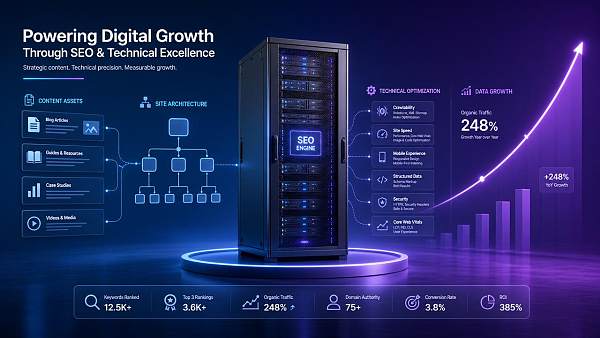
When screening search engine optimization companies, business evaluation personnel are advised to first determine whether their underlying capabilities are complete. A mature team usually covers at least 4 core roles: technical SEO, content strategy, data analysis, and project operations. If a service provider only has sales and editors, while lacking technical and data positions, subsequent projects will most likely remain at the level of surface optimization.
Technical capability is not just about whether they can publish articles
A truly capable search engine optimization company will incorporate website structure, crawl efficiency, index coverage, page speed, mobile adaptation, and conversion paths into the solution together. Usually, within 7 to 15 days before project launch, it should complete a foundational diagnosis and output a problem list, priority ranking, and phased goals, instead of directly promising “quickly reaching the first page”.
For the website + marketing services integration industry, SEO performance is highly correlated with website building quality. If a site has issues such as chaotic URLs, duplicate templates, page loading exceeding 3 seconds, weak internal linking, and lengthy form conversion paths, then no matter how much content is invested, it will still be dragged down by an inefficient technical foundation. Therefore, during evaluation, it is necessary to see whether the service provider has the ability to optimize marketing results from the site architecture level.
6 key technical items to review
- Whether there is a systematic diagnostic method for website crawling and indexing status
- Whether it can handle multilingual, multi-region, or multi-site structures
- Whether it pays attention to page experience metrics such as Core Web Vitals
- Whether it can coordinate with the website building team to adjust templates, navigation, and landing pages
- Whether it provides recommendations for log analysis, tracking setup, or conversion path analysis
- Whether it establishes a monthly issue tracking and fix closed loop
The table below can help business evaluation personnel quickly distinguish between an “execution-oriented vendor” and a “growth-oriented partner”.
If a search engine optimization company can expand the scope of optimization from “keywords” to “website” and “business goals”, its cooperation value is usually higher. For budget reviewers, although this type of company often involves more detailed early-stage communication and more complex delivery, it is more likely to form reusable digital assets within 12 months, rather than short-term fluctuating traffic.
Then look at proof of results: how business evaluation personnel should review data and case studies
To judge the strength of a search engine optimization company, it is not enough to only look at the four words “successful cases” on a sales presentation page; more importantly, whether it can provide clear data logic. Business evaluation personnel may ask the other party to show at least 3 types of result indicators: changes in organic traffic, growth in keyword coverage, and improvement in conversion behavior. If there are only ranking screenshots, without explanations of period, pages, business actions, and conversion paths, the reference value is not high.
Prioritize trends, not just single-point data
A reasonable SEO results evaluation cycle is usually divided into 3 stages. The 1st stage is 1 to 2 months, focusing on technical fixes, page indexing, and content publishing rhythm; the 2nd stage is 3 to 6 months, focusing on keyword coverage, organic traffic growth, and ranking improvement of key pages; the 3rd stage is 6 to 12 months, focusing on the number of inquiries, lead quality, and changes in the overall customer acquisition structure.
If a service provider promises to significantly improve rankings for highly competitive keywords within 30 days, business evaluation personnel should remain cautious. Because in the B2B service industry, especially in website + marketing services integration projects, long-tail keyword layout, content maturity, technical fixes, and accumulation of search signals all require time, and rapid fluctuations are often accompanied by higher risks.
4 questions for case study review
- What was the project starting point, and did the original site already have foundational traffic?
- How long was the optimization cycle, was it 3 months, 6 months, or 12 months?
- Did the growth come from branded keywords, long-tail keywords, or core transactional keywords?
- Did it ultimately convert into leads, consultations, or business opportunities, rather than just traffic?
When making internal procurement reports, it is recommended to split result evaluation into two groups: “visible indicators” and “business indicators”, to avoid the team being attracted only by attractive curves.
From a procurement perspective, if a search engine optimization company can clearly explain data definitions, statistical cycles, page dimensions, and lead attribution, its credibility will be significantly higher than that of vendors who only display result screenshots. Especially in enterprises running multiple channels in parallel, SEO must connect with advertising, social media, CRM, and website data to form a complete growth closed loop.
Service system and industry experience determine whether cooperation can be implemented steadily
When choosing a search engine optimization company, many enterprises find the early-stage proposal looks good, but problems emerge after entering the execution stage: empty weekly reports, slow response to needs, lack of cooperation from the website building team, and content directions disconnected from sales scenarios. This shows that the supplier’s problem is not “not knowing how to do it”, but having an immature service system. Business evaluation personnel should include service processes and organizational coordination mechanisms in pre-contract review.
Confirm at least 5 delivery milestones
- Project kickoff meeting: clarify target markets, competitors, and KPI definitions
- First-round diagnostic report: usually delivered in week 1 to week 2
- Monthly execution list: including details of technical fixes, content launch, and page optimization
- Quarterly review mechanism: review structural results at least once every 90 days
- Exception response mechanism: feedback within 24 to 48 hours in case of major indexing or traffic fluctuations
For the website + marketing services integration industry, industry experience is also reflected in whether the provider understands the enterprise’s real sales path. For example, the conversion goal of B2B enterprises is often not immediate transactions, but demo appointments, form submissions, white paper downloads, WhatsApp or telephone inquiries. Therefore, content layout and page structure must be designed around conversion points, rather than simply pursuing traffic.
Service providers with cross-business collaboration capabilities are more suitable for medium- and long-term cooperation
A service team like Ezyyb Information Technology (Beijing) Co., Ltd., which combines capabilities in intelligent website building, SEO optimization, social media marketing, and advertising placement, is more suitable for enterprises that need integrated growth. The reason is simple: SEO is not an isolated module. If landing page experience, social media content reach, ad remarketing, and CRM handoff cannot work in coordination, it will ultimately raise the overall cost per lead.
Since its establishment in 2013, the company has continuously focused on improving digital marketing efficiency through artificial intelligence and big data, and has served global markets with the dual-wheel strategy of “technological innovation + localized services”. For business evaluation personnel, the value of this type of service provider lies not only in delivering a certain execution item, but in coordinating multi-touchpoint growth under one framework and reducing the communication loss caused by parallel management of multiple vendors.
In some internal organizational evaluations, procurement teams may also refer to materials on related management and digitalization topics to help improve the overall decision-making perspective. For example, personnel responsible for integrated digital procurement may also pay attention to content such as how to optimize HR and labor management of public institutions in the digital economy era, in order to establish a more complete understanding of information-based management, but when selecting marketing services, they should still return to actual business growth and delivery capabilities themselves.
Common misunderstandings and procurement suggestions: avoid buying an SEO project as a “low-cost content package”
The most common misunderstanding business evaluation personnel encounter during the price comparison stage is equating a search engine optimization company with an “article publishing supplier”. In fact, what truly affects results is often not the amount of content, but the accuracy of strategy, site foundation, execution continuity, and cross-department collaboration efficiency. Publishing 20 pieces of content per month is not necessarily better than optimizing 8 high-intent pages per month.
4 common misjudgments
Misjudgment 1: only looking at price, not delivery boundaries
Low-cost plans often include only title adjustments, content publishing, and simple backlinks, but do not include technical troubleshooting, page revamp recommendations, conversion design, and data analysis. If the contract does not clearly specify monthly deliverables, scope of fixes, meeting frequency, and report depth, disputes are very likely to arise later.
Misjudgment 2: only looking at rankings, not traffic structure
Some ranking improvements may be concentrated on keywords with extremely low search volume, contributing little to business opportunities. During evaluation, at least 10 to 20 target keywords should be sampled to distinguish the proportion of branded keywords, informational keywords, and transactional keywords.
Misjudgment 3: ignoring site and marketing coordination
If the enterprise official website has restricted website management permissions, or if landing pages cannot be iterated quickly, SEO performance will slow down significantly. Ideally, page update permissions, tracking configuration, form optimization, and content publishing should form an execution closed loop within 2 weeks.
Misjudgment 4: replacing long-term evaluation with short-term assessment
SEO is a compounding investment and is more suitable for observation on a quarterly and semiannual basis. If an enterprise uses 30-day results as the sole retention criterion, it will often miss a search engine optimization company that can truly drive long-term growth.
More prudent procurement suggestions
- First conduct 1 diagnostic comparison, then decide whether to sign a long-term contract
- Split KPI into 2 layers: process indicators and result indicators
- Agree on monthly reports, quarterly reports, exception alerts, and review mechanisms
- Require the service provider to explain its coordination methods with website building, advertising, and social media
- Prioritize teams that can serve multiple markets, multiple languages, or complex business structures
For enterprises that are currently deeply cultivating the domestic market or expanding overseas, when choosing a search engine optimization company, it is best to prioritize partners with long-term technical accumulation, industry understanding, and localized service capabilities. Especially when the enterprise’s goal is not only to increase traffic, but also to build brand exposure, content assets, and stable lead sources, integrated service capability is more important than single-point optimization.
The most effective way to judge whether a search engine optimization company is truly capable is not to listen to promises, but to see whether it has a complete technical foundation, clear data logic, a stable delivery system, and a growth methodology aligned with business goals. For business evaluation personnel, a good partner should be able not only to explain “why this is done”, but also to implement “what to do next”, and continuously deliver verifiable results at different stages of 3 months, 6 months, and 12 months.
If you are screening an integrated website and marketing services partner for your enterprise and hope to achieve coordinated implementation of website building, SEO, social media, and advertising, you may further learn about a service team with more than ten years of digital marketing experience. Based on different markets, different budgets, and different growth cycles, obtain a customized solution that better fits your business. You are welcome to contact us now to inquire about product details and learn more solutions.
Related Articles
 What multilingual website services are available in Sanya? Which model is more suitable for local businesses going global?
 How to view the complete list of China SaaS companies in the top 100? Practical methods for screening website-building and marketing service providers
 There are so many used heavy-duty construction machines for foreign trade. How exactly should we acquire customers?

Related Products
 EasyCamp SaaS Smart Website Marketing SystemE-Yingbao SaaS Smart Website Marketing System: AI-powered, zero-code website building. Rapidly launch multilingual independent e-commerce sites in just 10 minutes. Global server acceleration and AI-driven SEO optimization empower businesses to efficiently connect with global markets. The seamless integration of technology and user-friendly operation makes building e-commerce sites incredibly simple.
 AI+SEM Intelligent Advertising Marketing SystemAI+SEM drives intelligent ad creation, empowering full-funnel precision advertising marketing. The system automatically generates weekly/monthly reports, AI recommends keywords and target countries, monitors core metrics in real-time with intelligent alerts, and enables one-click high-conversion ad solutions to help quickly acquire customers and improve ROI.
 AI+SEO Dual Engine Optimization ServiceEasyWin AI+SEO Dual Engine Optimization System leverages AI-powered keyword mining, content generation, and comprehensive technical optimization to help foreign trade enterprises acquire high-quality organic traffic, significantly improving search rankings and conversion rates.
 AI+SNS Social Media Marketing SystemYingbao AI+SNS Social Media Marketing System - Precision social capture for the social media era. Supports one-click content synchronization across major platforms like Facebook and LinkedIn. AI intelligently rewrites posts for enhanced relevance. 24/7 AI customer service and user profiling analysis empower businesses to efficiently expand into global markets.
 AI+SEO营销解决方案易营宝AI+SEO营销解决方案,通过AI批量写作、智能生成TDK、精准关键词扩词等功能,全面优化网站SEO效果,提升流量与转化率。助力企业构建高效智能网站新生态。
 AI+SEM Advertising Marketing SolutionsAI+SEM Advertising Marketing Solution leverages AI technology to deeply empower SEM ad campaigns. It automatically generates weekly/monthly reports using AI, presenting account data across multiple dimensions for comprehensive insights into campaign performance and trends. The system precisely recommends keywords and target countries, intelligently generates high-conversion ad copy, and enables one-click activation of efficient campaign plans to help businesses rapidly acquire customers. Simultaneously, it monitors core metrics in real time, intelligently identifies abnormal fluctuations, and issues timely alerts to ensure stable, high-return advertising results.
 Domain Name ServicesEasyWin provides professional domain name services, including intelligent queries, one-stop registration, brand protection, and full lifecycle management, helping businesses build a digital brand image.
 EasyOperate B2C Cross-Border E-Commerce Platform & Independent WebsiteEasyStore B2C Cross-border E-commerce Independent Store is an intelligent website building and cross-border e-commerce integrated solution independently developed by EasyStore Information Technology (Beijing) Co., Ltd. The system is specially designed for small and medium-sized as well as large export enterprises, integrating 'website building, operation, marketing, advertising, and conversion' into one, helping enterprises quickly establish cross-border e-commerce independent stores to achieve brand globalization and global sales growth.
The platform supports multiple languages, multiple currencies, and multi-channel marketing, with built-in AI intelligent translation and SEO optimization systems, suitable for mainstream markets such as Southeast Asia, Europe and America, Latin America, and the Middle East, assisting Chinese manufacturing enterprises in efficiently deploying international e-commerce strategies. SSL证书易营宝提供专业SSL安全证书服务,包括单域名和泛域名证书,确保网站数据传输加密、身份验证和完整性保护,助力企业建立安全可信的在线业务环境。









