









- What stages does the cross-border services ecosystem include? How do website building, promotion, payment, and compliance work togetherJun 22, 2026View details
- How will email marketing costs change in 2026Jun 22, 2026View details
- The China-US tariff arrangement has reached a preliminary consensus, and the trade association will be establishedJun 15, 2026View details
- Should overseas brand marketing start with ads or contentJun 21, 2026View details
- What determines B2C cross-border e-commerce website development costs? A breakdown of features, interfaces, and deployment methodsJun 17, 2026View details
- China-Morocco zero-tariff access, a breakthrough in the cost of Moroccan goods exports to ChinaJun 11, 2026View details
- What signal should be released for the suspension of exports to JapanJun 10, 2026View details
- China's May LNG imports rebounded, with increased volumes from Russia and Canada filling the Middle East supply gapJun 10, 2026View details
Why E-commerce Digital Marketing Website Design Should Focus on the Conversion Path
At a time when traffic acquisition costs continue to rise, e-commerce digital marketing website design can no longer focus solely on aesthetics, but must also prioritize a clear and efficient conversion path. For business decision-makers, only when visitors can smoothly complete inquiries, submit their information, and place orders can the website’s value truly be transformed into growth results.
Why use a checklist first to determine whether the conversion path is effective
When evaluating e-commerce digital marketing website design, companies most easily fall into two misunderstandings: first, placing the focus on page visuals and stacking functions; second, equating traffic growth with business growth. In fact, the website’s real task is to convert visitor intent into business results, so it is more appropriate to use a “checklist” to judge it rather than relying only on subjective impressions.
For business decision-makers, checklist-based evaluation has three values: first, it can quickly identify key shortcomings, such as unclear entry points, overly long forms, and high page bounce rates; second, it can unify the judgment criteria of marketing, sales, and technical teams; third, it facilitates subsequent ad optimization, content optimization, and conversion rate improvement. Especially under the trend of website + marketing service integration, e-commerce digital marketing website design is no longer a standalone build, but part of the growth chain.
6 core checklist items companies should confirm first
If you want to judge whether e-commerce digital marketing website design truly has conversion capabilities, it is recommended that companies first examine the following points one by one. Only when these basic links are in place will subsequent SEO optimization, advertising placement, and social media traffic generation have real value in carrying traffic forward.
- Whether there is a clear above-the-fold conversion goal. The first screen cannot be only a brand display; it should clearly tell users “who you are, what problems you can solve, and what to do next,” such as consult now, book a demo, get a quote, or place an order directly.
- Whether the navigation structure is designed around the decision-making path. A common problem on corporate websites is too many categories and overly complex hierarchies, causing users to be unable to find key pages. High-quality e-commerce digital marketing website design should make products, case studies, pricing, service processes, and contact methods clear at a glance.
- Whether the content can support trust building. Product introductions alone are far from enough; decision-makers care more about delivery capability, service cases, industry experience, data results, and guarantee mechanisms.
- Whether the conversion action is simple enough. Buttons placed too deep, too many form fields, and inconsistent inquiry entry points will all directly reduce the lead submission rate. The shorter the conversion path, the higher the likelihood of closing a deal.
- Whether the mobile experience is complete. A large amount of traffic comes from mobile devices. If pages load slowly, layouts are chaotic, or buttons are hard to click, even the best content will struggle to generate effective conversions.
- Whether data tracking is closed-loop. Without event tracking, without source identification, and without conversion attribution, companies cannot determine which types of pages, which types of keywords, and which types of channels are truly effective.
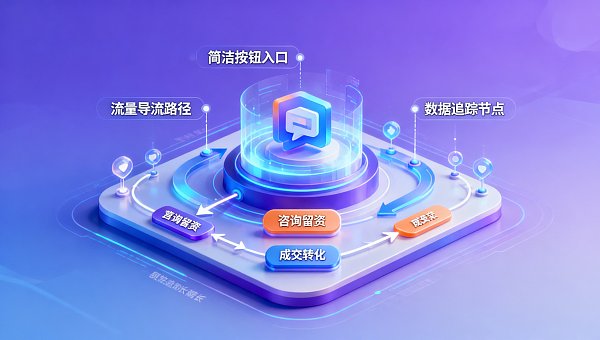
To determine whether the conversion path is clear, you can directly look at these 4 criteria
Many companies ask, what exactly counts as a “clear” conversion path? You can use four criteria to quickly evaluate the current website.
1. Whether users can understand the value within 10 seconds
After visitors enter the page, if they still need to spend a long time understanding the business content, it means the page communicates too inefficiently. E-commerce digital marketing website design must put the core value, target audience, and action entry points upfront, so users can quickly make a judgment.
2. Whether each key page has only one primary action
If a page simultaneously asks users to download materials, follow an account, consult customer service, view a quote, and register for a trial, it will often cause scattered decision-making. High-conversion pages usually have only one primary goal, while other actions serve only as support.
3. Whether different traffic sources have corresponding landing pages
Users coming from SEO search, social media content, advertising placement, and private traffic channels do not focus on the same things. Mature e-commerce digital marketing website design does not direct all traffic to the same homepage, but instead configures corresponding pages according to scenarios to improve conversion efficiency.
4. Whether users are guided again before leaving
Not every visitor will place an order on the spot, but if there is no remarketing entry point before they leave, such as submitting information to receive a plan, obtaining an industry white paper, or booking a consultation, it is equivalent to losing intent for nothing. Companies can appropriately set up resource-type conversion content, such as The practical difficulties and countermeasures of fintech promoting enterprise innovation and development for extended reading around innovation and growth topics, in order to improve the dwell time and lead submission probability of medium- and high-intent visitors.
Under different business scenarios, what differences should e-commerce digital marketing website design pay attention to
Different company sizes, product complexities, and sales cycles require different focuses in conversion path design. When advancing a project, decision-makers should not only refer to general templates, but should make differentiated settings based on their own business model.
- Standardized product sales scenarios: the focus is on shortening the ordering chain, strengthening pricing, promotions, reviews, logistics, and payment trust, and reducing repeated user jumps.
- High-ticket service scenarios: the focus is on building trust and inquiry conversion, and the page should highlight case studies, solutions, cooperation processes, and consultant-style communication entry points.
- Cross-border marketing scenarios: the focus is on multilingual support, loading speed in multiple regions, local payment habits, and localized content adaptation, avoiding sending global traffic into the same expression system.
- Lead-generation B2B scenarios: the focus is on form design, sales handoff, lead segmentation, and automated follow-up. At this time, e-commerce digital marketing website design is more like an entry point to a growth middle platform rather than a purely display platform.
Risk reminders most easily overlooked
Many websites perform unsatisfactorily after going live not because there is no traffic, but because some detailed issues were overlooked. The following risk points are most worth checking by companies.
- Focusing only on design drafts, not on real visitor behavior. Just because it looks good internally does not mean users can understand it.
- Vague conversion button copy. Generic expressions like “Learn More” are often less effective than “Get a Quote” or “Book a Demo”.
- Stagnant content updates. Outdated cases and expired information will reduce a company’s professionalism and confidence in closing deals.
- SEO disconnected from conversion. Only pursuing keyword rankings without designing page engagement around search intent means that even if traffic comes, it is still hard to monetize.
- Lack of a continuous optimization mechanism. E-commerce digital marketing website design is not a one-time delivery, but should be continuously iterated through data such as heatmaps, dwell time, bounce rate, and conversion rate.
When companies implement execution, they can proceed according to this roadmap
When choosing integrated website and marketing services, what questions should decision-makers ask
If a company is preparing to upgrade its e-commerce digital marketing website design, it is recommended not to ask only about price and timeline, but also to communicate in advance about the key parameters that affect results. For example: whether the service provider has coordinated capabilities in website building, SEO, content, advertising, and data analysis; whether it can provide conversion path solutions based on industry differences; whether it supports multi-version landing page testing; and whether it can integrate lead management with CRM or sales processes.
Taking Easy-Business Information Technology (Beijing) Co., Ltd. as an example, as a global digital marketing service provider established in 2013, the company takes artificial intelligence and big data as its core driving forces, and has built full-chain solutions around intelligent website building, SEO optimization, social media marketing, and advertising placement, helping more than 100,000 companies achieve global growth. For companies seeking to improve customer acquisition efficiency and conversion quality, this kind of integrated website + marketing service capability is more conducive to truly transforming e-commerce digital marketing website design into a growth asset rather than an isolated online storefront.
Conclusion and recommended next actions
At its core, the essence of e-commerce digital marketing website design does not lie in making pages more complex, but in whether it enables target customers to understand the value faster, complete actions more smoothly, and accumulate leads more steadily. For business decision-makers, checking the conversion path first and then investing in traffic budgets is often more efficient than scaling traffic first and trying to fix issues later.
If a company plans to move the project forward next, it is recommended to first prepare the following information: target customer personas, current main customer acquisition channels, historical conversion data, key products or services, expected deal path, budget range, and internal sales collaboration methods. When necessary, it is also possible to supplement industry trend content materials, such as The practical difficulties and countermeasures of fintech promoting enterprise innovation and development, to strengthen content engagement and professional image. Once these issues are clarified in advance, subsequent solution matching, timeline evaluation, and cooperation model confirmation will all become more efficient.
Related Articles
 It's easy to turn a foreign trade website into a piece of art, but it's the ultimate culprit behind your order decline
 Foreign trade website efficiency revolution! Yiyingbao component upgrade + inquiry optimization, inquiries surge!
 B2B Must-Know | The Difference Between Demand Gen and Legacy Video Ads



Related Products
 EasyCamp SaaS Smart Website Marketing SystemE-Yingbao SaaS Smart Website Marketing System: AI-powered, zero-code website building. Rapidly launch multilingual independent e-commerce sites in just 10 minutes. Global server acceleration and AI-driven SEO optimization empower businesses to efficiently connect with global markets. The seamless integration of technology and user-friendly operation makes building e-commerce sites incredibly simple.
 AI+SEM Intelligent Advertising Marketing SystemAI+SEM drives intelligent ad creation, empowering full-funnel precision advertising marketing. The system automatically generates weekly/monthly reports, AI recommends keywords and target countries, monitors core metrics in real-time with intelligent alerts, and enables one-click high-conversion ad solutions to help quickly acquire customers and improve ROI.
 AI+SEO Dual Engine Optimization ServiceEasyWin AI+SEO Dual Engine Optimization System leverages AI-powered keyword mining, content generation, and comprehensive technical optimization to help foreign trade enterprises acquire high-quality organic traffic, significantly improving search rankings and conversion rates.
 AI+SNS Social Media Marketing SystemYingbao AI+SNS Social Media Marketing System - Precision social capture for the social media era. Supports one-click content synchronization across major platforms like Facebook and LinkedIn. AI intelligently rewrites posts for enhanced relevance. 24/7 AI customer service and user profiling analysis empower businesses to efficiently expand into global markets.
 AI+SEO营销解决方案易营宝AI+SEO营销解决方案,通过AI批量写作、智能生成TDK、精准关键词扩词等功能,全面优化网站SEO效果,提升流量与转化率。助力企业构建高效智能网站新生态。
 AI+SEM Advertising Marketing SolutionsAI+SEM Advertising Marketing Solution leverages AI technology to deeply empower SEM ad campaigns. It automatically generates weekly/monthly reports using AI, presenting account data across multiple dimensions for comprehensive insights into campaign performance and trends. The system precisely recommends keywords and target countries, intelligently generates high-conversion ad copy, and enables one-click activation of efficient campaign plans to help businesses rapidly acquire customers. Simultaneously, it monitors core metrics in real time, intelligently identifies abnormal fluctuations, and issues timely alerts to ensure stable, high-return advertising results.
 Domain Name ServicesEasyWin provides professional domain name services, including intelligent queries, one-stop registration, brand protection, and full lifecycle management, helping businesses build a digital brand image.
 EasyOperate B2C Cross-Border E-Commerce Platform & Independent WebsiteEasyStore B2C Cross-border E-commerce Independent Store is an intelligent website building and cross-border e-commerce integrated solution independently developed by EasyStore Information Technology (Beijing) Co., Ltd. The system is specially designed for small and medium-sized as well as large export enterprises, integrating 'website building, operation, marketing, advertising, and conversion' into one, helping enterprises quickly establish cross-border e-commerce independent stores to achieve brand globalization and global sales growth.
The platform supports multiple languages, multiple currencies, and multi-channel marketing, with built-in AI intelligent translation and SEO optimization systems, suitable for mainstream markets such as Southeast Asia, Europe and America, Latin America, and the Middle East, assisting Chinese manufacturing enterprises in efficiently deploying international e-commerce strategies. SSL证书易营宝提供专业SSL安全证书服务,包括单域名和泛域名证书,确保网站数据传输加密、身份验证和完整性保护,助力企业建立安全可信的在线业务环境。









