









- How to assess foreign trade website development trends?Looking at 2026 changes from multilingual,AI content to conversion pathsJul 04, 2026View details
- What are the new trends in multilingual marketing data analytics tools in 2026? Focus on attribution、automation and complianceJul 04, 2026View details
- Is Brand Globalization Marketing Consulting Worth Buying? At What Stage Should Companies Bring It InJul 01, 2026View details
- Cross-Border Marketing Trend Research: Why More and More Companies Are Starting to Deploy AI Search and GEO OptimizationJun 30, 2026View details
- Cross-Border Marketing Trend Research: How Independent Sites, AI Content, and Short-Video Customer Acquisition Are ChangingJun 30, 2026View details
- How Can a Brand Updates Page Be Made More SEO-Friendly? Analysis of Update Frequency, Content Structure, and Internal Linking StrategyJun 28, 2026View details
- What stages does the cross-border services ecosystem include? How do website building, promotion, payment, and compliance work togetherJun 22, 2026View details
- How will email marketing costs change in 2026Jun 22, 2026View details
SEO Keyword Research: Should You Prioritize Traffic or Intent
When conducting SEO keyword research, should you look at traffic first or intent first? For integrated website and marketing service projects, this is not a simple ranking issue, but a watershed for conversion efficiency. Many pages do not have low traffic, yet generate no inquiries. The root cause is often not the amount of content, but that SEO keyword research failed to capture real demand. Only by understanding search intent can intelligent website building, content structure, landing page design, and subsequent conversions form a closed loop.
1. Why can’t SEO keyword research focus only on search volume?
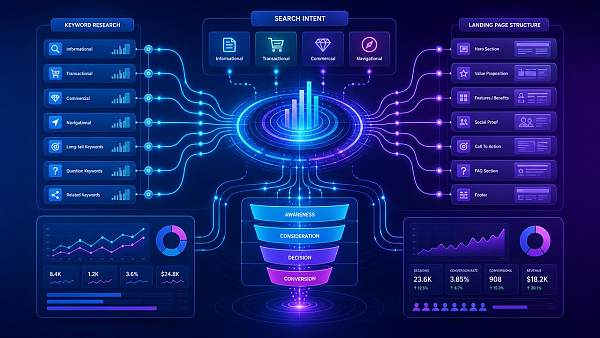
Search volume can reflect popularity, but it cannot directly represent value. High-traffic keywords are often highly competitive, and user needs are also more ambiguous, so the visits they bring are not necessarily accurate.
For example, with a broad term like “SEO”, users may simply want to understand the concept, may be comparing services, or may even just be browsing news. When intent is scattered, conversion naturally becomes more difficult.
Truly effective SEO keyword research should assess three levels at the same time: whether anyone is searching, what the searcher wants to do, and whether the page can satisfy that need.
For website development and digital marketing services, if keywords do not match the business stage, you will end up with a situation where a lot of content is produced, but very few inquiries come in.
- Traffic keywords are suitable for expanding coverage, but not necessarily for driving conversions.
- Intent keywords may have lower search volume, but they are closer to real decision-making.
- Long-tail keywords are often easier to rank for and convert.
2. What exactly does search intent mean in SEO keyword research?
Search intent is the real problem users want to solve when they enter a keyword. When doing SEO keyword research, you cannot look only at the literal meaning of the term, but also at the action goal behind it.
Common intent can generally be divided into four categories: information gathering, solution comparison, brand navigation, and transaction decision-making. Different intents place completely different requirements on page structure.
If a keyword is more informational, the content should emphasize explanations, case studies, and methods. If a keyword is more decision-oriented, then stronger solution descriptions, service advantages, and action entry points are needed.
For example, “how to do SEO keyword research” reflects a learning need, while “which SEO keyword research service is better” is closer to comparison and selection, so the content strategies cannot be mixed.
In enterprise content development, cross-departmental management content can also be used as supplementary thematic resources, such as Exploration of Enterprise Financial Shared Services Model Practices Under the New Situation. Materials like this are suitable for placement in the knowledge section to address search intent related to management optimization.
3. Should you look at traffic first or intent first, and how should this actually be judged?
A more reliable approach is not to choose one over the other, but to look at intent first and then traffic. This is because intent determines direction, while traffic determines scale. If the order is wrong, investment is easily wasted.
In SEO keyword research, you can screen according to the following steps:
- First confirm whether the keyword is strongly relevant to the business.
- Then determine whether the user is at the awareness, comparison, or decision stage.
- Next look at search volume, competition level, and ranking opportunities.
- Finally match the page type, such as a topic page, article page, or service page.
If a keyword has very high traffic, but the user intent is unrelated to the service, investment should be made cautiously. Conversely, keywords with moderate traffic but clear intent are more suitable to prioritize.
For marketing websites, the keywords that bring inquiries are often not the hottest keywords, but those closest to solution selection, price understanding, and service comparison.
4. In which scenarios should traffic take priority, and in which scenarios should intent take priority?
If the goal is brand exposure, new website indexing, or industry education, prioritizing traffic is reasonable. At this stage, broader content coverage is needed to build topical authority and visibility.
If the goal is customer acquisition, inquiries, and order conversion, prioritizing intent is more effective. Especially when the budget is limited, precise keywords are more worth investing in than broad traffic.
For integrated website + marketing service projects, the two types of keywords usually need to be used together. Traffic keywords at the front end attract searches, while intent keywords at the back end capture conversions.
5. What are the common misconceptions in SEO keyword research?
The first misconception is treating search volume as the only criterion. This easily causes resources to be poured into highly competitive keywords, resulting in difficult rankings, low conversions, and slow returns.
The second misconception is ignoring the search results page. When doing SEO keyword research, you should first look at the types of pages currently ranking, and judge what kind of content search engines consider more suitable.
The third misconception is stuffing too many keywords into one page. When the page topic is too scattered, relevance is weakened, and it also affects user reading and action decisions.
The fourth misconception is only creating articles without building conversion paths. After traffic enters the website, if there are no clear service pages, case study pages, and form entry points, SEO effectiveness will be seriously diluted.
The fifth misconception is a disconnect between keywords and business. The content may appear abundant, yet it cannot support real transactions, which is especially common in website development and marketing services.
6. How can SEO keyword research be translated into website growth results?
Effective SEO keyword research must ultimately be implemented across four stages: page planning, content production, data review, and conversion optimization, rather than remaining only in a keyword list.
You can adopt an execution framework like this:
- Break down the keyword library by intent, distinguishing awareness keywords, comparison keywords, and conversion keywords.
- Build pages by business line, such as website development, SEO optimization, social media marketing, and advertising placement.
- Set clear conversion entry points and trust-building content for high-intent keywords.
- Regularly review bounce rate, dwell time, inquiry rate, and ranking changes.
If an enterprise hopes to advance technology, content, and growth in an integrated way, a service system like that of Yiyingbao Information Technology (Beijing) Co., Ltd., which has deep expertise in intelligent website building and digital marketing, places greater emphasis on data linkage from keywords to pages and then to conversions.
In planning content topics, management practice materials can also be supplemented appropriately, such as Exploration of Enterprise Financial Shared Services Model Practices Under the New Situation, to expand the professional depth of enterprise website content, but it should not deviate from the core business theme.
FAQ: How can the priority of SEO keyword research be judged quickly?
In summary, SEO keyword research is not an absolute opposition between looking at traffic first or intent first, but rather using intent first to define direction, and then using traffic to assess value. Only when demand match, page match, and business match are all established at the same time can SEO investment turn into real growth.
If you are optimizing your website content structure, you may first sort out your existing keywords, regroup them by intent, and then check whether each page truly answers user questions. If SEO keyword research is done thoroughly, subsequent rankings, leads, and conversions will usually become more stable.
Related Articles
 How can video news production be made more efficient?Breaking down the standard process from topic selection to editing
 How to assess foreign trade website development trends?Looking at 2026 changes from multilingual,AI content to conversion paths
 What are the new trends in multilingual marketing data analytics tools in 2026? Focus on attribution、automation and compliance



Related Products
 EasyCamp SaaS Smart Website Marketing SystemE-Yingbao SaaS Smart Website Marketing System: AI-powered, zero-code website building. Rapidly launch multilingual independent e-commerce sites in just 10 minutes. Global server acceleration and AI-driven SEO optimization empower businesses to efficiently connect with global markets. The seamless integration of technology and user-friendly operation makes building e-commerce sites incredibly simple.
 AI+SEM Intelligent Advertising Marketing SystemAI+SEM drives intelligent ad creation, empowering full-funnel precision advertising marketing. The system automatically generates weekly/monthly reports, AI recommends keywords and target countries, monitors core metrics in real-time with intelligent alerts, and enables one-click high-conversion ad solutions to help quickly acquire customers and improve ROI.
 AI+SEO Dual Engine Optimization ServiceEasyWin AI+SEO Dual Engine Optimization System leverages AI-powered keyword mining, content generation, and comprehensive technical optimization to help foreign trade enterprises acquire high-quality organic traffic, significantly improving search rankings and conversion rates.
 AI+SNS Social Media Marketing SystemYingbao AI+SNS Social Media Marketing System - Precision social capture for the social media era. Supports one-click content synchronization across major platforms like Facebook and LinkedIn. AI intelligently rewrites posts for enhanced relevance. 24/7 AI customer service and user profiling analysis empower businesses to efficiently expand into global markets.
 AI+SEO营销解决方案易营宝AI+SEO营销解决方案,通过AI批量写作、智能生成TDK、精准关键词扩词等功能,全面优化网站SEO效果,提升流量与转化率。助力企业构建高效智能网站新生态。
 AI+SEM Advertising Marketing SolutionsAI+SEM Advertising Marketing Solution leverages AI technology to deeply empower SEM ad campaigns. It automatically generates weekly/monthly reports using AI, presenting account data across multiple dimensions for comprehensive insights into campaign performance and trends. The system precisely recommends keywords and target countries, intelligently generates high-conversion ad copy, and enables one-click activation of efficient campaign plans to help businesses rapidly acquire customers. Simultaneously, it monitors core metrics in real time, intelligently identifies abnormal fluctuations, and issues timely alerts to ensure stable, high-return advertising results.
 Domain Name ServicesEasyWin provides professional domain name services, including intelligent queries, one-stop registration, brand protection, and full lifecycle management, helping businesses build a digital brand image.
 EasyOperate B2C Cross-Border E-Commerce Platform & Independent WebsiteEasyStore B2C Cross-border E-commerce Independent Store is an intelligent website building and cross-border e-commerce integrated solution independently developed by EasyStore Information Technology (Beijing) Co., Ltd. The system is specially designed for small and medium-sized as well as large export enterprises, integrating 'website building, operation, marketing, advertising, and conversion' into one, helping enterprises quickly establish cross-border e-commerce independent stores to achieve brand globalization and global sales growth.
The platform supports multiple languages, multiple currencies, and multi-channel marketing, with built-in AI intelligent translation and SEO optimization systems, suitable for mainstream markets such as Southeast Asia, Europe and America, Latin America, and the Middle East, assisting Chinese manufacturing enterprises in efficiently deploying international e-commerce strategies. SSL证书易营宝提供专业SSL安全证书服务,包括单域名和泛域名证书,确保网站数据传输加密、身份验证和完整性保护,助力企业建立安全可信的在线业务环境。









