









- Which channel has the highest ROI in the global traffic ecosystem? Comparative analysis of search, social media, and advertisingJul 10, 2026View details
- What multilingual website services are available in Sanya? Which model is more suitable for local businesses going global?Jul 08, 2026View details
- How to view the complete list of China SaaS companies in the top 100? Practical methods for screening website-building and marketing service providersJul 08, 2026View details
- How to view pricing in the global traffic ecosystem? Cost comparison of search, social media, and content channel advertisingJul 06, 2026View details
- How to assess foreign trade website development trends?Looking at 2026 changes from multilingual,AI content to conversion pathsJul 04, 2026View details
- What are the new trends in multilingual marketing data analytics tools in 2026? Focus on attribution、automation and complianceJul 04, 2026View details
Which industries are suitable for AI-generated articles in bulk? Cross-border e-commerce, B2B manufacturing, SaaS services, and 2026 application landing list
Which industries are suitable for AI-generated articles in batches? Cross-border e-commerce, B2B manufacturing, and SaaS service providers are accelerating their application. How is YiYingBao's foreign trade website building service? How do Shenzhen suppliers and Hangzhou service providers empower the construction of Portuguese independent websites with responsive foreign trade website building? How to optimize SEO with LinkedIn marketing automation + AI website building? This article reveals a practical checklist for 2026.
I. Three industries with high adaptability for large-scale deployment of AI content
During the 2024–2026 global digital marketing effectiveness upgrade cycle, AI-generated articles have leaped from an "auxiliary tool" to a "growth infrastructure." Its core value lies not in replacing human writing, but in solving the content supply bottleneck in multilingual, high-frequency, and high-scenario environments. Cross-border e-commerce companies need to update hundreds of SKU detail pages and localized blogs daily; B2B manufacturing clients rely on technical white papers, case studies, and multilingual product documentation to build professional trust; and SaaS service providers face continuous pressure to iterate customer education content (such as feature guides, API documentation, and compliance instructions). According to data monitored by the YiYingBao platform, companies using AI content engines have seen a 3.2-fold increase in content production efficiency, a 68% reduction in the average launch cycle for multilingual websites, and a 41% acceleration in SEO organic traffic growth.

It's worth noting that AI writing cannot replace human writing. The answer is no—but it can free up human resources to focus on the strategy layer: humans are responsible for brand tone control, core conversion path design, and customized content for high-value clients; AI handles standardized, structured, and localized content production. For example, in building an independent website targeting the Portuguese market, relying solely on human translation is insufficient to accommodate the differences in language and search habits between Brazil and Portugal. However, YiYingBao's self-developed AI translation engine integrates a localized corpus and a search intent recognition model, enabling both Hangzhou and Shenzhen service providers for Portuguese independent website construction to achieve "one-time input, dual-track adaptation," significantly improving local user dwell time and inquiry conversion rates.
II. Cost Comparison Between AI Website Building and Traditional Website Building: More Than Just Initial Investment
How to optimize website speed after building an international trade website? YiYingBao, through a global server cluster spanning 7 continents and intelligent routing algorithms, reduces the first-screen loading time of independent websites to less than 0.8 seconds (the industry average is 2.3 seconds), improving SEO scores by 35%. More importantly, how does AI-powered website building optimize SEO? Essentially, it transforms SEO engineering into a data flow: AI continuously crawls behavioral data from platforms such as Google Search Console and Yandex.Metrica, dynamically adjusting H1 weight, image ALT tags, and internal anchor text density, ensuring that optimization actions always align with the real user search path.
III. LinkedIn Marketing Automation: A Precise Leverage for B2B Customer Acquisition
For B2B manufacturing and SaaS companies, LinkedIn has become a primary platform for reaching high-net-worth clients. However, manual operations have significant limitations: a single account can only generate a maximum of about 30 effective interactions per day, content creativity runs out quickly, and lead tiering response is often delayed. YiYingBao's LinkedIn Marketing Automation System deeply integrates AI content generation and behavioral prediction models. Based on 12 dimensions of data, including target company size, industry, technology stack, and recruitment activities, the system can automatically generate personalized in-mail messages and graphic posts, and trigger sales follow-up reminders in conjunction with CRM. Real-world testing data from Q1 2025 shows that clients enabling this feature experienced a 57% reduction in average lead acquisition costs and a 2.3-fold increase in the conversion rate of high-quality MQLs (Qualified Market Leads).
More importantly, this capability is deeply integrated with responsive e-commerce solutions for building foreign trade websites. When a user browses a page for an industrial sensor on an independent website for more than 90 seconds, the system immediately pushes a matching technical white paper and short video of customer case studies to their LinkedIn profile, forming a closed-loop response of "official website - social media - sales." This collaborative mechanism is the core answer to the question of how good YiYingBao's foreign trade website building service is: more than just website building, it builds an evolving growth neural network.
IV. From Website Building to Growth: The Underlying Logic Behind End-to-End Efficiency Improvement
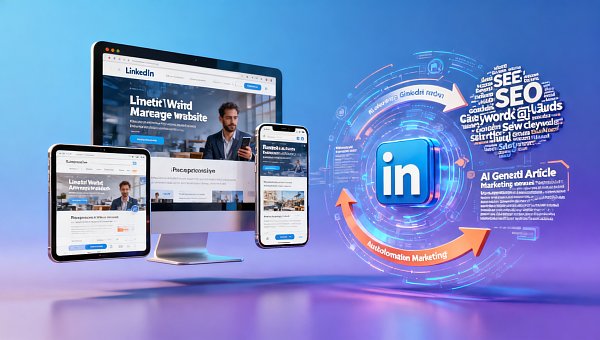
YiYingBao's technology platform undergoes 12 algorithm iterations annually, supporting 15 patents covering NLP, multimodal generation, and cross-platform behavioral modeling. This allows the question of which industries AI-generated articles are suitable for to go beyond superficial adaptation and delve into the very core of business operations. For example, in serving a Shenzhen-based smart hardware manufacturer, the system automatically identified a surge in orders exported to Mexico and immediately initiated three tasks: expanding content for a Spanish-language independent website, generating local KOL collaboration material packages, and dynamically expanding the Google Ads keyword library. The entire process was conducted without human intervention, resulting in a 190% month-on-month increase in new market leads.
At the same time, businesses also face new management challenges: with content, advertising, and social media all driven by AI, financial accounting dimensions need to be upgraded accordingly. Traditional cost center models struggle to assess the ROI of AI-generated content, necessitating the introduction of dynamic attribution and end-to-end LTV measurement. In response, YiYingBao, in collaboration with industry think tanks, released a series of challenges and strategies to broaden the scope of enterprise cost accounting, providing businesses with a benchmark for measuring growth investment in the AI era.
V. Conclusion: Choosing a service provider means choosing certainty of growth.
From the localized delivery capabilities of Hangzhou service providers for building Portuguese independent websites to the agile response mechanisms of Shenzhen suppliers for building responsive foreign trade websites; from the B2B penetration of LinkedIn marketing automation to the long-term value difference revealed by the cost comparison between AI website building and traditional website building—E-Creative has verified a fact through ten years of experience: true intelligent marketing is not about piling up technical jargon, but about enabling every company going global to accurately invest its limited manpower, budget, and time in the areas with the greatest growth leverage.
As a Google Premier Partner, official Meta agent, and Yandex core partner, EasyPro has helped over 100,000 companies achieve global growth. In 2026, we invite you to embark on a journey of AI-driven, certain growth—contact us now to receive a customized implementation assessment report and industry-specific solutions on "Which Industries are Suitable for AI-Generated Articles?"
- Website Development
- Foreign Trade Website Development
- Foreign Trade Website Development
- Website Speed Optimization
- AI Writing
- AI Batch Article Generation
- LinkedIn Marketing
- Google Ads
- Standalone website development
- Yiyingbao
- SEO
- Independent Website
- Smart Website Building
- AI Translation
- AI Translation Engine
- Global CDN Acceleration
- Global Digital Marketing
- AI Website Building
- cross-border e-commerce
- Marketing Automation
- Portuguese Standalone Website Development
- Responsive B2B Export Website Development
Related Articles
 Which channel has the highest ROI in the global traffic ecosystem? Comparative analysis of search, social media, and advertising
 What multilingual website services are available in Sanya? Which model is more suitable for local businesses going global?
 How to view the complete list of China SaaS companies in the top 100? Practical methods for screening website-building and marketing service providers
Related Products
 EasyCamp SaaS Smart Website Marketing SystemE-Yingbao SaaS Smart Website Marketing System: AI-powered, zero-code website building. Rapidly launch multilingual independent e-commerce sites in just 10 minutes. Global server acceleration and AI-driven SEO optimization empower businesses to efficiently connect with global markets. The seamless integration of technology and user-friendly operation makes building e-commerce sites incredibly simple.
 AI+SEM Intelligent Advertising Marketing SystemAI+SEM drives intelligent ad creation, empowering full-funnel precision advertising marketing. The system automatically generates weekly/monthly reports, AI recommends keywords and target countries, monitors core metrics in real-time with intelligent alerts, and enables one-click high-conversion ad solutions to help quickly acquire customers and improve ROI.
 AI+SEO Dual Engine Optimization ServiceEasyWin AI+SEO Dual Engine Optimization System leverages AI-powered keyword mining, content generation, and comprehensive technical optimization to help foreign trade enterprises acquire high-quality organic traffic, significantly improving search rankings and conversion rates.
 AI+SNS Social Media Marketing SystemYingbao AI+SNS Social Media Marketing System - Precision social capture for the social media era. Supports one-click content synchronization across major platforms like Facebook and LinkedIn. AI intelligently rewrites posts for enhanced relevance. 24/7 AI customer service and user profiling analysis empower businesses to efficiently expand into global markets.
 AI+SEO营销解决方案易营宝AI+SEO营销解决方案,通过AI批量写作、智能生成TDK、精准关键词扩词等功能,全面优化网站SEO效果,提升流量与转化率。助力企业构建高效智能网站新生态。
 AI+SEM Advertising Marketing SolutionsAI+SEM Advertising Marketing Solution leverages AI technology to deeply empower SEM ad campaigns. It automatically generates weekly/monthly reports using AI, presenting account data across multiple dimensions for comprehensive insights into campaign performance and trends. The system precisely recommends keywords and target countries, intelligently generates high-conversion ad copy, and enables one-click activation of efficient campaign plans to help businesses rapidly acquire customers. Simultaneously, it monitors core metrics in real time, intelligently identifies abnormal fluctuations, and issues timely alerts to ensure stable, high-return advertising results.
 Domain Name ServicesEasyWin provides professional domain name services, including intelligent queries, one-stop registration, brand protection, and full lifecycle management, helping businesses build a digital brand image.
 EasyOperate B2C Cross-Border E-Commerce Platform & Independent WebsiteEasyStore B2C Cross-border E-commerce Independent Store is an intelligent website building and cross-border e-commerce integrated solution independently developed by EasyStore Information Technology (Beijing) Co., Ltd. The system is specially designed for small and medium-sized as well as large export enterprises, integrating 'website building, operation, marketing, advertising, and conversion' into one, helping enterprises quickly establish cross-border e-commerce independent stores to achieve brand globalization and global sales growth.
The platform supports multiple languages, multiple currencies, and multi-channel marketing, with built-in AI intelligent translation and SEO optimization systems, suitable for mainstream markets such as Southeast Asia, Europe and America, Latin America, and the Middle East, assisting Chinese manufacturing enterprises in efficiently deploying international e-commerce strategies. SSL证书易营宝提供专业SSL安全证书服务,包括单域名和泛域名证书,确保网站数据传输加密、身份验证和完整性保护,助力企业建立安全可信的在线业务环境。









