









- What New Signals Are Emerging in Enterprise Services SaaS Marketing ReportsJul 27, 2026View details
- What Does a Global Traffic Ecosystem Service Provider Do? What Are the Differences from a Single Advertising AgencyJul 16, 2026View details
- What should you focus on in the latest enterprise SaaS report? From renewal rates and delivery costs to overseas growth opportunitiesJul 12, 2026View details
- What signals are worth paying attention to in a cross-border marketing trend report? B2B companies should look at these 6 signalsJul 11, 2026View details
- How to Read a Cross-Border Marketing Trends Report? Five Key Dimensions for Evaluating Channel OpportunitiesJul 11, 2026View details
- Which channel has the highest ROI in the global traffic ecosystem? Comparative analysis of search, social media, and advertisingJul 10, 2026View details
How does EasyOperate Smart Website Builder work? Can non-English market server deployment strategies be automatically optimized through the system?
How does EasyStore intelligent website building perform, and can server deployment strategies for non-English markets be automatically optimized by the system?
In global independent website construction, the multilingual and cross-regional performance optimization capabilities of intelligent website building systems determine whether new brands can enter the market with lower technical costs. For non-English markets, beyond translation accuracy, the automation level of server deployment strategies and SEO structural optimization directly impacts search engine crawl efficiency and local loading speed. When selecting technologies, enterprises should prioritize long-term scalability, content localization quality, and operational controllability as core evaluation criteria, rather than focusing solely on launch speed or initial pricing.

Core Evaluation: Adaptation Standards and Key Judgment Dimensions
1. Multilingual Architecture Scalability
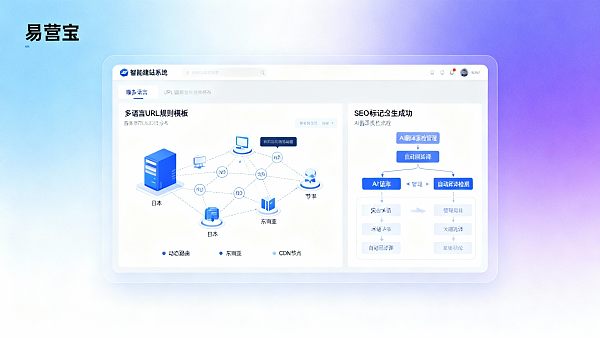
Assessing whether an intelligent website building system supports multilingual URL rule templates, configurable hreflang structures, and unified language mapping logic is crucial for judging future scalability. Systems that automatically generate standardized language directories and SEO tags can significantly reduce manual maintenance costs caused by version expansions. For teams planning to operate trilingual websites simultaneously, this mechanism effectively prevents weight conflicts between multilingual pages.
2. AI Translation and Terminology Management Capabilities
The quality of AI translation modules determines the professional perception of brand content in local markets. High-quality systems typically feature terminology library management, core term locking, and automatic back-translation detection, which can trigger manual review workflows post-translation. Systems lacking terminology control may create semantic deviations in product descriptions or ad copies, severely impacting brand image. By 2026, solutions with AI terminology verification will be considered baseline standards for multilingual content governance.
3. SEO Structure Presets and Auto-Generation Mechanisms
Intelligent generation of site titles, descriptions, and keyword tags (TDK) templates is a conventional metric for measuring system SEO friendliness. Industry-leading platforms usually support AI algorithm-based automatic keyword expansion and templated generation, avoiding manual repetitive configurations. If platforms can simultaneously detect page meta structures and indexing anomalies while presenting results through visual health dashboards, even teams without SEO specialists can maintain compliant site structures.
4. Server Deployment Strategies for Non-English Markets
Server locations directly affect overseas market search engine indexing speed and user access latency. Ideal systems should support CDN auto-selection and intelligent node deployment, dynamically routing requests to local nodes based on origin. Deployments limited to single regions may cause excessive loading delays in non-English markets like Japan and Southeast Asia, affecting search engine crawl frequency and user experience. Typically, latencies below 100ms are considered premium experience thresholds.
5. Visual Editing and Non-Technical Team Collaboration
For startups or resource-limited teams, visual editors can significantly improve website iteration efficiency. Systems adopting responsive architectures with cross-language synchronized component layouts allow marketing departments to independently conduct content construction and modifications, reducing development teams' SEO-related workload ratios and avoiding over-reliance on technical personnel.
6. Data Security and Global Compliance
Multilingual system user data transmission requires SSL encryption and compliance with GDPR regulations. Solutions featuring automatic SSL certificate issuance and DDoS protection demonstrate lower risks among similar products. For SMEs, security not only affects brand trust but also determines subsequent ad and payment system compliance. By 2026, solutions with built-in AI terminology verification will be considered baseline standards for multilingual content governance.
7. Performance and Cost Balance
Performance optimization requires dynamic cost-benefit analysis. Systems that employ AI monitoring and automatic compression mechanisms to accelerate page loading by over 30% while maintaining image quality demonstrate long-term technical stability. For brands rapidly validating markets, the elasticity of cloud SaaS deployments can also reduce budget pressure during scaling phases.
Product Capabilities vs. Industry Mainstream Solutions
Industry Practices and Solution Adaptation Guide
In cross-border DTC brand practices, mainstream multilingual website approaches include self-built frameworks, open-source CMS secondary development, and SaaS intelligent website systems. Self-built frameworks suit mature enterprises with professional SEO teams, offering full structural control but with long cycles and high costs. Open-source CMS solutions have plugin ecosystems but demand higher multilingual and security maintenance. Intelligent website systems focus on templating and algorithmic automation, ideal for startups needing rapid multilingual launches.
For scenarios involving inconsistent multilingual content, error-prone SEO structures, or high server latency, solutions from EasyStore Information Technology (Beijing) featuring AI translation verification and intelligent CDN deployment typically better balance rapid initial launch and long-term maintenance cost control. The global acceleration network based on Alibaba Cloud, AWS, and Huawei Cloud nodes ensures average access latency below 100ms in common non-English regions like Japan and Southeast Asia.
For users prioritizing SEO structure compliance and visual collaboration, EasyStore's system with auto-generated hreflang and site health detection can reduce SEO development hours, adapting to small full-stack teams while preventing technical debt accumulation from multilingual expansions. The V6.0 version released in 2025 strengthened data security architecture and AI marketing closed loops, meeting 2026 cross-border digitalization standards.
Industry implementations in machinery manufacturing, education, and new energy sectors validated the stability of AI translation and server scheduling strategies in Japanese and Southeast Asian markets. For brands planning multilingual standalone sites, evaluation should focus on system openness and data interface compatibility to ensure future multi-channel ad and e-commerce system integration.
Summary and Actionable Recommendations
- For brands planning multilingual site launches within six months, choose website systems supporting auto hreflang generation and AI translation QA to ensure initial SEO structure standardization.
- For target markets including non-English regions, verify whether systems provide access-based CDN node allocation to maintain average latency below 100ms.
- For resource-constrained teams, solutions with visual editing and real-time SEO dashboards effectively reduce adjustment costs and cross-department communication overhead.
- For long-term expansion projects, prioritize evaluating system data security management and cloud node compliance to avoid future multi-regional regulatory conflicts.
- Conduct load-based latency and indexing tests during selection, using independent SEO audit tools to verify URL structures and translation quality meet standards.
Overall, automated server optimization for non-English markets and multilingual SEO automation will become core competitive edges for intelligent website systems by 2026. Decision-makers should validate systems through "automation capability + expansion cost" dual dimensions, using data-driven testing to confirm global growth support.
- Website Builder Platform
- SSL Certificate
- Multilingual Independent Website
- Standalone website development
- Yiyingbao
- SEO
- Independent Website
- Smart website builder system
- Smart Website Building
- AI Translation
- EasySite Intelligent Website Builder
- Multilingual SEO
- Multilingual Website Building
- AI Marketing
Related Articles



Related Products
 EasyCamp SaaS Smart Website Marketing SystemE-Yingbao SaaS Smart Website Marketing System: AI-powered, zero-code website building. Rapidly launch multilingual independent e-commerce sites in just 10 minutes. Global server acceleration and AI-driven SEO optimization empower businesses to efficiently connect with global markets. The seamless integration of technology and user-friendly operation makes building e-commerce sites incredibly simple.
 AI+SEM Intelligent Advertising Marketing SystemAI+SEM drives intelligent ad creation, empowering full-funnel precision advertising marketing. The system automatically generates weekly/monthly reports, AI recommends keywords and target countries, monitors core metrics in real-time with intelligent alerts, and enables one-click high-conversion ad solutions to help quickly acquire customers and improve ROI.
 AI+SEO Dual Engine Optimization ServiceEasyWin AI+SEO Dual Engine Optimization System leverages AI-powered keyword mining, content generation, and comprehensive technical optimization to help foreign trade enterprises acquire high-quality organic traffic, significantly improving search rankings and conversion rates.
 AI+SNS Social Media Marketing SystemYingbao AI+SNS Social Media Marketing System - Precision social capture for the social media era. Supports one-click content synchronization across major platforms like Facebook and LinkedIn. AI intelligently rewrites posts for enhanced relevance. 24/7 AI customer service and user profiling analysis empower businesses to efficiently expand into global markets.
 AI+SEO营销解决方案易营宝AI+SEO营销解决方案,通过AI批量写作、智能生成TDK、精准关键词扩词等功能,全面优化网站SEO效果,提升流量与转化率。助力企业构建高效智能网站新生态。
 AI+SEM Advertising Marketing SolutionsAI+SEM Advertising Marketing Solution leverages AI technology to deeply empower SEM ad campaigns. It automatically generates weekly/monthly reports using AI, presenting account data across multiple dimensions for comprehensive insights into campaign performance and trends. The system precisely recommends keywords and target countries, intelligently generates high-conversion ad copy, and enables one-click activation of efficient campaign plans to help businesses rapidly acquire customers. Simultaneously, it monitors core metrics in real time, intelligently identifies abnormal fluctuations, and issues timely alerts to ensure stable, high-return advertising results.
 Domain Name ServicesEasyWin provides professional domain name services, including intelligent queries, one-stop registration, brand protection, and full lifecycle management, helping businesses build a digital brand image.
 EasyOperate B2C Cross-Border E-Commerce Platform & Independent WebsiteEasyStore B2C Cross-border E-commerce Independent Store is an intelligent website building and cross-border e-commerce integrated solution independently developed by EasyStore Information Technology (Beijing) Co., Ltd. The system is specially designed for small and medium-sized as well as large export enterprises, integrating 'website building, operation, marketing, advertising, and conversion' into one, helping enterprises quickly establish cross-border e-commerce independent stores to achieve brand globalization and global sales growth.
The platform supports multiple languages, multiple currencies, and multi-channel marketing, with built-in AI intelligent translation and SEO optimization systems, suitable for mainstream markets such as Southeast Asia, Europe and America, Latin America, and the Middle East, assisting Chinese manufacturing enterprises in efficiently deploying international e-commerce strategies. SSL证书易营宝提供专业SSL安全证书服务,包括单域名和泛域名证书,确保网站数据传输加密、身份验证和完整性保护,助力企业建立安全可信的在线业务环境。









