For an Inquiry-Conversion-Optimized Independent Website, Should You Improve Traffic or Pages First?
When optimizing an independent website for inquiry conversion, many project managers face the same question: if the website receives few inquiries, should they build up traffic first or improve the pages first? This may appear to be a choice about the order of promotion efforts, but it actually affects budget efficiency, the pace of sales follow-up, and whether the team can accurately identify the problem.
A common situation is that the website has been online for some time, receives a small amount of traffic, and has already undergone some promotion, but inquiry quality is average or there is no stable conversion at all. If the direction is misjudged, the team may continue buying traffic while doubting the channels, or spend considerable time redesigning the pages only to discover that no one is seeing them. To clarify the situation, the key is not to choose between “traffic” and “pages” first, but to determine where the current bottleneck lies.
Why Is This Question So Often Misjudged?
Traffic and pages both appear to be directly related to inquiries, but they play different roles in the conversion process. Traffic addresses “whether anyone comes,” while the page addresses “why visitors stay and why they get in touch.” If these two stages are not examined separately, it is easy to fall into a superficial judgment: when traffic is low, simply add more traffic; when there is traffic, assume the page is fine.
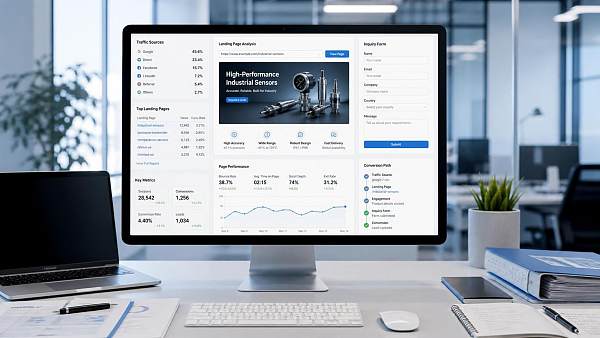
In practice, a more common mistake is to look only at total visits in the backend without examining the relationship between traffic sources, visitor behavior, entry pages, and inquiry actions. As a result, the team takes action every week without actually identifying the bottleneck. For an independent website focused on inquiry conversion optimization, the greatest risk is not moving slowly, but continually investing in the wrong area.
Before Making a Decision, Identify Which Situation the Website Is Currently In
Before deciding whether to improve traffic or pages first, you can use a practical approach: first determine whether “no one is coming,” then whether “visitors come but do not convert,” and finally whether “the traffic and page do not match.” These three situations require different priorities.
The first is a typical lack-of-traffic situation. For example, the website has almost no stable organic traffic, its ads have not gained traction, and social media and search have not generated consistent entry points. In this situation, even a complete page is difficult to evaluate because the sample size is too small to reveal user feedback.
The second is having traffic but no conversion. For example, the website receives a certain amount of traffic, and some pages may even perform reasonably well, but visitors leave quickly, bounce rapidly, few people complete the form, and contact information receives few clicks. In this case, the problem is probably not “whether anyone is looking,” but “why visitors do not trust, understand, or want to act after viewing the page.”
The third situation is more common and easier to overlook: the traffic and page do not match. For example, the ad copy emphasizes customization capabilities, but the visitor first sees a company introduction after clicking through; or search users are looking for a specific product solution, while the landing page contains only broad brand messaging. This is neither simply a lack of traffic nor simply a lack of pages; rather, the promise made at the entry point has become disconnected from the page content.
For an Inquiry-Conversion-Optimized Independent Website, How Should Priorities Be Set?
If a decision principle must be given, the more reliable order is to first confirm whether the page has basic conversion capabilities, and then decide whether to accelerate traffic acquisition. The reason is simple: increasing traffic to a page with no ability to engage visitors will only amplify the waste.
“Improve the page first” does not mean carrying out a major redesign or rebuilding the entire website. It means first completing the basic elements that affect inquiries. For example, can visitors understand within a few seconds what you do, whom you serve, and what differentiates you? Does the page have a clear call to action? Is the inquiry form too long? Is reading and submitting on mobile devices smooth? Do core pages support the language of the target market? Is trust-building information placed where it should be?
Only after these basic elements meet the standard is it meaningful to scale up traffic. Otherwise, what you see is not channel quality, but channel performance being obscured by page problems. For most companies acquiring overseas customers, the correct sequence is usually not a choice between “traffic first” and “pages first,” but rather “complete the page foundation first, validate it with a small amount of traffic, and then gradually scale up.”
A More Practical Approach: Check the Page First, Then Decide How Much to Invest in Traffic
If you are currently evaluating options or making a decision, follow the sequence below to avoid going off track.
- First check whether the homepage, core product pages, and landing pages are communicating the same message. After users arrive through a search term, ad copy, or social media content, the first screen must meet their expectations.
- Check whether the inquiry entry point is clear. This includes the button position, contact path, form length, and whether users can submit quickly on mobile devices, so that visitors who want to get in touch can easily find a way to do so.
- Check whether the page answers the questions customers care about most. These commonly include product scope, delivery methods, customization capabilities, target markets, language support, and pre-sales communication methods.
- Check whether enough trust has been established. Rather than filling the page with slogans, place company information, service scope, delivery processes, frequently asked questions, and necessary proof points where users need them to make a judgment.
- After the page foundation passes the assessment, conduct a small-scale traffic acquisition test. The channels do not need to be deployed extensively at once. Start with one core entry point among search, advertising, or social media and observe visitor behavior data.
- Fine-tune the page based on entry-point performance instead of changing every page at once. A truly effective independent website for inquiry conversion optimization is usually validated and adjusted continuously rather than rebuilt behind closed doors for several months.
When Should You Build Up Traffic First?
In some situations, traffic should indeed be prioritized. For example, the website has just launched, its content structure and conversion path are already relatively complete, but it currently has almost no organic exposure; or you are testing a new product direction, a new market-language page, or a new landing page and need a certain amount of traffic to validate whether the page works. Without sufficient traffic, the team will remain stuck in the guessing stage.
However, even if you start with traffic, that does not mean the page can be left unattended. A more reasonable approach is to first ensure that several key pages are readable, easy to contact, and clear in their explanation. Then use a limited budget to bring in the first group of visitors, observe search terms, click entry points, time on page, and submission actions, and decide whether to expand the campaign.
For websites serving overseas markets, multilingual structure, page loading speed, mobile responsiveness, and form submission stability can also directly affect traffic utilization. If these issues are not addressed in advance, the more traffic you generate, the more apparent the waste will become.
When Should You Improve the Pages First?
If the website already receives some traffic but has generated no meaningful inquiries over an extended period, improving the pages first is usually more appropriate than increasing traffic. This is especially true in the following situations: the content is comprehensive but lacks focus, and the homepage does not clearly communicate the core business above the fold; the product pages read like a company introduction and lack usage scenarios and purchasing information; CTAs are scattered and button copy is vague; the form is unfriendly to overseas users; or the mobile browsing experience is poor.
The greatest risk for these websites is that the team may mistakenly conclude that “the channel is ineffective.” In many cases, however, the issue is not that no one is coming, but that the page does not help users complete their evaluation. A page genuinely designed for inquiry conversion optimization should not simply place all company information on one page. Instead, it should organize content according to the customer decision-making sequence: understand quickly, build trust, and then make it easy to take action.
If You Are Evaluating Solutions, What Capabilities Should You Focus On?
When carrying out this type of optimization, many companies do not lack tools entirely. What they lack is a way of working that connects website building, page adjustments, traffic acquisition, and subsequent optimization. This is especially true when the target markets use multiple languages or when the team must address B2B inquiries, SEO, advertising landing pages, and social media engagement at the same time. Individual tools are often not enough.
In this situation, prioritize several aspects: whether the pages support continuous iteration rather than one-time production; whether the multilingual experience and overseas access are stable; whether it is convenient to create corresponding landing pages for different channels; whether SEO and advertising data can be reviewed within the same optimization process; and whether subsequent adjustments can easily be made around inquiry actions.
Platform-based solutions such as 易营宝, which cover intelligent website building, SEO optimization, advertising, and multilingual website operations, are more suitable for teams that do not want to handle website development, promotional customer acquisition, and conversion optimization as separate processes. Their value is not in replacing judgment, but in reducing the repeated switching and communication costs between different systems, allowing page engagement and traffic validation to progress at the same pace.
Frequently Asked Questions
The website receives almost no traffic. Do we still need to optimize the pages first?
Yes, but only basic optimization is needed. You do not need to rebuild the entire website first. Instead, complete the basic engagement capabilities of the homepage, core product pages, contact page, and landing pages, and then introduce test traffic. This gives subsequent data meaningful reference value.
If there is traffic but no inquiries, does that mean the advertising is ineffective?
Not necessarily. First check whether the traffic source matches the landing page, and then check whether the page clearly explains the issues users care about most. In many cases, the problem is that the promise made at the entry point is disconnected from the page content, rather than the advertising itself being completely ineffective.
Does an independent website for inquiry conversion optimization always require a major redesign?
Usually not. Most issues can first be addressed by adjusting the structure, above-the-fold messaging, CTAs, forms, mobile experience, and content sequence. A major redesign is suitable when the underlying architecture is no longer appropriate, but it should not be the default action.
Will a multilingual website make conversion optimization more complicated?
Yes, because users in different markets do not have exactly the same concerns, search terms, or reading habits. Multilingual pages cannot rely on direct translation alone. They must also consider the expression styles and inquiry-action design of the corresponding markets; otherwise, traffic may arrive without converting.
Conclusion
Returning to the original question—should an independent website focused on inquiry conversion optimization improve traffic or pages first? The more reliable answer is to first confirm that the page has basic engagement capabilities, then use controllable traffic to validate it, and finally decide which side to scale based on the data. Although this may not look as fast as focusing on a single area, it is closer to real business decision-making and makes it easier to avoid repeatedly consuming budget and time.
If you are selecting an independent website solution or preparing to restructure your customer acquisition path, first review your existing website in three steps: whether the entry point is accurate, whether the page explains the offering clearly, and whether the inquiry process is smooth. Clarifying the problems before deciding where to allocate resources is usually more effective than debating whether channels or pages are more important.