









- Is the EV SSL certificate market shrinking or upgrading? How should companies assess certificate procurement?Aug 11, 2026View details
- Why the old AMP SEO 2020 practices no longer work and what has changed in current optimization prioritiesAug 02, 2026View details
- How to Choose Topics for an Industry News Section to Attract More Organic Search TrafficJul 29, 2026View details
- Digital Marketing Shenzhen Market Insights: Why Are Companies Expanding Overseas Looking for Growth Teams in Shenzhen?Jul 31, 2026View details
- Can Zhejiang foreign trade independent websites still be developed today? Look at changes in traffic and lead generationJul 28, 2026View details
- What New Signals Are Emerging in Enterprise Services SaaS Marketing ReportsJul 27, 2026View details
How to Use a TDK Optimization Template to Prevent Page Indexing Misalignment
TDK optimization templates should follow indexing rules first, and only then consider the efficiency of bulk generation. Misaligned page indexing is commonly seen in several ways: a product detail page is identified as a category page, a filtered results page takes rankings away from the official page, language versions overwrite one another, or pages in the same category are merged, replaced, or delayed after being crawled because their title templates are too similar. The problem is often not whether a title has been written, but whether the template fields, page type, URL hierarchy, and indexability conditions are aligned.
In practice, first divide pages into several types instead of applying one TDK optimization template to every page. At a minimum, separate the homepage, category aggregation pages, product detail pages, article detail pages, tag pages, filter pages, search results pages, and multilingual mirror pages. This step should not be skipped even if the site is small. When determining a topic, search engines consider the title, description, above-the-fold content, breadcrumbs, link anchor text, canonical, and URL naming at the same time. If only the title emphasizes a product keyword while the body contains informational content, or if a category page template includes parameter, model, and application keywords all at once, the signals can easily become confused.
Write templates according to page roles, not keyword popularity
Many indexing misalignments result from a mistaken approach: selecting the primary keyword first and then forcing it into every page template. This may appear consistent in the short term, but over time it can cause pages to compete with one another for the same topic. A more reliable approach is to first define the role of each page type within the indexing system.
For example, category pages are responsible for covering broader topics and are suitable for scope terms, category terms, and application-direction terms. Detail pages cover specific objects and are suitable for product names, models, materials, specifications, processing methods, installation conditions, and applicable scenarios. Article pages are suitable for explaining processes, product selection, maintenance, troubleshooting, and parameter standards. If highly specific terms such as “304 stainless steel flange,” “DN50,” and “flange sealing face type” are included in a category page template, while the detail page repeats the same TDK optimization template, the search engine may regard the category page as the more complete result. This can delay or even replace the indexing of the detail page.
This is particularly evident in integrated website and marketing service scenarios, because a site often contains lead-generation pages, explanatory pages, case study pages, knowledge pages, and product pages at the same time. If templates do not distribute content according to page roles, the crawling system sees “many pages talking about the same thing, but not in exactly the same way.” This creates the conditions for misalignment.
Do not pursue keyword inclusion alone in title templates; preserve differentiation
Titles are easy to generate in bulk, and bulk generation can easily make them inaccurate. A usable TDK optimization template must at least ensure that pages of the same type can maintain stable differences. When differentiation is insufficient, the indexing system may select the wrong representative page or group multiple pages into the same topic cluster.
For detail-page titles, stable fields are usually more important than marketing terms. A combination such as “core object + key specification/model + application qualifier” can be prioritized. For pages covering mechanical components, sheet materials, pumps and valves, hardware accessories, packaging materials, and similar products, specification fields often help identify page independence more effectively than terms such as “high quality,” “manufacturer,” and “supplier.” Specification fields may include thickness, material, nominal diameter, surface treatment, temperature-resistance range, load-bearing grade, installation method, interface standard, and drive type. However, the corresponding information must actually appear in the body content; the title must not mention parameters unsupported by the page.
If a site contains many similar products, a template based only on “product name + company term” is usually not sufficiently distinctive. This is especially true for pages with differences only in color, package quantity, or minor dimensions. If the body content is also short, indexing conflicts between canonical pages and variant pages are more likely. In this case, clearly define which pages serve as primary index pages and which are only specification-switching pages. Even if variant pages without independent content remain accessible, they may not be suitable for independent indexing.
The purpose of the description is not to repeat the title. It is better suited to supplement information not covered in the title, such as delivery form, applicable working conditions, common application areas, maintenance requirements, and optional parameter ranges. For example, if an industrial component page mentions normal-temperature operation, corrosion resistance, outdoor installation, horizontal pipelines, flange connections, and manual maintenance intervals, the description can include one or two key limitations. This is more helpful for distinguishing the page topic than a vague description.
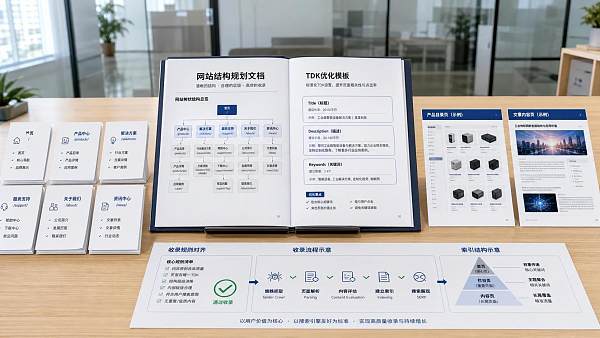
Template variables must come from stable fields, not temporary filter values
Many indexing misalignments are not caused by incorrect copy, but by disorganized template-variable sources. There are three especially common situations.
First, the title calls filter parameters. For example, after a list page is filtered by “material=aluminum,” “thickness=2mm,” “region=North China,” or “stock=available,” the system directly inserts these temporary parameters into the title, generating a large number of indexable pages that differ by only one filter value. Search engines may regard them as duplicate or low-difference pages and may instead index a filter page as the primary page.
Second, category pages and detail pages share the same field pool. The category name, product name, article title, and tag name are all taken from a single “title name” field. Although this appears convenient, it causes different page types to use similar TDK content and reduces their distinctiveness.
Third, multilingual pages directly replace fields through machine translation without semantic review. This is particularly common with specification terms, material grades, interface standards, and shipping and packaging terminology on industrial product sites, export sites, and cross-border catalogs. If translations are inconsistent, the topic mapping between pages in different languages may be incorrect, further affecting the evaluation of canonical or hreflang.
Template fields should preferably come from relatively stable data sources that can represent the page topic over the long term, such as the official product name, first-level category name, second-level category name, article topic term, fixed model, standard material, and clearly defined use. Stock status, promotional information, temporary regional terms, and frequently changing campaign statements are generally unsuitable for core TDK optimization templates.
The page body must give the template practical support
Indexing systems do not look only at TDK. If the title says “Specifications of Galvanized Steel Grating,” but the body contains only a general overview without opening spacing, flat-bar thickness, surface treatment, load-bearing scenarios, or installation considerations, the topic signals are incomplete. Conversely, if the body explains welding processes, hot-dip zinc coating, edge framing, transport stacking, and deformation-prevention requirements in detail, while the title contains only an overly broad category term, the page may also be suppressed by a broader category page.
Therefore, TDK optimization templates should be used together with the corresponding body fields. If a page emphasizes a “model,” the body should at least include the dimensions or interface information associated with that model. If the title includes “installation,” the body should provide installation-surface conditions, fastening methods, compatible components, or maintenance intervals. If an “application scenario” term is used, the body should preferably explain operating conditions such as indoor use, humid environments, high temperatures, dust, pressure-bearing applications, food contact, or outdoor exposure. These details are not intended to add words for their own sake, but to make the page topic more verifiable during crawling and indexing.
Leave deliberate semantic distance between category pages and detail pages
On many sites, misalignment is not caused by poor content, but by insufficient differences in hierarchy. A category page is written like a detail page, while the detail page reads like supplementary category content, causing the two to overwrite one another. The solution is not simply to delete keywords, but to clarify the semantic boundaries.
Category pages are better suited to discussing the scope of choice, such as material classifications, usage scenarios, structural differences, common specification ranges, and parameters that are easily confused during procurement. Detail pages should focus on a single object and expand on specific parameters, processing methods, packaging forms, transport precautions, installation interfaces, and maintenance requirements. For example, under the topic of “insulation materials,” a category page can discuss the differences between rock wool, glass wool, and rubber-plastic materials in terms of temperature resistance, water absorption, and installation location. A detail page should explain the thickness range, film-laminating form, cutting method, and moisture-proof storage and transport requirements of a specific panel. If both are written as an “introduction to insulation materials,” indexing misalignment is likely.
Internal links should also support this boundary. When a category page links to a detail page, the anchor text can be more specific; when a detail page links back to a category page, the anchor text should remain at the broader category level. Do not have dozens of detail pages use exactly the same “click to learn more” anchor text or link back with the same primary keyword, as this can further amplify the confusion in link signals.
Handle indexable filter pages, tag pages, and paginated pages with care
These page types are most likely to push official pages out of the results. On sites with many products and attribute dimensions, independently generating pages for color, size, process, application, region, brand compatibility terms, and other filters can quickly expand the indexing pool. More pages do not necessarily mean better results; what matters is which pages deserve to be indexed.
If a filter combination corresponds to a stable search demand and the page can provide substantive content—for example, a product collection for a specific material, thickness range, or industry application—consider designing a separate TDK optimization template and guidance copy for it. However, a results page generated only by combining URL parameters is generally unsuitable as a primary index page if its body contains no supplementary explanation and its list content changes frequently.
The same applies to paginated pages. Many systems automatically generate titles and descriptions for pages 2 and 3 that are almost identical to those of page 1, adding only “Page 2.” If canonical or indexing strategies are not properly controlled, the authority of the category homepage may be diluted. At a minimum, confirm whether paginated pages need to be indexed, whether their titles clearly indicate pagination, and whether they will compete with the category homepage for the same topic.
Common misjudgments are often caused not by writing, but by failing to conduct sampling before launching the template
In actual implementation, the most effective action is usually not to continue revising the copy, but to conduct sample checks. Do not look only at the template configuration interface; select URLs of different types and verify them page by page.
- Check whether the title, description, canonical, and robots in the page source code are consistent with one another. Avoid situations where the title describes the official page but the canonical points to the parent category.
- Sample three to five similar detail pages and confirm that the template variables actually reflect differences in model, material, or application, rather than merely changing the order of the product name.
- Check whether filter pages, internal search pages, or tag pages have accidentally been assigned the same primary keyword as official content pages.
- If multilingual versions exist, confirm that pages in different languages are not simply sharing the same Chinese logic fields, as this can easily cause topic-mapping deviations.
Another common situation is that the template has been corrected, but old page caches, historical indexing, and old canonicals are still influencing the evaluation. In this case, do not immediately continue changing the title. First confirm whether the crawled version has been updated, and then observe whether the topic returns to the correct page. Frequently rewriting TDK can sometimes make it more difficult for search engines to establish a stable understanding.
The real value of a TDK optimization template is not producing similar sentences in bulk, but fixing the page roles, field sources, and indexing boundaries. As long as pages within the same category remain consistent and sufficient semantic distance is maintained between different page types, indexing misalignment will generally decrease significantly. The remaining task is to ensure that the title, body content, links, and indexability rules all communicate the same message.
Related Articles

Related Products
 Yiyingbao SaaS Intelligent Website Building and Marketing SystemYiyingbao SaaS Intelligent Website Building and Marketing System, AI-powered no-code website building, rapid creation of multilingual B2B international websites in 10 minutes, global server acceleration, AI-powered SEO optimization, helping businesses connect efficiently with global markets. The perfect integration of technology and operation makes building an international trade website remarkably simple
 AI+SEM Intelligent Advertising Marketing SystemAI+SEM drives intelligent ad creation, empowering full-funnel precision advertising marketing. The system automatically generates weekly/monthly reports, AI recommends keywords and target countries, monitors core metrics in real-time with intelligent alerts, and enables one-click high-conversion ad solutions to help quickly acquire customers and improve ROI.
 AI+SEO Dual-Engine System Optimization ServicesYiyingbao’s AI+SEO dual-engine optimization system helps foreign trade enterprises acquire high-quality organic traffic through AI-powered keyword research, content generation, and comprehensive technical optimization, significantly improving search rankings and conversion rates.
 AI+SNS Social Media Marketing SystemYingbao AI+SNS Social Media Marketing System - Precision social capture for the social media era. Supports one-click content synchronization across major platforms like Facebook and LinkedIn. AI intelligently rewrites posts for enhanced relevance. 24/7 AI customer service and user profiling analysis empower businesses to efficiently expand into global markets.
 AI+SEO营销解决方案易营宝AI+SEO营销解决方案,通过AI批量写作、智能生成TDK、精准关键词扩词等功能,全面优化网站SEO效果,提升流量与转化率。助力企业构建高效智能网站新生态。
 AI+SEM Advertising Marketing SolutionsAI+SEM Advertising Marketing Solution leverages AI technology to deeply empower SEM ad campaigns. It automatically generates weekly/monthly reports using AI, presenting account data across multiple dimensions for comprehensive insights into campaign performance and trends. The system precisely recommends keywords and target countries, intelligently generates high-conversion ad copy, and enables one-click activation of efficient campaign plans to help businesses rapidly acquire customers. Simultaneously, it monitors core metrics in real time, intelligently identifies abnormal fluctuations, and issues timely alerts to ensure stable, high-return advertising results.
 Domain Name ServicesEasyWin provides professional domain name services, including intelligent queries, one-stop registration, brand protection, and full lifecycle management, helping businesses build a digital brand image.
 EasyOperate B2C Cross-Border E-Commerce Platform & Independent WebsiteEasyStore B2C Cross-border E-commerce Independent Store is an intelligent website building and cross-border e-commerce integrated solution independently developed by EasyStore Information Technology (Beijing) Co., Ltd. The system is specially designed for small and medium-sized as well as large export enterprises, integrating 'website building, operation, marketing, advertising, and conversion' into one, helping enterprises quickly establish cross-border e-commerce independent stores to achieve brand globalization and global sales growth.
The platform supports multiple languages, multiple currencies, and multi-channel marketing, with built-in AI intelligent translation and SEO optimization systems, suitable for mainstream markets such as Southeast Asia, Europe and America, Latin America, and the Middle East, assisting Chinese manufacturing enterprises in efficiently deploying international e-commerce strategies. SSL证书易营宝提供专业SSL安全证书服务,包括单域名和泛域名证书,确保网站数据传输加密、身份验证和完整性保护,助力企业建立安全可信的在线业务环境。









