









- Which customer acquisition channels will be affected by cross-border marketing trends in 2026?Sep 06, 2026View details
- Which homogenization risks should be considered in an analysis of the AI-powered website building industry?Aug 30, 2026View details
- How Will AI Marketing Trends 2026 Change Advertising Budget AllocationAug 28, 2026View details
- Is the EV SSL certificate market shrinking or upgrading? How should companies assess certificate procurement?Aug 11, 2026View details
- Why the old AMP SEO 2020 practices no longer work and what has changed in current optimization prioritiesAug 02, 2026View details
- How to Choose Topics for an Industry News Section to Attract More Organic Search TrafficJul 29, 2026View details
Which Companies Is SEM Outsourcing Suitable for? Understand the Costs, Results, and Risks at a Glance
SEM Outsourcing: Saving Effort Does Not Necessarily Mean Saving Money
When many companies hear the term outsourcing SEM, their first reaction is often, “Leave the advertising to a professional team so we can avoid unnecessary detours.” This is not entirely wrong, but it overlooks a key premise: SEM outsourcing addresses gaps in advertising capabilities, but it does not automatically solve fundamental issues such as product competitiveness, pricing structures, website conversion, and sales follow-up. In other words, outsourcing can amplify an existing foundation for growth, but it is difficult for it to replace a company’s own business judgment.
When making a decision, companies should not simply ask, “Should we outsource?” Instead, they should ask, “Who should handle it at this stage, is the cost structure reasonable, and can the results be continuously reused?” If a company does not have a mature in-house advertising team but wants to launch Google Ads, search advertising, or overseas customer acquisition relatively quickly, SEM outsourcing is usually a more practical option. However, if the company already has a stable advertising methodology and only needs additional execution support, fully outsourcing the work may instead increase communication costs.
What Types of Companies Are Better Suited to SEM Outsourcing?
Start by looking at three conditions: Is the budget continuous? Are the objectives clear? Is there someone internally who can take responsibility for the results? SEM is not a one-time purchase; it is more like an ongoing business optimization activity. Setting up advertising accounts, structuring keywords, testing landing pages, tracking conversions, and developing location and time-based strategies all require repeated iteration. If the budget is intermittent, or if the company wants inquiries today, brand exposure tomorrow, and direct sales the day after, it is difficult for an outsourcing team to establish a stable strategy.
The companies most suited to outsourcing are often the following: First, foreign trade manufacturers with highly specialized products and long sales cycles, but no one internally who is familiar with Google Ads or overseas search marketing. Second, cross-border brands or independent website sellers who want to quickly validate the market but do not plan to build a complete advertising team immediately. Third, companies that already have a certain business foundation and want to integrate website development, SEO, advertising, and data tracking into one system. For these companies, the value of outsourcing is not limited to managing campaigns on their behalf; it is also about quickly establishing a functioning process for traffic acquisition, page conversion, and data feedback.
Conversely, some companies are not suitable for handing over all SEM activities at the outset. For example, frequent changes in product pricing, unstable sales policies, slow customer service responses, and websites that are not updated for long periods can directly undermine advertising performance. No matter how professionally the account is managed, it cannot compensate for problems in downstream operations. Many people simply attribute poor advertising performance to the service provider, when the actual problem often lies outside the advertising itself.
Costs Should Not Be Evaluated Based Solely on Service Fees
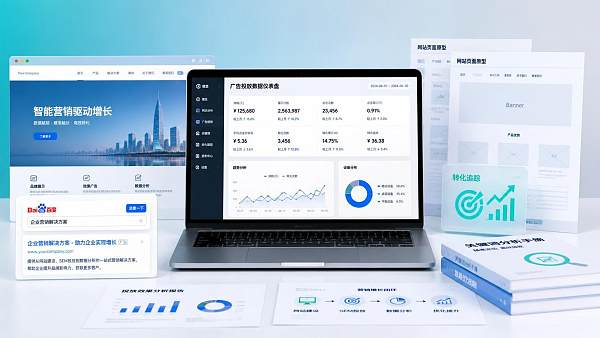
The most common mistake companies make when evaluating SEM outsourcing is focusing only on the monthly service fee. In reality, costs consist of at least four components: advertising media budgets, service provider management fees, landing page or website modification costs, and internal coordination costs. Many proposals appear inexpensive, but they do not include conversion tracking, creative testing, or multilingual page support. Additional costs may therefore accumulate later.
What should really be compared is the total customer acquisition cost, not the outsourcing unit price. If a team charges more but can reduce invalid clicks, establish a clearer keyword structure, and stabilize inquiry quality, it may not be more expensive overall. Especially for foreign trade and international expansion, account setup often involves advertising across multiple regions, multilingual landing pages, time zone management, and lead attribution. These areas cannot be easily covered through low-cost execution alone.
There is also an indirect cost that is often overlooked: whether someone within the company can understand the data. A monthly report from a service provider does not mean that the company truly understands the status of its campaigns. If no one reviews metrics such as click-through rate, conversion rate, cost per conversion, search term reports, and sources of invalid traffic, outsourcing can easily become a black-box service that is simply renewed every month.
Performance Should Not Be Judged Solely by the Number of Leads
Many companies ask directly during the procurement stage, “How many inquiries can outsourcing generate?” This question is understandable, but it is incomplete. SEM performance should be evaluated on at least three levels: whether the right target audience has been reached, whether clicks have been converted into meaningful actions, and whether those actions can ultimately enter the sales process. When only the first level looks good, companies often end up with many forms but no closed deals.
In particular, in the B2B foreign trade sector, inquiry quality is more important than quantity. When industry keywords are broad, advertising may generate a large number of visits, but the purchasing intent may not be strong. Long-tail keywords may have lower volume, but their conversion intent is usually clearer. A mature SEM outsourcing team will not simply pile up impressions and clicks. Instead, it will distinguish between brand keywords, core category keywords, competitor keywords, and high-intent long-tail keywords based on business objectives, and then use different landing pages to handle each type of traffic.
If a company also needs independent website development, SEO optimization, social media traffic acquisition, and other services, SEM performance should not be viewed in isolation. A website with slow page loading, poorly designed forms, or a weak mobile experience will cause advertising costs to remain high. Under an integrated website and marketing services model, planning website development, conversion tracking, advertising, and SEO fundamentals together is often more likely to produce stable results than purchasing a single campaign management service.
The Main Risk Is Not Being Scammed, but Losing Control
Companies are usually most concerned about account security, wasted budgets, and excessive performance promises when outsourcing. These are genuine concerns, but the more common risk is actually losing control of the process. For example, account ownership may be unclear, with the advertising account, conversion code, and creative assets all controlled by the service provider. Optimization activities may also lack transparency: the company sees only summary results, not the specific search terms, negative keyword logic, or page testing records. Once the cooperation ends, it may be difficult to retain historical data and accumulated strategies.
Another risk is unclear service boundaries. SEM outsourcing can address traffic acquisition and part of conversion optimization, but it cannot replace product positioning or sales follow-up. If vague promises such as guaranteed inquiries or guaranteed sales are included in the procurement agreement, subsequent disputes are almost unavoidable. A more reliable approach is to break the objectives down into phased indicators. For example, the early stage can focus on account setup, tracking accuracy, and basic conversions, followed later by the cost and quality of valid leads.
Incidentally, many industries have encountered similar issues when advancing digital transformation. Content such as Reflections on Advancing the Informatization of Financial Management in Public Institutions Against the Backdrop of Big Data essentially discusses the same logic: a system does not automatically produce results simply because it has been purchased. The key is whether the processes, permissions, data, and execution mechanisms are properly aligned. The same applies to SEM outsourcing. Once external capabilities are brought in, the extent to which internal management can support them determines the upper limit of the final results.
Focus on These Four Things When Choosing a Service Provider
First, examine the depth of its understanding of your business. An experienced team will first ask about your product structure, target markets, sales cycle, average order value, and lead qualification criteria, rather than immediately quoting an advertising package.
Second, examine whether the data is transparent. Account ownership, conversion tracking permissions, search term reports, advertising creatives, and landing page versions should ideally all be directly accessible to the company.
Third, examine whether its capabilities are comprehensive. Today, overseas customer acquisition involves more than purchasing clicks. It may also include intelligent website development, multilingual pages, SEO fundamentals, advertising landing pages, and social media coordination. The more fragmented the service chain, the higher the coordination costs will be later.
Fourth, examine whether expectations are managed conservatively. Be cautious of any proposal that excessively promises short-term results while avoiding industry differences and fundamental conversion issues. SEM can accelerate market validation, but it rarely allows a company to bypass the trial-and-error process itself.
Suitability Ultimately Depends on the Company’s Stage of Operations
If a company is in the early stage of overseas customer acquisition, lacks internal staff, has limited time, and wants to launch an account quickly to test the market, SEM outsourcing is usually a reasonable choice. If it has already developed a stable advertising model and has internal optimization and analysis capabilities, it may be more appropriate to retain the core strategy in-house while assigning part of the execution or specific projects to an external team.
Ultimately, outsourcing SEM is not a question of whether it is good or bad, but whether it is the right fit. The criteria are also straightforward: Can the budget be sustained? Can the website and sales team handle the leads? Is the data transparent? Can capabilities and assets be retained after the outsourcing engagement ends? Only after clarifying these points should the company discuss pricing. This makes it less likely that saving effort will turn into an additional cost.
Related Articles
 Why do SaaS cross-border e-commerce customer acquisition efforts often get stuck at demo booking?
 For an independent foreign trade website in Shanghai, is it better to focus first on inquiries or transactions?
 What parameters should a product selection guide include to reduce repeated communication with sales?


Related Products
 Yiyingbao SaaS Intelligent Website Building and Marketing SystemYiyingbao SaaS Intelligent Website Building and Marketing System, AI-powered no-code website building, rapid creation of multilingual B2B international websites in 10 minutes, global server acceleration, AI-powered SEO optimization, helping businesses connect efficiently with global markets. The perfect integration of technology and operation makes building an international trade website remarkably simple
 AI+SEM Intelligent Advertising Marketing SystemAI+SEM drives intelligent ad creation, empowering full-funnel precision advertising marketing. The system automatically generates weekly/monthly reports, AI recommends keywords and target countries, monitors core metrics in real-time with intelligent alerts, and enables one-click high-conversion ad solutions to help quickly acquire customers and improve ROI.
 AI+SEO Dual-Engine System Optimization ServicesYiyingbao’s AI+SEO dual-engine optimization system helps foreign trade enterprises acquire high-quality organic traffic through AI-powered keyword research, content generation, and comprehensive technical optimization, significantly improving search rankings and conversion rates.
 AI+SNS Social Media Marketing SystemYingbao AI+SNS Social Media Marketing System - Precision social capture for the social media era. Supports one-click content synchronization across major platforms like Facebook and LinkedIn. AI intelligently rewrites posts for enhanced relevance. 24/7 AI customer service and user profiling analysis empower businesses to efficiently expand into global markets.
 AI+SEO营销解决方案易营宝AI+SEO营销解决方案,通过AI批量写作、智能生成TDK、精准关键词扩词等功能,全面优化网站SEO效果,提升流量与转化率。助力企业构建高效智能网站新生态。
 AI+SEM Advertising Marketing SolutionsAI+SEM Advertising Marketing Solution leverages AI technology to deeply empower SEM ad campaigns. It automatically generates weekly/monthly reports using AI, presenting account data across multiple dimensions for comprehensive insights into campaign performance and trends. The system precisely recommends keywords and target countries, intelligently generates high-conversion ad copy, and enables one-click activation of efficient campaign plans to help businesses rapidly acquire customers. Simultaneously, it monitors core metrics in real time, intelligently identifies abnormal fluctuations, and issues timely alerts to ensure stable, high-return advertising results.
 Domain Name ServicesEasyWin provides professional domain name services, including intelligent queries, one-stop registration, brand protection, and full lifecycle management, helping businesses build a digital brand image.
 EasyOperate B2C Cross-Border E-Commerce Platform & Independent WebsiteEasyStore B2C Cross-border E-commerce Independent Store is an intelligent website building and cross-border e-commerce integrated solution independently developed by EasyStore Information Technology (Beijing) Co., Ltd. The system is specially designed for small and medium-sized as well as large export enterprises, integrating 'website building, operation, marketing, advertising, and conversion' into one, helping enterprises quickly establish cross-border e-commerce independent stores to achieve brand globalization and global sales growth.
The platform supports multiple languages, multiple currencies, and multi-channel marketing, with built-in AI intelligent translation and SEO optimization systems, suitable for mainstream markets such as Southeast Asia, Europe and America, Latin America, and the Middle East, assisting Chinese manufacturing enterprises in efficiently deploying international e-commerce strategies. SSL证书易营宝提供专业SSL安全证书服务,包括单域名和泛域名证书,确保网站数据传输加密、身份验证和完整性保护,助力企业建立安全可信的在线业务环境。









