









- Which customer acquisition channels will be affected by cross-border marketing trends in 2026?Sep 06, 2026View details
- Which homogenization risks should be considered in an analysis of the AI-powered website building industry?Aug 30, 2026View details
- How Will AI Marketing Trends 2026 Change Advertising Budget AllocationAug 28, 2026View details
- Is the EV SSL certificate market shrinking or upgrading? How should companies assess certificate procurement?Aug 11, 2026View details
- Why the old AMP SEO 2020 practices no longer work and what has changed in current optimization prioritiesAug 02, 2026View details
- How to Choose Topics for an Industry News Section to Attract More Organic Search TrafficJul 29, 2026View details
What SEO details are most likely to be overlooked when adapting a website for Yandex?
Before checking rankings, first determine whether your website is being treated as a “local site”
When targeting the Russian-speaking market, many teams immediately ask about keyword positions without first determining which region the site belongs to in Yandex’s eyes, whom it serves, and whether its content is prepared for local users. For technical evaluators, this step is more critical than monitoring a specific keyword. If you want to optimize your website for Yandex, the factors that most often lead to lost points are not a lack of keyword repetitions on the page, but mismatched regional attribution, language consistency, technical crawling rules, and trust signals.
The following checklist is suitable for evaluation before website development, acceptance testing before launch, or troubleshooting when taking over an existing Russian-language site. The sequence is generally arranged according to risk priority. It is not a theoretical framework, but a list of the issues most frequently encountered in real projects.
First, check whether the language version is a “complete site,” not a “translation layer”
Many multilingual websites appear to have a Russian-language entry point, but in reality only the navigation, buttons, and a small amount of main text have been translated, while product specifications, contact pages, policy pages, form prompts, and error pages remain in the original language. Yandex is not friendly toward such sites because it does not judge whether you have a Russian-language button, but whether Russian-speaking users can complete an entire browsing and conversion process after visiting.
- Check whether the navigation, categories, filters, breadcrumbs, and internal search results pages have all been localized into Russian.
- Check whether the units, currency, delivery information, and after-sales terms in product details match the reading habits of the Russian-speaking market.
- Check whether success messages after form submission, error messages, and email templates are still in English.
If the site merely has a layer of machine translation, user dwell time and interaction data are usually poor, making subsequent page optimization much more difficult.
Regional signals must form a complete loop; do not launch the site just by changing a language code
Yandex has always been sensitive to regional relevance, especially for businesses with clear local service characteristics. What is easy to overlook here is not that one particular item has been omitted, but that the signals contradict one another. For example, the page is in Russian, but the contact information includes only a Chinese phone number; the title mentions Moscow, but the landing page address contains no local information; the server is fast, but all commercial information on the site appears to target generic global traffic.
During technical evaluation, at minimum, the following fields should be aligned:
If your business is not itself a local door-to-door service, but rather a cross-regional business such as manufacturing, cross-border e-commerce, or a brand website, do not force “pseudo-localization.” A more effective approach is to clearly explain the service regions, transportation methods, payment and settlement process, and delivery boundaries, so that both search engines and users understand how the site serves the Russian-speaking market.
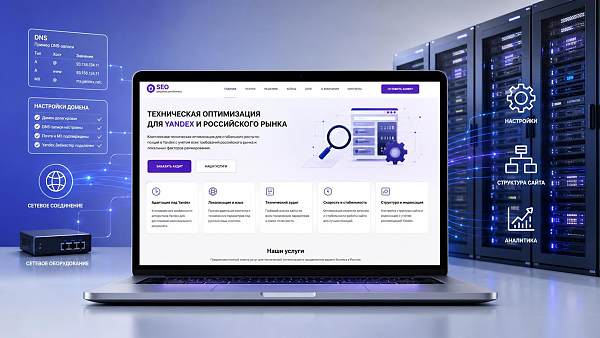
Do not copy Google project configurations for crawling rules
This is where technical teams most easily get caught. Many international sites directly reuse their existing SEO templates, configuring `robots.txt`, canonical tags, pagination handling, and parameter-page strategies according to Google’s conventions. Although there may be no obvious errors, this can affect how Yandex evaluates page hierarchy and indexing value.
- Check whether `robots.txt` mistakenly blocks Russian-language directories, filter pages, or static resources.
- Check whether canonical tags point incorrectly across languages. In particular, do not uniformly set Russian pages to canonicalize to the English main site.
- Check whether pagination, sorting, and filter URLs return stable responses, and avoid generating large numbers of empty and duplicate pages.
- Check the server response codes. A common issue on Russian-language sites is not too many 404 errors, but error pages returning 200 status codes.
If you are building a multilingual SaaS website or a marketing-oriented corporate website, it is best to handle these basic standards at the template level; otherwise, the same problems will recur every time a new language is added. For websites serving fragrance and lifestyle businesses, for example, pages generally place greater emphasis on visual presentation and product portfolio display. Solutions such as fragrance, personal care, and cosmetics are well suited to brand expression through large hero images, grid-based product sections, timeline modules, and data dashboards. However, the technical layer requires even earlier control over lazy loading, image URL standards, crawlable above-the-fold text, and mobile responsiveness. Otherwise, “looking premium” and “being consistently indexed” can easily become two different things.
Do not underestimate on-site trust pages; Yandex is sensitive to whether a site “looks like a legitimate business”
Many teams build Russian-language sites as simple traffic entry points: the homepage looks attractive and product pages are available, but the About Us, delivery process, refund policy, privacy policy, and contact information are very thin. This may be enough for an advertising landing page to operate for a while, but it is insufficient for organic search.
During evaluation, you can directly review three types of pages:
- Company identity page: Does it clearly state the legal entity, business scope, and service methods?
- Transaction information page: Are payment, shipping, customization, after-sales service, and sample procedures clearly explained?
- Contact and conversion page: Are the form fields reasonable, and are there submission failures, abnormal redirects, or no feedback after submission?
These pages are not technically complex, but they directly affect user behavior data and the search engine’s assessment of site credibility. This is especially true for B2B inquiry websites: the less pre-conversion information available, the higher the bounce rate is usually likely to be.
Page speed cannot be judged only by laboratory scores; examine the actual access path in Russian-speaking regions
Many teams run speed tests only from local or European and American nodes, and consider the site acceptable once the score looks good. The problem is that the access path, network environment, and availability of third-party scripts for users in the Russian-speaking market may differ from the environments you normally test. Especially when too many external fonts, video sources, analytics scripts, and chat plugins are used, the page may technically open while the above-the-fold content remains incomplete for too long.
A more practical testing approach is:
- Use nodes in the target regions to test the homepage, listing pages, detail pages, and form pages.
- Break down the resources to determine whether images, scripts, fonts, or third-party components are slowing down the above-the-fold area.
- Confirm that the core above-the-fold copy is not rendered only after scripts execute.
If the site is primarily for brand presentation, especially if it emphasizes large banners, whitespace, and immersive visuals, resource loading order must be controlled even more carefully. The design itself may be fine; the problem often lies in oversized images, above-the-fold animations, and excessive component dependencies.
Mobile is not just about being able to zoom; interactions must be complete
Russian text is generally longer, so buttons, menus, filter labels, and table fields are particularly likely to overflow on mobile devices. During technical acceptance testing, do not just take screenshots to inspect the layout. Actually go through the core paths: open the menu, filter products, view specifications, submit an inquiry, switch languages, and return to the previous page.
Common issues include being redirected to the homepage after switching languages, floating buttons covering forms, abnormal height after Russian buttons wrap, and product specification tables extending horizontally beyond the screen. From a search perspective, these are not merely front-end details; they directly increase user loss.
Do not write content solely around keywords; provide enough “decision-making information”
The problem with many Russian-language pages is not that there is too little content, but that the content is not useful. Product pages contain many adjectives but lack specification ranges, applicable scenarios, cooperation methods, minimum order logic, and customization procedures. What technical evaluators need to focus on is whether these pages genuinely answer the questions users have when comparing options.
If the site sells standardized products, focus on the organization of specifications and classification logic; if it sells solutions or OEM services, examine whether the process is clearly broken down. For example, a brand website may use a vertical hierarchical structure, transition from large images to a product portfolio, and then explain customization steps with a timeline. This approach helps users understand the offering and also makes it easier to divide page information into crawlable and indexable content blocks, rather than stacking full-screen visual assets together.
Structured data and sitemaps should serve indexing, not exist merely for the sake of existing
This item is often treated as routine configuration, but it is actually a good indicator of how mature the site development is. You should not only check whether there is a `sitemap`, but whether it contains only indexable, accessible, and normally functioning pages; likewise, do not only check whether breadcrumbs exist, but whether their paths match the actual categories.
Another common mistake is frequently changing URL rules, section names, and language directories after a new site goes live. This causes old addresses to lack stable redirects, so just as indexing begins to improve, it becomes fragmented again. In search environments such as Yandex, which place greater emphasis on site stability, the cost of repeatedly making such changes is high.
Finally, review analytics tracking: do not just count visits; identify where users drop off
When conducting a real investigation, the most valuable data is not “how many people came,” but where users left. Whether users drop off after switching languages, whether anyone uses product filters, whether users exit halfway through a form, and whether the mobile contact button is clicked are all more closely related to the real quality of SEO than simply looking at session counts.
If your website handles both brand presentation and inquiry conversion, pages such as fragrance, personal care, and cosmetics, which emphasize aesthetics, craftsmanship presentation, and a complete business communication loop, require an even more connected view of above-the-fold browsing, product clicks, time spent on process modules, and inquiry submissions. Otherwise, you can only know that the page “has been visited,” not whether the content supports conversion.
For actual implementation, it is recommended to investigate in the following order
First check language completeness and regional signals, then review crawling rules, canonical tags, and URL stability; next test access speed in the target regions, complete the trust pages and mobile interactions, and finally move on to content refinement and data optimization. The advantage of this sequence is that it addresses major issues affecting indexing and evaluation first, followed by details that affect performance and conversion.
When adapting to Yandex, the challenge has never been limited to keywords. It is about fully ensuring that “Russian-speaking users can understand, access, and convert smoothly.” Only when the technical evaluation is thorough will subsequent content and promotion have a solid foundation for amplification.
Related Articles
 Why do SaaS cross-border e-commerce customer acquisition efforts often get stuck at demo booking?
 For an independent foreign trade website in Shanghai, is it better to focus first on inquiries or transactions?
 What parameters should a product selection guide include to reduce repeated communication with sales?



Related Products
 Yiyingbao SaaS Intelligent Website Building and Marketing SystemYiyingbao SaaS Intelligent Website Building and Marketing System, AI-powered no-code website building, rapid creation of multilingual B2B international websites in 10 minutes, global server acceleration, AI-powered SEO optimization, helping businesses connect efficiently with global markets. The perfect integration of technology and operation makes building an international trade website remarkably simple
 AI+SEM Intelligent Advertising Marketing SystemAI+SEM drives intelligent ad creation, empowering full-funnel precision advertising marketing. The system automatically generates weekly/monthly reports, AI recommends keywords and target countries, monitors core metrics in real-time with intelligent alerts, and enables one-click high-conversion ad solutions to help quickly acquire customers and improve ROI.
 AI+SEO Dual-Engine System Optimization ServicesYiyingbao’s AI+SEO dual-engine optimization system helps foreign trade enterprises acquire high-quality organic traffic through AI-powered keyword research, content generation, and comprehensive technical optimization, significantly improving search rankings and conversion rates.
 AI+SNS Social Media Marketing SystemYingbao AI+SNS Social Media Marketing System - Precision social capture for the social media era. Supports one-click content synchronization across major platforms like Facebook and LinkedIn. AI intelligently rewrites posts for enhanced relevance. 24/7 AI customer service and user profiling analysis empower businesses to efficiently expand into global markets.
 AI+SEO营销解决方案易营宝AI+SEO营销解决方案,通过AI批量写作、智能生成TDK、精准关键词扩词等功能,全面优化网站SEO效果,提升流量与转化率。助力企业构建高效智能网站新生态。
 AI+SEM Advertising Marketing SolutionsAI+SEM Advertising Marketing Solution leverages AI technology to deeply empower SEM ad campaigns. It automatically generates weekly/monthly reports using AI, presenting account data across multiple dimensions for comprehensive insights into campaign performance and trends. The system precisely recommends keywords and target countries, intelligently generates high-conversion ad copy, and enables one-click activation of efficient campaign plans to help businesses rapidly acquire customers. Simultaneously, it monitors core metrics in real time, intelligently identifies abnormal fluctuations, and issues timely alerts to ensure stable, high-return advertising results.
 Domain Name ServicesEasyWin provides professional domain name services, including intelligent queries, one-stop registration, brand protection, and full lifecycle management, helping businesses build a digital brand image.
 EasyOperate B2C Cross-Border E-Commerce Platform & Independent WebsiteEasyStore B2C Cross-border E-commerce Independent Store is an intelligent website building and cross-border e-commerce integrated solution independently developed by EasyStore Information Technology (Beijing) Co., Ltd. The system is specially designed for small and medium-sized as well as large export enterprises, integrating 'website building, operation, marketing, advertising, and conversion' into one, helping enterprises quickly establish cross-border e-commerce independent stores to achieve brand globalization and global sales growth.
The platform supports multiple languages, multiple currencies, and multi-channel marketing, with built-in AI intelligent translation and SEO optimization systems, suitable for mainstream markets such as Southeast Asia, Europe and America, Latin America, and the Middle East, assisting Chinese manufacturing enterprises in efficiently deploying international e-commerce strategies. SSL证书易营宝提供专业SSL安全证书服务,包括单域名和泛域名证书,确保网站数据传输加密、身份验证和完整性保护,助力企业建立安全可信的在线业务环境。









