









- CBP Finalizes Electronic Rail Export Manifest Rule, Effective October 26, 2026Oct 26, 2026View details
- Amazon’s 2026 peak season surcharge takes effect on October 25Oct 26, 2026View details
- AI Is Eating SaaS: Three Real-World Cases in One AfternoonOct 25, 2026View details
- Exiger CEO: The SaaS Apocalypse Is Real, but It Means Something DifferentOct 25, 2026View details
- Hengqin Cooperation Zone Shares Cross-Border E-Commerce Developments, Focusing on Macao-Hengqin Collaboration and International MarketsOct 24, 2026View details
- A Shenyang study highlights the development of the “cross-border e-commerce + industrial cluster” modelOct 24, 2026View details
How can you identify search terms that generate valuable inquiries during keyword analysis?
To determine whether a search term can generate valuable inquiries, first consider whether it can attract purchasing demand your business can actually fulfill: Is the searcher looking for a supplier? Are the product, specifications, and delivery region they need within your business scope? Does your website have a relevant page to help them make a decision? Search volume can help you prioritize your efforts, but it should not be the sole factor in deciding whether a term is worth targeting.
When conducting keyword analysis, you can start by separating “terms that attract traffic” from “terms worth pursuing for inquiries.” A low-volume specification term that reflects clear purchasing demand may deserve higher priority than a broad, high-volume industry term. A term containing “quote” may also generate many unqualified inquiries if the order quantity, intended use, or region does not match your business.
First, understand what the searcher is trying to do
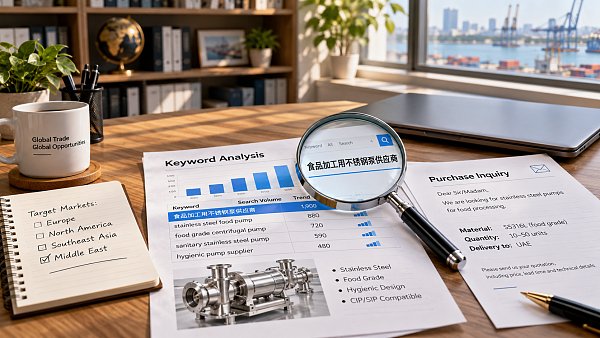
Take an export business that sells industrial water pumps as an example. “water pump” only indicates that the user is interested in water pumps; it does not tell you whether they want to buy equipment, find images, or troubleshoot a household product. “industrial water pump manufacturer” signals an intent to evaluate suppliers, while “stainless steel centrifugal pump for food processing” further specifies the material, product type, and application requirements.
When screening keywords, look for three types of clues: supplier identity, such as manufacturer or supplier; transaction terms, such as bulk orders, customization, lead time, and quotes; and technical or application constraints, such as material, dimensions, operating environment, and industry. When these clues appear together, it is easier to tell whether the searcher is progressing toward a purchase.
However, modifiers should not be treated as conclusive. Someone searching for “price” may only be researching their budget, while someone searching for “supplier” may simply be compiling a directory. Conversely, a question such as “How to choose sealing materials for food-processing pumps” may come from someone conducting a technical assessment before purchasing. For complex equipment, this type of query is worth addressing with product-selection content, followed by an invitation to submit operating parameters.
It is therefore advisable to group keywords by search task: direct supplier-search terms to product or procurement pages, solution-comparison terms to product-selection pages, and troubleshooting terms to technical articles. Do not direct every keyword to the homepage, and do not exclude a term simply because it does not contain the word “buy.”
Clear purchase intent is not enough; the business fit must also be right
The same term can have completely different value for different businesses. A factory that only handles bulk orders may not be suited to pursuing single-item retail demand, and a supplier of standard models may not be able to take on highly customized projects. Add business requirements to your keyword list; otherwise, you may achieve rankings and traffic that the sales team cannot follow up on.
When reviewing keywords, check these four points individually:
- Does the product match? Are the category, specifications, and application the searcher needs within your actual supply range?
- Do the transaction terms match? Is there a realistic opportunity to close a deal given the order quantity, level of customization, budget, and delivery requirements?
- Can you serve the market? Can your business meet the requirements for language, shipping, after-sales service, and relevant market access in the target region?
- Can the demand be addressed? Is there a page that explains the selection criteria and provides a way to request a quote, upload drawings, or submit specifications?
Lower the priority of terms that clearly do not fit your business. If you are already running search ads, you can also use actual search terms to set negative keywords. For terms that appear relevant but lack sufficient information, keep monitoring them. For example, “custom pump” signals customization intent, but the specific application still needs to be identified from search results and subsequent inquiries.
You can ultimately establish a screening process: determine whether the purchase signals are clear, whether your business can meet the demand, and whether the page is suitable for addressing it; then decide whether to prioritize the term, develop content to nurture the demand, or put it on hold. This is easier to implement than assigning every keyword a simple “commercial value score.”
Review search results to confirm which page to use to compete
After the initial screening, review search results in the target country and language environment, and assess them alongside keyword tools. Do not rely solely on a single search in your local browser. Focus on whether the results mainly consist of product pages, supplier directories, online stores, or tutorials, and what questions those pages answer.
If the results are mainly equipment product pages and supplier pages, a page with specifications, application details, and a quote request option is usually more suitable. If the results are mostly tutorials and repair videos, a quote form alone may not meet users’ needs. Search results can help you refine your assessment, but they cannot prove that a term will convert.
In multilingual markets, avoid directly translating Chinese keywords. The same product may be called different things in different markets; some expressions may be more closely associated with retail, while others are more commonly used in industrial procurement. Confirm that the terms are accurate by consulting local search results, expressions used by existing customers, and inquiry content.
Page experience also affects the results of your validation. Tables of specifications that are difficult to read on mobile, inconspicuous quote buttons, or forms that fail to submit can all cause valuable visits to be lost. When using solutions such as Yiyingbao AMP/MIP mobile-friendly intelligent website building to capture mobile search traffic, check the target-language page for complete content, loading performance, and form usability. Website-building technology cannot replace demand matching or guarantee rankings or inquiries.
Review keywords using qualified inquiries, not just form submissions
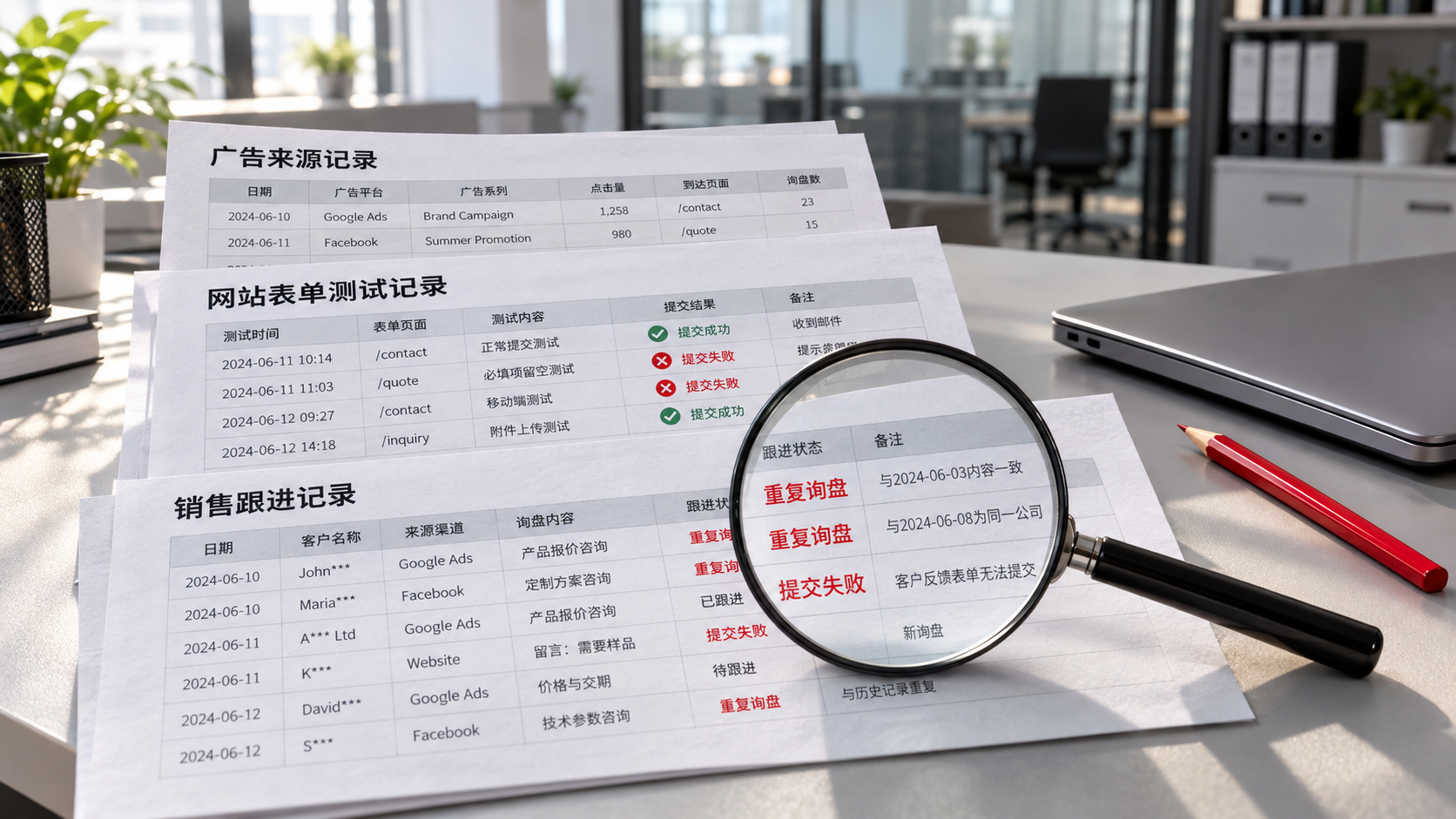
After launching keywords, connect traffic, inquiries, and sales assessments. Start by defining the minimum criteria for a “qualified inquiry”: the demand falls within your supply range, the contact details are usable, and the quantity or application requirements warrant further discussion. Whether a deal is ultimately closed also depends on factors such as pricing and lead time, so not every inquiry that fails to convert should be treated as evidence that a keyword is ineffective.
At a minimum, retain the landing page, available source information, a summary of the requirements, and the reason an inquiry was deemed unqualified. Search terms reports for ads can help identify specific queries. Organic search data often cannot be matched to individual inquiries one by one, so review performance by topic and landing page rather than attributing every inquiry received by a page to a single term.
If a term generates many inquiries but repeatedly attracts requests for single-item purchases, job applications, or repairs, adjust the keyword scope and page wording. If traffic is low but the specifications, quantities, and destinations in the inquiries fit your business, continue improving the relevant product pages and product-selection content. For high-value equipment with a long decision cycle, a small number of visits that generate no inquiries is not enough to rule out the term immediately.
In the next round of keyword research, prioritize adding the requirements that sales teams repeatedly ask about: what material the customer needs, the required production capacity, the operating environment, and the acceptable lead time. These specific questions can help your business identify search terms that more closely reflect the purchasing process and enable your pages to address customers’ concerns before they submit an inquiry.
Related Articles
 How to Choose a Digital Marketing Solution for Expanding Your Brand Overseas
 How Can a Website Analytics Platform Track the Ad Sources of Inquiries?
 How Can Digital Marketing Consulting Use Data Analytics to Identify Ineffective Ad Spend?

Related Products
 Yiyingbao SaaS Intelligent Website Building and Marketing SystemYiyingbao SaaS Intelligent Website Building and Marketing System, AI-powered no-code website building, rapid creation of multilingual B2B international websites in 10 minutes, global server acceleration, AI-powered SEO optimization, helping businesses connect efficiently with global markets. The perfect integration of technology and operation makes building an international trade website remarkably simple
 AI+SEM Intelligent Advertising Marketing SystemAI+SEM drives intelligent ad creation, empowering full-funnel precision advertising marketing. The system automatically generates weekly/monthly reports, AI recommends keywords and target countries, monitors core metrics in real-time with intelligent alerts, and enables one-click high-conversion ad solutions to help quickly acquire customers and improve ROI.
 AI+SEO Dual-Engine System Optimization ServicesYiyingbao’s AI+SEO dual-engine optimization system helps foreign trade enterprises acquire high-quality organic traffic through AI-powered keyword research, content generation, and comprehensive technical optimization, significantly improving search rankings and conversion rates.
 AI+SNS Social Media Marketing SystemYingbao AI+SNS Social Media Marketing System - Precision social capture for the social media era. Supports one-click content synchronization across major platforms like Facebook and LinkedIn. AI intelligently rewrites posts for enhanced relevance. 24/7 AI customer service and user profiling analysis empower businesses to efficiently expand into global markets.
 AI+SEO营销解决方案易营宝AI+SEO营销解决方案,通过AI批量写作、智能生成TDK、精准关键词扩词等功能,全面优化网站SEO效果,提升流量与转化率。助力企业构建高效智能网站新生态。
 AI+SEM Advertising Marketing SolutionsAI+SEM Advertising Marketing Solution leverages AI technology to deeply empower SEM ad campaigns. It automatically generates weekly/monthly reports using AI, presenting account data across multiple dimensions for comprehensive insights into campaign performance and trends. The system precisely recommends keywords and target countries, intelligently generates high-conversion ad copy, and enables one-click activation of efficient campaign plans to help businesses rapidly acquire customers. Simultaneously, it monitors core metrics in real time, intelligently identifies abnormal fluctuations, and issues timely alerts to ensure stable, high-return advertising results.
 Domain Name ServicesEasyWin provides professional domain name services, including intelligent queries, one-stop registration, brand protection, and full lifecycle management, helping businesses build a digital brand image.
 EasyOperate B2C Cross-Border E-Commerce Platform & Independent WebsiteEasyStore B2C Cross-border E-commerce Independent Store is an intelligent website building and cross-border e-commerce integrated solution independently developed by EasyStore Information Technology (Beijing) Co., Ltd. The system is specially designed for small and medium-sized as well as large export enterprises, integrating 'website building, operation, marketing, advertising, and conversion' into one, helping enterprises quickly establish cross-border e-commerce independent stores to achieve brand globalization and global sales growth.
The platform supports multiple languages, multiple currencies, and multi-channel marketing, with built-in AI intelligent translation and SEO optimization systems, suitable for mainstream markets such as Southeast Asia, Europe and America, Latin America, and the Middle East, assisting Chinese manufacturing enterprises in efficiently deploying international e-commerce strategies. SSL证书易营宝提供专业SSL安全证书服务,包括单域名和泛域名证书,确保网站数据传输加密、身份验证和完整性保护,助力企业建立安全可信的在线业务环境。









