









- CBP Finalizes Electronic Rail Export Manifest Rule, Effective October 26, 2026Oct 26, 2026View details
- Amazon’s 2026 peak season surcharge takes effect on October 25Oct 26, 2026View details
- AI Is Eating SaaS: Three Real-World Cases in One AfternoonOct 25, 2026View details
- Exiger CEO: The SaaS Apocalypse Is Real, but It Means Something DifferentOct 25, 2026View details
- Hengqin Cooperation Zone Shares Cross-Border E-Commerce Developments, Focusing on Macao-Hengqin Collaboration and International MarketsOct 24, 2026View details
- A Shenyang study highlights the development of the “cross-border e-commerce + industrial cluster” modelOct 24, 2026View details
How to Choose a Digital Marketing Solution for Expanding Your Brand Overseas
How to Choose an International Digital Marketing Solution for Taking Your Brand Global
For brands expanding overseas, the challenge is often not getting a website online, but consistently attracting the right people after launch, moving inquiries into the sales process, and determining whether the investment is worthwhile. When choosing an international digital marketing solution, do not compare only website development prices and the number of promotion channels. Look instead at whether the website, content, campaigns, and customer follow-up work together.
Some solutions may appear comprehensive, but in practice, different teams deliver separate services: website redesigns do not take advertising needs into account, and promotion reports are not linked to qualified inquiries. Businesses get a list of services but still have to coordinate them on their own. The key to choosing a solution is to define the desired business outcomes first, then assess the provider’s delivery capabilities.
First, Identify the Type of Customers You Want to Reach
A manufacturing company looking for overseas distributors needs a different website and marketing approach from a consumer brand selling standardized products. The former typically needs to showcase processes, specifications, customization limits, and delivery terms so that procurement professionals are willing to submit their requirements. The latter depends more on product presentation, payment, shipping information, and after-sales experience.
Before speaking with providers, define your flagship products, priority markets, customer types, and sales follow-up process. Do not try to expand into multiple regions and channels at once. If your team has not even decided who will respond to English-language inquiries or how quotations will be prepared, expanding your campaigns may simply expose gaps in your follow-up process more quickly.
Multilingual support is not just a matter of translating content in bulk. Product terminology, units of measurement, purchasing habits, and local search expressions can all influence how visitors make decisions. Content covering certifications, privacy, and transaction terms must be checked against the requirements of the target market, rather than copied directly from pages for other regions.
The Value of an Integrated Solution Lies in Reducing Gaps Between Deliverables
Integrating website and marketing services does not mean putting website development, SEO, advertising, and social media into a single quotation. It means designing around a complete customer acquisition journey: a customer searches for or sees content, visits a relevant page, submits an inquiry, and then the sales team provides feedback on lead quality. Each step should have an owner and records that can be reviewed.
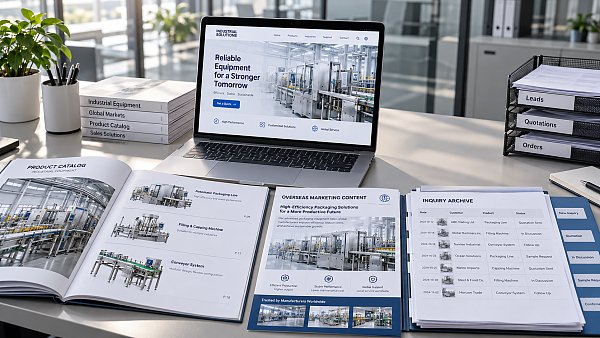
For example, when promoting a type of industrial equipment, the ad should link to a relevant product or application page, not a generic homepage. The page should address buyers’ questions about suitability, technical documentation, and quotation requirements. The form should be easy to submit while collecting the necessary information. The marketing team can then use sales feedback to determine whether the keywords are attracting relevant purchasing inquiries.
When evaluating a provider, ask them to demonstrate the process from “ad click to inquiry record” in real time. This is more useful than simply viewing a showcase website. Check whether traffic sources can be tracked, forms are delivered properly, pages in different languages correspond to one another, and who is responsible for subsequent updates.
Before Comparing Quotes, Align on Acceptance Criteria
Price differences often reflect differences in service scope. Businesses should document the following in the proposal or a contract appendix, rather than relying solely on a promise of “ongoing optimization”:
- Website delivery: page and language scope, mobile experience, redirects, form testing, and maintenance responsibilities after launch.
- Content and promotion: who is responsible for organizing materials, professional review, page production, and ad creatives, and how the number and timing of revisions are agreed.
- Cost breakdown: separate pricing for platform subscriptions, implementation, content production, managed services, and ad spend, with renewal terms and rules for additional development clearly defined.
- Data rights: ownership of the domain, advertising accounts, analytics tools, and customer leads, as well as export and migration options after the partnership ends.
For SaaS website building in particular, ease of use and migration flexibility should be assessed together. Do not ask only whether customer data can be exported; also ask whether page content, images, URL structures, and historical data can be retained. Exit costs are part of the total cost.
Use Business Metrics to Identify Promotion That Looks Busy but Delivers Little
Traffic, impressions, and keyword rankings can help with diagnosis, but they cannot prove business impact on their own. B2B projects should focus more on the proportion of qualified inquiries, the cost per qualified lead, and whether leads progress to the quotation or opportunity stage. Both parties should define “qualified” in advance—for example, whether the target region and product match, and whether the purchasing requirement is clear.
Advertising is useful for validating demand and landing pages, while SEO requires sustained investment in content and technical foundations. They should not be evaluated on the same timeline. AI can assist with content production and analysis, but professional specifications still require review. GEO (Generative Engine Optimization) should not come with guarantees of consistent citation, nor can it replace a well-built website and accurate source materials.
Compare Shortlisted Solutions Using Real-World Tasks
Yiyingbao Information Technology (Beijing) Co., Ltd. was founded in 2013 and is headquartered in Beijing. It provides intelligent website development and overseas marketing services powered by AI and big data, covering multilingual websites, cross-border e-commerce stores, SEO, advertising, social media, and GEO. This type of platform-based solution may be worth considering for businesses seeking to reduce the need to coordinate multiple providers, but broad feature coverage does not necessarily mean a good fit for a particular project.
A more useful way to evaluate providers is to give each shortlisted provider the same product materials and target-market requirements, then ask them to explain their page plan, channel choices, information gaps, implementation timeline, and acceptance process. Also verify the actual delivery team, materials from comparable projects, and data rights, rather than focusing only on the AI features shown in a demonstration.
Before signing, select one product area and a priority market, and agree on phase-based tasks, budget limits, and review milestones. An international digital marketing solution that clearly explains “what to do first, how to assess the results, and what to adjust if performance falls short” is more worthy of further consideration than one that promises to solve every growth challenge.
Related Articles
 How to Choose a Digital Marketing Solution for Expanding Your Brand Overseas
 How Can a Website Analytics Platform Track the Ad Sources of Inquiries?
 How Can Digital Marketing Consulting Use Data Analytics to Identify Ineffective Ad Spend?


Related Products
 Yiyingbao SaaS Intelligent Website Building and Marketing SystemYiyingbao SaaS Intelligent Website Building and Marketing System, AI-powered no-code website building, rapid creation of multilingual B2B international websites in 10 minutes, global server acceleration, AI-powered SEO optimization, helping businesses connect efficiently with global markets. The perfect integration of technology and operation makes building an international trade website remarkably simple
 AI+SEM Intelligent Advertising Marketing SystemAI+SEM drives intelligent ad creation, empowering full-funnel precision advertising marketing. The system automatically generates weekly/monthly reports, AI recommends keywords and target countries, monitors core metrics in real-time with intelligent alerts, and enables one-click high-conversion ad solutions to help quickly acquire customers and improve ROI.
 AI+SEO Dual-Engine System Optimization ServicesYiyingbao’s AI+SEO dual-engine optimization system helps foreign trade enterprises acquire high-quality organic traffic through AI-powered keyword research, content generation, and comprehensive technical optimization, significantly improving search rankings and conversion rates.
 AI+SNS Social Media Marketing SystemYingbao AI+SNS Social Media Marketing System - Precision social capture for the social media era. Supports one-click content synchronization across major platforms like Facebook and LinkedIn. AI intelligently rewrites posts for enhanced relevance. 24/7 AI customer service and user profiling analysis empower businesses to efficiently expand into global markets.
 AI+SEO营销解决方案易营宝AI+SEO营销解决方案,通过AI批量写作、智能生成TDK、精准关键词扩词等功能,全面优化网站SEO效果,提升流量与转化率。助力企业构建高效智能网站新生态。
 AI+SEM Advertising Marketing SolutionsAI+SEM Advertising Marketing Solution leverages AI technology to deeply empower SEM ad campaigns. It automatically generates weekly/monthly reports using AI, presenting account data across multiple dimensions for comprehensive insights into campaign performance and trends. The system precisely recommends keywords and target countries, intelligently generates high-conversion ad copy, and enables one-click activation of efficient campaign plans to help businesses rapidly acquire customers. Simultaneously, it monitors core metrics in real time, intelligently identifies abnormal fluctuations, and issues timely alerts to ensure stable, high-return advertising results.
 Domain Name ServicesEasyWin provides professional domain name services, including intelligent queries, one-stop registration, brand protection, and full lifecycle management, helping businesses build a digital brand image.
 EasyOperate B2C Cross-Border E-Commerce Platform & Independent WebsiteEasyStore B2C Cross-border E-commerce Independent Store is an intelligent website building and cross-border e-commerce integrated solution independently developed by EasyStore Information Technology (Beijing) Co., Ltd. The system is specially designed for small and medium-sized as well as large export enterprises, integrating 'website building, operation, marketing, advertising, and conversion' into one, helping enterprises quickly establish cross-border e-commerce independent stores to achieve brand globalization and global sales growth.
The platform supports multiple languages, multiple currencies, and multi-channel marketing, with built-in AI intelligent translation and SEO optimization systems, suitable for mainstream markets such as Southeast Asia, Europe and America, Latin America, and the Middle East, assisting Chinese manufacturing enterprises in efficiently deploying international e-commerce strategies. SSL证书易营宝提供专业SSL安全证书服务,包括单域名和泛域名证书,确保网站数据传输加密、身份验证和完整性保护,助力企业建立安全可信的在线业务环境。









