









- Can the average annual growth rate reflect real opportunities in overseas markets?Oct 07, 2026View details
- Which customer acquisition channels will be affected by cross-border marketing trends in 2026?Sep 06, 2026View details
- Which homogenization risks should be considered in an analysis of the AI-powered website building industry?Aug 30, 2026View details
- How Will AI Marketing Trends 2026 Change Advertising Budget AllocationAug 28, 2026View details
- Is the EV SSL certificate market shrinking or upgrading? How should companies assess certificate procurement?Aug 11, 2026View details
- Why the old AMP SEO 2020 practices no longer work and what has changed in current optimization prioritiesAug 02, 2026View details
How to Write an Inquiry Reply Email Template to Prevent Losing Contact with Customers
First, make sure the customer knows: this email is responding to their actual needs
After a customer sends an inquiry, the reason they are most likely to lose contact is not always an unsuitable price, but an overly generic reply: only an attached quotation, no response to their specific questions, and no next step. An effective inquiry reply email template should enable them to see three things within seconds of opening it: that you understand what they intend to purchase, what specific information you can currently provide, and what you still need them to confirm.
The response time should be as close as possible to when the inquiry is received, but “fast” does not mean immediately sending an unverified quotation. For inquiries with incomplete model, dimensions, material grade, surface treatment, quantity, or trade terms, you can first send a confirmation email stating that verification has begun, while asking a limited number of key questions that will affect pricing and lead time. This avoids leaving the customer without a response for too long and prevents subsequent disputes caused by incorrect commitments.
The basic structure of an inquiry reply email template
Do not use only “Re: Inquiry” or “Quotation” as the email subject. Include the product name, model, or inquiry reference number in the subject line so the customer can identify it among emails from multiple suppliers. For example: Quotation for Stainless Steel Valve DN50 - Ref. RFQ-042. If the customer is asking about a customized part, you can include the drawing number or main specifications in the subject line, but do not overload it with too many parameters.
After the salutation, use one or two sentences to restate the requirement. Restating does not mean copying the original inquiry; it means extracting the information that determines the purchasing decision, for example: “We understand that you are looking for 500 units of aluminum housings, based on drawing A-102, with anodized finish.” If the drawing revision, material condition, or tolerances are unclear, you can indicate the items requiring confirmation here. This allows the customer to quickly correct any misunderstanding without having to search through a long email for the issue.
Dear [Name],
Thank you for your inquiry regarding [product/model]. We understand that you need [quantity] for [application or specification]. Based on the information provided, we have prepared the preliminary details below.
[Core quotation or proposal information]
To confirm the final offer, could you please advise [1-3 required confirmation items]? Once confirmed, we will update the quotation accordingly.
Best regards,
[Name]
The square brackets in the template must not be left unchanged when sending the email. Many customers lose contact not because they lack interest, but because obvious signs of a mass email make them believe that subsequent communication will also lack relevance. Before sending, at a minimum replace the contact name, product name, quantity, inquiry source, and specific questions.
Quotation content should enable the customer to continue their internal evaluation
A quotation should not provide only a unit price. For standard products, the email body or attachment should at least include the model, unit, price corresponding to the quantity, currency, Incoterms, quotation validity period, production lead time, and payment terms. Where transportation is involved, clearly state whether the quotation is ex-works, port delivery, or freight-included; if freight may vary with destination, volumetric weight, or booking time, directly indicate that it is estimated or subject to confirmation.
For customized products, “manufactured according to drawings” needs to be broken down further. Material grade, wall thickness, color standard, processing method, critical tolerances, sampling requirements, and packaging method can all change costs and delivery arrangements. There is no need to elaborate on every process detail in the email, but it should state which drawing revision or set of parameters the current quotation is based on. If the customer has uploaded images rather than formal drawings, you may reply, “The quotation is based on a preliminary evaluation of the current images; confirmed drawings will be required before mass production,” to prevent the customer from interpreting preliminary information as a final technical commitment.
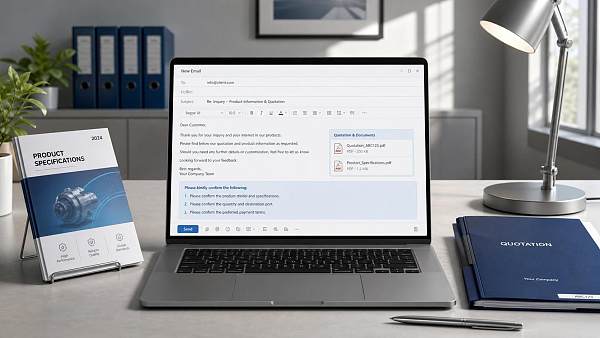
Attachment names also affect communication efficiency. Using “Quotation_Product_Model_Date.pdf” is easier to archive than “Final Quotation.pdf.” If the attachment includes multiple models, indicate in the email body the page number or table row containing the item the customer primarily inquired about, reducing the chance that they still cannot find the key information after opening the file.
Keep questions within a scope that encourages a reply
When inquiry information is incomplete, listing more than ten questions at once will usually slow down communication. Prioritize questions that directly affect pricing, compliance, or lead time. For example, whether the purchase quantity is a trial order or annual demand determines whether tiered pricing is needed; the destination country and delivery postal code affect the shipping solution; and material and testing requirements may differ if the product is used for food contact, outdoor installation, or high-temperature environments.
- For inquiries with a clearly specified model, you can ask about the expected purchase quantity, delivery location, and desired delivery date.
- For custom parts made from drawings, first confirm the drawing revision, material, surface treatment, and critical dimensional tolerances.
- When the customer only writes “Please quote,” do not guess all configurations. You can first provide a quotable basic configuration and explain the differences caused by optional items.
- If samples are required, the email should specify the sample specifications, sample lead time, shipping arrangements, and mass-production confirmation point, avoiding a disconnect between the sample and subsequent order standards.
Questions should ideally allow the customer to copy and reply directly. For example: “Please confirm: 1) quantity: 500 or 1,000 pcs; 2) destination: Hamburg or another port; 3) logo required: yes/no.” This format makes it easier to obtain valid information than open-ended questions. However, do not ask again for information that can already be determined from the inquiry, as this may appear inattentive.
Keep the tone clear and avoid vague commitments
Politeness in international trade emails does not mean using a large number of pleasantries. Customers care more about which information has been confirmed and which items are still being verified. For inventory, lead time, certifications, shipping transit time, and similar matters, distinguish between what can be confirmed immediately and what requires further confirmation. For example, when warehouse stock has not been confirmed, do not write “available now”; you can write “stock availability is being checked and will be confirmed before order placement.”
Likewise, avoid unsupported expressions such as “best quality,” “lowest price,” and “fast delivery.” If the product has technical limitations, state the conditions in advance. For example, a certain coating may be suitable for dry indoor environments, while outdoor installation requires a different corrosion protection grade; a quotation may apply to standard packaging, while pallets, wooden crates, or reinforced packaging require separate calculation. Including limitations in the first email usually makes it easier to maintain communication than adding them later at the order stage.
When there is no reply, follow-up emails should provide new information
If there is no response after the first email, it is not recommended to simply repeat “Any update?” The customer may be comparing specifications, waiting for internal approval, or may have overlooked the attachment. A follow-up email can focus on one specific matter: confirming whether the quotation was received, supplementing an alternative material solution, explaining a lead-time change for a certain specification, or asking again about a key parameter that remains unconfirmed.
Keep the original email thread when following up so the customer can view the context. If the initial quotation attachment was large, you can also briefly list the core price terms in the follow-up and reattach the file. Each follow-up should provide a clear but low-pressure way to respond, for example: “Please let us know whether the quoted specification matches your requirement, or share any revision needed.”
The value of an inquiry reply email template lies not in fixed wording, but in placing information verification, the basis for quotation, risk boundaries, and next steps into one clear chain. The customer does not need to guess whether you understand the requirement, nor search through emails to determine who should continue handling the reply, making communication naturally less likely to be interrupted.
Related Articles
Related Products
 Yiyingbao SaaS Intelligent Website Building and Marketing SystemYiyingbao SaaS Intelligent Website Building and Marketing System, AI-powered no-code website building, rapid creation of multilingual B2B international websites in 10 minutes, global server acceleration, AI-powered SEO optimization, helping businesses connect efficiently with global markets. The perfect integration of technology and operation makes building an international trade website remarkably simple
 AI+SEM Intelligent Advertising Marketing SystemAI+SEM drives intelligent ad creation, empowering full-funnel precision advertising marketing. The system automatically generates weekly/monthly reports, AI recommends keywords and target countries, monitors core metrics in real-time with intelligent alerts, and enables one-click high-conversion ad solutions to help quickly acquire customers and improve ROI.
 AI+SEO Dual-Engine System Optimization ServicesYiyingbao’s AI+SEO dual-engine optimization system helps foreign trade enterprises acquire high-quality organic traffic through AI-powered keyword research, content generation, and comprehensive technical optimization, significantly improving search rankings and conversion rates.
 AI+SNS Social Media Marketing SystemYingbao AI+SNS Social Media Marketing System - Precision social capture for the social media era. Supports one-click content synchronization across major platforms like Facebook and LinkedIn. AI intelligently rewrites posts for enhanced relevance. 24/7 AI customer service and user profiling analysis empower businesses to efficiently expand into global markets.
 AI+SEO营销解决方案易营宝AI+SEO营销解决方案,通过AI批量写作、智能生成TDK、精准关键词扩词等功能,全面优化网站SEO效果,提升流量与转化率。助力企业构建高效智能网站新生态。
 AI+SEM Advertising Marketing SolutionsAI+SEM Advertising Marketing Solution leverages AI technology to deeply empower SEM ad campaigns. It automatically generates weekly/monthly reports using AI, presenting account data across multiple dimensions for comprehensive insights into campaign performance and trends. The system precisely recommends keywords and target countries, intelligently generates high-conversion ad copy, and enables one-click activation of efficient campaign plans to help businesses rapidly acquire customers. Simultaneously, it monitors core metrics in real time, intelligently identifies abnormal fluctuations, and issues timely alerts to ensure stable, high-return advertising results.
 Domain Name ServicesEasyWin provides professional domain name services, including intelligent queries, one-stop registration, brand protection, and full lifecycle management, helping businesses build a digital brand image.
 EasyOperate B2C Cross-Border E-Commerce Platform & Independent WebsiteEasyStore B2C Cross-border E-commerce Independent Store is an intelligent website building and cross-border e-commerce integrated solution independently developed by EasyStore Information Technology (Beijing) Co., Ltd. The system is specially designed for small and medium-sized as well as large export enterprises, integrating 'website building, operation, marketing, advertising, and conversion' into one, helping enterprises quickly establish cross-border e-commerce independent stores to achieve brand globalization and global sales growth.
The platform supports multiple languages, multiple currencies, and multi-channel marketing, with built-in AI intelligent translation and SEO optimization systems, suitable for mainstream markets such as Southeast Asia, Europe and America, Latin America, and the Middle East, assisting Chinese manufacturing enterprises in efficiently deploying international e-commerce strategies. SSL证书易营宝提供专业SSL安全证书服务,包括单域名和泛域名证书,确保网站数据传输加密、身份验证和完整性保护,助力企业建立安全可信的在线业务环境。









