









- China’s Ministry of Commerce Responds to Additional Charges on Low-Value Imports Imposed by the EUNov 06, 2026View details
- Two Internet Development Reports Released at the 2026 World Internet ConferenceNov 05, 2026View details
- Internet Business Revenue of Enterprises Above the Designated Size Reached RMB 1.716 Trillion in the First Three Quarters, with Profits Up 17.6%Nov 05, 2026View details
- Shopify's Third-Quarter Revenue and GMV Fall Short of Expectations, Sending Shares Tumbling Before the Market OpensNov 04, 2026View details
- Temu Sellers See a Decline in Traffic as the Platform’s Traffic Allocation ShiftsNov 04, 2026View details
- UK Regulator Requires E-Commerce Businesses to Clearly Display Total Prices Including Mandatory Delivery ChargesNov 04, 2026View details
How can you verify data ownership before choosing a cross-border e-commerce independent website service provider?
When choosing a service provider to build a cross-border e-commerce website, procurement teams often compare website development costs, delivery timelines, and marketing capabilities. But one important question is easy to overlook: after the website has been operating for some time, who controls the customer data, product content, and domain name? Clarifying ownership, usage rights, and exit procedures before signing can help prevent the business from becoming dependent on the platform when renewing a contract or changing providers.
Data ownership is more than a line in the contract
After a company hires a service provider to build its website, its day-to-day operations will generate product information, customer registration details, order records, inquiries, advertising data, and website traffic data. Procurement teams need to confirm more than just “who owns the data.” They should also clarify who can view it, who can export it, whether exports are complete, and how the data will be handled when the service ends.
For example, a contract may state that customer data belongs to the company, but that does not necessarily mean the company can export it in bulk on its own. If exporting requires submitting a support ticket, paying an additional fee, or accepting files with only some fields, the company’s practical control may still be limited. Therefore, when comparing cross-border e-commerce website development providers, review data access rights alongside website development quotes.
Before signing, check these assets one by one
Customer, order, and inquiry data. Confirm whether the company can view and export customer information, order details, inquiry records, and relevant associated fields, such as product, date, and transaction status. Ask the provider for a sample export file and confirm that its format will be usable later. For payment information, follow the payment provider’s security rules and avoid requesting complete sensitive information such as full card details.
Website content and design assets. Product images, copy, translations, page designs, and videos may be provided by the company, the service provider, or third parties. During procurement, distinguish ownership of the assets from the rights to use them, and confirm the scope and term of those rights, as well as whether they can still be used after switching platforms. For paid fonts, stock images, and plugins in particular, verify whether the license can be transferred.
Domain, email, and server accounts. The company should retain control of the domain registrant information, registrar account, and renewals wherever possible. If the service provider purchases and manages the domain on the company’s behalf, specify the transfer conditions and the provider’s obligations to assist. Administrator responsibilities, handover procedures, and renewal obligations should also be clarified for company email, cloud services, and related management accounts to avoid losing access after a contact leaves or the relationship ends.
Marketing and analytics assets. Google Analytics, Google Search Console, advertising platforms, and social media accounts hold traffic, campaign, and operational records. It is advisable for the company to create or own accounts with full administrative privileges, then grant the service provider access as needed. Distinguish account administration rights from the ability to export data: whether some historical records can be migrated also depends on the rules of the relevant platform.
Website systems and source code. SaaS website-building platforms are generally maintained by the service provider. A company’s ownership of its content and business data does not mean it owns the platform’s source code. Procurement teams should confirm which content—such as pages, products, and customers—can be exported, and which functions would need to be redeveloped after changing systems. This avoids mistaking “data can be exported” for “the entire website can be moved exactly as it is.”
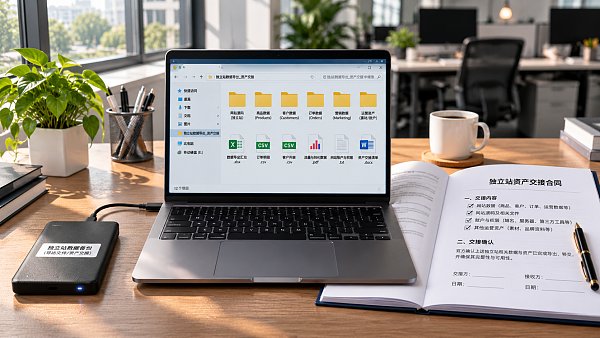
Look beyond the quote and calculate the cost of exiting
Some website projects have low initial development costs, but data exports, domain transfers, technical support, or packaging historical files may incur additional charges. For procurement evaluation, ask the provider to list fees and responsibilities separately for “normal operations” and “termination of the relationship,” then compare them across providers.
- Are exports included in the service fee? Are there limits on frequency, data volume, or the period during which they can be used?
- How long will the backend remain accessible after the contract expires? Can data still be downloaded during that period?
- How are migration support services charged, and which tasks are the responsibility of the company or the new provider?
- How soon after termination will data be deleted or returned? How will backups be handled, and can the provider confirm that this has been done?
Migration costs go beyond service fees. Reimporting products, rebuilding pages, adjusting ad tracking codes, and training staff on a new backend can all take time. For SEO, also check whether URL structures, page titles, descriptions, and redirect rules can be obtained. Even with a proper handover, search performance may fluctuate after changing platforms.
How can contracts prevent confusion during handover?
Procurement, business, technical, and legal teams should jointly confirm the data inventory, then include key details in the contract or an appendix. Rather than accepting the vague statement “the data belongs to the customer,” specify requirements around the following questions:
- Scope: List categories such as customer, order, product, inquiry, website content, and marketing-related materials, distinguishing company-provided content from third-party licensed assets.
- Permissions: Define the company’s administrator and day-to-day access rights, as well as the scope of access granted to the provider for maintenance.
- Exports: Specify exportable fields, file formats, request procedures, delivery times, and fees. Note in advance any exceptions for content restricted by platform rules.
- Confidentiality and security: Define the provider’s permitted purposes for using the data, access controls, subcontracting arrangements, incident notification requirements, and each party’s responsibilities.
- Termination and handover: Specify domain transfers, account permission handovers, data retention or deletion timelines, and the assistance each party must provide.
When handling personal information about overseas customers, also review the applicable privacy and cross-border data rules in the target markets, including data storage locations, processing roles, third-party tools, and any required authorization arrangements. The company’s legal team or a qualified professional should assess its specific compliance obligations in light of its business. A provider’s statement that it “supports overseas operations” should not be taken as confirmation that all requirements are met.
Verify the provider’s answers with a demonstration
Before signing, ask shortlisted providers to perform a small-scale task in a demo environment: export products and test orders from the backend and show the fields and file formats, then review the permission settings for domain, advertising, and website analytics accounts. The demonstration need not involve real customer information, but it can help procurement teams identify differences between written commitments and actual procedures.
Companies purchasing website development, SEO, and advertising services together should also confirm the scope of deliverables. YiYingBao provides intelligent website-building and overseas marketing services. When evaluating this type of integrated solution, ask the provider to specify who owns each account, how data can be exported, and how handover will work when the contract expires, in addition to reviewing the website development and promotion services. Specific permissions and fees are subject to the services agreed by both parties and the contract.
The goal of procurement is not to assume that the company will change providers, but to ensure that it has clear asset boundaries throughout the partnership. Data arrangements that are written into the contract, verifiable in the backend, and actionable at termination are usually more valuable than the simple statement “the data belongs to the customer.”
Related Articles
 How Does an AI Website Translation SaaS Platform Calculate Translation Costs?
 Can an advertising landing page builder track form conversions?
 How Does a Cross-Border Brand Website System Differ from a Standard Website for Foreign Trade? From Brand Management to Scalability



Related Products
 Yiyingbao SaaS Intelligent Website Building and Marketing SystemYiyingbao SaaS Intelligent Website Building and Marketing System, AI-powered no-code website building, rapid creation of multilingual B2B international websites in 10 minutes, global server acceleration, AI-powered SEO optimization, helping businesses connect efficiently with global markets. The perfect integration of technology and operation makes building an international trade website remarkably simple
 AI+SEM Intelligent Advertising Marketing SystemAI+SEM drives intelligent ad creation, empowering full-funnel precision advertising marketing. The system automatically generates weekly/monthly reports, AI recommends keywords and target countries, monitors core metrics in real-time with intelligent alerts, and enables one-click high-conversion ad solutions to help quickly acquire customers and improve ROI.
 AI+SEO Dual-Engine System Optimization ServicesYiyingbao’s AI+SEO dual-engine optimization system helps foreign trade enterprises acquire high-quality organic traffic through AI-powered keyword research, content generation, and comprehensive technical optimization, significantly improving search rankings and conversion rates.
 AI+SNS Social Media Marketing SystemYingbao AI+SNS Social Media Marketing System - Precision social capture for the social media era. Supports one-click content synchronization across major platforms like Facebook and LinkedIn. AI intelligently rewrites posts for enhanced relevance. 24/7 AI customer service and user profiling analysis empower businesses to efficiently expand into global markets.
 AI+SEO营销解决方案易营宝AI+SEO营销解决方案,通过AI批量写作、智能生成TDK、精准关键词扩词等功能,全面优化网站SEO效果,提升流量与转化率。助力企业构建高效智能网站新生态。
 AI+SEM Advertising Marketing SolutionsAI+SEM Advertising Marketing Solution leverages AI technology to deeply empower SEM ad campaigns. It automatically generates weekly/monthly reports using AI, presenting account data across multiple dimensions for comprehensive insights into campaign performance and trends. The system precisely recommends keywords and target countries, intelligently generates high-conversion ad copy, and enables one-click activation of efficient campaign plans to help businesses rapidly acquire customers. Simultaneously, it monitors core metrics in real time, intelligently identifies abnormal fluctuations, and issues timely alerts to ensure stable, high-return advertising results.
 Domain Name ServicesEasyWin provides professional domain name services, including intelligent queries, one-stop registration, brand protection, and full lifecycle management, helping businesses build a digital brand image.
 EasyOperate B2C Cross-Border E-Commerce Platform & Independent WebsiteEasyStore B2C Cross-border E-commerce Independent Store is an intelligent website building and cross-border e-commerce integrated solution independently developed by EasyStore Information Technology (Beijing) Co., Ltd. The system is specially designed for small and medium-sized as well as large export enterprises, integrating 'website building, operation, marketing, advertising, and conversion' into one, helping enterprises quickly establish cross-border e-commerce independent stores to achieve brand globalization and global sales growth.
The platform supports multiple languages, multiple currencies, and multi-channel marketing, with built-in AI intelligent translation and SEO optimization systems, suitable for mainstream markets such as Southeast Asia, Europe and America, Latin America, and the Middle East, assisting Chinese manufacturing enterprises in efficiently deploying international e-commerce strategies. SSL证书易营宝提供专业SSL安全证书服务,包括单域名和泛域名证书,确保网站数据传输加密、身份验证和完整性保护,助力企业建立安全可信的在线业务环境。









