









- Which customer acquisition channels will be affected by cross-border marketing trends in 2026?Sep 06, 2026View details
- Which homogenization risks should be considered in an analysis of the AI-powered website building industry?Aug 30, 2026View details
- How Will AI Marketing Trends 2026 Change Advertising Budget AllocationAug 28, 2026View details
- Is the EV SSL certificate market shrinking or upgrading? How should companies assess certificate procurement?Aug 11, 2026View details
- Why the old AMP SEO 2020 practices no longer work and what has changed in current optimization prioritiesAug 02, 2026View details
- How to Choose Topics for an Industry News Section to Attract More Organic Search TrafficJul 29, 2026View details
How to Assess the Cross-Time-Zone Collaboration Capabilities of an International Website Development Company
Meta Title: How to Assess the Cross-Time-Zone Collaboration Capabilities of an International Website Development Company
When selecting an international website development company, many businesses first look at pricing, case studies, and the technology stack. It is only when the project gets underway that they discover the factor that most affects the outcome is often not whether the company can do the work, but whether it can collaborate effectively across time zones. If this is assessed incorrectly, the common consequences are not simply delays, but repeated requirements, prolonged confirmation chains, and missed launch windows. In the end, the project may appear to be completed, yet the results fail to meet expectations.
To put it more directly, assessing the cross-time-zone collaboration capabilities of an international website development company is not about whether it has overseas clients. It is about whether it has four basic capabilities: stable responsiveness, clear handovers, traceable processes, and localized understanding. The first two determine efficiency, while the latter two determine whether risks can be controlled.
Before Looking at “How Many Countries Are Covered,” Check Whether Collaboration Can Be Verified
Many sales representatives are easily persuaded by statements such as “We serve global markets,” “We support multilingual communication,” or “We have international experience.” These statements are not without value, but they are more like marketing language and are insufficient as evaluation criteria.
For an experienced international website development company, cross-time-zone collaboration capabilities can usually be verified. You do not need to focus on how impressively the company describes itself. Instead, look at three things: how the project schedule is broken down, how issues are escalated, and how work is handled outside regular working hours.
Consider a common situation. If the client submits revisions before the end of its working day and the supplier is just beginning its working hours, the process can move smoothly. However, if the two parties have a time difference of approximately 8 to 12 hours and there are no clearly defined on-call windows, handover procedures, or priority rules, a minor issue that could originally have been confirmed the same day may easily take two or three days. In website development, the most troublesome problems are often not major issues, but these constantly accumulating minor bottlenecks.
When Evaluating an International Website Development Company, Ask These 5 Questions First
If you are conducting an initial supplier screening, these five questions can reveal the supplier’s actual capabilities more effectively than asking, “Which industries have you worked with?”
First, do they commit to fixed overlapping communication hours?
Cross-time-zone collaboration does not require the other party to be online 24 hours a day. It does, however, require at least one stable two-way overlapping window. For example, this could include two or three fixed project meetings each week and one to two hours reserved for real-time communication each working day. Without such a window, requirements can generally only be confirmed through messages, and efficiency will decline significantly.
Second, are requirement changes confirmed verbally or recorded in a system?
Reliable teams place requirements, versions, responsible persons, and deadlines in a unified tool rather than scattering them across emails, WeChat groups, instant messaging, and verbal meeting records. In cross-time-zone projects, maintaining records is not merely a management formality; it is the foundation for reducing disputes.
Third, is there a clearly designated handover person rather than simply having “whoever is online” respond?
Many teams respond quickly during the early sales stage, but once execution begins, you may find that development, design, content, SEO, and advertising contacts are all working from different understandings. A truly mature international website development company usually has a project manager or customer success representative responsible for connecting information across different time zones and roles.
Fourth, is the issue classification and escalation mechanism clear?
Minor page-style adjustments, payment failures, server abnormalities, and indexing issues on multilingual pages have completely different priorities. If a supplier cannot clearly explain which issues will receive a response within a few hours and which will be resolved within several working days, it will be difficult for you to control risks later.
Fifth, do they understand the target market rather than merely know how to build pages?
The difficulty of cross-time-zone collaboration lies not only in the time difference, but also in differences in understanding. For different markets such as Europe and the United States, the Middle East, and Southeast Asia, website structure, form preferences, language details, compliance notices, and marketing entry-point design may all vary. A team that only knows how to “build a site according to a design” will find it difficult to genuinely support overseas business.
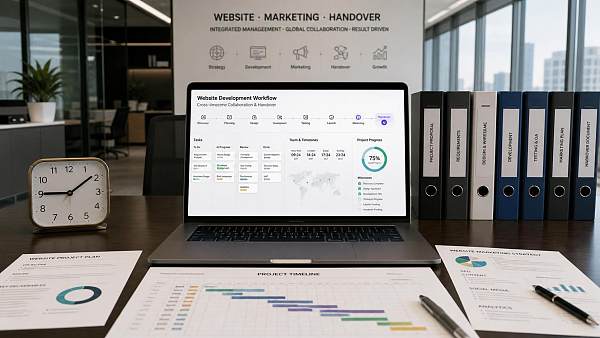
[Image Placeholder 1: Diagram illustrating the cross-time-zone collaboration evaluation of an international website development company, showing response hours, project processes, and handover mechanisms, alt="国际网站开发公司跨时区协作能力评估示意图"]
Many Projects Fail Not Because of the Time Difference, but Because the Process Design Is Too Loose
This is often underestimated.
Some companies believe that cross-time-zone communication is slow because “that is just how things are overseas.” Others attribute the problem to language. In actual projects, however, what usually slows progress is a loose process: no requirement freeze points, no standardized feedback format, no acceptance checklist before a version goes live, and no escalation path for urgent matters.
Therefore, when evaluating an international website development company, you can directly ask it to demonstrate an actual project delivery process, even if the materials have been anonymized. Focus on these details:
- Whether requirement documents include version numbers and update times
- Whether task assignments correspond to specific roles
- Whether there are clearly defined deliverables each week rather than a vague statement such as “ongoing progress”
- Whether acceptance criteria are specific to pages, functions, data tracking, and basic SEO items
- Whether there is an observation period and issue-recovery mechanism after launch
If these materials cannot be provided, even the best case studies should be viewed with caution. Case studies describe the past; processes determine whether your project will proceed smoothly in the future.
A Team That Only Develops but Does Not Understand Marketing Collaboration Usually Makes Cross-Time-Zone Projects More Difficult
There is another practical issue with international website projects: the work does not end when the website is delivered. It often also needs to connect with SEO, advertising, social media lead generation, data analysis, and landing-page testing. In other words, you are not simply selecting a development team, but a partner that can collaborate smoothly with subsequent growth activities.
This is why many businesses now place greater emphasis on the ability to provide “integrated website and marketing services” when evaluating international website development companies. The reason is simple: cross-time-zone work already increases communication costs. If website development, SEO infrastructure, advertising landing-page logic, and conversion-tracking implementation are outsourced separately, interface gaps will continue to appear later.
For example, if hreflang, page speed, form attribution, and localized content structure are not properly handled before a multilingual independent website goes live, fixing them later will require more time and cost. If the development team has a deeper understanding of overseas marketing scenarios at the early stage, many fundamental elements can be planned in advance.
Service providers such as 易营宝, which cover intelligent website building, SEO optimization, advertising, and overseas social media operations, can serve as useful reference examples during evaluation—not because “more services are always better,” but because in cross-time-zone projects, having the upstream and downstream processes handled through the same system generally makes it easier to reduce communication losses. This integrated collaboration is particularly valuable for foreign trade companies, cross-border e-commerce sellers, and brands expanding overseas.
When Evaluating Response Speed, Do Not Focus Only on Whether They “Reply Quickly”
Some teams reply to messages quickly, but the actual problem is not resolved. Other teams may not send many replies on the same day, but each response is complete. The quality of collaboration between the two is very different.
During the business evaluation stage, you can conduct a practical test: deliberately include a somewhat complex question in the discussion, such as “Are the content structures of the English site and the minor-language sites managed separately?”, “Do advertising landing pages share templates with the main site?”, or “How is overseas access speed handled?” Then observe the other party’s response.
What you need to evaluate is not an instant reply, but these three points:
- Whether they first clarify the scope of the issue
- Whether they provide a clearly responsible person and an estimated response time
- Whether they can translate a technical issue into a business judgment
Teams that can do this are generally more reliable in cross-time-zone collaboration. The biggest concern in cross-time-zone work is “read but not progressed,” rather than simply replying slowly.
What Should Be Clearly Specified in the Contract Besides the Delivery Schedule
Once you have entered the quotation-comparison and supplier-selection stage, the contract should preferably include the key requirements for cross-time-zone collaboration. Many companies specify only the delivery period, number of pages, and functional modules. Later, when responses are delayed, no one is available to handle nighttime failures, or temporary changes require repeated explanations, they discover that there is no contractual basis for enforcement.
Practical provisions include agreeing on fixed communication hours, specifying response times, defining the handling mechanism for urgent issues, stipulating the method for requirement confirmation, and identifying milestone acceptance points. For key functions involving servers, payments, forms, and data tracking, the scope of launch support and the boundaries of assistance for abnormalities should also be added. Specific provisions should be verified according to the actual project and legal requirements, with the formal contract prevailing.
This is important because if cross-time-zone collaboration capabilities cannot be implemented through rules, the process will ultimately revert to the old model of relying on individuals to monitor the project.
Which Companies Deserve Closer Examination, and Which Require Caution?
If your project is a standard corporate website with few languages and limited subsequent marketing activity, an international website development company with mature templates and basic project management capabilities will generally be sufficient. There is no need to pursue a large, all-encompassing provider.
However, if you are dealing with a multilingual website, overseas advertising, long-term SEO operations, parallel development across different regional markets, or a website that is responsible for inquiry conversion, you should not look only at the development quotation. You should prioritize service providers that understand website development processes, overseas customer-acquisition logic, and cross-regional collaboration.
Conversely, if a supplier’s primary advantage lies only in visual design, its project management depends on individual experience, and it lacks systematic tools and marketing collaboration capabilities, it may be suitable for a local presentation website. However, greater caution is required when using it for a website project genuinely targeting international markets.
Finally, here is a practical evaluation standard: whether an international website development company is worth working with does not depend on whether it claims to have “international experience,” but on whether it can turn cross-time-zone collaboration into a predictable, traceable, and reviewable daily mechanism. When it can do this, the project is more likely to proceed according to plan, and the operational transition after the website goes live will also be much smoother. This is the key question that should be confirmed once more near the end when screening an international website development company.
FAQ
1. Is it necessary to choose a local overseas team for cross-time-zone collaboration?
Not necessarily. The key is not where the team is located, but whether it has a stable collaboration mechanism, localized understanding, and a clearly defined delivery process.
2. Can a company that only develops websites and does not provide marketing services be selected?
Yes, provided that the scope of your project is clearly defined and subsequent SEO, advertising, social media, and other activities are handled by an internal team or other suppliers.
3. How can you quickly determine whether the other party is “strong in sales but weak in delivery”?
Ask to see its project management methods, actual delivery rhythm, and issue-escalation process. If it presents case studies smoothly but explains its processes vaguely, you should usually pay closer attention.
4. What risk is most easily overlooked in cross-time-zone projects?
It is not language, but the lack of unified records and handover mechanisms, which leads to repeated requirements, unclear responsibilities, and slow issue identification.
Image Placeholder List
Image Placeholder 1: Recommended placement after “When Evaluating an International Website Development Company, Ask These 5 Questions First”; content: a diagram illustrating cross-time-zone collaboration evaluation, including response hours, process milestones, and handover roles; alt="国际网站开发公司跨时区协作能力评估示意图"
Suggested Internal-Link Anchor Text
- Multilingual website development solutions: suggested link to the multilingual website development service page
- SEO optimization for overseas independent websites: suggested link to the Google SEO service page
- B2B foreign trade marketing website: suggested link to the foreign trade website development topic page
- Cross-border e-commerce store system development: suggested link to the cross-border e-commerce independent website solution page
- Overseas advertising landing-page optimization: suggested link to the advertising or conversion optimization page
Suggested Authoritative External Sources
- Official search engine technical documentation, such as materials related to website internationalization, multilingual indexing, and performance optimization
- Official best-practice documentation from mainstream project management tools, to supplement methods for distributed collaboration and task recording
- Reports from industry associations or research institutions on cross-border e-commerce, foreign trade digitalization, and global marketing collaboration
Related Articles



Related Products
 Yiyingbao SaaS Intelligent Website Building and Marketing SystemYiyingbao SaaS Intelligent Website Building and Marketing System, AI-powered no-code website building, rapid creation of multilingual B2B international websites in 10 minutes, global server acceleration, AI-powered SEO optimization, helping businesses connect efficiently with global markets. The perfect integration of technology and operation makes building an international trade website remarkably simple
 AI+SEM Intelligent Advertising Marketing SystemAI+SEM drives intelligent ad creation, empowering full-funnel precision advertising marketing. The system automatically generates weekly/monthly reports, AI recommends keywords and target countries, monitors core metrics in real-time with intelligent alerts, and enables one-click high-conversion ad solutions to help quickly acquire customers and improve ROI.
 AI+SEO Dual-Engine System Optimization ServicesYiyingbao’s AI+SEO dual-engine optimization system helps foreign trade enterprises acquire high-quality organic traffic through AI-powered keyword research, content generation, and comprehensive technical optimization, significantly improving search rankings and conversion rates.
 AI+SNS Social Media Marketing SystemYingbao AI+SNS Social Media Marketing System - Precision social capture for the social media era. Supports one-click content synchronization across major platforms like Facebook and LinkedIn. AI intelligently rewrites posts for enhanced relevance. 24/7 AI customer service and user profiling analysis empower businesses to efficiently expand into global markets.
 AI+SEO营销解决方案易营宝AI+SEO营销解决方案,通过AI批量写作、智能生成TDK、精准关键词扩词等功能,全面优化网站SEO效果,提升流量与转化率。助力企业构建高效智能网站新生态。
 AI+SEM Advertising Marketing SolutionsAI+SEM Advertising Marketing Solution leverages AI technology to deeply empower SEM ad campaigns. It automatically generates weekly/monthly reports using AI, presenting account data across multiple dimensions for comprehensive insights into campaign performance and trends. The system precisely recommends keywords and target countries, intelligently generates high-conversion ad copy, and enables one-click activation of efficient campaign plans to help businesses rapidly acquire customers. Simultaneously, it monitors core metrics in real time, intelligently identifies abnormal fluctuations, and issues timely alerts to ensure stable, high-return advertising results.
 Domain Name ServicesEasyWin provides professional domain name services, including intelligent queries, one-stop registration, brand protection, and full lifecycle management, helping businesses build a digital brand image.
 EasyOperate B2C Cross-Border E-Commerce Platform & Independent WebsiteEasyStore B2C Cross-border E-commerce Independent Store is an intelligent website building and cross-border e-commerce integrated solution independently developed by EasyStore Information Technology (Beijing) Co., Ltd. The system is specially designed for small and medium-sized as well as large export enterprises, integrating 'website building, operation, marketing, advertising, and conversion' into one, helping enterprises quickly establish cross-border e-commerce independent stores to achieve brand globalization and global sales growth.
The platform supports multiple languages, multiple currencies, and multi-channel marketing, with built-in AI intelligent translation and SEO optimization systems, suitable for mainstream markets such as Southeast Asia, Europe and America, Latin America, and the Middle East, assisting Chinese manufacturing enterprises in efficiently deploying international e-commerce strategies. SSL证书易营宝提供专业SSL安全证书服务,包括单域名和泛域名证书,确保网站数据传输加密、身份验证和完整性保护,助力企业建立安全可信的在线业务环境。









