









- Which customer acquisition channels will be affected by cross-border marketing trends in 2026?Sep 06, 2026View details
- Which homogenization risks should be considered in an analysis of the AI-powered website building industry?Aug 30, 2026View details
- How Will AI Marketing Trends 2026 Change Advertising Budget AllocationAug 28, 2026View details
- Is the EV SSL certificate market shrinking or upgrading? How should companies assess certificate procurement?Aug 11, 2026View details
- Why the old AMP SEO 2020 practices no longer work and what has changed in current optimization prioritiesAug 02, 2026View details
- How to Choose Topics for an Industry News Section to Attract More Organic Search TrafficJul 29, 2026View details
How Much Does Consultant Internet Marketing Cost? How to Evaluate Service Scope and Return on Investment
What Should You Look at First When Reviewing a consultant internet marketing Quote for Financial Approval?
Don't rush to compare the total price. For financial approvers, the first thing to look at is what the quote actually includes: strategic recommendations or execution as well; campaign management only or also the website, content, SEO, and lead follow-up process; a monthly consulting fee or additional advertising, website development, creative production, and technical service fees.
Many companies assume that "consulting services" simply means providing a plan. In reality, services described by the same term, consultant internet marketing, can differ greatly in delivery depth. Some focus on diagnosis and training, which suits companies with mature in-house teams; others handle website development, search optimization, advertising, and social media operations together, functioning more like an outsourced growth team. If approval decisions are based only on the monthly fee, these two types of services can easily be compared in the same table, leading to distorted conclusions.
Why Do Some Quotes Differ So Much?
Price differences are usually not about who is more reasonable, but about differences in scope. The key variables affecting costs generally fall into four categories:
- Service scope: The cost structure is completely different between doing Google SEO only and handling website development, advertising, and social media at the same time.
- Market complexity: Serving a single English-speaking market is much less demanding than covering Europe, Japan and South Korea, the Middle East, and multilingual websites.
- Delivery model: Consulting-led projects primarily sell methodologies and execution cadence; outsourced operations projects sell personnel, tools, and ongoing execution.
- Technical foundation: If the service provider has its own website-building system, advertising management system, and SEO/GEO tools, efficiency is usually higher, but the pricing model may not be based solely on person-days.
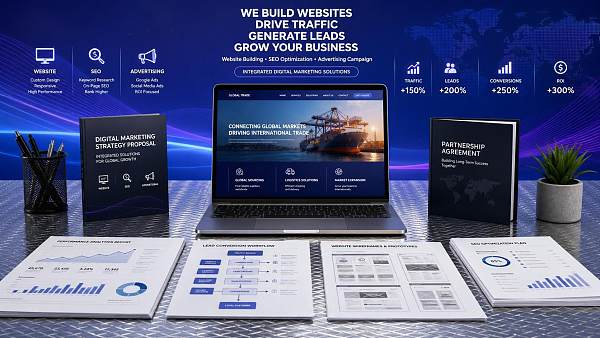
For companies seeking overseas leads, websites and marketing often cannot be viewed separately. Website structure, landing-page speed, lead forms, and search crawlability directly affect advertising costs and organic traffic performance. Therefore, an integrated service provider that offers intelligent website building, SEO, advertising, and social media may appear more expensive without actually being costly. The key is whether it reduces duplicate procurement and multi-party coordination costs.
What Items Should a Qualified Quote Break Down at a Minimum?
If a quote contains only the words "bundled service fee," the approval risk is high. A more reliable approach is to ask the supplier to break the quote down into verifiable items. Common breakdowns include:
Only by separating the costs can you determine which parts are one-time investments and which are ongoing expenses, making subsequent budget reviews easier.
Is It Worth Approving a Consulting-Only Service Without Execution?
It depends on whether the company has people internally who can take over the work. Pure consulting consultant internet marketing services are generally suitable in three situations: the company already has an internal marketing team, it already has a website and advertising account foundation, and management wants to establish a long-term methodology rather than use short-term outsourced operations.
If the company has no English content team, no one experienced in campaign management, and still relies on outsourcing for website iteration, even a complete consulting plan will be difficult to implement effectively. During approval, don't ask only whether the plan is good. Ask instead: Who will execute it? Who will be responsible for the results? If these two questions cannot be answered, purchasing consulting services separately will often result in an attractive but unused document.
How Can You Tell Whether Any Items Are Hidden in the Service Scope?
The most common hidden items are not in the contract title, but in the execution details. For example, "website development" may not specify whether multilingual versions, mobile adaptation, basic SEO configuration, and the form conversion path are included; "advertising management" may not specify who is responsible for creative production, tracking implementation, conversion tracking, and weekly or monthly reports.
The finance department can directly ask the supplier to provide a delivery checklist and require at least the following items to be clarified:
- What are the fixed deliverables each month, such as pages, content, reports, and optimization activities?
- Which items are part of the initial setup, and which are part of ongoing operations?
- What materials, account permissions, and product information must the client provide?
- Which items will be billed separately once they exceed the scope, and how will the unit prices be calculated?
This step is much like standardizing the basis for budget management. If those responsible for approval also pay attention to institutional design, reading content such as Research on Comprehensive Budget Management in Administrative Institutions can make it easier to identify key points such as consistent cost definitions and clear responsibility boundaries. The same principle applies to marketing procurement.
How Should ROI Be Calculated to Avoid Being Misled by Surface-Level Data?
Don't look only at traffic, and don't look only at the number of leads. For financial approvers, ROI should be examined at least on three levels.
The first level is channel efficiency. Focus on cost per click, cost per visit, cost per form submission, and cost per inquiry. This level mainly determines whether the campaigns and pages are performing as expected.
The second level is lead quality. In many projects, each lead appears inexpensive on the surface, but once sales follows up, the region may not match, purchase intent may be weak, or the inquiry content may be vague. The truly meaningful indicators are the percentage of valid inquiries and the percentage that can proceed to the quotation stage.
The third level is business results. For B2B international trade, the payment cycle is long, so the transaction value may not be visible in the short term. At a minimum, however, you should track sample requests, in-depth communications, repeat visits, time spent on key pages, and sales progress. If a supplier only shows you impressions, clicks, and follower growth, it is basically still focused on the earliest stage.
Why Should Website Costs and Marketing Costs Not Be Approved Separately in Isolation for Overseas Markets?
Because many performance issues are actually caused by the website rather than the campaigns. Slow page loading, confusing structure, overly long forms, and poor mobile experiences all directly increase advertising costs and also hinder SEO indexing and organic inquiries.
If a company's goal is to target multiple regions such as North America, Europe, and Southeast Asia, multilingual websites, landing-page adaptation, search visibility, and advertising tracking codes are inherently part of one connected process. Platform-based services such as Yiyingbao, which integrate intelligent website building, SEO, advertising management, and social media operations, are usually not advantageous because they are the cheapest in each individual category, but because they reduce information gaps and shorten the path from website development to lead generation. During approval, this can be understood as the difference between "point procurement" and "system procurement."
Which Contract Terms Are Most Likely to Affect Subsequent Costs?
Four types of terms deserve particular attention.
- Account ownership: Do the advertising accounts, website backend, domain name, and data analytics permissions belong to the company itself?
- Data definitions: Are the definitions of leads, valid inquiries, and conversions clearly stated?
- Renewal rules: Will the contract renew automatically after expiration, and is there a minimum service period?
- Additional charges: Will urgent revisions, extra pages, multilingual expansion, and new creative materials be billed separately?
Account ownership in particular should not be overlooked until you discover at the end of the project that historical data cannot be transferred. For subsequent reviews, changing suppliers, and internal handovers, the value of this provision is greater than negotiating a discount of a few thousand yuan.
Before Approval, What Materials Should Finance Request from the Business Team and the Supplier?
Ask the business department for objectives and the supplier for the implementation path. If either side is missing, it is difficult to approve the budget with confidence.
The business side should at least provide the target markets, main products, types of leads it hopes to acquire, acceptable lead-generation cycle, and the historical website or advertising foundation. The supplier should at least provide the service boundaries, monthly activities, ownership of accounts and data, estimated evaluation criteria, and phased milestones.
If the target markets and main conversion actions have not been clearly defined, comparing which consultant internet marketing provider is cheaper will most likely lead to continuous rework during execution, with costs continuing to accumulate.
When the Budget Is Limited, What Should Be Cut First and What Should Be Preserved?
Broad, scattershot investment can be reduced, but basic infrastructure should not be cut lightly. For most companies expanding overseas, the website foundation, conversion tracking, core landing pages, and basic SEO configuration are prerequisites. Without them, subsequent advertising may simply waste the budget more quickly.
By contrast, spreading across too many channels, opening too many target markets at once, and producing too much content in too many languages are all areas that can be scaled back initially. It is generally more suitable for financial risk control to first make one region, one primary channel, and one clear lead objective work, and then decide whether to increase investment, rather than launching everything at once.
How Can You Make the Final Decision and Avoid Approving the Wrong Proposal?
In practice, follow this sequence: first verify the service boundaries, then verify the execution resources, next review the data definitions, and only then discuss the price. A low quote with unclear boundaries often leads to more additional charges later. A higher quote that connects key activities such as website development, SEO, advertising, social media, and AI search visibility may actually make the return on investment easier to calculate.
If you are a financial approver, the most reliable question is not "Who is cheaper?" but "Which budget can be continuously tracked and reviewed, with clear responsibility when deviations occur?" If a consultant internet marketing service can achieve this, the budget can be approved with confidence.
Related Articles



Related Products
 Yiyingbao SaaS Intelligent Website Building and Marketing SystemYiyingbao SaaS Intelligent Website Building and Marketing System, AI-powered no-code website building, rapid creation of multilingual B2B international websites in 10 minutes, global server acceleration, AI-powered SEO optimization, helping businesses connect efficiently with global markets. The perfect integration of technology and operation makes building an international trade website remarkably simple
 AI+SEM Intelligent Advertising Marketing SystemAI+SEM drives intelligent ad creation, empowering full-funnel precision advertising marketing. The system automatically generates weekly/monthly reports, AI recommends keywords and target countries, monitors core metrics in real-time with intelligent alerts, and enables one-click high-conversion ad solutions to help quickly acquire customers and improve ROI.
 AI+SEO Dual-Engine System Optimization ServicesYiyingbao’s AI+SEO dual-engine optimization system helps foreign trade enterprises acquire high-quality organic traffic through AI-powered keyword research, content generation, and comprehensive technical optimization, significantly improving search rankings and conversion rates.
 AI+SNS Social Media Marketing SystemYingbao AI+SNS Social Media Marketing System - Precision social capture for the social media era. Supports one-click content synchronization across major platforms like Facebook and LinkedIn. AI intelligently rewrites posts for enhanced relevance. 24/7 AI customer service and user profiling analysis empower businesses to efficiently expand into global markets.
 AI+SEO营销解决方案易营宝AI+SEO营销解决方案,通过AI批量写作、智能生成TDK、精准关键词扩词等功能,全面优化网站SEO效果,提升流量与转化率。助力企业构建高效智能网站新生态。
 AI+SEM Advertising Marketing SolutionsAI+SEM Advertising Marketing Solution leverages AI technology to deeply empower SEM ad campaigns. It automatically generates weekly/monthly reports using AI, presenting account data across multiple dimensions for comprehensive insights into campaign performance and trends. The system precisely recommends keywords and target countries, intelligently generates high-conversion ad copy, and enables one-click activation of efficient campaign plans to help businesses rapidly acquire customers. Simultaneously, it monitors core metrics in real time, intelligently identifies abnormal fluctuations, and issues timely alerts to ensure stable, high-return advertising results.
 Domain Name ServicesEasyWin provides professional domain name services, including intelligent queries, one-stop registration, brand protection, and full lifecycle management, helping businesses build a digital brand image.
 EasyOperate B2C Cross-Border E-Commerce Platform & Independent WebsiteEasyStore B2C Cross-border E-commerce Independent Store is an intelligent website building and cross-border e-commerce integrated solution independently developed by EasyStore Information Technology (Beijing) Co., Ltd. The system is specially designed for small and medium-sized as well as large export enterprises, integrating 'website building, operation, marketing, advertising, and conversion' into one, helping enterprises quickly establish cross-border e-commerce independent stores to achieve brand globalization and global sales growth.
The platform supports multiple languages, multiple currencies, and multi-channel marketing, with built-in AI intelligent translation and SEO optimization systems, suitable for mainstream markets such as Southeast Asia, Europe and America, Latin America, and the Middle East, assisting Chinese manufacturing enterprises in efficiently deploying international e-commerce strategies. SSL证书易营宝提供专业SSL安全证书服务,包括单域名和泛域名证书,确保网站数据传输加密、身份验证和完整性保护,助力企业建立安全可信的在线业务环境。









