









- Which customer acquisition channels will be affected by cross-border marketing trends in 2026?Sep 06, 2026View details
- Which homogenization risks should be considered in an analysis of the AI-powered website building industry?Aug 30, 2026View details
- How Will AI Marketing Trends 2026 Change Advertising Budget AllocationAug 28, 2026View details
- Is the EV SSL certificate market shrinking or upgrading? How should companies assess certificate procurement?Aug 11, 2026View details
- Why the old AMP SEO 2020 practices no longer work and what has changed in current optimization prioritiesAug 02, 2026View details
- How to Choose Topics for an Industry News Section to Attract More Organic Search TrafficJul 29, 2026View details
- Digital Marketing Shenzhen Market Insights: Why Are Companies Expanding Overseas Looking for Growth Teams in Shenzhen?Jul 31, 2026View details
- Can Zhejiang foreign trade independent websites still be developed today? Look at changes in traffic and lead generationJul 28, 2026View details
What Types of Businesses Is Consulting Internet Marketing Suitable for? 5 Criteria for Evaluating the Value of External Consultants
What Types of Businesses Is Consulting Internet Marketing Suitable For? 5 Criteria for Assessing the Value of External Consultants
Not every business needs consulting internet marketing, but when growth has stalled, the team lacks experience, or a company is preparing to enter overseas markets but cannot settle on an approach, an external consultant may indeed be more cost-effective than continuing with internal trial and error. The question is not simply whether to hire a consultant, but whether this type of consultant can fill the specific gap your business currently has. The following five criteria can basically help business evaluation personnel understand the overall picture.
This article does not discuss abstract concepts. Instead, it breaks down the common decision-making steps taken before procurement. You can treat it as a screening checklist: anything that cannot be explained clearly, provided, or verified will most likely become an execution risk later.
1. First, determine whether the business has reached a stage where the internal team is struggling to move forward
Many companies seek external consultants not because they have large budgets, but because the cost of internal execution has begun to spiral out of control. Typical situations include: the website has gone live, but traffic and inquiries have never gained momentum; advertising expenses are being incurred, but lead quality is unstable; the company is preparing to build a multilingual website, while the team understands neither the technical architecture nor the search habits of the target market; or management wants to enter the North American, European, or Southeast Asian markets quickly, but no one internally can connect SEO, advertising, social media, landing pages, and data attribution.
If the company's current issue is simply that it “wants to try a new channel,” consulting internet marketing may not be necessary. However, if the following signals have already appeared, an external consultant will usually have practical value:
- The website, advertising, and social media are each handled by different people, but there is no unified objective or consistent data framework;
- There are many marketing activities, but management cannot clearly identify which channel is actually generating conversions;
- The overseas expansion direction has been determined, but there is no methodology for content, localization, or advertising schedules in different countries;
- The team has adequate execution capability, but lacks someone who can conduct diagnosis, set priorities, and help avoid unnecessary detours.
Here is a very practical distinction: if what you lack is “manpower,” a consultant may not be the optimal solution; if what you lack is “direction and judgment,” that is where a consultant’s value becomes apparent. Do not confuse the two.
2. Determine whether the other party can break problems down to the business level instead of merely discussing traffic terminology
The easiest trap to fall into during procurement is mistaking “someone who can talk about channels” for “someone who can make business decisions.” A truly valuable external consultant will not start by discussing rankings, clicks, and exposure, nor will they apply a generic PPT to every business. They should first ask about your business model: Are you pursuing B2B inquiries or B2C transactions? What are your primary markets? How long is the sales cycle? Does the independent website serve primarily for brand presentation, lead generation and conversion, or channel fulfillment?
Take foreign trade manufacturers and cross-border brand sellers as examples. On the surface, both are conducting overseas marketing, but their actual strategies differ significantly. The former places greater emphasis on high-quality inquiries, industry keyword coverage, multilingual page structures, form conversion, and sales follow-up efficiency; the latter focuses more on the shopping journey, advertising payback period, on-site experience, and repurchase mechanisms. If a consultant cannot distinguish between these scenarios, it only indicates that they remain at the channel execution level and have not reached the level of business diagnosis.
During business evaluation, it is advisable to ask three direct questions: How do you determine whether our main problem lies with the website, traffic, or conversion? If the budget is limited, what should be prioritized during the first three months? If the target market changes from Europe and the United States to the Middle East or the Russian-speaking region, which parts of the strategy will be adjusted? Those who can provide practical answers to these questions are worth continuing discussions with.
3. Do not only assess whether they understand marketing; determine whether they can connect the website, content, advertising, and compliance
In the integrated website and marketing services industry, the biggest concern is a broken chain. Some people can run advertising, but the landing page structure is inadequate; some can perform SEO, but the website infrastructure is unsuitable for indexing; some can create content, but forms, tracking, inquiry distribution, and subsequent follow-up are not connected at all. In the end, every link appears to have been addressed, yet there is still no stable growth.
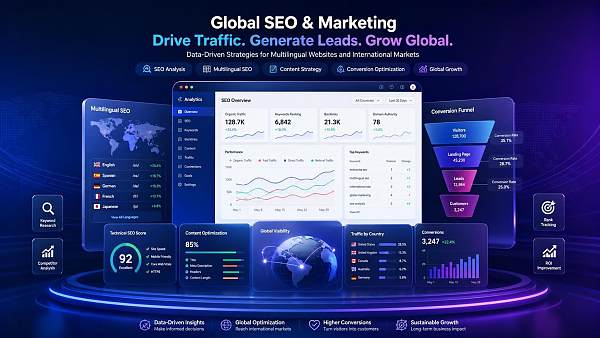
This is why many businesses are placing increasing importance on “integration capabilities” when selecting consulting internet marketing services. Platform-based service providers such as Yiyingbao, which cover AI-powered website building, multilingual website development, Google SEO, advertising, social media operations, and AI search visibility optimization, have the advantage of viewing front-end lead generation and back-end website fulfillment within the same growth logic rather than handling each separately.
There is also a procurement consideration that is often overlooked: compliance and infrastructure. For example, for businesses targeting domestic operations or requiring a website to be launched in China, website filing is an unavoidable step before the official launch. If a supplier is completely unfamiliar with the filing process, preliminary document review, information submission, verification coordination, and regulatory authority review, the project schedule can easily be delayed. Supporting services such as Domestic ICP Filing Service Number are essentially not add-ons, but basic conditions that affect the launch schedule and the stability of subsequent operations. When filing is involved, the Measures for the Administration of Filing of Non-Commercial Internet Information Services and the Measures for the Administration of Internet Information Services should also be followed, with details subject to the requirements of the competent local authorities.
4. To assess value, do not listen only to promises; determine whether the other party can provide verifiable phased objectives
Statements such as “helping you increase traffic” or “helping you enter overseas markets” have almost no evaluative value in business terms. A truly actionable consulting plan should define phased objectives that can at least be tracked. Even if results cannot be guaranteed, process metrics, schedules, and delivery boundaries should be clearly defined.
Note that reliable consultants generally do not readily promise “a certain number of orders within a certain period.” This is because conversions are affected by multiple factors, including products, prices, delivery, and sales capabilities, none of which can be fully controlled by a marketing consultant alone. Being able to clearly explain what is controllable and what is not actually makes a consultant more credible.
5. Finally, assess organizational fit: even the strongest consultant is ineffective if they cannot integrate into the business
This point is often underestimated. Many collaborations fail not because of inadequate professional capabilities, but because the organization cannot effectively support them. External consultants need data access, website permissions, content support, product information, and sales feedback, and may even need the business owner to make decisions on priorities. If there is no corresponding internal contact person, even a highly professional consultant can easily become someone who “makes suggestions every week while no one implements them.”
During the business evaluation stage, you can clarify the following questions in advance:
- Who do we need to assign internally to coordinate with you, and will the involvement of technical, sales, and design teams be required?
- If we build a multilingual website or conduct overseas promotion, will the content review cycle slow down execution?
- Will the consultant provide strategy documents only, or will the service also include execution support, reviews, and iteration recommendations?
- After the collaboration ends, will the internal team be able to take over, or will it have to remain dependent on external support over the long term?
If the other party is only suitable for “large companies with complete teams,” while your current team consists of only two or three people handling foreign trade, the website, and advertising, even the most attractive plan may fail in practice. Conversely, consultants who can adjust delivery depth according to the maturity of the business are more suitable for small and medium-sized enterprises and overseas expansion teams at an early stage.
Here is another practical reminder: be cautious of anyone who attributes every problem to “spending more on advertising” or “publishing more content.” Truly effective consulting internet marketing should help businesses shorten decision-making time, reduce ineffective activities, and bring the website, channels, content, and conversion process into alignment. For business evaluation personnel, the most important thing is not how many new concepts they hear, but whether this external consultant can solve, at your current stage, the issues that are most costly, time-consuming, and prone to repeated trial and error.
If three or more of these five criteria clearly indicate that “the internal team cannot temporarily fill the gap,” it is worth seriously evaluating external cooperation. If the problem definition has not even been aligned, do not rush to sign. First clarify the target market, website positioning, conversion objectives, and internal division of responsibilities, and then discuss suppliers. The quality of the resulting engagement will usually be much higher.
Related Articles



Related Products
 Yiyingbao SaaS Intelligent Website Building and Marketing SystemYiyingbao SaaS Intelligent Website Building and Marketing System, AI-powered no-code website building, rapid creation of multilingual B2B international websites in 10 minutes, global server acceleration, AI-powered SEO optimization, helping businesses connect efficiently with global markets. The perfect integration of technology and operation makes building an international trade website remarkably simple
 AI+SEM Intelligent Advertising Marketing SystemAI+SEM drives intelligent ad creation, empowering full-funnel precision advertising marketing. The system automatically generates weekly/monthly reports, AI recommends keywords and target countries, monitors core metrics in real-time with intelligent alerts, and enables one-click high-conversion ad solutions to help quickly acquire customers and improve ROI.
 AI+SEO Dual-Engine System Optimization ServicesYiyingbao’s AI+SEO dual-engine optimization system helps foreign trade enterprises acquire high-quality organic traffic through AI-powered keyword research, content generation, and comprehensive technical optimization, significantly improving search rankings and conversion rates.
 AI+SNS Social Media Marketing SystemYingbao AI+SNS Social Media Marketing System - Precision social capture for the social media era. Supports one-click content synchronization across major platforms like Facebook and LinkedIn. AI intelligently rewrites posts for enhanced relevance. 24/7 AI customer service and user profiling analysis empower businesses to efficiently expand into global markets.
 AI+SEO营销解决方案易营宝AI+SEO营销解决方案,通过AI批量写作、智能生成TDK、精准关键词扩词等功能,全面优化网站SEO效果,提升流量与转化率。助力企业构建高效智能网站新生态。
 AI+SEM Advertising Marketing SolutionsAI+SEM Advertising Marketing Solution leverages AI technology to deeply empower SEM ad campaigns. It automatically generates weekly/monthly reports using AI, presenting account data across multiple dimensions for comprehensive insights into campaign performance and trends. The system precisely recommends keywords and target countries, intelligently generates high-conversion ad copy, and enables one-click activation of efficient campaign plans to help businesses rapidly acquire customers. Simultaneously, it monitors core metrics in real time, intelligently identifies abnormal fluctuations, and issues timely alerts to ensure stable, high-return advertising results.
 Domain Name ServicesEasyWin provides professional domain name services, including intelligent queries, one-stop registration, brand protection, and full lifecycle management, helping businesses build a digital brand image.
 EasyOperate B2C Cross-Border E-Commerce Platform & Independent WebsiteEasyStore B2C Cross-border E-commerce Independent Store is an intelligent website building and cross-border e-commerce integrated solution independently developed by EasyStore Information Technology (Beijing) Co., Ltd. The system is specially designed for small and medium-sized as well as large export enterprises, integrating 'website building, operation, marketing, advertising, and conversion' into one, helping enterprises quickly establish cross-border e-commerce independent stores to achieve brand globalization and global sales growth.
The platform supports multiple languages, multiple currencies, and multi-channel marketing, with built-in AI intelligent translation and SEO optimization systems, suitable for mainstream markets such as Southeast Asia, Europe and America, Latin America, and the Middle East, assisting Chinese manufacturing enterprises in efficiently deploying international e-commerce strategies. SSL证书易营宝提供专业SSL安全证书服务,包括单域名和泛域名证书,确保网站数据传输加密、身份验证和完整性保护,助力企业建立安全可信的在线业务环境。









