









- Which customer acquisition channels will be affected by cross-border marketing trends in 2026?Sep 06, 2026View details
- Which homogenization risks should be considered in an analysis of the AI-powered website building industry?Aug 30, 2026View details
- How Will AI Marketing Trends 2026 Change Advertising Budget AllocationAug 28, 2026View details
- Is the EV SSL certificate market shrinking or upgrading? How should companies assess certificate procurement?Aug 11, 2026View details
- Why the old AMP SEO 2020 practices no longer work and what has changed in current optimization prioritiesAug 02, 2026View details
- How to Choose Topics for an Industry News Section to Attract More Organic Search TrafficJul 29, 2026View details
How to implement digital marketing solutions? A review of an integrated website and marketing strategy covering lead generation, content, and conversion
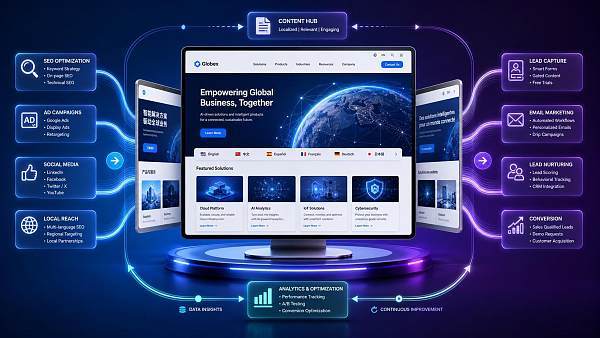
How Can Digital Marketing Solutions Be Implemented? An Overview of Strategies from Lead Generation and Content to Conversion
When it comes to putting digital marketing solutions into practice, the real challenge is usually not whether advertising is being run, but whether the entire process is connected from one stage to the next. Website teams focus only on launching pages, promotion teams focus only on clicks, and sales teams focus only on lead quality. Once these three areas become disconnected, budgets can easily be spent on activities that appear active but do not actually build lasting customer assets. This is especially true for foreign trade companies, manufacturing plants, and brands expanding overseas. They are not facing a single market: search habits, content preferences, and inquiry cycles for the same product differ across North America, Europe, and Southeast Asia. If the strategy is still driven by a single-channel approach, conversion will almost certainly become the bottleneck later on.
In projects of this kind, the problems become apparent even faster when website development and marketing are handled separately. Many companies focus on visual design and site structure during the early stage, only adding SEO, advertising landing pages, and social media content after the site goes live. As a result, the page structure may not be suitable for indexing, and product content may not be suitable for distribution. Fixing these issues later costs much more than planning everything together from the start. Having worked extensively in integrated website and marketing services, EasyYingbao has developed a clear understanding: lead generation, content, and conversion are not parallel tasks handled by three departments, but consecutive actions within one growth system.
Start with Lead Generation: Entry Points Differ Completely by Business Model
B2B foreign trade inquiry websites and B2C cross-border stores both appear to focus on overseas traffic, but their entry-point logic is fundamentally different. The former relies more on search and the accumulation of professional content. Customers often research solutions, specifications, and application industries before deciding whether to submit an inquiry. The latter places greater emphasis on advertising efficiency, campaign timing, and page conversion speed. If both types of projects are forced into the same digital marketing solutions framework, the common results are that B2B websites receive considerable traffic but generate low-quality inquiries, while B2C campaigns generate clicks but cannot control costs.
Determining how to build entry points is not about choosing channels by intuition; it depends on the actual conditions. For example, a manufacturing plant building a multilingual website usually has many SKUs, complex specifications, and long procurement cycles. The value of search engines and accumulated content is therefore greater, because customers need to repeatedly verify supply capacity, industry experience, and delivery reliability. In contrast, for standardized cross-border retail products with short decision chains and high price sensitivity, advertising landing pages and social media promotion may be more direct. One of the easiest points to misjudge is treating short-term traffic growth as evidence of channel fit. Short-term effectiveness only shows that a platform has provided exposure; it does not mean that the traffic will develop into sustainable orders.
For companies planning to expand overseas, the usual sensible approach is to treat the website as the central hub for receiving traffic, rather than as a simple showcase page. The site must first have a foundation that supports indexing, expansion, and advertising before traffic allocation is determined. Service models such as EasyYingbao's, centered on AI-powered website building, multilingual website development, and coordinated SEO and advertising, essentially address the disconnect between front-end lead-generation activities and back-end lead-handling capabilities.
Content Is Not About Filling Sections, but About Matching Different Decision Stages
When many companies talk about content development, their first reaction is to publish more articles and create more product pages. This approach is incomplete. What truly affects conversion is whether the content corresponds to the customer's decision stage. In a B2B inquiry scenario, there is nothing wrong with presenting brand strength on the homepage. However, if the product detail page lacks application information, delivery methods, applicable industries, and frequently asked questions, it is difficult for customers to form an initial judgment during their first visit. Similarly, if a multilingual website simply translates Chinese materials directly into foreign languages, search engines may not recognize the content as relevant, and customers may also find it insufficiently localized.
This is why content strategy must be considered together with channels. Search content places greater emphasis on covering user questions, clear structure, and long-term indexing. Advertising landing pages emphasize one-time persuasion, while social media content focuses on continuous reach and relationship building. Although all three are called “content,” their writing styles cannot be used interchangeably. In practice, a common situation is that a company reposts website articles to social media without modification, resulting in weak readership and engagement. The problem is not that the content lacks value, but that it does not fit the platform context. Social platforms require higher information density, stronger recognizability, and a consistent publishing rhythm. If content still has to be manually adapted for each platform, management costs will quickly rise.
In scenarios like these, tools such as the AI+SNS Social Media Full-Intelligence Marketing System are valuable not simply because they can publish posts, but because they connect independent website content, social media distribution, and multilingual adaptation. For foreign trade companies and brands expanding overseas, Facebook, LinkedIn, Instagram, and Youtube are often operated in parallel. If each platform requires separate rewriting, scheduling, and replies, execution can easily become unmanageable. Automatic adaptation to platform formats, natural-language-processing-based generation of posts that better match each platform's characteristics, account synchronization, and automatic publishing are what make the system truly suitable for teams with high content frequencies and widely distributed markets.
Conversion Problems Are Often Caused Not by Poor Page Design, but by Broken Paths
Many companies attribute low conversion rates to page design, but the more common problem is an incomplete conversion path. Customers arriving from search, clicking through from an advertising landing page, or coming from social media naturally have different areas of focus. If every entry point ultimately leads to the same form, the same introduction, and the same type of customer service response, the losses can be substantial. Manufacturing customers may care more about certifications, lead times, and minimum order quantities, while cross-border retail customers may be more concerned with pricing, logistics, and after-sales information. Path design should help each group see the information they need most as quickly as possible.
Another very practical constraint is response speed. Overseas inquiries do not always occur during working hours in China. If a company still relies on manual shift coverage, many leads will be lost while waiting. This is particularly true of social media direct messages and online website consultations, where users expect immediate feedback. If there is no response or the response is too slow, the traffic costs invested earlier are simply wasted. Systems with intelligent interaction capabilities are better suited to handling the first round of reception: they can address frequently asked questions first and then transfer high-value customers to human staff for follow-up. According to the available product information, the relevant system can automatically handle common inquiries and, when a high-value customer is identified, forward the complete interaction history. This design is closer to real business processes than simply adding a chat window.
If a company is already running advertising campaigns, two additional details should be examined on the conversion side. One is whether data transmission is complete and whether customer quality from different channels can be distinguished. The other is whether the page and customer service processes support A/B testing. Advertising costs change quickly, especially with the significant bidding fluctuations on overseas platforms. Only when front-end creatives, landing page content, and back-end conversion actions are adjusted together do lower CPC or increased inquiries become meaningful. Otherwise, a period of good-looking data may simply reflect a platform traffic dividend and may not be consistently reproducible.
For Multi-Market, Multilingual Projects, the Biggest Risk Is “One Standard Template for the Whole World”
Content that works in the North American market may not be suitable for the Middle East or Latin America. The communication style accepted by European customers may not necessarily suit Southeast Asia. When results become unstable in the later stages of many projects, the problem may not lie in advertising techniques, but in the failure to truly differentiate website structures, language versions, creative styles, and user communication methods by region. If a multilingual website merely adds languages without taking local search habits and platform preferences into account, both indexing and conversion will usually suffer.
There are also several easily overlooked implementation constraints in these projects. First, content maintenance cycles become significantly longer. The more language versions there are, the higher the subsequent update costs, so the underlying system must support fast duplication, flexible adjustments, and unified management. Second, data and account management must respect compliance boundaries. This is particularly important when social media account linking, user behavior analysis, and customer information storage are involved. At a minimum, it is necessary to confirm whether the service complies with basic requirements such as GDPR. The information provided indicates that the relevant system uses the OAuth2.0 protocol, stores sensitive data in encrypted form, and complies with GDPR standards, while also having obtained ISO27001 information security certification. For companies that need to manage overseas customer data over the long term, this is not an added advantage but a basic requirement.
How Can You Determine Whether a Solution Can Actually Be Implemented?
Rather than listening to expressions such as “full-link” and “one-stop,” a more effective way to evaluate a solution is to look at four things: whether the website can quickly support new markets and new pages; whether content can be reused across search, advertising, and social media without losing accuracy; whether leads can be identified, categorized, and responded to promptly; and whether data can be incorporated into the same set of operational decisions. If any one of these stages relies heavily on manual intervention, the digital marketing solutions have not yet truly taken shape.
Platforms such as EasyYingbao that integrate website development and marketing services are suitable for foreign trade, manufacturing, and overseas brand expansion projects not simply because they offer many services, but because their technology covers intelligent website building, SEO/GEO optimization, advertising marketing, social media operations, and cross-border stores. They can change the approach from “thinking about promotion after building the website” to “building the website according to promotion and conversion logic from the outset.” This is particularly important for companies with frequent annual content updates, complex market regions, and scattered customer sources.
If a company is evaluating its overseas growth strategy, it should not rush to ask which platform to invest in. It should first verify whether the existing website has a foundation for indexing, whether the content can genuinely support distribution across multiple channels, whether customer service and sales can handle traffic from overseas time zones, and whether the data is sufficient to support subsequent optimization. Only after these conditions are clear should channel combinations and budget allocation be discussed. In this way, the solution will be closer to being executable rather than remaining a seemingly complete marketing checklist.
Related Articles


Related Products
 Yiyingbao SaaS Intelligent Website Building and Marketing SystemYiyingbao SaaS Intelligent Website Building and Marketing System, AI-powered no-code website building, rapid creation of multilingual B2B international websites in 10 minutes, global server acceleration, AI-powered SEO optimization, helping businesses connect efficiently with global markets. The perfect integration of technology and operation makes building an international trade website remarkably simple
 AI+SEM Intelligent Advertising Marketing SystemAI+SEM drives intelligent ad creation, empowering full-funnel precision advertising marketing. The system automatically generates weekly/monthly reports, AI recommends keywords and target countries, monitors core metrics in real-time with intelligent alerts, and enables one-click high-conversion ad solutions to help quickly acquire customers and improve ROI.
 AI+SEO Dual-Engine System Optimization ServicesYiyingbao’s AI+SEO dual-engine optimization system helps foreign trade enterprises acquire high-quality organic traffic through AI-powered keyword research, content generation, and comprehensive technical optimization, significantly improving search rankings and conversion rates.
 AI+SNS Social Media Marketing SystemYingbao AI+SNS Social Media Marketing System - Precision social capture for the social media era. Supports one-click content synchronization across major platforms like Facebook and LinkedIn. AI intelligently rewrites posts for enhanced relevance. 24/7 AI customer service and user profiling analysis empower businesses to efficiently expand into global markets.
 AI+SEO营销解决方案易营宝AI+SEO营销解决方案,通过AI批量写作、智能生成TDK、精准关键词扩词等功能,全面优化网站SEO效果,提升流量与转化率。助力企业构建高效智能网站新生态。
 AI+SEM Advertising Marketing SolutionsAI+SEM Advertising Marketing Solution leverages AI technology to deeply empower SEM ad campaigns. It automatically generates weekly/monthly reports using AI, presenting account data across multiple dimensions for comprehensive insights into campaign performance and trends. The system precisely recommends keywords and target countries, intelligently generates high-conversion ad copy, and enables one-click activation of efficient campaign plans to help businesses rapidly acquire customers. Simultaneously, it monitors core metrics in real time, intelligently identifies abnormal fluctuations, and issues timely alerts to ensure stable, high-return advertising results.
 Domain Name ServicesEasyWin provides professional domain name services, including intelligent queries, one-stop registration, brand protection, and full lifecycle management, helping businesses build a digital brand image.
 EasyOperate B2C Cross-Border E-Commerce Platform & Independent WebsiteEasyStore B2C Cross-border E-commerce Independent Store is an intelligent website building and cross-border e-commerce integrated solution independently developed by EasyStore Information Technology (Beijing) Co., Ltd. The system is specially designed for small and medium-sized as well as large export enterprises, integrating 'website building, operation, marketing, advertising, and conversion' into one, helping enterprises quickly establish cross-border e-commerce independent stores to achieve brand globalization and global sales growth.
The platform supports multiple languages, multiple currencies, and multi-channel marketing, with built-in AI intelligent translation and SEO optimization systems, suitable for mainstream markets such as Southeast Asia, Europe and America, Latin America, and the Middle East, assisting Chinese manufacturing enterprises in efficiently deploying international e-commerce strategies. SSL证书易营宝提供专业SSL安全证书服务,包括单域名和泛域名证书,确保网站数据传输加密、身份验证和完整性保护,助力企业建立安全可信的在线业务环境。









