









- Ministry of Commerce: Online retail sales grew 4.4% in the first three quarters, while cross-border e-commerce maintained relatively rapid growthOct 29, 2026View details
- CCTV reports: AI-powered smart hardware is expanding overseas at a faster pace, with orders for some best-selling products booked through next yearOct 29, 2026View details
- Alphabet Q3 Earnings: Google Search Advertising Revenue Rises 10.5% to $82 BillionOct 29, 2026View details
- AliExpress Announces New Service Rules for Russia, Linked to Wildberries Product IntegrationOct 28, 2026View details
- Black Friday Preparations Enter the Final Sprint Week as Cross-Border E-Commerce Platforms Roll Out Their PlansOct 28, 2026View details
- CBP Finalizes Electronic Rail Export Manifest Rule, Effective October 26, 2026Oct 26, 2026View details
What Problems Can Digital Marketing Consulting Solve? The Scope of Diagnosis, Strategy, and Execution Services
What Problems Can Online Marketing Consulting Solve? The Scope of Diagnosis, Strategy, and Execution
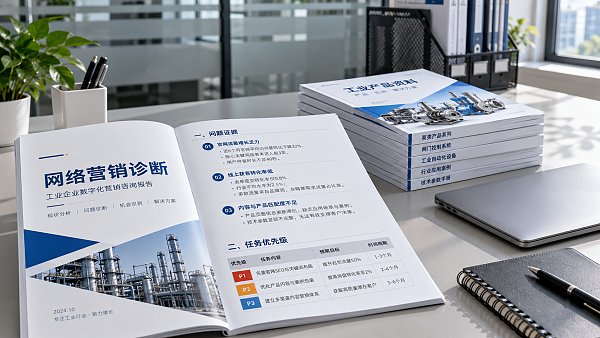
Can online marketing consulting (conseil en e-marketing) improve lead generation? First, clarify the scope of diagnosis, strategy, and execution, then determine what the business actually needs. For export-oriented businesses, “the website generates no inquiries” is only the outcome. The cause may be untargeted traffic, insufficient product information, a faulty form, or a disconnect in sales follow-up. The value of consulting lies in separating these possibilities first, rather than immediately recommending a website rebuild or a larger advertising budget.
Diagnosis Is Not About Finding Fault; It Is About Identifying What Should Be Addressed First
An effective online marketing diagnosis requires looking at the website, channels, and sales leads together. A screenshot showing only visit volume makes it difficult to assess lead quality; inquiry counts alone cannot reveal duplicate submissions, spam, or requests outside the business’s scope.
For example, if a manufacturer promotes custom equipment but attracts visitors searching for how-to guides through broad keywords, the issue may be search intent alignment rather than insufficient traffic. If visitors come from target markets and browse product pages but rarely submit inquiries, it is worth checking whether specifications, application requirements, and delivery information are sufficient, and whether the inquiry process works smoothly on mobile devices. These are areas to investigate; conclusions should not be drawn without reviewing the data.
Businesses typically need to provide website analytics, search performance data, advertising accounts, and anonymized lead records. A sound diagnostic deliverable should distinguish “verified problems” from “assumptions to be validated,” and list the evidence, scope of impact, priority, and validation method. A website score and a list of generic recommendations are not enough to support budget decisions.
Strategy Determines What to Do First—and What to Leave for Later
Diagnosis answers “Where is the problem?” Strategy answers “Where should limited resources go?” Businesses need to clarify their priority products, target regions, purchasing roles, and lead-generation goals, then decide what roles website content, Google SEO, advertising, and social media should each play, rather than launching every channel at once.
For industrial products with long purchasing cycles, technical specification pages, selection materials, and application content often need to work together. Advertising can be used to test specific demand, but click volume is no substitute for lead quality. When entering a new language market, it is not enough to simply translate existing pages; businesses should also confirm local buyers’ search terms, information needs, and communication preferences.
A strategy deliverable should include phased tasks, the rationale for budget allocation, owners, and conditions for making adjustments. Metrics should also be tiered: indexing, visits, and form submissions reflect process, while qualified inquiries and sales acceptance are closer to business outcomes. Quotes, samples, and sales are also affected by pricing, products, and sales response, so they cannot all be attributed to marketing.
There Is an Execution Agreement Between Recommendations and Launch
Consulting does not automatically include page production, content writing, advertising operations, or ongoing maintenance. A consulting-only project can deliver a diagnostic report, roadmap, and review recommendations for the business to implement internally; managed services, by contrast, require clearly defined operational tasks. An integrated service can reduce handoffs, but that is no reason to leave the scope of work unclear.
Before signing, specify which pages will be modified, who will review technical content, whether ad spend is charged separately, who owns the data, how account permissions will be configured, and whether content and leads can be exported when the engagement ends. The business also needs to designate product and sales contacts; otherwise, even if the service provider can edit pages, they may not be able to verify specifications or assess lead value.
Acceptance should be based on verifiable work, such as whether forms are delivered, conversion events fire correctly, and pages are published as agreed. Organic rankings, inquiry volume, and sales can be optimization goals, but fixed results should not be promised without accounting for competition, budget, and sales conditions.
For Websites and Marketing to Work Together, Data and Responsibilities Must Connect
When website development and promotion are managed separately, problems can arise—for example, advertising may require a new landing page while the website provider is only responsible for display pages. The practical value of an integrated solution is to create a continuous workflow linking page updates, content publishing, traffic acquisition, and lead feedback, not simply to add more services.
Yingyingbao Information Technology (Beijing) Co., Ltd., founded in 2013 and headquartered in Beijing, provides website and marketing services covering intelligent website building, multilingual websites, SEO, advertising, and overseas social media. Its customers include export-oriented businesses, manufacturers, and brands expanding overseas. When evaluating this type of service, focus on whether channel data can inform page improvements and whether sales feedback can feed into the next round of optimization.
At the tool level, Yingyingbao SaaS Intelligent Website Building and Marketing System offers AI no-code website building, responsive design across devices, and intelligent SEO features. It is configured with 22 server nodes and uses Google Neural Machine Translation (GNMT). These capabilities can reduce website setup and routine maintenance work, but the number of nodes alone does not prove access speeds in target markets, and automated translations still need to be reviewed for industry terminology, specifications, and transaction terms.
If a business is not yet sure where lead generation is getting stuck, it can start with a clearly scoped diagnosis. If the direction is clear but staff are lacking, adding execution support may be a better fit. If the website, content, and channels have been disconnected for a long time, an integrated overhaul may be worth considering. There is no need to rush into buying a complete package; first confirm what the existing data can demonstrate, who will be responsible for implementing recommendations, and what criteria will be used to assess improvement.
Related Articles
 IEAT and Amazon Release 2026 Cross-Border E-Commerce Report, Focusing on AI and Global Brand Expansion
 How Can Digital Marketing Solutions for Manufacturing Track Qualified Inquiries?
 How Can Construction and Renovation Companies Optimize Overseas Website Access?



Related Products
 Yiyingbao SaaS Intelligent Website Building and Marketing SystemYiyingbao SaaS Intelligent Website Building and Marketing System, AI-powered no-code website building, rapid creation of multilingual B2B international websites in 10 minutes, global server acceleration, AI-powered SEO optimization, helping businesses connect efficiently with global markets. The perfect integration of technology and operation makes building an international trade website remarkably simple
 AI+SEM Intelligent Advertising Marketing SystemAI+SEM drives intelligent ad creation, empowering full-funnel precision advertising marketing. The system automatically generates weekly/monthly reports, AI recommends keywords and target countries, monitors core metrics in real-time with intelligent alerts, and enables one-click high-conversion ad solutions to help quickly acquire customers and improve ROI.
 AI+SEO Dual-Engine System Optimization ServicesYiyingbao’s AI+SEO dual-engine optimization system helps foreign trade enterprises acquire high-quality organic traffic through AI-powered keyword research, content generation, and comprehensive technical optimization, significantly improving search rankings and conversion rates.
 AI+SNS Social Media Marketing SystemYingbao AI+SNS Social Media Marketing System - Precision social capture for the social media era. Supports one-click content synchronization across major platforms like Facebook and LinkedIn. AI intelligently rewrites posts for enhanced relevance. 24/7 AI customer service and user profiling analysis empower businesses to efficiently expand into global markets.
 AI+SEO营销解决方案易营宝AI+SEO营销解决方案,通过AI批量写作、智能生成TDK、精准关键词扩词等功能,全面优化网站SEO效果,提升流量与转化率。助力企业构建高效智能网站新生态。
 AI+SEM Advertising Marketing SolutionsAI+SEM Advertising Marketing Solution leverages AI technology to deeply empower SEM ad campaigns. It automatically generates weekly/monthly reports using AI, presenting account data across multiple dimensions for comprehensive insights into campaign performance and trends. The system precisely recommends keywords and target countries, intelligently generates high-conversion ad copy, and enables one-click activation of efficient campaign plans to help businesses rapidly acquire customers. Simultaneously, it monitors core metrics in real time, intelligently identifies abnormal fluctuations, and issues timely alerts to ensure stable, high-return advertising results.
 Domain Name ServicesEasyWin provides professional domain name services, including intelligent queries, one-stop registration, brand protection, and full lifecycle management, helping businesses build a digital brand image.
 EasyOperate B2C Cross-Border E-Commerce Platform & Independent WebsiteEasyStore B2C Cross-border E-commerce Independent Store is an intelligent website building and cross-border e-commerce integrated solution independently developed by EasyStore Information Technology (Beijing) Co., Ltd. The system is specially designed for small and medium-sized as well as large export enterprises, integrating 'website building, operation, marketing, advertising, and conversion' into one, helping enterprises quickly establish cross-border e-commerce independent stores to achieve brand globalization and global sales growth.
The platform supports multiple languages, multiple currencies, and multi-channel marketing, with built-in AI intelligent translation and SEO optimization systems, suitable for mainstream markets such as Southeast Asia, Europe and America, Latin America, and the Middle East, assisting Chinese manufacturing enterprises in efficiently deploying international e-commerce strategies. SSL证书易营宝提供专业SSL安全证书服务,包括单域名和泛域名证书,确保网站数据传输加密、身份验证和完整性保护,助力企业建立安全可信的在线业务环境。









