









- Which customer acquisition channels will be affected by cross-border marketing trends in 2026?Sep 06, 2026View details
- Which homogenization risks should be considered in an analysis of the AI-powered website building industry?Aug 30, 2026View details
- How Will AI Marketing Trends 2026 Change Advertising Budget AllocationAug 28, 2026View details
- Is the EV SSL certificate market shrinking or upgrading? How should companies assess certificate procurement?Aug 11, 2026View details
- Why the old AMP SEO 2020 practices no longer work and what has changed in current optimization prioritiesAug 02, 2026View details
- How to Choose Topics for an Industry News Section to Attract More Organic Search TrafficJul 29, 2026View details
How to choose Beratung Internetmarketing? An evaluation checklist to avoid vague solutions
How to Choose Internet Marketing Beratung? An Evaluation Checklist to Avoid Vague Proposals
Many people understand beratung internetmarketing as “providing a company with an online marketing recommendation,” but this is actually too narrow. Consulting that delivers real procurement value is not simply about telling you whether to do SEO, run ads, or use social media. It connects business objectives, channel strategy, the technology foundation, data standards, and execution cadence into one coherent process. Proposals tend to become vague not because service providers cannot create presentations, but because they fail to clarify in advance “who will do what, who it is intended for, what system will support it, and which metrics will be used for final acceptance.”
For procurement teams, the key to determining whether a beratung internetmarketing service is reliable is not whether its messaging sounds advanced, but whether it can answer several practical questions: Who is the target market? How should the customer acquisition path be broken down? Can a multilingual website support indexing and conversion? How should advertising and organic traffic work together? Who will take over subsequent content, pages, and lead management? Proposals that discuss growth without conversion support, traffic without conversion, or methods without resource allocation often appear complete, but are the most likely to lose accuracy during implementation.
First Clarify Whether the Objectives Are Clearly Defined, Rather Than How Many Channels Are Listed
One of the most common mistakes in procurement and vendor selection is mistaking “a wide range of services” for “comprehensive capabilities.” In practice, a consulting proposal should begin with a breakdown of business objectives. For example, an international trading company promoting its business overseas may focus on B2B inquiries; a cross-border brand’s independent website may prioritize order conversion; and a manufacturing factory expanding into a new regional market may first want to verify the visibility of a website in a particular language within local search results. Different objectives should lead to different consulting deliverables.
If a proposal does not clearly distinguish between “brand exposure,” “lead generation,” “on-site transactions,” and “channel testing,” subsequent budget allocation and execution schedules will likely become confused as well. A mature service provider generally defines the objectives for each stage first and then works backward to determine the channel mix. For example, SEO is suitable for building long-term search coverage, Google Ads is more suitable for testing keyword and landing page alignment, and social media operations are suitable for building trust and supporting remarketing, rather than simply listing all channels side by side.
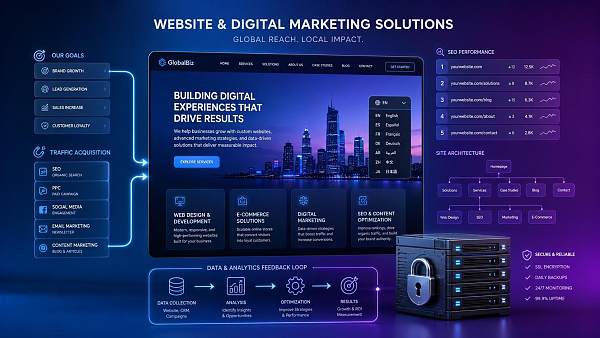
This is also why the integration of website and marketing services is becoming increasingly important. A website is not an independent presentation asset; it is the destination that supports all subsequent promotional activities. For an AI-driven website development and overseas marketing platform such as 易营宝, the core value lies in viewing website development, SEO, advertising, social media, and subsequent data tracking as one continuous process, rather than splitting them into multiple disconnected service components.
If the Technology Foundation Is Unstable, Even Well-Designed Consulting Recommendations Are Difficult to Deliver
When evaluating beratung internetmarketing, many procurement teams tend to focus on strategy while overlooking technical implementation. In actual projects, however, technical conditions often directly determine whether consulting recommendations can work. For example, if you plan to carry out multilingual SEO but the website URL structure is disorganized, pages load slowly, redirect rules are unclear, and the mobile experience is poor, the strategy itself will not take effect automatically.
One frequently underestimated aspect of the technical foundation is HTTPS security and certificate deployment. It is not merely about “adding a lock to the website”; it also affects browser trust, form submission security, API call stability, and how search engines assess the website’s basic standards compliance. For corporate websites, membership systems, API interfaces, and e-commerce platforms, security configuration is not an add-on but part of the marketing conversion path. Capabilities such as SSL certificates, when deeply integrated with the website development system and supporting SHA-256 encryption, 2048-bit keys, HSTS, and automatic HTTP-to-HTTPS redirection, can significantly reduce coordination costs during subsequent operations and maintenance. In particular, when a service provider can also offer automatic CSR generation, automatic domain ownership verification, certificate deployment, and mixed-content repair, consulting recommendations have a genuinely executable technical foundation.
Here is a very practical evaluation criterion: Can the service provider translate technical parameters into business impact? For example, can it clearly explain why browser security warnings may affect the inquiry submission rate, why incomplete certificate configuration may cause browsers to block certain resources, and why mobile loading and server deployment location may affect landing page performance for advertising campaigns? The ability to explain these relationships clearly indicates experience in project implementation. Providers that only discuss concepts without addressing implementation paths usually mean that subsequent execution will depend on external coordination to fill the gaps.
Data Standards Must Form a Closed Loop; Otherwise, “Performance Evaluation” Is Merely Superficial Activity
When reviewing a proposal, procurement teams should not only ask “Can you manage advertising campaigns?” but also “How is performance defined?” A common feature of vague proposals is that they provide a series of exposure, click, and visit metrics without connecting them to actual business actions. For overseas customer acquisition, it should at least be possible to distinguish valid inquiries, spam inquiries, duplicate leads, and lead quality generated by different channels. For e-commerce projects, it is also necessary to examine such stages as add-to-cart, checkout, and completed payment.
This requires the service provider to define tracking points, attribution, and reporting logic during the consulting stage, rather than adding them temporarily after the project begins. When multiple channels operate in parallel, SEO, advertising, social media, and AI search visibility optimization may influence one another. Without unified data standards, it is easy to end up in a situation where “every channel claims to be effective, but the overall result remains unclear.”
It is worth noting that service providers capable of serving global markets generally pay greater attention to data differences between regions. Markets such as North America, Europe, Southeast Asia, Japan and South Korea, and the Middle East may differ in search habits, device distribution, page language preferences, and inquiry cycles. If a consulting proposal only provides one standardized template without discussing markets separately, it will be difficult to support genuine decision-making.
Evaluate Execution, Not Promises
The real gap between providers is usually not found in the strategic framework, but in execution organization. Procurement teams can use the checklist below when questioning service providers; vague proposals often reveal their limitations as soon as these questions are asked:
The purpose of this table is not to put the supplier on the spot, but to determine whether it has actually completed full-scale projects. Experienced teams can usually clearly explain the person responsible for each stage, the dependencies, and the estimated timeline. Less experienced teams are more likely to remain at the level of statements such as “we can do it,” “everything is supported,” or “we will see later.”
Do Not Interpret “Consulting” as a One-Time Deliverable
There is another common misunderstanding about beratung internetmarketing: many companies believe they are purchasing a report, while what is often more valuable is a mechanism for continuous calibration. Overseas markets change quickly, and search rules, advertising costs, and user behavior all evolve. A one-time proposal is unlikely to remain effective over the long term. The service model most suitable for procurement decisions is one that can provide initial diagnosis and adjust direction according to data during subsequent execution.
From this perspective, whether a service provider has platform-based capabilities is crucial. Take an integrated platform with approximately ten years of industry experience and coverage of website development, SEO, advertising, social media, and AI search optimization as an example. Its advantage is not simply that it has “many business lines,” but that different modules can share data and execution schedules. Procurement teams do not need to coordinate separately with a website development company, advertising agency, SEO consultant, and technical operations team, so the decision chain is shorter and problems can be identified more quickly.
If a practical conclusion must be given, it is this: when evaluating this type of service, first examine whether the objectives have been clearly broken down, then assess whether the technology and data can support them, and finally verify whether the execution boundaries are clearly defined. Proposals that can explain these three layers coherently are generally more worthy of entering the vendor shortlist than proposals with advanced concepts and abundant promises but no implementation details. What procurement teams truly need is not a document that merely sounds knowledgeable about marketing, but a growth plan that can be clearly explained, deployed, verified, and adjusted.
Related Articles



Related Products
 Yiyingbao SaaS Intelligent Website Building and Marketing SystemYiyingbao SaaS Intelligent Website Building and Marketing System, AI-powered no-code website building, rapid creation of multilingual B2B international websites in 10 minutes, global server acceleration, AI-powered SEO optimization, helping businesses connect efficiently with global markets. The perfect integration of technology and operation makes building an international trade website remarkably simple
 AI+SEM Intelligent Advertising Marketing SystemAI+SEM drives intelligent ad creation, empowering full-funnel precision advertising marketing. The system automatically generates weekly/monthly reports, AI recommends keywords and target countries, monitors core metrics in real-time with intelligent alerts, and enables one-click high-conversion ad solutions to help quickly acquire customers and improve ROI.
 AI+SEO Dual-Engine System Optimization ServicesYiyingbao’s AI+SEO dual-engine optimization system helps foreign trade enterprises acquire high-quality organic traffic through AI-powered keyword research, content generation, and comprehensive technical optimization, significantly improving search rankings and conversion rates.
 AI+SNS Social Media Marketing SystemYingbao AI+SNS Social Media Marketing System - Precision social capture for the social media era. Supports one-click content synchronization across major platforms like Facebook and LinkedIn. AI intelligently rewrites posts for enhanced relevance. 24/7 AI customer service and user profiling analysis empower businesses to efficiently expand into global markets.
 AI+SEO营销解决方案易营宝AI+SEO营销解决方案,通过AI批量写作、智能生成TDK、精准关键词扩词等功能,全面优化网站SEO效果,提升流量与转化率。助力企业构建高效智能网站新生态。
 AI+SEM Advertising Marketing SolutionsAI+SEM Advertising Marketing Solution leverages AI technology to deeply empower SEM ad campaigns. It automatically generates weekly/monthly reports using AI, presenting account data across multiple dimensions for comprehensive insights into campaign performance and trends. The system precisely recommends keywords and target countries, intelligently generates high-conversion ad copy, and enables one-click activation of efficient campaign plans to help businesses rapidly acquire customers. Simultaneously, it monitors core metrics in real time, intelligently identifies abnormal fluctuations, and issues timely alerts to ensure stable, high-return advertising results.
 Domain Name ServicesEasyWin provides professional domain name services, including intelligent queries, one-stop registration, brand protection, and full lifecycle management, helping businesses build a digital brand image.
 EasyOperate B2C Cross-Border E-Commerce Platform & Independent WebsiteEasyStore B2C Cross-border E-commerce Independent Store is an intelligent website building and cross-border e-commerce integrated solution independently developed by EasyStore Information Technology (Beijing) Co., Ltd. The system is specially designed for small and medium-sized as well as large export enterprises, integrating 'website building, operation, marketing, advertising, and conversion' into one, helping enterprises quickly establish cross-border e-commerce independent stores to achieve brand globalization and global sales growth.
The platform supports multiple languages, multiple currencies, and multi-channel marketing, with built-in AI intelligent translation and SEO optimization systems, suitable for mainstream markets such as Southeast Asia, Europe and America, Latin America, and the Middle East, assisting Chinese manufacturing enterprises in efficiently deploying international e-commerce strategies. SSL证书易营宝提供专业SSL安全证书服务,包括单域名和泛域名证书,确保网站数据传输加密、身份验证和完整性保护,助力企业建立安全可信的在线业务环境。









