









- Which customer acquisition channels will be affected by cross-border marketing trends in 2026?Sep 06, 2026View details
- Which homogenization risks should be considered in an analysis of the AI-powered website building industry?Aug 30, 2026View details
- How Will AI Marketing Trends 2026 Change Advertising Budget AllocationAug 28, 2026View details
- Is the EV SSL certificate market shrinking or upgrading? How should companies assess certificate procurement?Aug 11, 2026View details
- Why the old AMP SEO 2020 practices no longer work and what has changed in current optimization prioritiesAug 02, 2026View details
- How to Choose Topics for an Industry News Section to Attract More Organic Search TrafficJul 29, 2026View details
How to Evaluate the Localization Capabilities of a Multilingual Website Solutions Provider for Foreign Trade?
When evaluating companies that provide multilingual website solutions for foreign trade, the most common misjudgment is treating “support for multiple languages” as proof of localization capability. The number of languages, machine translation speed, and page presentation can only demonstrate that the system has basic delivery capabilities; what truly affects overseas business is whether content is credible in different markets, whether search engines can correctly identify pages, whether users can complete inquiries or place orders, and whether the company can continuously maintain these capabilities afterward.
Localization is not a translation project, but a set of digital operational capabilities designed for specific markets. For business evaluation, the key is not how many languages a supplier claims it can support, but whether it can connect market adaptation, site architecture, content production, technical compliance, and continuous optimization into a verifiable delivery process.
First distinguish between “multilingual display” and “market localization”
Multilingual display usually refers to providing versions in different languages within the same website, converting the text of menus, product introductions, forms, and basic pages. This capability is suitable for initially covering multiple markets, but it does not mean that the website has already adapted to local users.
Market localization involves at least four layers: whether language expression fits the industry context; whether product information, units of measurement, delivery times, and trade terms suit local purchasing practices; whether trust elements, contact methods, payment, or inquiry paths on the page meet target market expectations; and whether search, access, and data processing mechanisms can operate reliably locally. For example, for an industrial products website targeting the German-speaking market, terminology accuracy, completeness of technical parameters, and clarity of privacy notices often affect trust more than whether the page copy is “fluent”; for the Latin American market, Spanish must also distinguish regional expressions, and content intended for Spain cannot simply be copied directly to all Spanish-speaking countries.
Therefore, when assessing companies that provide multilingual website solutions for foreign trade, they should be required to explain the specific adaptations made for each target market, rather than merely providing a language list or translation samples.
Market adaptation capabilities must be reflected in reviewable page rules
A supplier’s understanding of the target market should be translated into specific rules for pages, content, and conversion paths. During evaluation, focus on whether its requirements research covers product classification methods, purchasing decision chains, commonly used search terms, quotation practices, contact roles, and common local trust credentials.
For example, overseas customers of B2B manufacturing companies may not convert through “Buy Now”; more commonly, they download materials, submit technical requirements, request quotations, or schedule consultations. A highly localized site will not simply translate the sections and inquiry forms of a Chinese official website and put them online. Instead, it will reorganize pages based on the decision-making actions of target customers: whether technical materials are easy to obtain, whether key certifications and delivery capabilities can be quickly verified, whether form fields reduce unnecessary completion burden, and whether sales leads can enter follow-up processes by country, product, or source.
It is also necessary to examine whether the solution provider can explain the boundaries of content localization. Information such as product specifications, compliance statements, certification documents, prices, and delivery commitments must be based on materials that the company can confirm. If a supplier directly regards automatically generated content as finished material ready for publication, without mechanisms for terminology review, fact verification, and version management, problems such as distorted technical descriptions and inconsistent information across different language pages are likely to arise later.
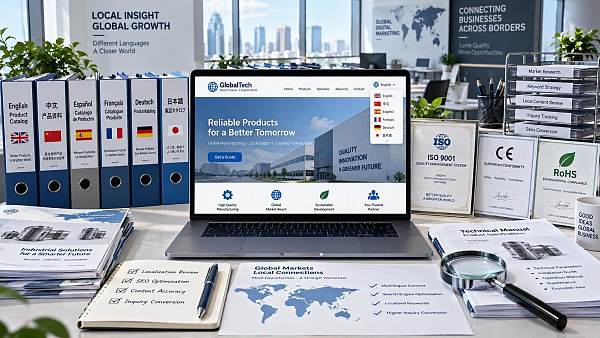
Technical architecture determines search visibility and long-term maintenance costs
Technical issues with multilingual websites often become apparent only after launch. A business evaluation does not need to delve into code, but it needs to confirm how language versions are organized, who owns the data and content, and how costs will arise when new markets are added later.
Key assessment points include: whether different language versions use independent and stable URL structures; whether language switching enables users and search engines to accurately access the corresponding versions; whether pages are configured with language and regional tags such as hreflang; whether pages in different languages have independent capabilities for managing titles, descriptions, body content, and internal links; and whether the system can avoid indiscriminately duplicating large volumes of highly similar content.
These matters are not merely technical details. If relationships between language versions are handled chaotically, search engines may be unable to determine which page should be shown to users in which country or language; if all languages share one set of content fields, operators may abandon maintenance because updates are inconvenient; if the supplier uses closed templates or locks content assets within its platform, the company will also face additional restrictions when migrating in the future or integrating CRM, analytics tools, or third-party advertising landing pages.
During evaluation, clearly ask about the ownership of domains, source code or page data, images, and multilingual content; the conditions for site export and migration; and the integration capabilities for APIs, forms, and data analytics tools. So-called “scalability” needs to be reflected in the actual process for adding languages, country sites, product lines, and marketing pages, rather than in general system descriptions.
Translation quality should not be judged by grammar alone; terminology governance also matters
The content with the greatest business value on foreign trade websites is often also the part that can least rely on general translation: product names, material grades, performance parameters, application scenarios, certification names, after-sales terms, and industry abbreviations. Being correct at the word level does not mean that purchasing personnel can understand it accurately, nor does it mean that the page can cover local professional search expressions.
A capable service provider should offer clear content governance mechanisms, including terminology database development, rules for retaining brand names and model numbers, responsibility for translation review, methods for multilingual synchronization after source text changes, and whether content differentiation and rewriting are permitted for different markets. For fields such as professional equipment, components, chemical materials, and medical-related products, these rules provide more evaluative value than labels such as “human translation” or “AI translation.”
It is also important to avoid rolling out all language pages at once. If a company lacks product materials, sales follow-up capabilities, and content maintenance resources for the corresponding markets, launching a large number of low-quality pages will neither generate effective traffic nor reduce later correction costs. A more prudent solution should support phased development according to market priorities while retaining content and technical capacity for subsequent expansion.
Localization services should cover post-launch operations rather than end with delivery
Website publication is only the starting point of localization work. Pages in different languages will continue to be adjusted as products are updated, market feedback is received, advertising is placed, and search performance changes. The ongoing service capability of a solution provider is mainly reflected in whether it can establish clear update responsibilities, rather than whether it promises long-term “maintenance.”
Items that need to be confirmed include: who initiates and reviews content changes; how multilingual versions are synchronized; how translation disputes or market feedback are handled; whether SEO page optimization distinguishes between languages and regions; whether conversion data from forms, telephone calls, emails, and other channels can be tracked by market; and whether the scope of response to website issues, plugin upgrades, and security problems is included in service agreements.
Especially for service models that integrate website development, SEO, advertising, and social media operations, the advantage should not be reflected merely in having many service offerings, but in whether data can be used in a unified manner. For example, whether search terms and landing page conversion performance generated by advertising can feed back into local-language content optimization; whether high-intent pages generated by organic search can be used for subsequent campaigns and sales follow-up. If these services are disconnected from one another, the company must still bear the cost of cross-team coordination itself.
Use delivery evidence rather than demonstration results for evaluation
Demonstration sites can often present attractive language switching and page layouts, but they may not reflect actual delivery capabilities for complex projects. Rather than reviewing templates, candidate companies should be asked to provide verifiable explanations for the intended markets: examples of site structures for language versions, terminology review processes, content migration plans, SEO technical configuration checklists, launch acceptance scope, and role allocation and change mechanisms in ongoing services.
At the contract level, it is also necessary to avoid defining “localization” as a concept that cannot be accepted or verified. It can be broken down into specific deliverables, such as the scope of target-language pages, the scope of human review, localized content rules, technical tag configuration, form and data-tracking tests, training, and the boundaries of subsequent maintenance. For solutions that rely on AI generation and automatic translation, the proportion of human review, company confirmation checkpoints, and responsibility for error corrections should also be clearly defined.
A company providing multilingual website solutions for foreign trade that is worth including on an evaluation shortlist does not necessarily offer the most languages or the most complex functions, but it should be able to clearly explain: which issues are solved by the system, which require market content support, and which risks need to be jointly assumed by the company. Only when it can clearly define these boundaries and incorporate them into the delivery process does its localization capability demonstrate practical business implementation value.
Related Articles

Related Products
 Yiyingbao SaaS Intelligent Website Building and Marketing SystemYiyingbao SaaS Intelligent Website Building and Marketing System, AI-powered no-code website building, rapid creation of multilingual B2B international websites in 10 minutes, global server acceleration, AI-powered SEO optimization, helping businesses connect efficiently with global markets. The perfect integration of technology and operation makes building an international trade website remarkably simple
 AI+SEM Intelligent Advertising Marketing SystemAI+SEM drives intelligent ad creation, empowering full-funnel precision advertising marketing. The system automatically generates weekly/monthly reports, AI recommends keywords and target countries, monitors core metrics in real-time with intelligent alerts, and enables one-click high-conversion ad solutions to help quickly acquire customers and improve ROI.
 AI+SEO Dual-Engine System Optimization ServicesYiyingbao’s AI+SEO dual-engine optimization system helps foreign trade enterprises acquire high-quality organic traffic through AI-powered keyword research, content generation, and comprehensive technical optimization, significantly improving search rankings and conversion rates.
 AI+SNS Social Media Marketing SystemYingbao AI+SNS Social Media Marketing System - Precision social capture for the social media era. Supports one-click content synchronization across major platforms like Facebook and LinkedIn. AI intelligently rewrites posts for enhanced relevance. 24/7 AI customer service and user profiling analysis empower businesses to efficiently expand into global markets.
 AI+SEO营销解决方案易营宝AI+SEO营销解决方案,通过AI批量写作、智能生成TDK、精准关键词扩词等功能,全面优化网站SEO效果,提升流量与转化率。助力企业构建高效智能网站新生态。
 AI+SEM Advertising Marketing SolutionsAI+SEM Advertising Marketing Solution leverages AI technology to deeply empower SEM ad campaigns. It automatically generates weekly/monthly reports using AI, presenting account data across multiple dimensions for comprehensive insights into campaign performance and trends. The system precisely recommends keywords and target countries, intelligently generates high-conversion ad copy, and enables one-click activation of efficient campaign plans to help businesses rapidly acquire customers. Simultaneously, it monitors core metrics in real time, intelligently identifies abnormal fluctuations, and issues timely alerts to ensure stable, high-return advertising results.
 Domain Name ServicesEasyWin provides professional domain name services, including intelligent queries, one-stop registration, brand protection, and full lifecycle management, helping businesses build a digital brand image.
 EasyOperate B2C Cross-Border E-Commerce Platform & Independent WebsiteEasyStore B2C Cross-border E-commerce Independent Store is an intelligent website building and cross-border e-commerce integrated solution independently developed by EasyStore Information Technology (Beijing) Co., Ltd. The system is specially designed for small and medium-sized as well as large export enterprises, integrating 'website building, operation, marketing, advertising, and conversion' into one, helping enterprises quickly establish cross-border e-commerce independent stores to achieve brand globalization and global sales growth.
The platform supports multiple languages, multiple currencies, and multi-channel marketing, with built-in AI intelligent translation and SEO optimization systems, suitable for mainstream markets such as Southeast Asia, Europe and America, Latin America, and the Middle East, assisting Chinese manufacturing enterprises in efficiently deploying international e-commerce strategies. SSL证书易营宝提供专业SSL安全证书服务,包括单域名和泛域名证书,确保网站数据传输加密、身份验证和完整性保护,助力企业建立安全可信的在线业务环境。









