









- Which customer acquisition channels will be affected by cross-border marketing trends in 2026?Sep 06, 2026View details
- Which homogenization risks should be considered in an analysis of the AI-powered website building industry?Aug 30, 2026View details
- How Will AI Marketing Trends 2026 Change Advertising Budget AllocationAug 28, 2026View details
- Is the EV SSL certificate market shrinking or upgrading? How should companies assess certificate procurement?Aug 11, 2026View details
- Why the old AMP SEO 2020 practices no longer work and what has changed in current optimization prioritiesAug 02, 2026View details
- How to Choose Topics for an Industry News Section to Attract More Organic Search TrafficJul 29, 2026View details
Japan Introduces WAP Certification, Making Standalone Websites a JETRO Procurement Eligibility Requirement
Starting September 1, 2026, Chinese suppliers applying for JETRO overseas procurement matchmaking and eligibility to participate in the Tokyo International Procurement Exhibition will face an admission change that has entered the implementation phase: an independent website will no longer be merely a showcase window, but will be included in the compliance review scope for procurement access.
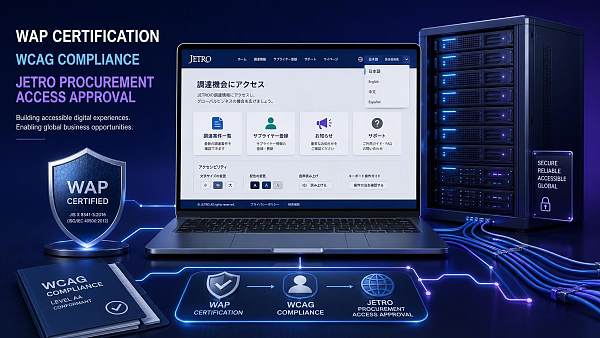
Confirmed Details of This Admission Change
Confirmed information shows that Japan’s Ministry of Internal Affairs and Communications launched the “Web Accessibility Passport (WAP)” certification system on July 30, 2026. According to the currently available summary, all Chinese suppliers applying for JETRO overseas procurement matchmaking or eligibility to participate in the Tokyo Sourcing exhibition must have an independent website that passes WCAG 2.2 Level AA accessibility certification and obtain a WAP number.
The disclosed certification scope covers 12 key indicators, including multilingual switching, screen reader compatibility, and form logic validation. The summary also specifies that, from September 2026, websites without certification will be unable to enter the official JETRO procurement database.
Based on the known facts, this requirement is not merely an initiative, but is directly linked to access to the procurement database, procurement matchmaking eligibility, and exhibition participation eligibility.
Which Business Processes Are Affected by the Changes to Procurement Access Rules?
Export Enterprises Targeting the Japanese Market Need to Reassess the Role of Their Independent Websites
The analysis indicates that Chinese suppliers directly applying for JETRO procurement matchmaking or planning to participate in the Tokyo International Procurement Exhibition will be affected most directly. This is because whether an independent website has completed WCAG 2.2 Level AA accessibility certification and obtained a WAP number is now linked to access to the official procurement database. The main business impacts will fall on market-access preparation, exhibition application materials, and preliminary reviews for overseas procurement communications. These enterprises now need to focus not only on whether their websites are online, but also on whether the websites meet the conditions for certification review and whether the relevant number can be aligned with the external application process.
Procurement and Business Teams Will Face a New Qualification Verification Checkpoint
From an industry perspective, this change will also affect internal procurement, sales, and business development teams. In the past, independent websites primarily served presentation, inquiry generation, and brand communication purposes. Their compliance status may now become a prerequisite for obtaining procurement contact opportunities. The impact will mainly be reflected in supplier qualification preparation, coordination of matchmaking schedules, exhibition application coordination, and updates to customer communication materials. For enterprises that rely on exposure in official databases and procurement matching opportunities, the website certification status may affect when they enter the procurement field of vision.
Website Development, Testing, and Certification Support Services Will Also Face Pressure
The website development, operation and maintenance, testing, and certification support services related to independent websites will also be affected. Since the certification covers indicators such as multilingual switching, screen reader compatibility, and form logic validation, these services will no longer involve merely page production or basic feature delivery; they will require verification and remediation based on certification requirements. The main impacts will be reflected in project acceptance standards, delivery schedule planning, issue remediation priorities, and document retention methods. For service providers responsible for building foreign trade websites, customer requirements may shift from “building a website” to “building a certifiable website.”
Practical Issues Enterprises Should Pay Closer Attention to Now
First Confirm Whether the Website Has a Basis for Certification Remediation
The analysis indicates that enterprises should first verify not whether they “attach importance to accessibility” at the promotional level, but whether their existing independent websites have the foundation for remediation and certification according to WCAG 2.2 Level AA requirements. Pages involving clearly identified indicators such as multilingual switching, screen reader compatibility, and form logic validation are often related to product pages, inquiry pages, registration pages, or contact forms. These are external business touchpoints rather than peripheral modules that can be postponed.
Include the WAP Number in External Applications and Document Preparation
Since the WAP number is related to access to the official JETRO procurement database, enterprises should regard the website certification status and number management as part of document preparation when preparing for procurement matchmaking, exhibition applications, or external qualification explanations. The input does not provide specific document formats or submission procedures. Therefore, for now, this point is better understood as something that should be included in the application-material checklist in advance, rather than as an established result based on a unified declaration template.
Monitor Whether the Implementation Standards Will Be Further Specified
What also requires continued attention is the subsequent implementation approach. The known information clarifies the certification requirements, covered indicators, and database access restrictions starting in September, but does not provide more detailed review procedures, re-examination mechanisms, exception-handling methods, or timing arrangements. Therefore, when arranging website remediation, exhibition applications, and procurement matchmaking schedules, enterprises need to retain a certain buffer and monitor whether clearer official statements, changes to tender documents, or explanations on the application side emerge.
Place Website Delivery and Market-Entry Planning on the Same Schedule
From a practical perspective, independent website modification, testing, certification, and WAP number acquisition should not be separated from market development plans. For enterprises currently advancing procurement matchmaking or exhibition registration in the Japanese market, whether the website meets certification requirements may directly affect the coordination of business milestones. Since the input does not provide a specific certification period, it is more appropriate to suggest that enterprises arrange technical remediation, compliance review, and business applications in parallel to avoid the website status falling behind the progress of external applications.
This Appears More Like an Implementation Signal Than Merely a Technical Initiative
From an editorial perspective, the most noteworthy aspect of this information is that accessibility requirements are no longer merely recommendations at the website experience level, but have been incorporated into procurement database access and exhibition eligibility assessments. In other words, the rule change has moved from “the standard exists” to “it affects business access points.”
At the same time, there is still room to continue monitoring this change. The reason is that the currently known information covers the certification framework, applicable parties, core indicators, and access restrictions starting in September, but does not elaborate on specific implementation rules, consistency of review standards, challenges enterprises may face in adapting through remediation, or market feedback. Therefore, it is more appropriate to understand this as a rule implementation signal that has released a clear direction for enforcement, rather than as a final arrangement in which all operational aspects are already fully clear.
For the Industry, Independent Websites Are Being Included in the Scope of Procurement Compliance
Overall, the key significance of the WAP certification requirement is not that it adds a standalone website technology standard, but that it places independent websites, procurement access, exhibition eligibility, and the official database within the same compliance chain. For Chinese suppliers planning to enter the relevant procurement system, this means website development, certification preparation, and market matchmaking can no longer be handled separately.
It is more appropriate to understand this as a rule change that has already been implemented and begun to affect business access points. Its subsequent scope of impact, implementation details, and the speed of industry adaptation will still need to be monitored continuously in light of subsequent official statements, changes to tender documents, and actual enterprise implementation.
Basis of This Article and Key Points for Subsequent Verification
This article was generated based on the information title, event date, and event summary provided by the user. The information used includes: the launch of the WAP certification system on July 30, 2026; its applicability to Chinese suppliers applying for JETRO overseas procurement matchmaking and eligibility to participate in the Tokyo International Procurement Exhibition; the requirement for independent websites to pass WCAG 2.2 Level AA accessibility certification and obtain a WAP number; the 12 key indicators covered by the certification; and the inability of uncertified websites to enter the official JETRO procurement database from September 2026.
For events of this type, cross-verification is generally also required against official announcements, releases from regulatory authorities, information from trade authorities, industry association information, documents from standards organizations, and reports from authoritative media. Since the input does not provide specific official source links, the relevant official links and detailed documents still require continued verification.
Points worth continuing to monitor include whether policy details will be disclosed further, whether certification implementation standards will be clarified, whether tender or exhibition documents will be updated simultaneously, whether concentrated industry issues will emerge in feedback, and how enterprises actually implement certification and business coordination.
Related Articles

Related Products
 Yiyingbao SaaS Intelligent Website Building and Marketing SystemYiyingbao SaaS Intelligent Website Building and Marketing System, AI-powered no-code website building, rapid creation of multilingual B2B international websites in 10 minutes, global server acceleration, AI-powered SEO optimization, helping businesses connect efficiently with global markets. The perfect integration of technology and operation makes building an international trade website remarkably simple
 AI+SEM Intelligent Advertising Marketing SystemAI+SEM drives intelligent ad creation, empowering full-funnel precision advertising marketing. The system automatically generates weekly/monthly reports, AI recommends keywords and target countries, monitors core metrics in real-time with intelligent alerts, and enables one-click high-conversion ad solutions to help quickly acquire customers and improve ROI.
 AI+SEO Dual-Engine System Optimization ServicesYiyingbao’s AI+SEO dual-engine optimization system helps foreign trade enterprises acquire high-quality organic traffic through AI-powered keyword research, content generation, and comprehensive technical optimization, significantly improving search rankings and conversion rates.
 AI+SNS Social Media Marketing SystemYingbao AI+SNS Social Media Marketing System - Precision social capture for the social media era. Supports one-click content synchronization across major platforms like Facebook and LinkedIn. AI intelligently rewrites posts for enhanced relevance. 24/7 AI customer service and user profiling analysis empower businesses to efficiently expand into global markets.
 AI+SEO营销解决方案易营宝AI+SEO营销解决方案,通过AI批量写作、智能生成TDK、精准关键词扩词等功能,全面优化网站SEO效果,提升流量与转化率。助力企业构建高效智能网站新生态。
 AI+SEM Advertising Marketing SolutionsAI+SEM Advertising Marketing Solution leverages AI technology to deeply empower SEM ad campaigns. It automatically generates weekly/monthly reports using AI, presenting account data across multiple dimensions for comprehensive insights into campaign performance and trends. The system precisely recommends keywords and target countries, intelligently generates high-conversion ad copy, and enables one-click activation of efficient campaign plans to help businesses rapidly acquire customers. Simultaneously, it monitors core metrics in real time, intelligently identifies abnormal fluctuations, and issues timely alerts to ensure stable, high-return advertising results.
 Domain Name ServicesEasyWin provides professional domain name services, including intelligent queries, one-stop registration, brand protection, and full lifecycle management, helping businesses build a digital brand image.
 EasyOperate B2C Cross-Border E-Commerce Platform & Independent WebsiteEasyStore B2C Cross-border E-commerce Independent Store is an intelligent website building and cross-border e-commerce integrated solution independently developed by EasyStore Information Technology (Beijing) Co., Ltd. The system is specially designed for small and medium-sized as well as large export enterprises, integrating 'website building, operation, marketing, advertising, and conversion' into one, helping enterprises quickly establish cross-border e-commerce independent stores to achieve brand globalization and global sales growth.
The platform supports multiple languages, multiple currencies, and multi-channel marketing, with built-in AI intelligent translation and SEO optimization systems, suitable for mainstream markets such as Southeast Asia, Europe and America, Latin America, and the Middle East, assisting Chinese manufacturing enterprises in efficiently deploying international e-commerce strategies. SSL证书易营宝提供专业SSL安全证书服务,包括单域名和泛域名证书,确保网站数据传输加密、身份验证和完整性保护,助力企业建立安全可信的在线业务环境。









