









- Maersk Adjusts Middle East Emergency Operating Cost Recovery Surcharge to USD 2,000 per ContainerOct 30, 2026View details
- Ministry of Commerce: Online retail sales grew 4.4% in the first three quarters, while cross-border e-commerce maintained relatively rapid growthOct 29, 2026View details
- CCTV reports: AI-powered smart hardware is expanding overseas at a faster pace, with orders for some best-selling products booked through next yearOct 29, 2026View details
- Alphabet Q3 Earnings: Google Search Advertising Revenue Rises 10.5% to $82 BillionOct 29, 2026View details
- AliExpress Announces New Service Rules for Russia, Linked to Wildberries Product IntegrationOct 28, 2026View details
- Black Friday Preparations Enter the Final Sprint Week as Cross-Border E-Commerce Platforms Roll Out Their PlansOct 28, 2026View details
Reduced Direct Sailings from Shanghai to Rotterdam Put Delivery Schedule Management Under Pressure
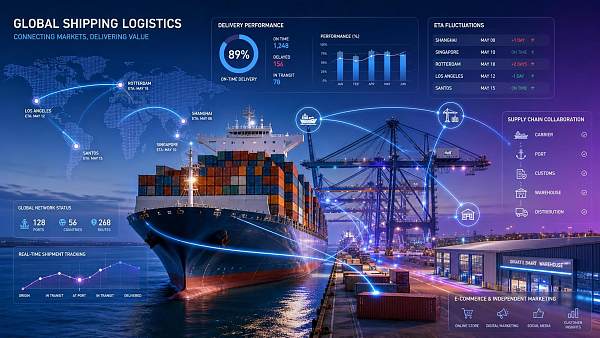
Starting August 10, 2026, direct sailings on the core Shanghai–Rotterdam route have contracted significantly. On July 30, Maersk, CMA CGM, and Hapag-Lloyd jointly announced that weekly direct sailings on this route would be reduced from 12 to 8, while the average space premium would increase by 23%. As a result, European orders are generally facing pressure from delivery cycles extending by 7 to 12 days. For foreign trade companies serving the European market, supply chain service providers that rely on stable sailing schedules, and sellers using independent websites to handle inquiries and orders, the key concern has shifted from simple freight-rate fluctuations to the interconnected risks involving delivery commitments, customer communication, and order conversion.
Key Information Confirmed for This Round of Route Adjustments
According to the information provided, the three shipping companies Maersk, CMA CGM, and Hapag-Lloyd jointly announced on July 30, 2026, that, due to the continuing Red Sea crisis and increased Suez Canal transit fees, direct sailings on the core Shanghai–Rotterdam route would be reduced from 12 to 8 per week starting August 10, 2026.
At the same time, the average premium for the relevant shipping space has reached 23%. In terms of delivery, this adjustment will generally extend the delivery cycle for orders from European customers by 7 to 12 days. The information provided also indicates that if foreign trade companies cannot synchronize logistics status in real time through a dynamic delivery-date module on their independent websites, they may face risks of declining inquiry conversion rates and customer loss.
From Booking to Closing, the Impact Extends Beyond Transportation
European-Facing Foreign Trade Orders Are First to Face Pressure on Delivery Commitments
The analysis indicates that foreign trade companies directly serving European customers will feel the impact first. The reason is not only the reduction in sailing frequency, but also the weakening stability of delivery-date commitments. For these companies, the impact is mainly reflected in quotation, order acceptance, delivery-date confirmation, and presales communication: once the delivery time stated on the website, in inquiry replies, or in order confirmations is not updated in a timely manner, customers’ expectations regarding fulfillment may become misaligned.
What deserves greater attention now is that the 7-to-12-day order delay is not an isolated logistics issue. It will directly affect customers’ purchasing decisions. In particular, for business models that rely on independent websites to generate inquiries, whether delivery information is displayed promptly and transparently will directly affect whether customers continue to advance their purchasing plans.
Production and Stocking Arrangements Require Recalibration
From an observational perspective, processing and manufacturing companies, as well as suppliers undertaking supporting supply tasks, will also be affected indirectly. The reduction in sailing frequency and increase in space premiums mean that the coordination between existing production completion times and shipping schedules has been disrupted. The impact is mainly reflected in production scheduling coordination, stocking pace, selection of shipping windows, and confirmation of delivery milestones with customers.
The change these companies need to monitor is whether their existing delivery-date templates remain applicable. If production and shipping continue to be arranged according to the previous sailing frequency, problems may arise later, such as goods waiting for available space after completion or previously promised delivery dates becoming difficult to fulfill.
Response Speed in Supply Chain Services Becomes a Key Variable
From an industry perspective, the importance of freight forwarders, logistics coordination service providers, and independent website technology services will increase further. This is because the current change is not merely a single price fluctuation; sailing frequency, transit time, and customer expectations are all under pressure at the same time. The impact is mainly reflected in space coordination, transit-time feedback, logistics-status synchronization, and the transmission of delivery information.
For service providers, the focus is not only on the increased difficulty of booking space, but also on how to transmit logistics changes to the front-end sales system in a timely manner. The information provided explicitly states that the real-time synchronization capability of dynamic delivery-date modules has become directly connected with inquiry conversion and customer retention.
Which Business Details Deserve Closer Attention Now
First, Monitor Whether Shipping Companies Further Adjust Their Subsequent Statements
The analysis indicates that companies should continue monitoring subsequent announcements related to this route adjustment, particularly whether sailing arrangements, space strategies, and transit-time explanations continue to change. Although the confirmed adjustment will take effect on August 10, 2026, what matters more in practical business operations is whether further tightening, continuation, or revision will follow.
Delivery-Date Displays on Independent Websites Need to Be Synchronized with Logistics Status
The information provided has already made clear that foreign trade companies need to synchronize logistics status in real time through dynamic delivery-date modules on their independent websites. The focus here is not whether a specific product is launched, but whether the delivery information displayed on the front end can be updated promptly in line with changes in sailing schedules and logistics conditions. If the information shown on the website remains based on the old schedule, the delivery time promised to inquiry customers may become disconnected from actual fulfillment capabilities.
For Orders in Key Markets, Communication Should Be Brought Forward to the Confirmation Stage
From an observational perspective, for orders from European customers, companies should move delivery-date communication forward to the quotation, inquiry-response, and order-confirmation stages. This is because the known impact is a general extension of the delivery cycle by 7 to 12 days, and whether customers accept the delay often depends on whether the information is transparent, rather than simply on whether the goods ultimately arrive. For business teams, the key points to verify are whether the commitment wording is consistent, whether customers are aware of the changes, and whether documentation and shipping arrangements match the new schedule.
Fulfillment Contingency Plans Should Focus on Making Delays Explainable
From a practical perspective, companies need to prepare not only internal scheduling adjustments, but also clear and continuous status updates for customers when delivery delays occur. The risk highlighted in the information provided is a decline in inquiry conversion rates and customer loss. This shows that fulfillment contingency plans should focus on visualized progress, timely notifications, and consistent communication, rather than merely providing passive explanations after an exception occurs.
This Is More Like a Stress Test of Delivery Management Capabilities
From the editor’s perspective, this news is currently better understood as a delivery management stress test triggered by changes on the shipping side, rather than merely a conventional report about rising ocean freight rates. The reduction from 12 to 8 sailings, the 23% average space premium, and the 7-to-12-day extension of delivery cycles all point to one issue: the buffer between front-end sales commitments and back-end logistics realities is narrowing.
Looking further, this development has both direct short-term impacts at the execution level and signals that require continued observation. In the short term, companies need to address order lead times and customer communication. From an industry perspective, however, the ability to quickly map logistics changes to delivery information on independent websites, inquiry replies, and fulfillment explanations will gradually become a basic capability in cross-border foreign trade operations. Therefore, this is neither a short-term fluctuation that can be ignored nor a basis for drawing longer-term, definitive conclusions about the industry.
The Reminder for the Foreign Trade Chain Is Already Clear
Overall, the industry significance of this news lies in the direct connection it establishes between route capacity adjustments, rising space costs, and delivery management on independent websites. For foreign trade companies that rely on the European market, it is currently more appropriate to view this as an operational variable that has already taken effect: changes on the shipping side have clearly occurred, pressure on order lead times can already be anticipated, but the scope and duration of the subsequent impact still require ongoing observation in light of further developments.
Rationally speaking, this is not an issue that can be resolved independently by a single link in the chain. It requires companies to review the coordination among space booking, production scheduling, delivery commitments, and customer communication, while in particular avoiding a disconnect between front-end promises and back-end execution. At this stage, the most practical approach is to first improve delivery transparency and response speed, and then observe whether subsequent changes in sailing schedules and costs continue to develop.
Basis of This Article and Directions for Further Verification
This article was generated based on the information title, event date, and event summary provided by the user. The information used includes the implementation date of August 10, 2026; the route adjustment jointly announced by Maersk, CMA CGM, and Hapag-Lloyd on July 30, 2026; the space premium; changes in delivery cycles; and the risk warning regarding dynamic delivery-date management on independent websites.
For this type of information, ongoing verification can generally be conducted by referring to official announcements, company announcements, industry association information, authoritative media reports, and relevant business documents. Since no specific official source links were provided in the input, this article cannot list specific links. Further observation and verification are still required regarding the shipping companies’ official statements, changes in route execution, and feedback from the delivery side of businesses.
Related Articles
 Amazon Launches a Refund Without Return Program for FBA Sellers Across Five European Marketplaces
 From November 1, the EU will require identification codes to be declared for each low-value item
 How Can You Evaluate Lead Generation Effectiveness for B2B Export Marketing Solutions with Long Sales Cycles?



Related Products
 Yiyingbao SaaS Intelligent Website Building and Marketing SystemYiyingbao SaaS Intelligent Website Building and Marketing System, AI-powered no-code website building, rapid creation of multilingual B2B international websites in 10 minutes, global server acceleration, AI-powered SEO optimization, helping businesses connect efficiently with global markets. The perfect integration of technology and operation makes building an international trade website remarkably simple
 AI+SEM Intelligent Advertising Marketing SystemAI+SEM drives intelligent ad creation, empowering full-funnel precision advertising marketing. The system automatically generates weekly/monthly reports, AI recommends keywords and target countries, monitors core metrics in real-time with intelligent alerts, and enables one-click high-conversion ad solutions to help quickly acquire customers and improve ROI.
 AI+SEO Dual-Engine System Optimization ServicesYiyingbao’s AI+SEO dual-engine optimization system helps foreign trade enterprises acquire high-quality organic traffic through AI-powered keyword research, content generation, and comprehensive technical optimization, significantly improving search rankings and conversion rates.
 AI+SNS Social Media Marketing SystemYingbao AI+SNS Social Media Marketing System - Precision social capture for the social media era. Supports one-click content synchronization across major platforms like Facebook and LinkedIn. AI intelligently rewrites posts for enhanced relevance. 24/7 AI customer service and user profiling analysis empower businesses to efficiently expand into global markets.
 AI+SEO营销解决方案易营宝AI+SEO营销解决方案,通过AI批量写作、智能生成TDK、精准关键词扩词等功能,全面优化网站SEO效果,提升流量与转化率。助力企业构建高效智能网站新生态。
 AI+SEM Advertising Marketing SolutionsAI+SEM Advertising Marketing Solution leverages AI technology to deeply empower SEM ad campaigns. It automatically generates weekly/monthly reports using AI, presenting account data across multiple dimensions for comprehensive insights into campaign performance and trends. The system precisely recommends keywords and target countries, intelligently generates high-conversion ad copy, and enables one-click activation of efficient campaign plans to help businesses rapidly acquire customers. Simultaneously, it monitors core metrics in real time, intelligently identifies abnormal fluctuations, and issues timely alerts to ensure stable, high-return advertising results.
 Domain Name ServicesEasyWin provides professional domain name services, including intelligent queries, one-stop registration, brand protection, and full lifecycle management, helping businesses build a digital brand image.
 EasyOperate B2C Cross-Border E-Commerce Platform & Independent WebsiteEasyStore B2C Cross-border E-commerce Independent Store is an intelligent website building and cross-border e-commerce integrated solution independently developed by EasyStore Information Technology (Beijing) Co., Ltd. The system is specially designed for small and medium-sized as well as large export enterprises, integrating 'website building, operation, marketing, advertising, and conversion' into one, helping enterprises quickly establish cross-border e-commerce independent stores to achieve brand globalization and global sales growth.
The platform supports multiple languages, multiple currencies, and multi-channel marketing, with built-in AI intelligent translation and SEO optimization systems, suitable for mainstream markets such as Southeast Asia, Europe and America, Latin America, and the Middle East, assisting Chinese manufacturing enterprises in efficiently deploying international e-commerce strategies. SSL证书易营宝提供专业SSL安全证书服务,包括单域名和泛域名证书,确保网站数据传输加密、身份验证和完整性保护,助力企业建立安全可信的在线业务环境。









