









- Can the average annual growth rate reflect real opportunities in overseas markets?Oct 07, 2026View details
- Which customer acquisition channels will be affected by cross-border marketing trends in 2026?Sep 06, 2026View details
- Which homogenization risks should be considered in an analysis of the AI-powered website building industry?Aug 30, 2026View details
- How Will AI Marketing Trends 2026 Change Advertising Budget AllocationAug 28, 2026View details
- Is the EV SSL certificate market shrinking or upgrading? How should companies assess certificate procurement?Aug 11, 2026View details
- Why the old AMP SEO 2020 practices no longer work and what has changed in current optimization prioritiesAug 02, 2026View details
How to Estimate the Turnaround Time for Translating a Corporate Website Based on Page Volume
How to Estimate Corporate Website Translation Turnaround Time Based on Page Volume
How long does it take to deliver a corporate website translation? Simply stating the number of pages is unlikely to produce a reliable estimate. Translating ten technical solution pages may take more work than translating dozens of product pages that use the same template. Project managers should estimate the schedule based on page volume, content repetition, and language complexity, and schedule translation delivery separately from website launch.
A more reliable approach is to start by taking inventory of the content, then confirm capacity with a trial translation of representative pages, and finally allow time for review, content entry, and acceptance testing. This provides a practical basis for setting the delivery date.
Page Count Is Only a Starting Point: First Identify the Content to Be Processed
For each URL, the page inventory should record the page type, source word count, repeated content, target language, and reviewer. Shared content such as navigation, footers, and inquiry forms should be counted separately to avoid duplicate billing and scheduling on every page. Text in images, downloadable materials, and prompts should not be overlooked either.
Repetition rates should not be treated as equivalent to percentage savings. Even changing a single number in “Suitable for different pressure ranges” can affect product selection decisions. Identical copy that has been approved can be reused, but similar content still needs to be reviewed and should not be entirely deducted from the workload.
Use Trial Translation Output to Convert Page Volume into Workdays
Select one homepage, one product page, and one technical page for a trial translation to confirm terminology, writing style, and the level of review required. Then estimate based on the effective daily output measured during the trial, rather than applying a generic estimate of “how many pages one person can translate per day.” The source text count must also be standardized in advance, whether it is based on Chinese characters or foreign-language words.
Translation workdays ≈ effective word count to be processed ÷ the team’s confirmed effective daily output. If this output covers only initial translation, review time should be listed separately; if it already includes review, do not count it twice. The final delivery date also depends on content preparation, client approval, and whether the different stages can run in parallel.
Here is a sample scheduling calculation: Assume a website has 40 pages, averaging 500 words per page, for a total of 20,000 words. After review, 6,000 words are confirmed as reusable, leaving 14,000 words to process. If both parties confirm after the trial translation that the team can complete 3,500 words of initial translation and review per day, this stage will take about four working days. Assuming one day for terminology preparation, two days for client review, and two days for content entry and acceptance testing, with all stages running sequentially, the total is about nine working days. These figures are for calculation purposes only and do not represent a fixed delivery commitment.
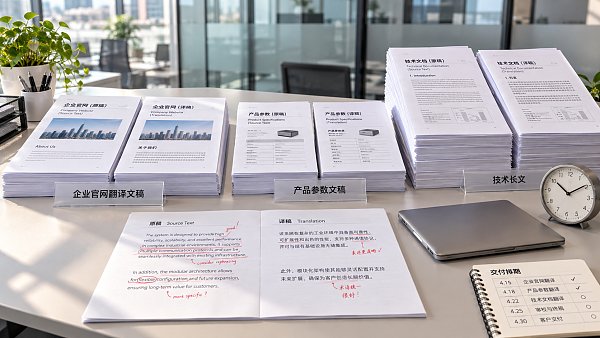
Adding pages does not necessarily mean extending the schedule in direct proportion. A large number of product pages using the same template may be suitable for batch processing, while a new technical topic may require terminology to be confirmed again. Adding translators also does not mean the schedule will be cut in half; style consistency, task handoffs, and final review capacity must also be considered.
The Biggest Delays Often Come from More Than the Translation Itself
For multilingual projects, confirm the resources available for each language separately. The availability of professional reviewers and the need to adapt wording for local markets will both affect progress. Different languages can be handled in parallel, but if other languages depend on intermediate translations that have not been finalized, revisions to an earlier stage may trigger a chain of rework.
Frequent source-text changes are another risk. Before work begins, freeze a version and have one person consolidate feedback from the engineering, sales, and brand teams. Add new pages and subsequent revisions to a change log, specifying whether they affect the delivery date to avoid multiple versions circulating at the same time.
For projects involving overseas promotion, confirm whether page titles, descriptions, link text, and inquiry buttons are included in scope. Keyword localization is more than simply replacing words; it may require changes to titles and content focus. This should be planned before translation begins, rather than added after delivery.
Set Separate Acceptance Milestones for “Translation Delivered” and “Ready to Launch”
Passing translation review does not mean a page is ready to publish. Longer text may cause buttons to wrap, and some languages require a change in reading direction. Mobile layouts, language switching, form prompts, parameter units, and download links all need to be checked on the actual pages. Whether content will be pasted manually or imported in batches should also be confirmed in advance.
Founded in 2013 and headquartered in Beijing, EasySite Information Technology (Beijing) Co., Ltd. provides AI-powered website building, multilingual website development, SEO, and overseas advertising and marketing services. For integrated website and marketing projects of this kind, it is helpful to include the translation inventory, page content entry, and promotional preparations in the same schedule, avoiding situations where copy has been delivered but the website development or advertising stage is still waiting.
Before confirming a date, verify at least three things: whether the pages and word counts have been fully inventoried, whether reviewers can provide feedback on time, and whether the scope ends with translated copy or includes launch acceptance testing. If the launch date cannot be changed, prioritize core product pages, inquiry paths, and advertising landing pages, then process supporting materials in batches instead of making the entire site wait for the final article.
Related Articles

Related Products
 Yiyingbao SaaS Intelligent Website Building and Marketing SystemYiyingbao SaaS Intelligent Website Building and Marketing System, AI-powered no-code website building, rapid creation of multilingual B2B international websites in 10 minutes, global server acceleration, AI-powered SEO optimization, helping businesses connect efficiently with global markets. The perfect integration of technology and operation makes building an international trade website remarkably simple
 AI+SEM Intelligent Advertising Marketing SystemAI+SEM drives intelligent ad creation, empowering full-funnel precision advertising marketing. The system automatically generates weekly/monthly reports, AI recommends keywords and target countries, monitors core metrics in real-time with intelligent alerts, and enables one-click high-conversion ad solutions to help quickly acquire customers and improve ROI.
 AI+SEO Dual-Engine System Optimization ServicesYiyingbao’s AI+SEO dual-engine optimization system helps foreign trade enterprises acquire high-quality organic traffic through AI-powered keyword research, content generation, and comprehensive technical optimization, significantly improving search rankings and conversion rates.
 AI+SNS Social Media Marketing SystemYingbao AI+SNS Social Media Marketing System - Precision social capture for the social media era. Supports one-click content synchronization across major platforms like Facebook and LinkedIn. AI intelligently rewrites posts for enhanced relevance. 24/7 AI customer service and user profiling analysis empower businesses to efficiently expand into global markets.
 AI+SEO营销解决方案易营宝AI+SEO营销解决方案,通过AI批量写作、智能生成TDK、精准关键词扩词等功能,全面优化网站SEO效果,提升流量与转化率。助力企业构建高效智能网站新生态。
 AI+SEM Advertising Marketing SolutionsAI+SEM Advertising Marketing Solution leverages AI technology to deeply empower SEM ad campaigns. It automatically generates weekly/monthly reports using AI, presenting account data across multiple dimensions for comprehensive insights into campaign performance and trends. The system precisely recommends keywords and target countries, intelligently generates high-conversion ad copy, and enables one-click activation of efficient campaign plans to help businesses rapidly acquire customers. Simultaneously, it monitors core metrics in real time, intelligently identifies abnormal fluctuations, and issues timely alerts to ensure stable, high-return advertising results.
 Domain Name ServicesEasyWin provides professional domain name services, including intelligent queries, one-stop registration, brand protection, and full lifecycle management, helping businesses build a digital brand image.
 EasyOperate B2C Cross-Border E-Commerce Platform & Independent WebsiteEasyStore B2C Cross-border E-commerce Independent Store is an intelligent website building and cross-border e-commerce integrated solution independently developed by EasyStore Information Technology (Beijing) Co., Ltd. The system is specially designed for small and medium-sized as well as large export enterprises, integrating 'website building, operation, marketing, advertising, and conversion' into one, helping enterprises quickly establish cross-border e-commerce independent stores to achieve brand globalization and global sales growth.
The platform supports multiple languages, multiple currencies, and multi-channel marketing, with built-in AI intelligent translation and SEO optimization systems, suitable for mainstream markets such as Southeast Asia, Europe and America, Latin America, and the Middle East, assisting Chinese manufacturing enterprises in efficiently deploying international e-commerce strategies. SSL证书易营宝提供专业SSL安全证书服务,包括单域名和泛域名证书,确保网站数据传输加密、身份验证和完整性保护,助力企业建立安全可信的在线业务环境。









