









- Can the average annual growth rate reflect real opportunities in overseas markets?Oct 07, 2026View details
- Which customer acquisition channels will be affected by cross-border marketing trends in 2026?Sep 06, 2026View details
- Which homogenization risks should be considered in an analysis of the AI-powered website building industry?Aug 30, 2026View details
- How Will AI Marketing Trends 2026 Change Advertising Budget AllocationAug 28, 2026View details
- Is the EV SSL certificate market shrinking or upgrading? How should companies assess certificate procurement?Aug 11, 2026View details
- Why the old AMP SEO 2020 practices no longer work and what has changed in current optimization prioritiesAug 02, 2026View details
How to Evaluate Arabic Localization Quality for Short-Form Video Marketing Services in the Middle East
When accepting a short-video project localized into Arabic for the Middle East, do not check only whether the translation is correct. Confirm that people in the target market can understand it naturally, that the finished video displays correctly, and that viewers can continue to submit an inquiry or make a purchase after clicking. Approval of the Arabic script does not mean the voice-over, subtitles, and landing page are also acceptable.
Before purchasing, specify the target country, audience language, voice-over accent, subtitle requirements, and scope of page adaptation in the delivery agreement, then assess the work against the same criteria. If you agree only to “an Arabic version,” the supplier may treat the deliverable as a translation, while you assess it as full localization, making rework costs difficult to determine.
First, define which market the Arabic version is for
The Middle East should not be treated as a single-language market, and Arabic should not be equated with any one spoken variety. Modern Standard Arabic is suitable for communication across regions; for short videos that aim for a conversational feel, whether to use a local dialect should be determined according to the target country and audience. Saudi Arabia and the UAE should not be assumed to share fully interchangeable language based solely on the label “Gulf accent.”
More localized dialect is not necessarily better. Introductions to industrial equipment, technical specifications, and distributor partnerships require accurate terminology and clearly stated conditions; lifestyle content and on-camera speech should also take tone and communication habits into account. The choice should be based on the content’s purpose, not on how many dialects the supplier can offer.
The language approval form should specify the target country, target customers, content context, voice-over language, and subtitle language. It should also confirm whether conversational wording is permitted in the spoken script, whether subtitles should retain Standard Arabic expressions, and how brand names and technical terms should be pronounced. For audiences who speak languages other than Arabic, determine separate language versions; do not use “Middle East version” as a catch-all.
Review must cover the final video
A Chinese back-translation from the supplier can help check whether information has been omitted, but it cannot prove that the Arabic sounds natural. A sentence may back-translate correctly and still have awkward word order, an unsuitable form of address, or an inappropriate accent. A more effective approach is to have an independent reviewer familiar with the target market check the Arabic and link each comment to the specific sentence and video timecode.
The review should also check the original business materials. For example, a minimum order quantity must not be changed into a recommended purchase quantity; “certification documents can be provided” must not be rendered as “certified”; and lead times must not be stated without their applicable conditions. Such discrepancies are not just language issues; they can change commitments made to customers.
Voice-over acceptance should also check how model numbers, units, figures, and abbreviations are read, and whether emphasis shifts the meaning of a selling point or a limitation. AI-generated voice-overs should be accompanied by the same review records; “system-generated” is not a reason to exempt them from review.
Correct subtitles are not necessarily usable on a phone
Arabic is written from right to left. When English model numbers, phone numbers, prices, and URLs are mixed into the text, check the order and punctuation of each item. Even if the text is correct in the design software, inspect connected letterforms, missing fonts, line breaks, and subtitle timing in the exported video. Do not approve it based only on a screenshot of the script.
Check the video in a mobile preview on the target platform: Are subtitles obscured by buttons or description areas? Is there enough time to read them? Has a word been split across lines? Have conditions been separated from the main statement? Do not judge subtitle font size by a fixed number alone; verify it against the actual image, screen size, and viewing distance.
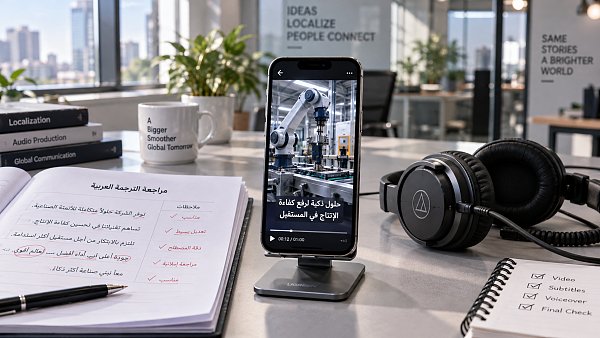
If the direction of the visuals needs to be adjusted, do not simply mirror the entire video. Brand marks, product operating directions, equipment nameplates, and interface screenshots may all become incorrect as a result. Adjust the reading flow and information layout rather than indiscriminately reversing all the assets.
Check the video’s claims all the way through to the landing page
When a short video directs viewers to an Arabic landing page, acceptance should not stop at the video file. Product names, offer terms, currency, and inquiry methods in the ad should match the page. If the video promises a quote but the page contains only a general company introduction, the language may be accurate, but the customer journey is incomplete.
Test right-to-left layouts, mixed Arabic and English text, form error messages, buttons, and submission success messages on the actual page. Fields such as phone numbers, email addresses, and model numbers should not be mechanically reversed, and mobile country codes should match the service area. If inquiries are handled through WhatsApp, also check that the link, pre-filled message, and language used in follow-up conversations work together.
If another supplier maintains the page, agree in advance on who is responsible for changes and the scope of integration testing. Otherwise, the video supplier may consider the job complete once the link opens, while the website supplier may assume the client is responsible for the Arabic text, leaving the issue unresolved at the boundary between their services.
Including rework terms in the quote matters more than comparing the price of a single item
When comparing quotes for short-video marketing services in the Middle East, distinguish whether translation, transcreation, voice-over, subtitle layout, native-language review, and landing-page integration are billed separately. The line item “Arabic localization” does not explain what work is actually included.
Consider first producing a paid sample video that represents the project and includes technical terms, on-camera speech, mixed-language subtitles, and a call to action. Once the sample is approved, proceed with batch production and lock down the glossary, voice-over sample, and subtitle style. This allows you to verify the supplier’s capabilities and avoid discovering after batch delivery that the style is unsuitable.
Acceptance issues can be grouped by impact: mistranslated prices, specifications, or commitments, and broken links, should be corrected before publication; obvious grammar errors, missing subtitles, and obstruction of key content should be designated for rework; stylistic preferences that do not affect comprehension should be assessed against the approved sample. These specific categories must be agreed in the contract and should not be presented as a universal industry standard.
Payment milestones should correspond to verifiable deliverables: script approval, sample approval, batch video delivery, and landing-page integration. Bill separately for correcting errors covered by the agreement and for changes to requirements, and specify the scope of re-review after revisions. The delivery package should include at least the final script, subtitle files, finished videos, glossary, and issue closure records, so that switching suppliers later does not mean paying again for basic preparation.
Views, click-through rates, and cost per inquiry are affected by advertising, audience, and product competitiveness, so they cannot independently prove Arabic quality. A sounder purchasing decision is to first verify that the deliverables meet reviewable language and functional criteria, then test how the content performs through a small-scale campaign. This keeps localization responsibility separate from responsibility for marketing results.
Related Articles
Related Products
 Yiyingbao SaaS Intelligent Website Building and Marketing SystemYiyingbao SaaS Intelligent Website Building and Marketing System, AI-powered no-code website building, rapid creation of multilingual B2B international websites in 10 minutes, global server acceleration, AI-powered SEO optimization, helping businesses connect efficiently with global markets. The perfect integration of technology and operation makes building an international trade website remarkably simple
 AI+SEM Intelligent Advertising Marketing SystemAI+SEM drives intelligent ad creation, empowering full-funnel precision advertising marketing. The system automatically generates weekly/monthly reports, AI recommends keywords and target countries, monitors core metrics in real-time with intelligent alerts, and enables one-click high-conversion ad solutions to help quickly acquire customers and improve ROI.
 AI+SEO Dual-Engine System Optimization ServicesYiyingbao’s AI+SEO dual-engine optimization system helps foreign trade enterprises acquire high-quality organic traffic through AI-powered keyword research, content generation, and comprehensive technical optimization, significantly improving search rankings and conversion rates.
 AI+SNS Social Media Marketing SystemYingbao AI+SNS Social Media Marketing System - Precision social capture for the social media era. Supports one-click content synchronization across major platforms like Facebook and LinkedIn. AI intelligently rewrites posts for enhanced relevance. 24/7 AI customer service and user profiling analysis empower businesses to efficiently expand into global markets.
 AI+SEO营销解决方案易营宝AI+SEO营销解决方案,通过AI批量写作、智能生成TDK、精准关键词扩词等功能,全面优化网站SEO效果,提升流量与转化率。助力企业构建高效智能网站新生态。
 AI+SEM Advertising Marketing SolutionsAI+SEM Advertising Marketing Solution leverages AI technology to deeply empower SEM ad campaigns. It automatically generates weekly/monthly reports using AI, presenting account data across multiple dimensions for comprehensive insights into campaign performance and trends. The system precisely recommends keywords and target countries, intelligently generates high-conversion ad copy, and enables one-click activation of efficient campaign plans to help businesses rapidly acquire customers. Simultaneously, it monitors core metrics in real time, intelligently identifies abnormal fluctuations, and issues timely alerts to ensure stable, high-return advertising results.
 Domain Name ServicesEasyWin provides professional domain name services, including intelligent queries, one-stop registration, brand protection, and full lifecycle management, helping businesses build a digital brand image.
 EasyOperate B2C Cross-Border E-Commerce Platform & Independent WebsiteEasyStore B2C Cross-border E-commerce Independent Store is an intelligent website building and cross-border e-commerce integrated solution independently developed by EasyStore Information Technology (Beijing) Co., Ltd. The system is specially designed for small and medium-sized as well as large export enterprises, integrating 'website building, operation, marketing, advertising, and conversion' into one, helping enterprises quickly establish cross-border e-commerce independent stores to achieve brand globalization and global sales growth.
The platform supports multiple languages, multiple currencies, and multi-channel marketing, with built-in AI intelligent translation and SEO optimization systems, suitable for mainstream markets such as Southeast Asia, Europe and America, Latin America, and the Middle East, assisting Chinese manufacturing enterprises in efficiently deploying international e-commerce strategies. SSL证书易营宝提供专业SSL安全证书服务,包括单域名和泛域名证书,确保网站数据传输加密、身份验证和完整性保护,助力企业建立安全可信的在线业务环境。









