









- Which customer acquisition channels will be affected by cross-border marketing trends in 2026?Sep 06, 2026View details
- Which homogenization risks should be considered in an analysis of the AI-powered website building industry?Aug 30, 2026View details
- How Will AI Marketing Trends 2026 Change Advertising Budget AllocationAug 28, 2026View details
- Is the EV SSL certificate market shrinking or upgrading? How should companies assess certificate procurement?Aug 11, 2026View details
- Why the old AMP SEO 2020 practices no longer work and what has changed in current optimization prioritiesAug 02, 2026View details
- How to Choose Topics for an Industry News Section to Attract More Organic Search TrafficJul 29, 2026View details
How can a cross-border brand website synchronize multilingual content?
How Cross-Border Brand Websites Can Synchronize Multilingual Content
Introduction: How cross-border brand websites synchronize multilingual content directly affects the global user experience and search visibility. With AI and centralized management, businesses can improve translation efficiency, SEO performance, and localized conversions.
First, Understand This: What Businesses Truly Need Is Not “Translation,” but Controllable Multilingual Operations

Businesses searching for “how cross-border brand websites synchronize multilingual content” are usually not simply looking for a translation tool. They want to solve practical issues such as unsynchronized content updates, loss of control over overseas pages, fragmented SEO traffic, and excessive maintenance costs.
For export-oriented factories, cross-border sellers, and global brands, product specifications, pricing strategies, campaign pages, and brand news frequently change. If each update requires different personnel to copy, translate, and publish pages one by one, errors are almost inevitable.
Therefore, the core goal of multilingual content synchronization should be to enable one content source to be distributed to websites in different languages according to defined rules, while retaining the necessary room for localization adjustments in each market, rather than mechanically converting Chinese pages into foreign-language pages.
Managers are most concerned about whether the investment is worthwhile, while execution teams focus more on operational efficiency. A good solution must address four questions at the same time: who is responsible for content, which content is synchronized automatically, which content may be adapted, and how to ensure that search engines can index it correctly.
Why Direct Copying and Translation Often Affect Overseas Conversions and SEO
In the early stages, many companies copy Chinese content to English, German, or Spanish pages and launch them quickly through machine translation. Although this approach seems cost-effective, product terminology, units of measurement, purchasing practices, and styles of expression often fail to meet local user expectations.
For example, B2B buyers place greater importance on certifications, lead times, minimum order quantities, and technical specifications, while B2C consumers are more concerned about materials, delivery, returns and exchanges, and reviews. The same information priorities should also differ in page structure and presentation order across language markets.
From an SEO perspective, multilingual pages cannot simply replace text. If URL structures are disorganized, page language tags are missing, or content across multiple language pages is highly duplicated, Google may have difficulty determining which version should be shown to users in a particular country and language.
A more common issue is disconnected content updates: the Chinese site has already changed a product model, while the English site still displays old specifications; headquarters has discontinued a product, but overseas landing pages are still running ads for it. Such issues not only damage trust but also waste advertising budgets.
For Multilingual Content Synchronization, First Establish a “Master Content Repository + Localization Layer”
A more suitable approach for cross-border brands is to establish a unified master content repository. Product names, core selling points, specification parameters, image assets, downloadable files, and basic SEO fields can be centrally maintained in the backend and then synchronized to front-end pages by language version.
Information with a high degree of standardization is suitable for automatic synchronization, such as model numbers, dimensions, materials, certificates, technical parameters, and images. Such content changes frequently and requires accuracy, so centralized updates can significantly reduce omissions in multi-site maintenance.
Market-facing content, however, should retain localized editing permissions, such as title wording, above-the-fold selling points, case references, call-to-action buttons, shipping instructions, and holiday campaigns. This content directly affects user understanding and inquiry conversion and should not rely entirely on literal translation.
Businesses can divide content into three categories: “must remain consistent,” “adjustments allowed,” and “locally unique.” Defining the rules first and then configuring system synchronization relationships can prevent repeated communication between headquarters and regional teams regarding content responsibilities and authority.
Manufacturing companies with a large number of products should also establish field templates. By entering product attributes, application scenarios, FAQs, and certification information in a standardized manner, structured content can be quickly used when adding new languages later, without having to reorganize materials for the entire website.
How to Achieve Both Synchronization Efficiency and Localization Quality
AI can handle tasks such as initial translation, terminology matching, title generation, and meta description suggestions, making it particularly suitable for the batch processing of product catalogs, technical materials, and long-tail content. However, AI output should undergo necessary review by brand, sales, or local market personnel.
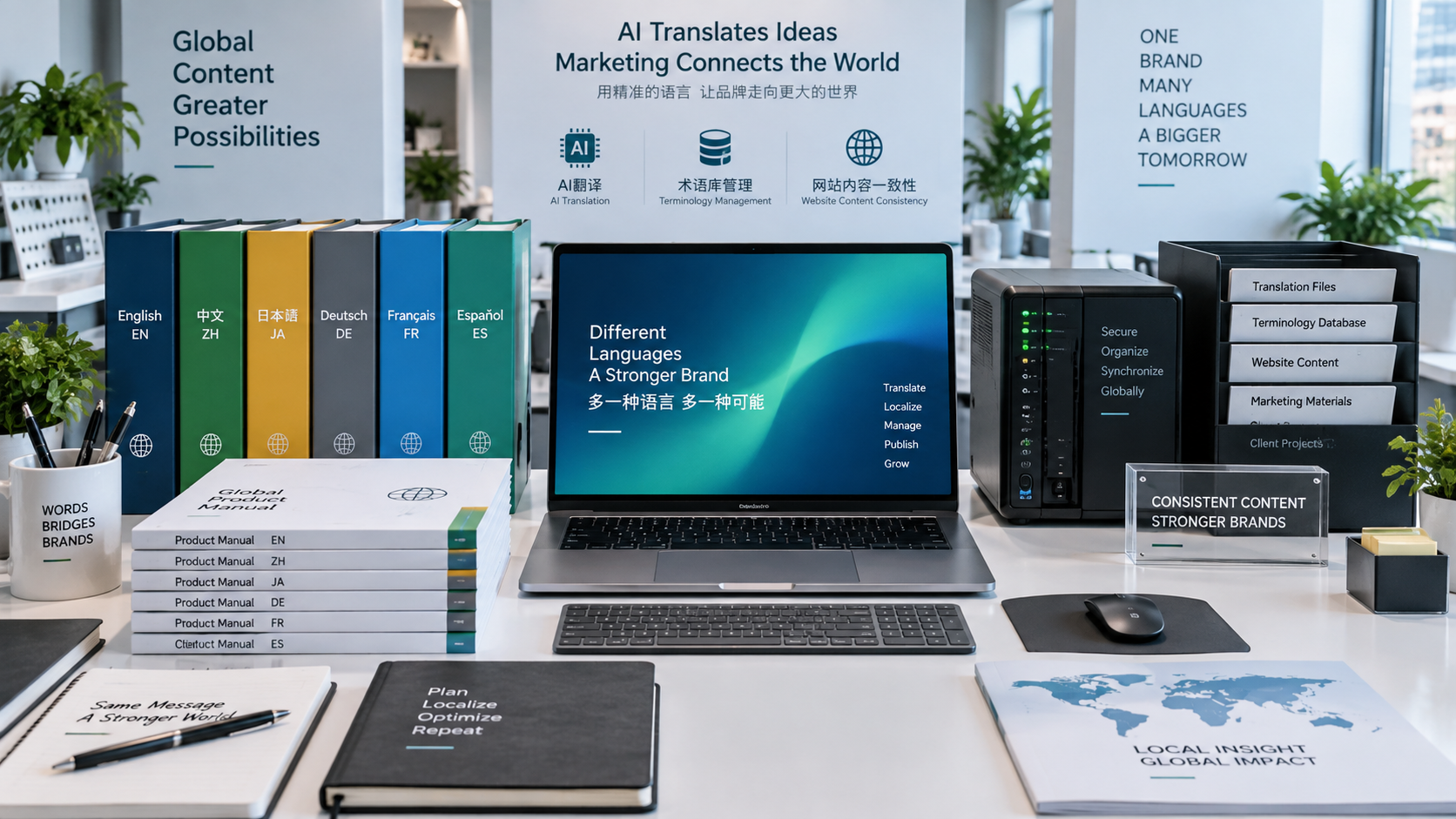
Businesses are advised to first establish a terminology database to standardize brand names, product names, core processes, certification names, and prohibited wording. This ensures that whether content is translated manually or generated by AI, the same product does not appear under multiple inconsistent names across different pages.
The content workflow can be set as follows: after Chinese or primary-language content is approved, translation tasks are automatically generated; after AI completes the first draft, it enters human proofreading; once publication is confirmed, it is synchronized to the corresponding language pages, while version records and revision histories are retained.
For urgent pricing, inventory, lead-time, or compliance information, a priority synchronization mechanism should be established. Such fields should not wait until the entire piece of content has been manually completed before publication; otherwise, inconsistencies may arise between sales commitments and website displays.
At the same time, publishing calendars should be established for different markets. Holidays, industry trade shows, and purchasing cycles differ across North America, Europe, the Middle East, and Latin America, and local teams need to be able to independently schedule marketing content within a unified brand framework.
Which Technical Configurations Must Be Synchronized for Multilingual SEO
After multilingual content goes live, search engines also need to understand the relationship between corresponding pages. Each language version should have a clear and stable URL. Common approaches include subdirectories, subdomains, or separate country domains; the key is to maintain consistency over the long term.
Pages should be configured with hreflang language and regional tags to help Google correctly match English, French, Japanese, and other versions to the appropriate users. When targeting multiple English-speaking markets, a general English version and regional versions should also be differentiated according to actual business needs.
Do not force all language pages to redirect to the country associated with the visitor's IP address. During search engine crawling and visits by overseas buyers, forced redirects may make pages inaccessible. A more reliable approach is to provide prominent language and region switching options.
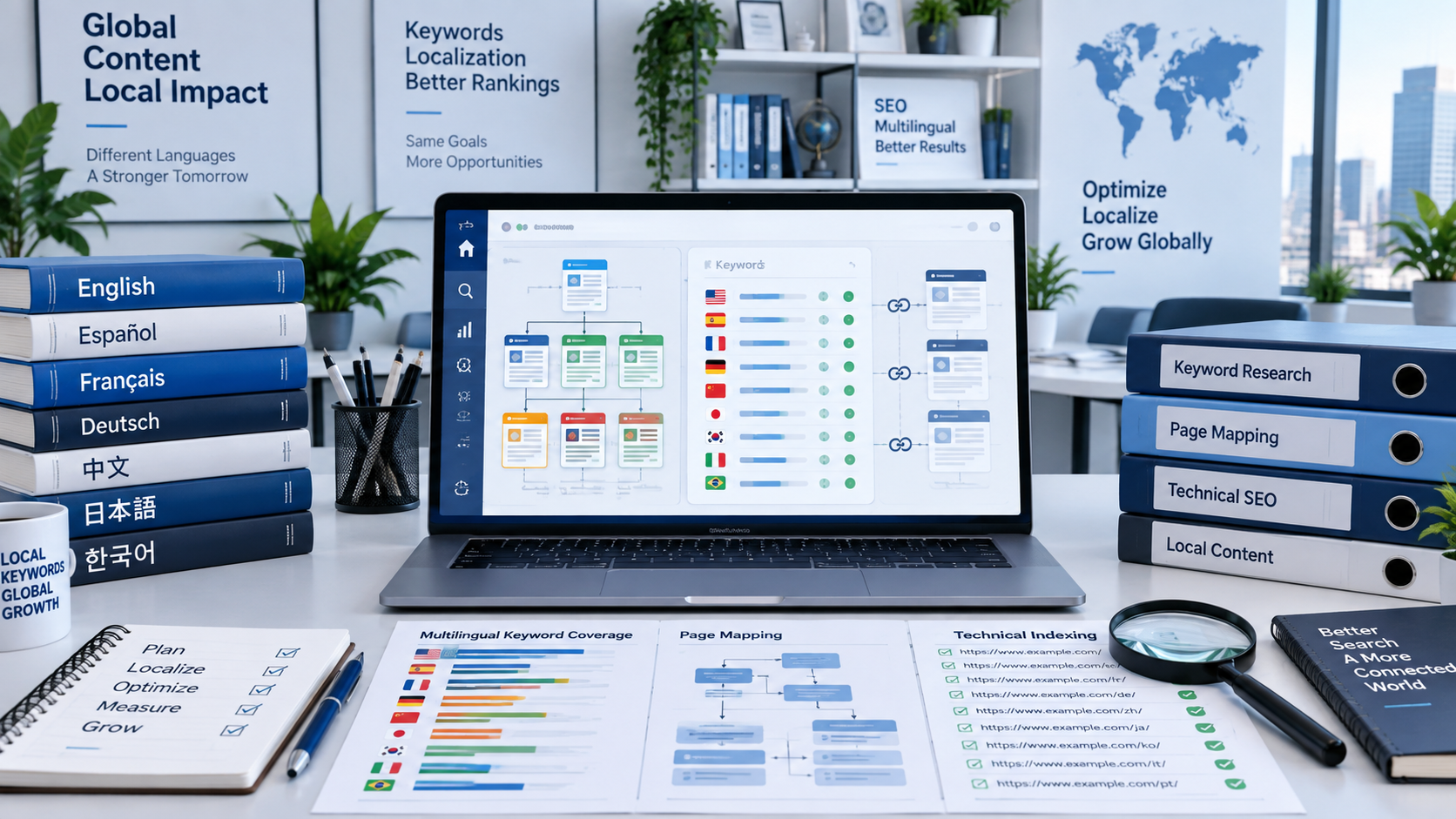
Titles, descriptions, image alt text, and internal links for each language should correspond to local keywords. Direct translations of Chinese keywords may not necessarily have search volume, so businesses should redefine their keyword database based on local users' product terminology, purchasing habits, and search intent.
For published pages, continue monitoring indexing, rankings, bounce rates, inquiry rates, and time on page. If a language version has traffic but low conversion, the issue may not be translation quality, but rather pricing methods, trust-building content, or CTA design.
When Choosing a Website Building and Content Management Solution, Focus on These Five Capabilities
First, check whether it supports maintenance in one location and multilingual distribution, with synchronization rules configurable by field. Systems that only copy entire pages and cannot distinguish between parameters, SEO fields, and local copy will still be cumbersome to manage later.
Second, check whether it supports multi-role collaboration, approval workflows, and version traceability. When headquarters, product departments, overseas sales teams, and distributors participate in content, permissions must be clearly defined to prevent unapproved translations from directly overwriting official pages.
Third, check whether its SEO fundamentals are complete, including multilingual URLs, hreflang, sitemaps, page speed, mobile compatibility, and editable metadata. A multilingual site is not better simply because it has more pages; every page should meet the conditions for indexing.
Fourth, check whether the system can connect with advertising, forms, CRM, and data analytics. Businesses need to know which inquiries come from different countries, languages, and pages in order to determine whether investment in content synchronization is truly driving overseas growth.
Fifth, check whether the service provider understands target-market localization. Technology platforms can improve efficiency, but content strategies, payment preferences, and trust factors differ across markets such as North America, Europe, Japan and South Korea, and the Middle East, and still require continuous optimization based on business scenarios.
Conclusion: Manage Multilingual Websites as Long-Term Growth Assets
Multilingual content synchronization for cross-border brand websites should not be viewed as a one-time translation project, but as an ongoing operating mechanism covering content creation, review and publication, SEO indexing, and conversion analysis. Only by first unifying the content foundation and then creating differentiated expressions for each market can businesses balance efficiency and quality.
For companies expanding overseas, the most practical assessment criterion is this: when product, campaign, or brand information changes, can the team quickly and accurately update all key language pages, and clearly identify which markets are generating real business opportunities?
With AI-powered website building, multilingual content management, and SEO data monitoring, businesses can reduce repetitive maintenance costs, keep overseas independent websites consistent in information, search-friendly, and aligned with local users' reading habits, thereby providing a stable foundation for long-term customer acquisition and brand growth.
Related Articles
Related Products
 Yiyingbao SaaS Intelligent Website Building and Marketing SystemYiyingbao SaaS Intelligent Website Building and Marketing System, AI-powered no-code website building, rapid creation of multilingual B2B international websites in 10 minutes, global server acceleration, AI-powered SEO optimization, helping businesses connect efficiently with global markets. The perfect integration of technology and operation makes building an international trade website remarkably simple
 AI+SEM Intelligent Advertising Marketing SystemAI+SEM drives intelligent ad creation, empowering full-funnel precision advertising marketing. The system automatically generates weekly/monthly reports, AI recommends keywords and target countries, monitors core metrics in real-time with intelligent alerts, and enables one-click high-conversion ad solutions to help quickly acquire customers and improve ROI.
 AI+SEO Dual-Engine System Optimization ServicesYiyingbao’s AI+SEO dual-engine optimization system helps foreign trade enterprises acquire high-quality organic traffic through AI-powered keyword research, content generation, and comprehensive technical optimization, significantly improving search rankings and conversion rates.
 AI+SNS Social Media Marketing SystemYingbao AI+SNS Social Media Marketing System - Precision social capture for the social media era. Supports one-click content synchronization across major platforms like Facebook and LinkedIn. AI intelligently rewrites posts for enhanced relevance. 24/7 AI customer service and user profiling analysis empower businesses to efficiently expand into global markets.
 AI+SEO营销解决方案易营宝AI+SEO营销解决方案,通过AI批量写作、智能生成TDK、精准关键词扩词等功能,全面优化网站SEO效果,提升流量与转化率。助力企业构建高效智能网站新生态。
 AI+SEM Advertising Marketing SolutionsAI+SEM Advertising Marketing Solution leverages AI technology to deeply empower SEM ad campaigns. It automatically generates weekly/monthly reports using AI, presenting account data across multiple dimensions for comprehensive insights into campaign performance and trends. The system precisely recommends keywords and target countries, intelligently generates high-conversion ad copy, and enables one-click activation of efficient campaign plans to help businesses rapidly acquire customers. Simultaneously, it monitors core metrics in real time, intelligently identifies abnormal fluctuations, and issues timely alerts to ensure stable, high-return advertising results.
 Domain Name ServicesEasyWin provides professional domain name services, including intelligent queries, one-stop registration, brand protection, and full lifecycle management, helping businesses build a digital brand image.
 EasyOperate B2C Cross-Border E-Commerce Platform & Independent WebsiteEasyStore B2C Cross-border E-commerce Independent Store is an intelligent website building and cross-border e-commerce integrated solution independently developed by EasyStore Information Technology (Beijing) Co., Ltd. The system is specially designed for small and medium-sized as well as large export enterprises, integrating 'website building, operation, marketing, advertising, and conversion' into one, helping enterprises quickly establish cross-border e-commerce independent stores to achieve brand globalization and global sales growth.
The platform supports multiple languages, multiple currencies, and multi-channel marketing, with built-in AI intelligent translation and SEO optimization systems, suitable for mainstream markets such as Southeast Asia, Europe and America, Latin America, and the Middle East, assisting Chinese manufacturing enterprises in efficiently deploying international e-commerce strategies. SSL证书易营宝提供专业SSL安全证书服务,包括单域名和泛域名证书,确保网站数据传输加密、身份验证和完整性保护,助力企业建立安全可信的在线业务环境。









