









- Hapag-Lloyd’s $4.2 billion acquisition of ZIM faces a closing delay; ZIM reports third-quarter net profit of $830 millionNov 24, 2026View details
- SCFI falls for a third straight week to 3,503.78 points, with blank sailings on trans-Pacific routes rising to 10Nov 24, 2026View details
- Lazada 11.11 Mega Sale: LazMall Contributes Nearly Two-Thirds of GMVNov 23, 2026View details
- Shein’s European Revenue Falls 16% as Tighter Rules on Low-Value Direct Shipments Take EffectNov 23, 2026View details
- EU Low-Value Parcel Rules Impact Cargo Flows: Air Freight Volume from China to Europe Down 17% in OctoberNov 23, 2026View details
- Indonesia and the EU Sign Comprehensive Economic Partnership Agreement, 90.4% of Tariff Lines to Become Duty-Free ImmediatelyNov 23, 2026View details
How can cross-border e-commerce businesses localize product descriptions for overseas markets?
To localize product descriptions for overseas markets, first confirm how local customers search for, compare, and use the products. Then adjust the title, selling points, specifications, and purchase guidance. Verify the product facts before revising the wording: natural language is only the starting point. Dimensions, units, applicable conditions, and after-sales information must also match the actual sales conditions in the target market.
Choose the Market First, Then Organize the Product Information
Do not treat all overseas regions as a single market. Even within the same language, countries may differ in vocabulary, spelling, and measurement conventions. Customers may also care about different things, even when the product is the same. For example, clothing pages should explain which body measurements a size corresponds to and where to measure; electrical product pages should specify the voltage, plug type, and regions where the product can be used. Select the country, language, and currency first, then create a description version for that market to reduce repeated revisions later.
Before rewriting, organize the original materials into a fact sheet that can be checked: product name, material, dimensions, weight, color, components, package contents, instructions for use, and limitations. Confirm any missing information with the product information provider. Do not let translation or content-generation tools fill in the gaps on their own. For statements concerning skin contact, use by children, or electrical safety, also verify the applicable local labeling and compliance requirements.
Use Local Search Terms to Structure Product Titles and Selling Points
Collect expressions from on-site search terms, search suggestions, pages for similar products, and customer service inquiries in the target market. Distinguish between product names, uses, materials, and specifications. When selecting terms, check that their meanings are accurate: even a highly searched term can attract mismatched visitors if it refers to a different style or use. Place the main product name near the beginning of the title, then add materials, dimensions, or use cases according to their importance in purchase decisions.
When describing selling points, make specifications easy to understand while retaining any limitations. For example, rather than simply saying “large capacity,” state the actual capacity and container dimensions, and clarify whether the capacity includes the lid or accessories. Words such as waterproof, heat-resistant, and natural can be interpreted as having no limitations. State the test conditions or scope of use only when supported by product information; otherwise, use a more precise, neutral description.
- Title: Use the locally common product name and key specifications; include the model or a key compatibility reference only when it helps distinguish the product.
- Above-the-fold selling points: Prioritize the product's use, material, dimensions, and package contents. Avoid leading with decorative adjectives.
- Detailed description: Add instructions for use, care information, and limitations so customers can judge whether the product suits their needs.
Turn Specifications into Information That Is Easy to Compare and Use
Localizing specifications involves more than converting units. First confirm how the original measurements were taken, then convert them to units commonly used in the target market, retaining the original units where appropriate. For dimensions, clarify whether they refer to the external size or usable interior space. For weight, distinguish the product's net weight from its weight including packaging. For clothing sizes, specify whether measurements are taken with the garment laid flat or from the body, and indicate where they are taken. Present converted figures to an appropriate level of precision, avoiding rounding that could affect product selection.
Electrical products and accessories also need clear compatibility information. A matching plug shape does not necessarily mean the voltage and frequency are compatible. Likewise, a connector that fits does not necessarily guarantee full functional compatibility. Where models differ, list only the models or conditions confirmed as compatible; do not describe unverified combinations as “universal.” For bundled products, distinguish the main product, included components, and accessories that must be purchased separately.
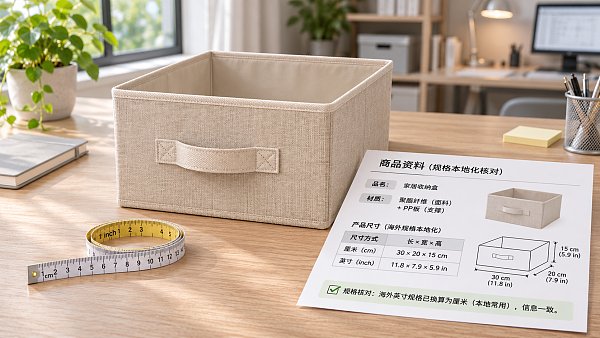
Localized specifications should match the product images, variant options, inventory, and checkout page. For example, a title that says “2-pack” can cause confusion if the priced variant is for a single item. After changing the package quantity or specifications, check all language versions rather than updating just one.
Adapt the Wording to Local Reading Habits Instead of Translating Sentence by Sentence
First identify the name commonly used for the product locally, then adjust the word order, forms of address, and information sequence. A literal translation may preserve the original structure but make it hard for customers to find the key information. A localized rewrite should retain verifiable facts while making the product's use, specifications, and limitations easier to understand. For colors, use names commonly recognized locally, and explain that the displayed color may differ from the actual product when there is a risk of color variation.
Cultural references should also fit the product's context. Holidays, family terms, and usage habits are not universal across regions. Without clear evidence, avoid presenting a particular scenario as a shared habit of everyone. Shipping coverage, return and exchange terms, and warranty information must reflect the services actually available in that market; do not simply translate promises made for other regions.
When using machine translation or content-generation tools, first provide confirmed product facts, the target country and language, and any expressions to avoid. Then request separate rewrites for the title, selling points, and detailed description. Have a person check the results, especially numbers, negations, scope of use, and any newly added claims about product benefits. If “not dishwasher-safe” in the original loses the negation in translation, the instructions for use will be directly contradicted.
Use Search and Purchase Signals to Identify Issues After Publication
Keep the original fact sheet, translation versions, and revision history for each market. Before publication, check on a mobile device whether the title is truncated, units are displayed in full, and special characters render correctly. Also verify the information shown in the product page title, body text, variant names, and search results to ensure customers do not see conflicting specifications.
When reviewing data, distinguish between possible causes. If search impressions are low, first check whether the page can be indexed and whether the product name matches local search habits. If impressions are high but clicks are low, check whether the product type and key specifications are clear in the title. If traffic is substantial but few customers add the product to their cart, assess the price, shipping costs, inventory, and page presentation together; do not attribute the issue to the copy alone. Repeated customer service questions about the same size or accessory may indicate that the relevant information needs to be repositioned or reworded.
Prioritize one clearly defined issue with each revision, and record the revision date and affected versions. Then monitor the results using data from comparable periods and customer feedback. When product configurations, shipping conditions, or specifications change, update the fact sheet first, then update pages in all languages to prevent outdated descriptions from continuing to affect purchase decisions.
Related Articles
 How can cross-border e-commerce businesses localize product descriptions for overseas markets?
 How to Evaluate the Localization Capabilities of a Russian Website Development Company
 How should export companies handle right-to-left layouts when developing Arabic websites?


Related Products
 Yiyingbao SaaS Intelligent Website Building and Marketing SystemYiyingbao SaaS Intelligent Website Building and Marketing System, AI-powered no-code website building, rapid creation of multilingual B2B international websites in 10 minutes, global server acceleration, AI-powered SEO optimization, helping businesses connect efficiently with global markets. The perfect integration of technology and operation makes building an international trade website remarkably simple
 AI+SEM Intelligent Advertising Marketing SystemAI+SEM drives intelligent ad creation, empowering full-funnel precision advertising marketing. The system automatically generates weekly/monthly reports, AI recommends keywords and target countries, monitors core metrics in real-time with intelligent alerts, and enables one-click high-conversion ad solutions to help quickly acquire customers and improve ROI.
 AI+SEO Dual-Engine System Optimization ServicesYiyingbao’s AI+SEO dual-engine optimization system helps foreign trade enterprises acquire high-quality organic traffic through AI-powered keyword research, content generation, and comprehensive technical optimization, significantly improving search rankings and conversion rates.
 AI+SNS Social Media Marketing SystemYingbao AI+SNS Social Media Marketing System - Precision social capture for the social media era. Supports one-click content synchronization across major platforms like Facebook and LinkedIn. AI intelligently rewrites posts for enhanced relevance. 24/7 AI customer service and user profiling analysis empower businesses to efficiently expand into global markets.
 AI+SEO营销解决方案易营宝AI+SEO营销解决方案,通过AI批量写作、智能生成TDK、精准关键词扩词等功能,全面优化网站SEO效果,提升流量与转化率。助力企业构建高效智能网站新生态。
 AI+SEM Advertising Marketing SolutionsAI+SEM Advertising Marketing Solution leverages AI technology to deeply empower SEM ad campaigns. It automatically generates weekly/monthly reports using AI, presenting account data across multiple dimensions for comprehensive insights into campaign performance and trends. The system precisely recommends keywords and target countries, intelligently generates high-conversion ad copy, and enables one-click activation of efficient campaign plans to help businesses rapidly acquire customers. Simultaneously, it monitors core metrics in real time, intelligently identifies abnormal fluctuations, and issues timely alerts to ensure stable, high-return advertising results.
 Domain Name ServicesEasyWin provides professional domain name services, including intelligent queries, one-stop registration, brand protection, and full lifecycle management, helping businesses build a digital brand image.
 EasyOperate B2C Cross-Border E-Commerce Platform & Independent WebsiteEasyStore B2C Cross-border E-commerce Independent Store is an intelligent website building and cross-border e-commerce integrated solution independently developed by EasyStore Information Technology (Beijing) Co., Ltd. The system is specially designed for small and medium-sized as well as large export enterprises, integrating 'website building, operation, marketing, advertising, and conversion' into one, helping enterprises quickly establish cross-border e-commerce independent stores to achieve brand globalization and global sales growth.
The platform supports multiple languages, multiple currencies, and multi-channel marketing, with built-in AI intelligent translation and SEO optimization systems, suitable for mainstream markets such as Southeast Asia, Europe and America, Latin America, and the Middle East, assisting Chinese manufacturing enterprises in efficiently deploying international e-commerce strategies. SSL证书易营宝提供专业SSL安全证书服务,包括单域名和泛域名证书,确保网站数据传输加密、身份验证和完整性保护,助力企业建立安全可信的在线业务环境。









