









- Hapag-Lloyd’s $4.2 billion acquisition of ZIM faces a closing delay; ZIM reports third-quarter net profit of $830 millionNov 24, 2026View details
- SCFI falls for a third straight week to 3,503.78 points, with blank sailings on trans-Pacific routes rising to 10Nov 24, 2026View details
- Lazada 11.11 Mega Sale: LazMall Contributes Nearly Two-Thirds of GMVNov 23, 2026View details
- Shein’s European Revenue Falls 16% as Tighter Rules on Low-Value Direct Shipments Take EffectNov 23, 2026View details
- EU Low-Value Parcel Rules Impact Cargo Flows: Air Freight Volume from China to Europe Down 17% in OctoberNov 23, 2026View details
- Indonesia and the EU Sign Comprehensive Economic Partnership Agreement, 90.4% of Tariff Lines to Become Duty-Free ImmediatelyNov 23, 2026View details
How should you adapt website content for target markets in international SEO?
Even with multilingual pages, a website may still attract little traffic from target markets, see visitors leave soon after arriving, or receive irrelevant inquiries. The reason may be more than translation quality: the terms used on the page, the product information presented, and the purchasing process may not match local users’ search needs.
To adapt content for a target market, first identify the country, language, and search intent. Then revisit the keywords and page information, and configure dedicated URLs, language annotations, and performance checks. When people search for “how to adapt content for international seo,” the real goal is not simply to translate the original into more languages, but to make each version discoverable, understandable, and useful to users in its intended market.
Define Your Markets Before Deciding Which Pages to Adapt
Do not assume that “one language equals one market.” In different countries that use the same language, product names, units of measurement, pricing conventions, and delivery expectations may all vary. First, list the countries or regions you plan to serve, their main languages, your sales coverage, and the actions you want visitors to take on your website, such as submitting an inquiry or placing an order directly.
Next, review your existing pages and map the homepage, core product pages, category pages, and important FAQs to each target market. Prioritize pages with clear business value that meet genuine local demand and that your company can deliver on. There is no need to translate products you do not plan to sell just to increase the number of pages.
If the needs of several regions are very similar, you can initially use a shared language version and clearly state the service coverage on the page. If terminology, product specifications, or transaction terms differ significantly, consider creating separate regional versions. Separate pages should be based on meaningful content differences, not just a change to the country name.
Research Keywords Based on Local Search Behavior
A direct translation of the original website’s keywords can be a starting point, but should not be used as page titles without further research. Search in the target language for product names, applications, and problems. Review the search results to see which expressions are commonly used and whether the results focus more on product listings, technical information, or buying guides. You can also compile candidate keywords from on-site search terms and questions that come up repeatedly in sales conversations.
Focus on three factors when evaluating keywords:
- Is the meaning accurate? The same term may refer to different products in a local market, or be used more often in another industry. Checking the product types in search results is more reliable than relying on a word-for-word translation.
- Does the intent match? Users searching for specifications should land on detailed product pages. Those comparing different solutions may be better served by selection guidance; they should not all be directed to the homepage.
- Can your business meet the need? Even if a search term is relevant, it is not suitable for attracting traffic if your company does not offer the corresponding specifications, delivery regions, or service arrangements.
Once you have selected your primary keywords, use natural expressions in page titles, headings, product descriptions, and image alt text. Related terms can be explained where appropriate; there is no need to repeat them in every paragraph. Review search results separately for similar pages in different markets instead of reusing the content structure from your original market.
What Page Content Should You Adapt Beyond Translation?
Provide the Information Visitors Need to Make a Decision
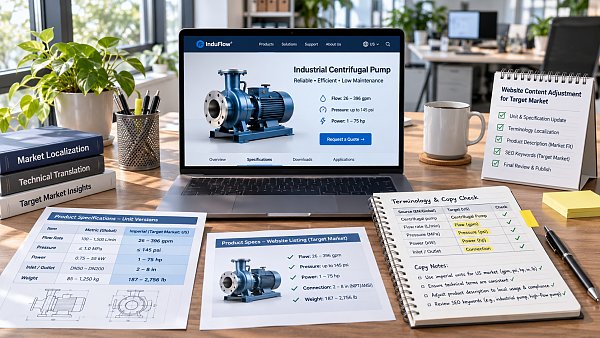
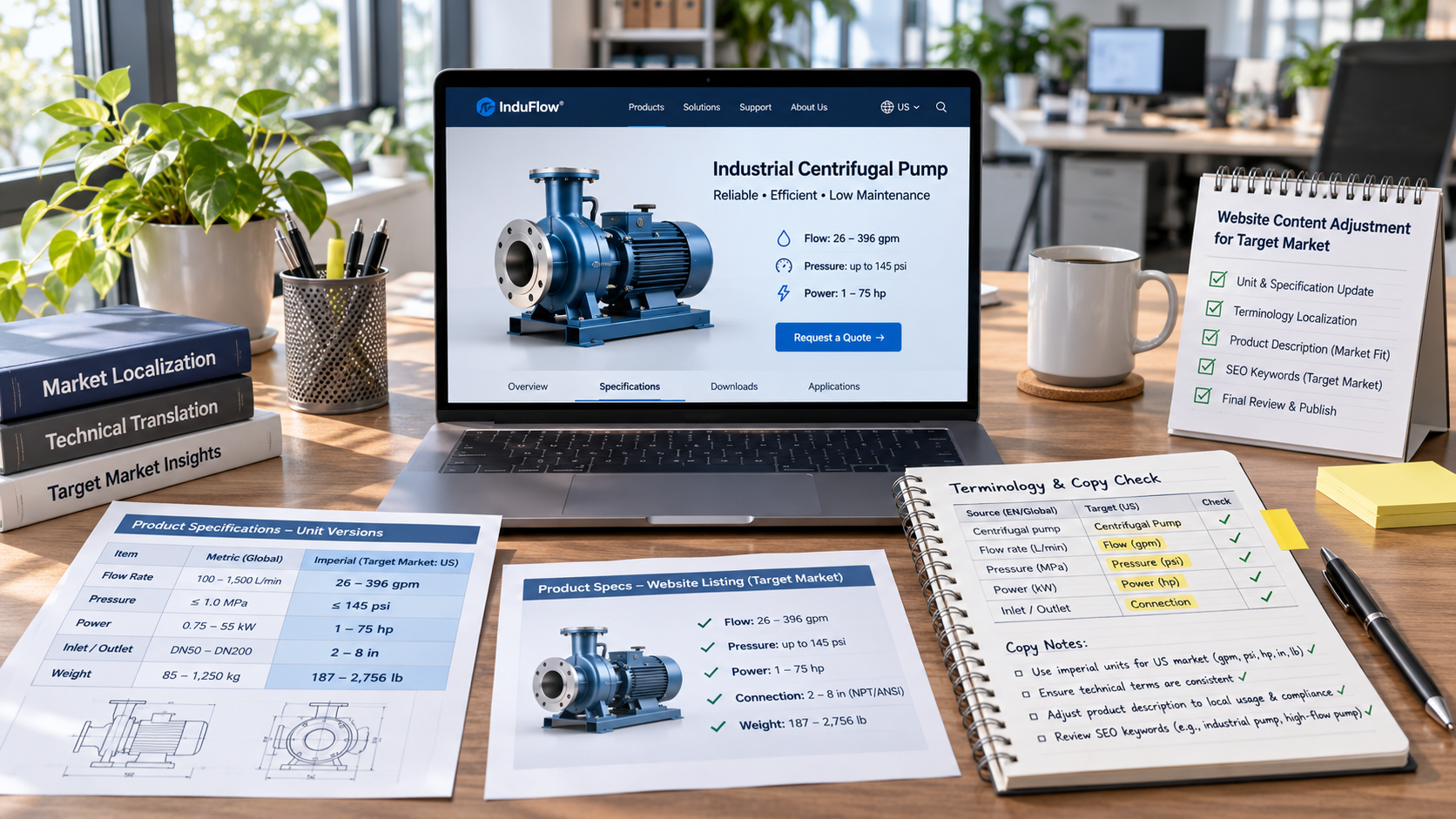
For product pages, review dimensions, weight, materials, models, and conditions of use in light of local needs. Provide measurements in different units where necessary, and make sure conversions are accurate. Prices, currencies, shipping costs, delivery coverage, and after-sales arrangements should reflect your actual business. If fixed terms are not available, explain what affects the quote and how visitors can request one.
Pages designed to generate inquiries should also tell users what information to provide. For example, replace a generic “Contact Us” prompt with guidance on fields such as application, quantity, or specifications. More fields are not necessarily better: include only the information needed to assess the initial request and avoid placing an unnecessary burden on visitors.
Align the Language With the Page Experience
Machine translation can be used to produce a first draft, but product names, technical specifications, button text, and transaction terms need to be reviewed by a person. Check that the wording is natural for the local market, the sentences are easy to understand, and the translation has not changed the scope of any commitments. Ideally, someone familiar with both the target language and the product should review the content, especially technical terms that are easy to confuse.
Also check whether text in images, downloadable files, form prompts, navigation, and error messages is still in the original language. If the main page content has been translated but visitors cannot understand the inquiry button or submission confirmation, they may still abandon the process. Local date formats, currency symbols, and reading direction should also be consistent with the page content.
Help Search Engines Identify Different Versions
Each language or regional version you want search engines to index should have its own stable, accessible URL. You can use directories, subdomains, or other structures. The key is to keep the rules clear, ensure internal links lead to the relevant version, and avoid dynamically replacing content on the same URL only after visitors switch languages.
Use hreflang tags to indicate the language or region each version targets, and check the language and region codes, corresponding URLs, and reciprocal references. These tags help search engines understand the relationship between versions, but do not guarantee that a specific page will be shown. Each version still needs to provide useful content. Canonical tags should also be consistent with your versioning strategy; avoid incorrectly pointing every regional page to the same page as the sole canonical version.
Make the language switcher easy to find, and, where possible, take users to the corresponding content rather than automatically sending them to the homepage. Geolocation can be used to make suggestions, but should not prevent visitors or search engines from accessing other versions. Before launch, open each version separately and check the page status, internal links, title, body language, and forms.
After Launch, Troubleshoot by Market Instead of Looking Only at Total Traffic
Review data by country or region, language version, and page type. If search impressions are low, first check whether the page can be discovered and indexed and whether its content matches local search terms. If impressions are high but clicks are low, check whether the title clearly describes the product and its application and whether the page is attracting irrelevant search intent.
If visitors arrive but rarely submit an inquiry or place an order, check whether the landing page matches their search intent, whether delivery coverage, pricing information, and contact options are clear, and whether the mobile form works. In addition to the number of inquiries, assess their quality based on the region, product needs, and valid contact details. Avoid straying from your actual business just to increase visits.
For each change, record the page, market, and content updated, then compare results after a representative observation period. Advertising activity, seasonal demand, or website redesigns during the same period may also affect the data. If the terminology and needs in a region consistently fail to match the existing version, revise the keywords and content first, then decide whether a separate regional page is necessary.
Related Articles
 How should you adapt website content for target markets in international SEO?
 Can Bulk AI-Generated Articles on a Standalone Website Affect SEO?
 Google’s Sleep-Learning Architecture Draws Attention: How Search Absorbs New Knowledge


Related Products
 Yiyingbao SaaS Intelligent Website Building and Marketing SystemYiyingbao SaaS Intelligent Website Building and Marketing System, AI-powered no-code website building, rapid creation of multilingual B2B international websites in 10 minutes, global server acceleration, AI-powered SEO optimization, helping businesses connect efficiently with global markets. The perfect integration of technology and operation makes building an international trade website remarkably simple
 AI+SEM Intelligent Advertising Marketing SystemAI+SEM drives intelligent ad creation, empowering full-funnel precision advertising marketing. The system automatically generates weekly/monthly reports, AI recommends keywords and target countries, monitors core metrics in real-time with intelligent alerts, and enables one-click high-conversion ad solutions to help quickly acquire customers and improve ROI.
 AI+SEO Dual-Engine System Optimization ServicesYiyingbao’s AI+SEO dual-engine optimization system helps foreign trade enterprises acquire high-quality organic traffic through AI-powered keyword research, content generation, and comprehensive technical optimization, significantly improving search rankings and conversion rates.
 AI+SNS Social Media Marketing SystemYingbao AI+SNS Social Media Marketing System - Precision social capture for the social media era. Supports one-click content synchronization across major platforms like Facebook and LinkedIn. AI intelligently rewrites posts for enhanced relevance. 24/7 AI customer service and user profiling analysis empower businesses to efficiently expand into global markets.
 AI+SEO营销解决方案易营宝AI+SEO营销解决方案,通过AI批量写作、智能生成TDK、精准关键词扩词等功能,全面优化网站SEO效果,提升流量与转化率。助力企业构建高效智能网站新生态。
 AI+SEM Advertising Marketing SolutionsAI+SEM Advertising Marketing Solution leverages AI technology to deeply empower SEM ad campaigns. It automatically generates weekly/monthly reports using AI, presenting account data across multiple dimensions for comprehensive insights into campaign performance and trends. The system precisely recommends keywords and target countries, intelligently generates high-conversion ad copy, and enables one-click activation of efficient campaign plans to help businesses rapidly acquire customers. Simultaneously, it monitors core metrics in real time, intelligently identifies abnormal fluctuations, and issues timely alerts to ensure stable, high-return advertising results.
 Domain Name ServicesEasyWin provides professional domain name services, including intelligent queries, one-stop registration, brand protection, and full lifecycle management, helping businesses build a digital brand image.
 EasyOperate B2C Cross-Border E-Commerce Platform & Independent WebsiteEasyStore B2C Cross-border E-commerce Independent Store is an intelligent website building and cross-border e-commerce integrated solution independently developed by EasyStore Information Technology (Beijing) Co., Ltd. The system is specially designed for small and medium-sized as well as large export enterprises, integrating 'website building, operation, marketing, advertising, and conversion' into one, helping enterprises quickly establish cross-border e-commerce independent stores to achieve brand globalization and global sales growth.
The platform supports multiple languages, multiple currencies, and multi-channel marketing, with built-in AI intelligent translation and SEO optimization systems, suitable for mainstream markets such as Southeast Asia, Europe and America, Latin America, and the Middle East, assisting Chinese manufacturing enterprises in efficiently deploying international e-commerce strategies. SSL证书易营宝提供专业SSL安全证书服务,包括单域名和泛域名证书,确保网站数据传输加密、身份验证和完整性保护,助力企业建立安全可信的在线业务环境。









