









- Hapag-Lloyd’s $4.2 billion acquisition of ZIM faces a closing delay; ZIM reports third-quarter net profit of $830 millionNov 24, 2026View details
- SCFI falls for a third straight week to 3,503.78 points, with blank sailings on trans-Pacific routes rising to 10Nov 24, 2026View details
- Lazada 11.11 Mega Sale: LazMall Contributes Nearly Two-Thirds of GMVNov 23, 2026View details
- Shein’s European Revenue Falls 16% as Tighter Rules on Low-Value Direct Shipments Take EffectNov 23, 2026View details
- EU Low-Value Parcel Rules Impact Cargo Flows: Air Freight Volume from China to Europe Down 17% in OctoberNov 23, 2026View details
- Indonesia and the EU Sign Comprehensive Economic Partnership Agreement, 90.4% of Tariff Lines to Become Duty-Free ImmediatelyNov 23, 2026View details
Can Bulk AI-Generated Articles on a Standalone Website Affect SEO?
Using AI to generate articles in bulk can help an independent website fill out its content faster, but publishing speed does not equal search traffic. What really affects SEO is not “whether AI is used,” but whether a page solves users’ problems, whether its information is reliable, and whether bulk production turns into low-value content designed to manipulate rankings. For website operators, the key is to make AI part of a publishing process that can be reviewed and corrected, rather than letting it directly replace editors.
Will an independent website be penalized for publishing AI-generated articles in bulk?
Not simply for using AI. Google says generative AI can be used to research and organize content. However, generating large numbers of pages that offer little value to users, primarily to manipulate search rankings, may violate its “scaled content abuse” policy. This policy does not target AI alone; content produced through human manipulation or a combination of human and AI efforts may also violate it.
It is important to distinguish between not being indexed, a drop in rankings, and receiving a spam penalty. A new page may not yet have been discovered, or it may have been crawled but not indexed. A drop in traffic may also be related to search demand, competition, technical changes, or content quality. Investigate the cause first rather than assuming that AI is the only reason for a fluctuation.
Sources: Google Search Central, “Google Search’s guidance about AI-generated content” https://developers.google.com/search/blog/2023/02/google-search-and-ai-content?hl=zh-cn; “Spam Policies for Google Web Search” https://developers.google.com/search/docs/essentials/spam-policies?hl=zh-cn.
Check these four types of risk before publishing at scale
- Changing words while covering the same topic: Generating separate articles for similar keywords, when the body text merely swaps out a country, product name, or adjective, gives users no different answers. If one page can address the problem, there is no need to split it into multiple pages just to cover different keyword phrases.
- Inaccurate facts: AI may invent product specifications, test results, standard numbers, or market data. For information about certifications, regulations, and safety requirements, verify the official source and the markets where it applies. Do not publish content that cannot be confirmed.
- Lack of firsthand experience: For example, an article from an export manufacturer may explain “how to choose a supplier” without covering lead-time communication, the sampling process, or quality inspection methods. This makes it difficult to show why the company is qualified to answer the question.
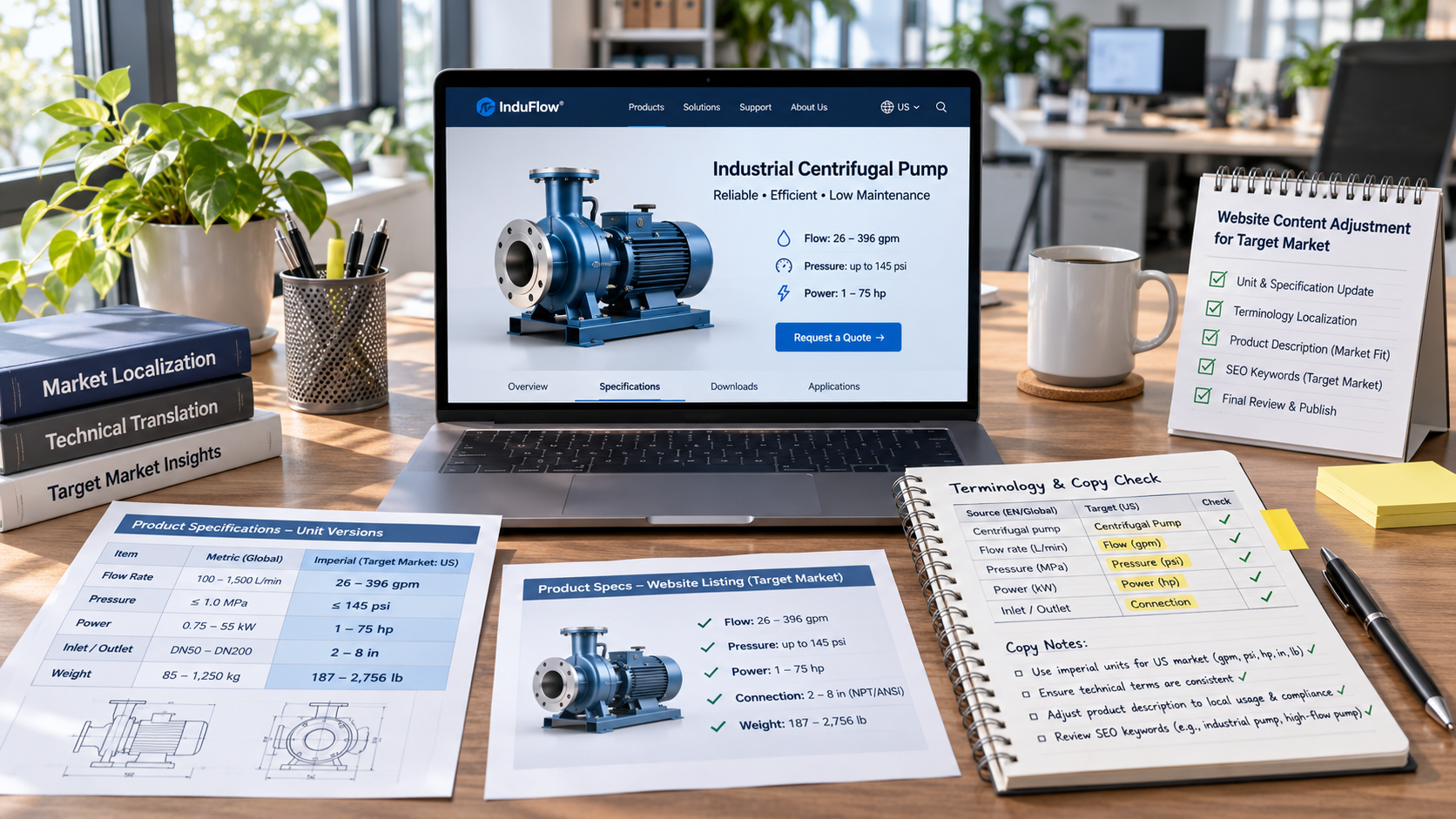
- No review after translation: Multilingual content may mistranslate units, trade terms, and local expressions. Pages in different languages should address the needs of users in each market, rather than simply translating the English text sentence by sentence.
To decide whether an article is ready to publish, ask yourself: After reading it, can a target customer make a specific decision or complete a specific task? If the article would still apply in exactly the same way after replacing your company’s name with a competitor’s, it usually needs more facts and real-world experience.
A practical workflow for producing content with AI
For an export-focused independent website run by a manufacturing company, instead of generating dozens of generic articles about “product advantages” at once, produce content in stages around the purchasing process: product selection, specification confirmation, sampling, shipping, and after-sales service. Each article should address a clearly defined question and link to a relevant product or inquiry page.

- Create a topic plan: Record the target customer, search intent, question to be answered, target language, and internal links. First check whether similar content already exists on the site. If an existing page can be improved, update it before creating a new one.
- Prepare reliable source material: Gather confirmed product specifications, common inquiries, engineers’ answers, and public sources, and record the date of the latest update and the person responsible. Do not enter non-public customer information into external AI tools.
- Define the generation task: Ask AI to organize the structure and prepare a first draft based on the source material, distinguishing known facts from questions that need verification. Mark missing data as “to be confirmed” instead of filling it in yourself.
- Review and add information manually: The content editor checks search intent and readability, while product or technical staff verify specifications, conditions of use, and risk notices. Keep the original, traceable source when citing third-party findings.
- Review after publication: Confirm that the title, body text, internal links, and target pages are consistent, and check the mobile reading experience and inquiry path. Update the content later based on search performance; do not treat the publication date as a substitute for quality management.
If review capacity is limited, publish fewer articles rather than releasing content that still needs verification. Start with a small number of articles to establish a workable process, then adjust the pace based on review time and search feedback. Google has not specified a safe number of articles to publish per day that applies to every website.
How can you tell whether SEO has been affected after publishing an article?
First, check the page indexing report in Google Search Console, then use the URL Inspection tool to review specific pages. Note that a URL being crawlable does not mean it will necessarily be indexed, and submitting a sitemap does not guarantee indexing. Sources: Google Search Central, “URL Inspection tool” https://support.google.com/webmasters/answer/9012289?hl=zh-Hans; “Learn about sitemaps” https://developers.google.com/search/docs/crawling-indexing/sitemaps/overview?hl=zh-cn.
When analyzing performance, group pages by type, language, and publication date, and compare them with an equivalent previous period. Consider impressions, clicks, indexing, and inquiries together: ranking fluctuations for a single article are not enough to prove that bulk production has succeeded or failed.
Frequently asked questions
Do all older AI-generated articles need to be deleted?
No. Do not delete articles solely because AI was used to create them. First check for factual errors, duplicate content, and user value. Useful articles can be updated with additional evidence; pages that genuinely have no independent value can be consolidated or removed, while also checking how to handle their old links.
Do articles need to disclose the use of AI?
Google recommends considering disclosure of automation or AI use when readers would reasonably expect to know how the content was produced. Rather than adding a blanket disclosure to every article, it is more important to state who is responsible for reviewing the content, explain where the information came from, and ensure that the content is accurate. Source: Google Search Central, “Creating helpful, reliable, people-first content” https://developers.google.com/search/docs/fundamentals/creating-helpful-content?hl=zh-cn.
Related Articles
 How should you adapt website content for target markets in international SEO?
 Can Bulk AI-Generated Articles on a Standalone Website Affect SEO?
 Google’s Sleep-Learning Architecture Draws Attention: How Search Absorbs New Knowledge


Related Products
 Yiyingbao SaaS Intelligent Website Building and Marketing SystemYiyingbao SaaS Intelligent Website Building and Marketing System, AI-powered no-code website building, rapid creation of multilingual B2B international websites in 10 minutes, global server acceleration, AI-powered SEO optimization, helping businesses connect efficiently with global markets. The perfect integration of technology and operation makes building an international trade website remarkably simple
 AI+SEM Intelligent Advertising Marketing SystemAI+SEM drives intelligent ad creation, empowering full-funnel precision advertising marketing. The system automatically generates weekly/monthly reports, AI recommends keywords and target countries, monitors core metrics in real-time with intelligent alerts, and enables one-click high-conversion ad solutions to help quickly acquire customers and improve ROI.
 AI+SEO Dual-Engine System Optimization ServicesYiyingbao’s AI+SEO dual-engine optimization system helps foreign trade enterprises acquire high-quality organic traffic through AI-powered keyword research, content generation, and comprehensive technical optimization, significantly improving search rankings and conversion rates.
 AI+SNS Social Media Marketing SystemYingbao AI+SNS Social Media Marketing System - Precision social capture for the social media era. Supports one-click content synchronization across major platforms like Facebook and LinkedIn. AI intelligently rewrites posts for enhanced relevance. 24/7 AI customer service and user profiling analysis empower businesses to efficiently expand into global markets.
 AI+SEO营销解决方案易营宝AI+SEO营销解决方案,通过AI批量写作、智能生成TDK、精准关键词扩词等功能,全面优化网站SEO效果,提升流量与转化率。助力企业构建高效智能网站新生态。
 AI+SEM Advertising Marketing SolutionsAI+SEM Advertising Marketing Solution leverages AI technology to deeply empower SEM ad campaigns. It automatically generates weekly/monthly reports using AI, presenting account data across multiple dimensions for comprehensive insights into campaign performance and trends. The system precisely recommends keywords and target countries, intelligently generates high-conversion ad copy, and enables one-click activation of efficient campaign plans to help businesses rapidly acquire customers. Simultaneously, it monitors core metrics in real time, intelligently identifies abnormal fluctuations, and issues timely alerts to ensure stable, high-return advertising results.
 Domain Name ServicesEasyWin provides professional domain name services, including intelligent queries, one-stop registration, brand protection, and full lifecycle management, helping businesses build a digital brand image.
 EasyOperate B2C Cross-Border E-Commerce Platform & Independent WebsiteEasyStore B2C Cross-border E-commerce Independent Store is an intelligent website building and cross-border e-commerce integrated solution independently developed by EasyStore Information Technology (Beijing) Co., Ltd. The system is specially designed for small and medium-sized as well as large export enterprises, integrating 'website building, operation, marketing, advertising, and conversion' into one, helping enterprises quickly establish cross-border e-commerce independent stores to achieve brand globalization and global sales growth.
The platform supports multiple languages, multiple currencies, and multi-channel marketing, with built-in AI intelligent translation and SEO optimization systems, suitable for mainstream markets such as Southeast Asia, Europe and America, Latin America, and the Middle East, assisting Chinese manufacturing enterprises in efficiently deploying international e-commerce strategies. SSL证书易营宝提供专业SSL安全证书服务,包括单域名和泛域名证书,确保网站数据传输加密、身份验证和完整性保护,助力企业建立安全可信的在线业务环境。









