









- Hapag-Lloyd’s $4.2 billion acquisition of ZIM faces a closing delay; ZIM reports third-quarter net profit of $830 millionNov 24, 2026View details
- SCFI falls for a third straight week to 3,503.78 points, with blank sailings on trans-Pacific routes rising to 10Nov 24, 2026View details
- Lazada 11.11 Mega Sale: LazMall Contributes Nearly Two-Thirds of GMVNov 23, 2026View details
- Shein’s European Revenue Falls 16% as Tighter Rules on Low-Value Direct Shipments Take EffectNov 23, 2026View details
- EU Low-Value Parcel Rules Impact Cargo Flows: Air Freight Volume from China to Europe Down 17% in OctoberNov 23, 2026View details
- Indonesia and the EU Sign Comprehensive Economic Partnership Agreement, 90.4% of Tariff Lines to Become Duty-Free ImmediatelyNov 23, 2026View details
What factors typically affect the pricing of overseas digital marketing services?
The differences in pricing for overseas digital marketing services mainly come from service scope, target markets, channel mix, execution workload, and billing method. Even when the goal is the same—acquiring customers overseas—the cost basis differs between managing a single advertising account and an integrated project that includes a multilingual website, search optimization, and social media operations.
When evaluating a quote, first distinguish the service provider’s fees from ad platform spend, then check one-time setup costs, ongoing operating costs, and third-party expenses. Looking only at the monthly price can make it easy to overlook future renewals, changes, and additional investment.
What costs make up the price of overseas digital marketing services?
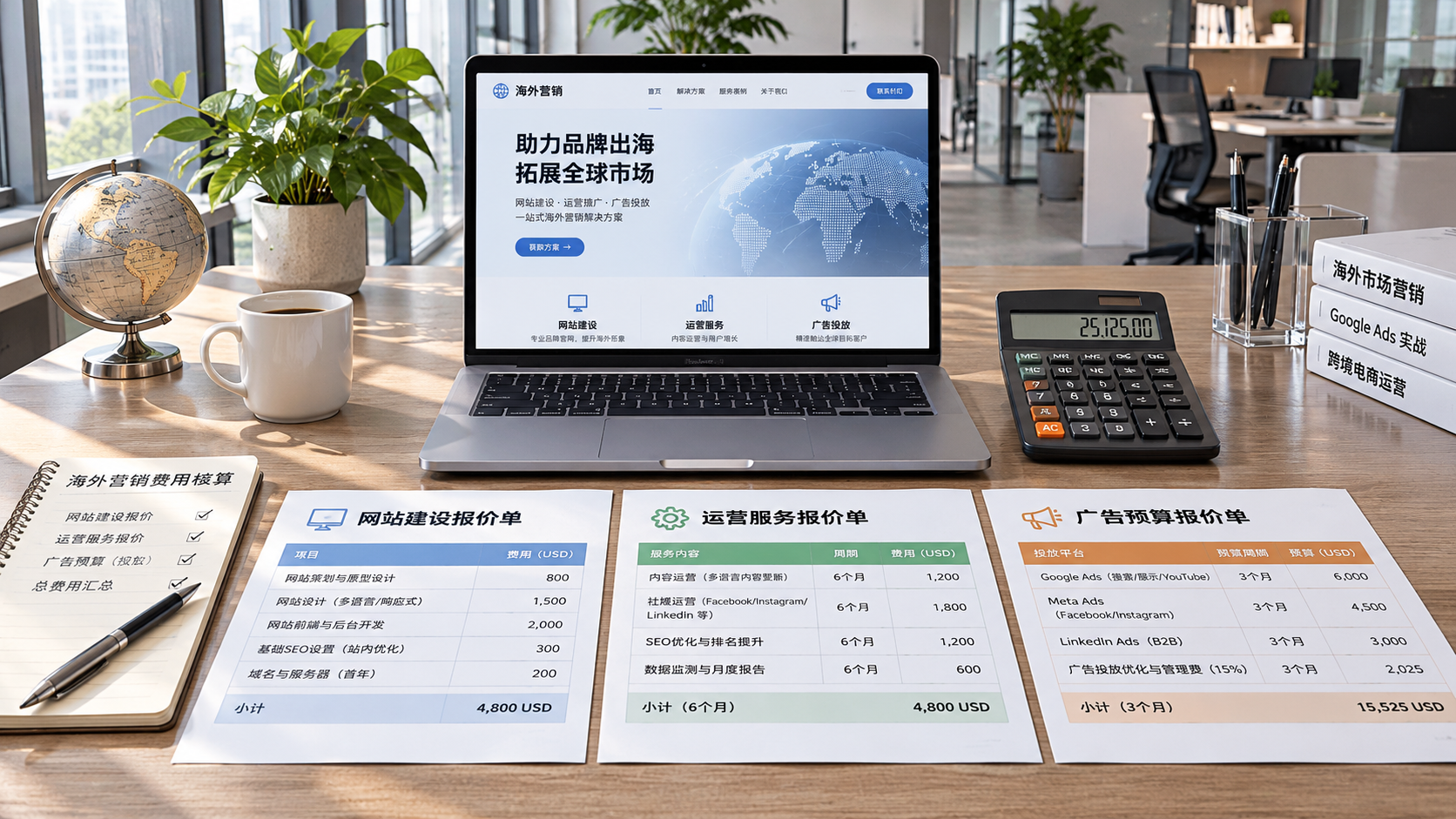
A complete quote should specify deliverables, billing units, and which party is responsible for each cost. The table below can be used to break down common expenses; the specific items remain subject to the contract.

Media spend and service fees are particularly easy to confuse. For example, if a contract states that the “monthly fee includes ad placement,” confirm how much goes to platform bidding and how much covers account management. An increase in the advertising budget does not necessarily mean a proportional increase in the service workload. If the management fee is calculated as a percentage of spend, also check the minimum fee, rate tiers, and how overspending is handled.
Which project conditions can increase or change the price?
Target markets and language coverage
When multiple countries or regions are covered, keyword research, audience segmentation, ad creatives, and page content often need to be configured separately. The cost of a multilingual project is not limited to translation; it also includes terminology consistency, checks for natural local phrasing, page adaptation, and ongoing updates.
Using the same language across different markets does not mean that one set of ads and landing pages can be used everywhere without changes. The quote should specify the number of markets and languages, as well as the billing rules for adding countries, pages, or languages, to avoid a low-priced basic package with unclear expansion costs.
Channel mix and competitive conditions
Search advertising, social media advertising, organic search optimization, and content operations involve different types of work. Search advertising involves account setup, keyword management, and bid management; SEO involves website technical audits, content optimization, and work such as link building. Their delivery timelines and how results are achieved also differ.
Actual ad platform spend is affected by factors such as the bidding environment, audience targeting, and ad quality. A service quote cannot replace a media budget estimate. The service provider should explain the budget assumptions and the basis for the estimate, rather than presenting projected clicks or inquiries as guaranteed results.
Existing assets and depth of service
The upfront investment differs between a project with an existing website that is accessible, supports the target language, and has conversion tracking, and one that requires a new website. If the existing site has issues with mobile experience, loading speed, or form tracking, also determine whether fixes are included in the scope of service.
Even when both services are described as “operations,” checking an account and providing a report each month is not the same workload as continuously producing creatives, testing landing pages, and optimizing the conversion path. Break down broad terms such as “full-service management” into verifiable tasks, such as the number of pages, creative specifications, optimization frequency, and report content.
How should different pricing models be compared?
- Fixed project fee: Suitable for work with a relatively clear scope, such as website development or account setup. Check the acceptance criteria, payment milestones, and how changes to requirements will be priced.
- Monthly service fee: Suitable for ongoing operations, but the service period, monthly deliverables, and handling of unfinished work should be clearly defined. If the agreement only says “ongoing optimization” without defining the scope, it is difficult to assess value for money.
- Percentage of ad spend: The fee changes with the scale of advertising. Evaluate it alongside any fixed base fee, rate tiers, and calculation method; fees during ad pauses or when the budget decreases should also be agreed upon.
- Per-lead or performance-based fee: Key terms include the definition of a lead, deduplication rules, attribution window, and handling of invalid leads. If responsibility for sales follow-up and data feedback is not agreed upon, disputes over settlement may arise later.
Different models can be combined, but the same work should not be charged for twice. When comparing providers, request quotes based on the same markets, channels, duration, and budget assumptions, then consolidate media spend, service fees, and third-party expenses into a single cost table.
Budget approval should cover the entire service period
In addition to the initial contract amount, consider ongoing expenses after launch. For a one-year comparison period, total investment can be broken down as follows: one-time setup fees + service fees over the period + estimated media spend + third-party and renewal expenses + identified change fees. The quote should also clarify whether taxes are included, the settlement currency, and who bears exchange rate costs.
For example, in a hypothetical project, two providers charge different monthly service fees, but one includes maintenance of multilingual pages while the other bills separately for translation and page revisions. Only by calculating total spending based on the expected number of pages, maintenance frequency, and contract term can you determine which quote better fits the requirements. If the requirements are not yet clear, list the unit prices for changes rather than assuming that additional costs will be zero.
What criteria can be used to assess return on investment and contract risks?
Evaluate customer acquisition by working backward from business goals. For lead-generation projects, consider the cost per qualified lead, lead conversion rate, and subsequent sales results. For cross-border e-commerce stores, assess results alongside order revenue, ad spend, and costs such as products and fulfillment. Conversions reported by a platform are not the same as completed sales; refunds, duplicate leads, and attribution to organic traffic can also affect the assessment.
Suppose total marketing investment for a given period is RMB 100,000 and it generates 100 qualified leads that meet the agreed criteria. The cost per qualified lead is RMB 1,000. This metric does not account for subsequent sales costs and cannot, by itself, prove profitability. Whether to continue investing should also be determined by the conversion rate, gross profit per order, and payment collection.
- Asset ownership: Confirm ownership and management access for the domain, website, advertising accounts, data, and creatives to avoid being unable to continue advertising after the partnership ends.
- Acceptance and payment: Link payment milestones to deliverables that can be checked. Results affected by multiple factors, such as SEO rankings and ad-driven sales, should be distinguished from service-process deliverables.
- Termination and handover: Agree on how early termination, unspent ad funds, data exports, and account handover will be handled, and check any related fees.
A reasonable quote is not one with the most items, nor is the lowest unit price necessarily the best value. Compare providers using clearly defined deliverables and consistent cost criteria, then approve the budget in light of the target market, affordable time frame, and measurable business results. This helps control additional expenses hidden behind an apparently low price.
Related Articles
 What factors typically affect the pricing of overseas digital marketing services?
 What factors affect the monthly cost of overseas social media content management?
 How to Calculate the Total Cost of Purchasing an All-in-One Marketing Platform Service


Related Products
 Yiyingbao SaaS Intelligent Website Building and Marketing SystemYiyingbao SaaS Intelligent Website Building and Marketing System, AI-powered no-code website building, rapid creation of multilingual B2B international websites in 10 minutes, global server acceleration, AI-powered SEO optimization, helping businesses connect efficiently with global markets. The perfect integration of technology and operation makes building an international trade website remarkably simple
 AI+SEM Intelligent Advertising Marketing SystemAI+SEM drives intelligent ad creation, empowering full-funnel precision advertising marketing. The system automatically generates weekly/monthly reports, AI recommends keywords and target countries, monitors core metrics in real-time with intelligent alerts, and enables one-click high-conversion ad solutions to help quickly acquire customers and improve ROI.
 AI+SEO Dual-Engine System Optimization ServicesYiyingbao’s AI+SEO dual-engine optimization system helps foreign trade enterprises acquire high-quality organic traffic through AI-powered keyword research, content generation, and comprehensive technical optimization, significantly improving search rankings and conversion rates.
 AI+SNS Social Media Marketing SystemYingbao AI+SNS Social Media Marketing System - Precision social capture for the social media era. Supports one-click content synchronization across major platforms like Facebook and LinkedIn. AI intelligently rewrites posts for enhanced relevance. 24/7 AI customer service and user profiling analysis empower businesses to efficiently expand into global markets.
 AI+SEO营销解决方案易营宝AI+SEO营销解决方案,通过AI批量写作、智能生成TDK、精准关键词扩词等功能,全面优化网站SEO效果,提升流量与转化率。助力企业构建高效智能网站新生态。
 AI+SEM Advertising Marketing SolutionsAI+SEM Advertising Marketing Solution leverages AI technology to deeply empower SEM ad campaigns. It automatically generates weekly/monthly reports using AI, presenting account data across multiple dimensions for comprehensive insights into campaign performance and trends. The system precisely recommends keywords and target countries, intelligently generates high-conversion ad copy, and enables one-click activation of efficient campaign plans to help businesses rapidly acquire customers. Simultaneously, it monitors core metrics in real time, intelligently identifies abnormal fluctuations, and issues timely alerts to ensure stable, high-return advertising results.
 Domain Name ServicesEasyWin provides professional domain name services, including intelligent queries, one-stop registration, brand protection, and full lifecycle management, helping businesses build a digital brand image.
 EasyOperate B2C Cross-Border E-Commerce Platform & Independent WebsiteEasyStore B2C Cross-border E-commerce Independent Store is an intelligent website building and cross-border e-commerce integrated solution independently developed by EasyStore Information Technology (Beijing) Co., Ltd. The system is specially designed for small and medium-sized as well as large export enterprises, integrating 'website building, operation, marketing, advertising, and conversion' into one, helping enterprises quickly establish cross-border e-commerce independent stores to achieve brand globalization and global sales growth.
The platform supports multiple languages, multiple currencies, and multi-channel marketing, with built-in AI intelligent translation and SEO optimization systems, suitable for mainstream markets such as Southeast Asia, Europe and America, Latin America, and the Middle East, assisting Chinese manufacturing enterprises in efficiently deploying international e-commerce strategies. SSL证书易营宝提供专业SSL安全证书服务,包括单域名和泛域名证书,确保网站数据传输加密、身份验证和完整性保护,助力企业建立安全可信的在线业务环境。









