









- Which customer acquisition channels will be affected by cross-border marketing trends in 2026?Sep 06, 2026View details
- Which homogenization risks should be considered in an analysis of the AI-powered website building industry?Aug 30, 2026View details
- How Will AI Marketing Trends 2026 Change Advertising Budget AllocationAug 28, 2026View details
- Is the EV SSL certificate market shrinking or upgrading? How should companies assess certificate procurement?Aug 11, 2026View details
- Why the old AMP SEO 2020 practices no longer work and what has changed in current optimization prioritiesAug 02, 2026View details
- How to Choose Topics for an Industry News Section to Attract More Organic Search TrafficJul 29, 2026View details
How to Conduct Global Website Operations? Coordinating Multi-Regional Sites and Breaking Down Growth Metrics
How to Manage Global Website Operations? Coordinating Multi-Regional Sites and Breaking Down Growth Metrics
How to manage global website operations? The key is not simply building several more websites, but establishing a unified architecture, coordinating processes, and breaking down growth metrics. Many projects initially focus on creating one English, Japanese, and German site each, only to find that six months later, the first things to get out of control are not traffic, but versions, content, lead attribution, and team coordination. For project managers, the real focus should be on what must be unified, what must be localized, and which metrics can directly determine whether a regional site is worth continued investment.
The checklist below is more suitable for teams preparing to build websites for multiple overseas regions, or teams that have already launched several sites but are finding them increasingly difficult to manage. It is not a theoretical framework, but an execution-level troubleshooting guide.
Before Rolling Out More Sites, Confirm That You Are Pursuing “Regional Growth,” Not “Language Replication”
Many teams interpret multi-regional operations as launching multilingual pages, which is usually the first misconception. Users in North America, Europe, Southeast Asia, and the Middle East differ in their search terms, inquiry habits, payment methods, and page trust factors. Even within English-speaking markets, the product messaging, delivery information, and case-study presentation for a US site may not be directly applicable to a Singapore site.
- First, clarify the regional objective: is it to generate B2B inquiries, drive transactions through an independent website, or support advertising landing pages?
- Do not prioritize regions by language. Rank them by revenue opportunity, delivery capability, compliance difficulty, and content supply capacity.
- If a region lacks stable presales, logistics, payment, or delivery support, launching the site first will most likely waste leads later.
A simple way to assess this is to ask: if 100 qualified visitors arrived from this market today, could your team respond within 24 hours in a way that local users would accept? If not, do not treat it as a mature operating region.
The Site Architecture Determines Whether the Next Year Will Be Efficient or Full of Rework
Site architecture is what project leaders most often underestimate. Whether to use subdirectories, subdomains, or separate domains is not merely a technical issue; it also affects SEO accumulation, team maintenance costs, and the boundaries of regional authorization. Without unified rules, content synchronization, tag configuration, and data tracking will become fragmented.
In practice, if the brand is unified, management is centralized at headquarters, and SEO assets are intended to be consolidated, teams usually prioritize regional or language structures under the main domain. If certain markets are operated independently by local teams, or clear channel separation exists, a more independent structure may be considered. The specific approach should still be determined based on development resources, the capabilities of the content team, and existing domain assets.
Here is another very practical reminder: if the technical team is not familiar with the basics of multi-regional SEO configuration, be sure to conduct a page-level spot check before launch. In global website operations, many traffic problems are not caused by poor content, but by improperly configured tag relationships.

Content Coordination Should Not Depend on “Translation Completed”; Focus on Whether Local Users Can Understand and Convert
The most common misjudgment in multi-regional sites is treating translation progress as launch progress. Translating a page does not mean that the market can use it. In particular, for B2B manufacturing, cross-border e-commerce, and brands expanding overseas, users will immediately lose trust if product specifications, certification information, delivery times, after-sales commitments, and industry terminology are handled too literally.
- Product pages should distinguish between “headquarters-standard information” and “regionally variable information.” The former includes core specifications and standard models; the latter includes lead times, case studies, logistics coverage, and contact details.
- Do not use one global inquiry form. Different regions have different expectations regarding phone numbers, company names, purchase volumes, and instant-messaging tools.
- Be cautious when presenting case studies and qualifications. When there is no publicly citable material, do not fabricate details simply to make the message more persuasive.
If content maintenance capacity is limited, prioritize high-intent pages: the homepage, core category pages, key product pages, application pages, FAQ, and contact page. There is no need to expand the blog and news sections too aggressively at the beginning; otherwise, the updating burden may overwhelm the entire coordination process.
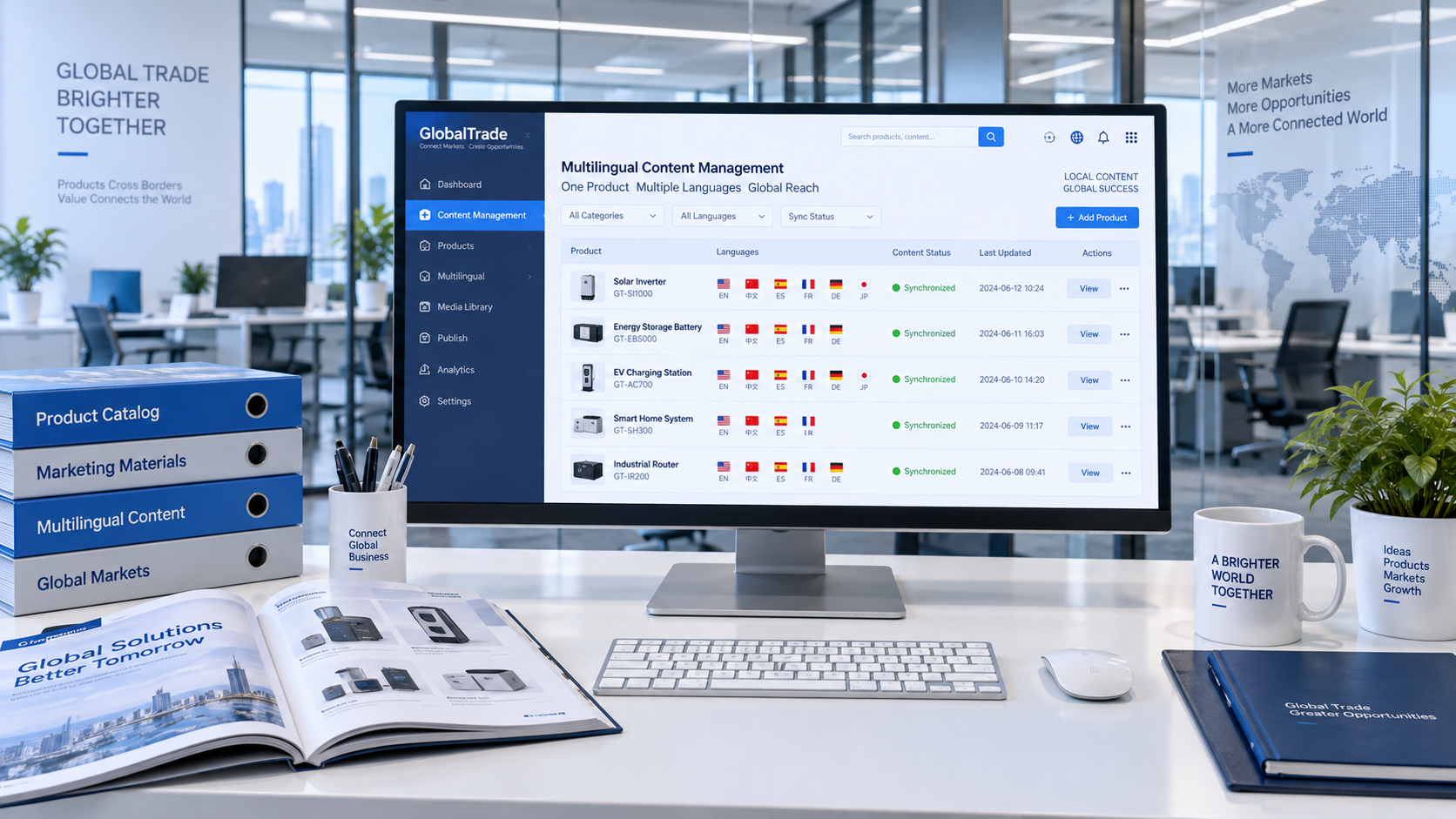
In such scenarios, a platform such as Yingyingbao Foreign Trade Marketing (Super) Website, with multilingual management, SEO optimization, and closed-loop marketing analysis capabilities, is more suitable for project execution than a simple website builder. The reason is practical: you do not just need the site to go live; you need content, advertising, and lead tracking to remain coordinated over time.
Do Not Wait Until Advertising Starts Running to Address Speed, Stability, and Node Coverage
In multi-regional operations, page speed is not merely the technical team’s KPI. It directly affects advertising conversion, organic rankings, and bounce rate. Especially in cross-border e-commerce, advertising landing pages, and mobile inquiry scenarios, if the first screen loads slowly, users will not give you a second chance.
Before launch, project leaders should at least verify the following: whether visitors from target markets are routed through nearby nodes; whether images and scripts are too heavy; whether mobile forms load reliably; and whether backup bandwidth strategies are available during peak periods. If a provider can clearly provide technical parameters, evaluation becomes much easier. For example, loading times controlled within 1.5 seconds, support for 100+ languages, 2500+ server nodes, and 120T bandwidth capacity can at least help you initially assess whether the provider has prepared the infrastructure for global access.
However, one reminder is necessary: parameters themselves are not results. Ultimately, they must be verified against actual speed tests, conversion data, and device distribution in your target markets.
With Multiple Teams, the Biggest Risk Is That “Everyone Is Working, but No One Is Accountable for the Results”
Once global website operations involve the headquarters marketing department, regional sales, development, design, content, and advertising agencies, collaboration costs rise rapidly. The project leader’s job is not to participate in every detail, but to clearly define the boundaries of responsibility.
- Who is responsible for templates and brand guidelines, and who has final publishing authority?
- Who is responsible for proofreading regional content, and who should fix terminology errors?
- Who is responsible for lead distribution rules, ensuring that website form submissions are followed up?
- Who is accountable for the monthly metrics of each regional site, rather than merely the “number of pages launched”?
It is recommended to divide site operations into three tables: a version change log, a content schedule, and a data review table. The first two resolve disorder, while the last resolves disputes. Many teams do not lack execution; what they lack is a common set of standards for review.
Do Not Focus Only on Traffic; Project Leaders Should Monitor These Layers
As soon as a multi-regional site goes live, the most common question is: “Has traffic increased?” This question is too broad. A genuinely useful breakdown should include at least four layers: visibility, engagement, conversion rate, and the quality of downstream follow-up.
- Visibility: organic exposure in target countries, rankings for core keywords, and the proportion of branded versus non-branded keywords.
- Engagement: landing-page time on page, scroll depth, form reach rate, and mobile bounce rate.
- Conversion rate: inquiry submission rate, add-to-cart rate, and registration rate, broken down by channel and region.
- Lead quality: whether sales approves of the leads, whether response-time targets are met, and whether quotations or repeat purchases result.
If you look only at the first two layers, the site can easily fall into a state where “the data looks good, but the business sees no impact.” In weekly meetings, project managers should ask directly: which country’s high-intent pages generated real opportunities, and which pages generated only invalid clicks?
Advertising, SEO, and Social Media Should Not Operate in Isolation; Different Entry Points Require Different Page Logic
If a multi-regional site simultaneously supports Google SEO, advertising, and overseas social media traffic, its pages cannot be designed solely around the idea of “introducing the company website.” SEO places greater emphasis on topic completeness and clear structure, advertising pages prioritize a short action path, and social media traffic requires faster trust building.
This is why many companies manage their corporate website, landing pages, and store pages within the same system. With a solution such as Yingyingbao Foreign Trade Marketing (Super) Website, if AI-powered website building, multilingual maintenance, synchronized PC and mobile sites, SEO, and data analysis can be connected, project execution becomes much easier. At the very least, it avoids the familiar problem of “the pages exist, the data is disconnected, and sales cannot receive the leads.”
Final Review: These Issues Indicate That the System Is Not Yet in Place
- Titles, descriptions, and page structures are largely duplicated across regional sites, causing indexing conflicts.
- Lead sources cannot be attributed to countries, channels, or pages, so reviews rely entirely on guesswork.
- Regional sales say the leads are inaccurate, the marketing department says traffic is fine, and no one can provide closed-loop evidence.
- The site can be translated into 100 languages, but only two or three have a genuine maintenance mechanism.
- Every new market requires redevelopment from scratch, causing time and costs to continue rising.
If you are currently responsible for an overseas website project, consider going through this checklist item by item. Put the site architecture, content boundaries, data standards, and team responsibilities in order before discussing scaling. Whether multi-regional sites can achieve sustained growth often depends not on how many pages you have created, but on whether you manage each region as a verifiable, iterative, and reviewable operating unit.
Related Articles


Related Products
 Yiyingbao SaaS Intelligent Website Building and Marketing SystemYiyingbao SaaS Intelligent Website Building and Marketing System, AI-powered no-code website building, rapid creation of multilingual B2B international websites in 10 minutes, global server acceleration, AI-powered SEO optimization, helping businesses connect efficiently with global markets. The perfect integration of technology and operation makes building an international trade website remarkably simple
 AI+SEM Intelligent Advertising Marketing SystemAI+SEM drives intelligent ad creation, empowering full-funnel precision advertising marketing. The system automatically generates weekly/monthly reports, AI recommends keywords and target countries, monitors core metrics in real-time with intelligent alerts, and enables one-click high-conversion ad solutions to help quickly acquire customers and improve ROI.
 AI+SEO Dual-Engine System Optimization ServicesYiyingbao’s AI+SEO dual-engine optimization system helps foreign trade enterprises acquire high-quality organic traffic through AI-powered keyword research, content generation, and comprehensive technical optimization, significantly improving search rankings and conversion rates.
 AI+SNS Social Media Marketing SystemYingbao AI+SNS Social Media Marketing System - Precision social capture for the social media era. Supports one-click content synchronization across major platforms like Facebook and LinkedIn. AI intelligently rewrites posts for enhanced relevance. 24/7 AI customer service and user profiling analysis empower businesses to efficiently expand into global markets.
 AI+SEO营销解决方案易营宝AI+SEO营销解决方案,通过AI批量写作、智能生成TDK、精准关键词扩词等功能,全面优化网站SEO效果,提升流量与转化率。助力企业构建高效智能网站新生态。
 AI+SEM Advertising Marketing SolutionsAI+SEM Advertising Marketing Solution leverages AI technology to deeply empower SEM ad campaigns. It automatically generates weekly/monthly reports using AI, presenting account data across multiple dimensions for comprehensive insights into campaign performance and trends. The system precisely recommends keywords and target countries, intelligently generates high-conversion ad copy, and enables one-click activation of efficient campaign plans to help businesses rapidly acquire customers. Simultaneously, it monitors core metrics in real time, intelligently identifies abnormal fluctuations, and issues timely alerts to ensure stable, high-return advertising results.
 Domain Name ServicesEasyWin provides professional domain name services, including intelligent queries, one-stop registration, brand protection, and full lifecycle management, helping businesses build a digital brand image.
 EasyOperate B2C Cross-Border E-Commerce Platform & Independent WebsiteEasyStore B2C Cross-border E-commerce Independent Store is an intelligent website building and cross-border e-commerce integrated solution independently developed by EasyStore Information Technology (Beijing) Co., Ltd. The system is specially designed for small and medium-sized as well as large export enterprises, integrating 'website building, operation, marketing, advertising, and conversion' into one, helping enterprises quickly establish cross-border e-commerce independent stores to achieve brand globalization and global sales growth.
The platform supports multiple languages, multiple currencies, and multi-channel marketing, with built-in AI intelligent translation and SEO optimization systems, suitable for mainstream markets such as Southeast Asia, Europe and America, Latin America, and the Middle East, assisting Chinese manufacturing enterprises in efficiently deploying international e-commerce strategies. SSL证书易营宝提供专业SSL安全证书服务,包括单域名和泛域名证书,确保网站数据传输加密、身份验证和完整性保护,助力企业建立安全可信的在线业务环境。









