









- Which customer acquisition channels will be affected by cross-border marketing trends in 2026?Sep 06, 2026View details
- Which homogenization risks should be considered in an analysis of the AI-powered website building industry?Aug 30, 2026View details
- How Will AI Marketing Trends 2026 Change Advertising Budget AllocationAug 28, 2026View details
- Is the EV SSL certificate market shrinking or upgrading? How should companies assess certificate procurement?Aug 11, 2026View details
- Why the old AMP SEO 2020 practices no longer work and what has changed in current optimization prioritiesAug 02, 2026View details
- How to Choose Topics for an Industry News Section to Attract More Organic Search TrafficJul 29, 2026View details
Is It Normal for French-English Bilingual Ads to Have Significantly Different Conversion Rates?
Is it normal for French and English bilingual ads to have significantly different conversion rates? It is usually normal and quite common in overseas advertising. French- and English-speaking users do not have exactly the same markets, search habits, click motivations, or ways of building trust. Therefore, it is not unexpected for conversion results to differ significantly when the same advertising structure is directly transferred from one language to the other. What really matters is not “why aren’t the rates the same?”, but whether the difference comes from the markets themselves or from issues with translation, landing pages, localization, and advertising strategy.
For companies focused on overseas customer acquisition, the difference in conversion rates between French and English ads is more than a data fluctuation. It directly affects budget allocation, lead quality, and overall return on investment. If companies can determine early whether the difference is a “reasonable market difference” or an “optimizable problem,” they can adjust ad language versions, landing page content, and audience strategies more quickly, avoiding wasted budget caused by incorrect judgments.
When French and English bilingual ads have significantly different conversion rates, is it really abnormal?
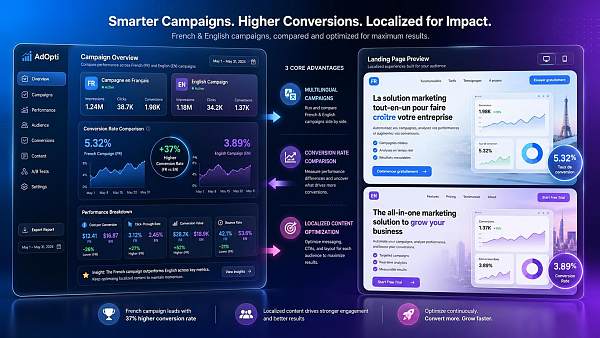
Here is the conclusion first: a large difference is not necessarily abnormal, but it needs to be broken down and analyzed. Many companies find that when they run English and French ads simultaneously, click-through rates are similar while conversion rates differ by as much as two times or even more. This is relatively common in North America, Europe, and some French-speaking markets in Africa, especially in B2B inquiries, cross-border e-commerce independent websites, and brand expansion campaigns.
Whether the difference is normal depends mainly on three criteria: First, are the two language versions targeting the same region and the same audience? Second, are the ad copy, keywords, and landing pages truly localized rather than merely translated? Third, is the sample size sufficient? If the traffic comes from different sources, or if the French page is simply a direct translation of the English page, a large conversion gap does not necessarily indicate poor market performance. It is more likely that the campaign model has not yet been properly optimized.
For business managers, the most important goal is not to make the conversion rates of the two language versions exactly the same, but to determine which version delivers greater commercial efficiency. Different language ads naturally face different competitive environments, customer decision cycles, and acquisition costs. As long as the final lead quality and conversion potential are consistent with the budget, the difference can be considered reasonable.
Why do French and English ads often perform differently in terms of conversion?
The first reason is differences in market structure. English ads cover a broad audience and usually face more intense competition, but users tend to have a higher level of market education and more mature search behavior. French ads reach a more concentrated audience, with greater differences between countries. For example, France, Quebec in Canada, Belgium, and French-speaking regions in North Africa all use French, but user needs, price sensitivity, and communication preferences are not the same.
The second reason is differences in search intent. English-speaking users are often more accustomed to directly searching for product terms, solution terms, or procurement-related terms. In many industries, French-speaking users are more likely to use phrases that are more descriptive and clearly problem-oriented. If the keyword strategy is copied directly from an English account, the campaign may appear to generate impressions and clicks, while the users entering the website may not actually have strong purchase intent. Conversion rates will naturally be lower.
The third reason is the difference in trust created by language expression. Many companies think that translating English ads and landing pages into French is sufficient. However, the French market is generally more sensitive to accuracy of expression, natural tone, and business rigor. If the headline sounds awkward, the CTA is not idiomatic, or the wording on the page resembles machine translation, users are more likely to leave quickly and bounce at a higher rate, ultimately affecting form submissions or inquiry conversions.
The fourth reason comes from the structure of the landing page content. English pages often use concise and direct sales language, emphasizing efficiency, price, and advantages. In many situations, French users place greater importance on brand credibility, service details, contact information, qualifications, and privacy protection. If the page structure is not adjusted to reflect the decision-making habits behind the language, even highly relevant traffic may fail to convert.
What should companies check first to determine whether the difference can be optimized?
The first step is to check whether the traffic sources are consistent. Many accounts appear to compare French and English campaigns, but in practice the English ads may target core markets in Europe and the United States, while the French ads cover France, Canada, French-speaking regions in Africa, and other areas at the same time. Purchasing power, industry maturity, competition intensity, and customer needs vary by region, so directly comparing conversion rates is not rigorous.
The second step is to check whether keyword intent is consistent. Do not compare language alone; compare the stage of the search journey as well. If the English account mainly uses high-intent terms such as “supplier,” “manufacturer,” and “quote,” while the French account uses more broad or informational terms, the difference comes from the keyword structure rather than from French being inherently less effective at driving conversions. This is particularly important for B2B foreign trade companies.
The third step is to check whether the ads and landing pages provide a consistent user experience. Users may see a French ad but be directed to an English form, a mixed-language page, or a French page containing obvious traces of direct translation. These issues directly weaken trust. The ad promise, page headline, core selling points, and form guidance must be consistent. Otherwise, even a large number of clicks generated by the system may not produce valid inquiries.
The fourth step is to determine whether the conversion actions themselves are suitable for French-speaking users. Some markets may prefer phone calls, WhatsApp, email, or instant messaging rather than long forms. If a company provides only one conversion path, it may underestimate the actual value of French traffic. For multilingual independent websites, conversion design is often just as important as language localization.
How should companies optimize when French and English bilingual ads have significantly different conversion rates?
A more effective approach is not to simply increase bids, but to rebuild the campaign structure around “language + region + intent.” French ads should preferably be separated by region, such as France, Quebec, and other French-speaking markets, and tested separately instead of grouping multiple countries together. Only in this way can companies determine whether the issue is related to language or to a specific market.
Ad copy needs to be rewritten rather than merely translated. English ads often emphasize direct action and efficiency, while French ads are more suitable for incorporating elements such as credibility, service, delivery capabilities, and local support. For industries with high decision-making thresholds, such as manufacturing, equipment, and B2B services, the French version needs to explain the company’s qualifications, lead times, cooperation process, and after-sales support more clearly.
Landing pages should also be optimized separately for the two languages rather than using the same template. French pages should place greater emphasis on localized headlines, trust elements, case information, frequently asked questions, and contact guidance, while avoiding mixed languages, translation-like wording, and formatting errors. A page is not simply a language-switching button; the entire persuasion logic must be adjusted to match user habits.
If a company runs Google Ads, SEO, and a multilingual website at the same time, it is best to use advertising data to optimize the website in return. Which French keywords generate high-quality inquiries, which pages have longer visit durations, and which pages achieve higher inquiry rates can all provide a basis for subsequent multilingual website development and SEO content planning. In this way, advertising is not only a customer acquisition tool but also helps improve long-term organic growth.
Which differences are worth accepting, and which must be addressed?
If French ads have a lower conversion rate than English ads but produce higher-quality leads, higher average order values, lower competition, or better subsequent close rates, the difference may be acceptable. When conducting overseas marketing, companies should not focus only on form conversion rates. They should also consider cost per lead, sales follow-up efficiency, and the final value of closed deals. A seemingly low conversion rate does not necessarily mean a low return.
However, if French ads simultaneously show a high bounce rate, short visit duration, low inquiry rate, weak engagement, and poor lead quality, this is not a normal difference but a systemic problem. Common causes include keyword mismatch, insufficient page localization, a disconnect between the ad promise and the page content, or website loading speed and mobile experience issues that affect conversion.
For companies seeking long-term global customer acquisition, the right approach is to establish an independent evaluation system for multilingual marketing rather than treating the French market as an extension of the English market. Ads, websites, and content in different languages essentially correspond to different user decision-making paths. Only by managing data from a localized perspective can companies assess return on investment more accurately.
How should companies plan from short-term campaigns to long-term growth?
If a company has already entered France, Canada, or other French-speaking markets, bilingual advertising should not be merely a temporary testing initiative. It should be planned together with multilingual website development, SEO optimization, and social media operations. Advertising is responsible for quickly validating market feedback, the website is responsible for supporting conversions, and SEO and content are responsible for accumulating long-term traffic. This creates a more stable customer acquisition structure.
For foreign trade manufacturers, cross-border brands, and companies expanding overseas, the truly effective approach is to establish a sustainable overseas marketing system: first, use French and English bilingual advertising to test market demand; then optimize pages based on website data and search term reports; finally, incorporate high-converting content into multilingual websites and SEO pages, gradually reducing customer acquisition costs.
An integrated service such as 易营宝, which covers AI-powered website building, multilingual website development, Google SEO optimization, and Google Ads management, is more suitable for companies that need coordinated French and English operations. This is because differences in conversion rates between bilingual ads are often not caused by a single advertising account, but by coordination issues among the website, localization, content, and campaigns. These elements need to be optimized consistently across the entire customer acquisition process.
Summary: When French and English bilingual ads have significantly different conversion rates, the key is not to be surprised but to know how to assess the difference
Returning to the original question, is it normal for French and English bilingual ads to have significantly different conversion rates? The answer is: it is common and is not necessarily a bad thing. What truly matters is determining whether the difference comes from objective market variations or from deficiencies in translation, page design, localized expression, and campaign strategy. Once the cause is correctly identified, subsequent optimization will have a clear direction.
For companies, the value of French and English bilingual advertising does not lie in producing exactly the same data, but in finding the most suitable customer acquisition method for each market. As long as companies continue optimizing around user search intent, landing page performance, and commercial conversion efficiency, multilingual advertising can not only generate more stable overseas leads but also lay a stronger foundation for website SEO and global growth.
Related Articles

Related Products
 Yiyingbao SaaS Intelligent Website Building and Marketing SystemYiyingbao SaaS Intelligent Website Building and Marketing System, AI-powered no-code website building, rapid creation of multilingual B2B international websites in 10 minutes, global server acceleration, AI-powered SEO optimization, helping businesses connect efficiently with global markets. The perfect integration of technology and operation makes building an international trade website remarkably simple
 AI+SEM Intelligent Advertising Marketing SystemAI+SEM drives intelligent ad creation, empowering full-funnel precision advertising marketing. The system automatically generates weekly/monthly reports, AI recommends keywords and target countries, monitors core metrics in real-time with intelligent alerts, and enables one-click high-conversion ad solutions to help quickly acquire customers and improve ROI.
 AI+SEO Dual-Engine System Optimization ServicesYiyingbao’s AI+SEO dual-engine optimization system helps foreign trade enterprises acquire high-quality organic traffic through AI-powered keyword research, content generation, and comprehensive technical optimization, significantly improving search rankings and conversion rates.
 AI+SNS Social Media Marketing SystemYingbao AI+SNS Social Media Marketing System - Precision social capture for the social media era. Supports one-click content synchronization across major platforms like Facebook and LinkedIn. AI intelligently rewrites posts for enhanced relevance. 24/7 AI customer service and user profiling analysis empower businesses to efficiently expand into global markets.
 AI+SEO营销解决方案易营宝AI+SEO营销解决方案,通过AI批量写作、智能生成TDK、精准关键词扩词等功能,全面优化网站SEO效果,提升流量与转化率。助力企业构建高效智能网站新生态。
 AI+SEM Advertising Marketing SolutionsAI+SEM Advertising Marketing Solution leverages AI technology to deeply empower SEM ad campaigns. It automatically generates weekly/monthly reports using AI, presenting account data across multiple dimensions for comprehensive insights into campaign performance and trends. The system precisely recommends keywords and target countries, intelligently generates high-conversion ad copy, and enables one-click activation of efficient campaign plans to help businesses rapidly acquire customers. Simultaneously, it monitors core metrics in real time, intelligently identifies abnormal fluctuations, and issues timely alerts to ensure stable, high-return advertising results.
 Domain Name ServicesEasyWin provides professional domain name services, including intelligent queries, one-stop registration, brand protection, and full lifecycle management, helping businesses build a digital brand image.
 EasyOperate B2C Cross-Border E-Commerce Platform & Independent WebsiteEasyStore B2C Cross-border E-commerce Independent Store is an intelligent website building and cross-border e-commerce integrated solution independently developed by EasyStore Information Technology (Beijing) Co., Ltd. The system is specially designed for small and medium-sized as well as large export enterprises, integrating 'website building, operation, marketing, advertising, and conversion' into one, helping enterprises quickly establish cross-border e-commerce independent stores to achieve brand globalization and global sales growth.
The platform supports multiple languages, multiple currencies, and multi-channel marketing, with built-in AI intelligent translation and SEO optimization systems, suitable for mainstream markets such as Southeast Asia, Europe and America, Latin America, and the Middle East, assisting Chinese manufacturing enterprises in efficiently deploying international e-commerce strategies. SSL证书易营宝提供专业SSL安全证书服务,包括单域名和泛域名证书,确保网站数据传输加密、身份验证和完整性保护,助力企业建立安全可信的在线业务环境。









