









- Which customer acquisition channels will be affected by cross-border marketing trends in 2026?Sep 06, 2026View details
- Which homogenization risks should be considered in an analysis of the AI-powered website building industry?Aug 30, 2026View details
- How Will AI Marketing Trends 2026 Change Advertising Budget AllocationAug 28, 2026View details
- Is the EV SSL certificate market shrinking or upgrading? How should companies assess certificate procurement?Aug 11, 2026View details
- Why the old AMP SEO 2020 practices no longer work and what has changed in current optimization prioritiesAug 02, 2026View details
- How to Choose Topics for an Industry News Section to Attract More Organic Search TrafficJul 29, 2026View details
How should low ad CTR in the German market generally be optimized?
How can you improve a low advertising CTR in the German market? The key lies in localized copy, precise audience targeting, creative testing, and coordinated landing page optimization. Only by combining German user preferences with data-driven strategies can you truly improve click-through and conversion rates.
For foreign trade companies, manufacturing factories, cross-border e-commerce brands, and overseas expansion service providers, Germany is not a market where simply running ads guarantees results. Many companies encounter the same problem in Google Ads, display advertising, or social media advertising: impressions are not low, but the click-through rate remains below 1% for a long time, and even high-quality traffic is difficult to convert into inquiries and orders.
In an integrated website and marketing services scenario, a low CTR is often not caused by a single issue, but by the combined effects of ad creatives, keyword strategy, landing page experience, language localization, and the conversion path. German users, in particular, tend to have high expectations regarding information accuracy, professionalism, and page trustworthiness. Broad-brush advertising is therefore usually unlikely to deliver sustained growth.
For companies seeking to expand into the European market, the key to improving a low advertising CTR in Germany is not simply to “make the headlines more attractive,” but to establish a complete loop from ad exposure and click attraction to website engagement. Only when the website, advertising, and data analysis work together can CTR and conversion rates improve simultaneously.
Why Is the Advertising Click-Through Rate Low in the German Market
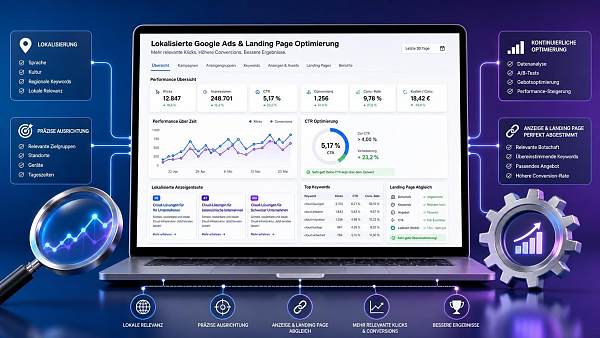
Advertising click behavior in the German market is relatively rational. Unlike markets where impulse consumption is more common, German users pay greater attention when searching and browsing ads to whether the information is specific, whether product parameters are clear, and whether the company identity is trustworthy. If an ad only emphasizes generalized claims such as “high quality” and “low prices,” the CTR will usually be difficult to improve significantly.
Unlocalized Copy Is the Most Common Initial Barrier
When advertising in Germany, many companies directly translate English ads into German or continue using marketing language intended for the North American market. This can make the wording appear correct while still lacking local relevance. German users place greater emphasis on logic, standards, and verifiable information. If ad headlines omit details such as model, service scope, delivery time, and application scenarios, users’ willingness to click will decline significantly.
Typical Low-CTR Signals
- Search ad CTR remains below 2% for 2 to 4 consecutive weeks
- Display ad CTR remains below 0.5% over an extended period
- Click-through rates among multiple creatives within the same ad group differ by more than 3 times
- Mobile click-through rate is significantly higher than desktop, but conversion performance is weak
Broad Audience Segmentation Can Lower Overall Account Performance
How can you improve a low advertising CTR in the German market? The second key point is refined audience targeting. Many companies treat “Germany” as a single unified market, but the decision-making paths of audiences for B2B procurement, industrial components, cross-border retail, and brand-owned websites are completely different. If keywords, locations, devices, and audience interests are mixed at the same level, both click-through rates and subsequent conversions will be diluted.
For a B2B foreign trade website, for example, it is recommended to divide the basic audience into at least three categories: brand terms/competitor terms, general industry terms, and long-tail procurement terms. If the budget allows, targeting can also be segmented by southern German industrial areas, the Rhine region, and areas related to port logistics. The differences in CTR among different ad groups can usually be identified within the first two weeks.
The following table can help companies quickly identify common causes of low CTR in German advertising campaigns and match them with corresponding optimization directions.
From a practical perspective, a low CTR does not necessarily mean that there is insufficient demand for traffic. More often, it means that the advertising structure and website engagement approach do not match the decision-making logic of German users. Identifying the cause first and then carrying out layered optimization is often more effective than blindly increasing the budget.
How to Improve a Low Advertising CTR in Germany: 4 Core Optimization Directions
If a company wants to see a clearer improvement trend within 4 to 8 weeks, it is recommended to advance four areas simultaneously: copy, localized keyword sets, creative testing, and coordinated landing page optimization. Single-point optimization may produce a 10% to 20% improvement, but systematic adjustments are more likely to create sustained growth.
1. Improve the Copy Structure First, Rather Than Just Changing the Wording
German advertising copy is better suited to “information-based attraction” than “emotion-based stimulation.” In B2B and high-value sectors, headlines are recommended to follow a three-part structure: “product or service term + core advantage + application scenario.” For example, instead of simply writing “professional website development services,” specify “German-language website development, SEO-friendly structure, and optimized for B2B inquiry conversion.”
The description should prioritize three types of information: delivery time, functional capabilities, and service scope. Examples include launch within 7 to 15 days, multilingual support, and support for building Google Ads landing pages. Such wording makes it easier for users to determine whether a click is worthwhile, rather than merely seeing an ambiguous brand name.
2. Build a Mapping Between Localized Keywords and Search Intent
How can you improve a low advertising CTR in the German market? This also depends on whether keywords match user intent. The problem with many accounts is not an insufficient number of keywords, but a disorderly intent hierarchy. It is recommended to divide keywords into four levels: brand terms, solution terms, procurement terms, and comparison terms. Each level should correspond to different ad copy and different landing pages; the same set of creatives should not be shared across all levels.
4 Keyword Optimization Actions
- Clean up low-relevance search terms once a week to control the spread of ineffective matches.
- Add a new batch of long-tail procurement terms every 14 days, including roots such as price, lead time, supplier, and customization.
- Analyze ad relevance separately for keywords with a click-through rate below 1.5%.
- Configure dedicated landing pages for high-intent terms instead of directing users to the homepage or category pages.
3. Creative Testing Must Be Continuous, and Test Variables Must Not Be Confused
Many companies know that they need to conduct A/B testing, but the results are unsatisfactory because too many elements are changed at once. The correct approach is to test only 1 to 2 variables in each round. For example, first test the value proposition in the headline, then the trust elements in the description, and finally the additional information. Each testing cycle should ideally last no less than 7 days; an overly small sample size can easily lead to misjudgment.
In the German market, commonly effective variables include whether to emphasize local-language services, whether to highlight delivery time, whether to include industry qualification information, and whether to specify applicability to B2B or standalone website scenarios. For companies offering integrated website and marketing services, ad creatives should ideally directly reflect the overall capabilities of “website development + promotion + conversion,” rather than a single selling point.
To make testing more systematic, the creative optimization path can be designed according to the following table, reducing repeated trial and error within the account.
Improving ad CTR should not focus solely on the click metric. It should also take dwell time, conversion actions, and qualified inquiry rate into account. Otherwise, CTR may increase while traffic quality declines, causing the actual customer acquisition cost to rise instead.
4. Make the Landing Page Support the Ad Instead of Blaming the Ad for the Page’s Problems
How can you improve a low advertising CTR in the German market? The final key link is landing page coordination. Many ads are not inherently poor, but after clicking, users encounter a page that loads slowly, has a confusing information hierarchy, or uses awkward German wording. The system may gradually determine that the ad has insufficient relevance, which then affects subsequent impressions and click performance.
For German users, a landing page should meet at least four basic requirements: the main content should load within 3 seconds, the target audience should be clearly identified above the fold, clear contact information should be available, and core modules should be supported by professional information. For a B2B website, it is recommended that the first screen present product capabilities, application industries, delivery methods, and an inquiry entry point.
Website and Marketing Integration Is the Fundamental Capability for Sustained CTR Improvement
From a long-term operations perspective, improving a low advertising CTR in Germany cannot rely solely on temporary keyword and bid adjustments by an advertising specialist. The truly stable approach is to connect advertising, standalone website development, SEO content planning, conversion page design, and data analysis into a unified growth system.
Why Integrated Solutions Are More Suitable for Companies Expanding Overseas
For foreign trade companies and brands expanding overseas, ad CTR is only a front-end metric. If the website structure does not support multilingual SEO, the page content is not adapted to the German market, and the inquiry path is too long, the marginal return from ad optimization will decline rapidly within 30 to 60 days. By contrast, results are more stable when the website and advertising campaigns are iterated simultaneously.
Platforms such as Yiyingbao, an AI-driven enterprise SaaS intelligent website development and overseas marketing platform, are more suitable for companies that need to improve overall efficiency. Its advantage is not a single advertising service, but the ability to link multilingual website development, Google Ads, SEO optimization, social media lead generation, and AI search visibility enhancement, reducing communication costs between teams.
3 Types of Companies That Should Prioritize an Integrated Solution
- Manufacturing companies planning to expand simultaneously in Germany and multiple other European countries
- Teams that already have a standalone website but have seen no improvement in advertising CTR and inquiry rate for one consecutive quarter
- Overseas brands that need to advance website development, advertising, SEO, and content localization simultaneously with limited personnel
An Executable Optimization Process
If a company wants to achieve a higher click-through rate and more stable conversions in the German market, it is recommended to follow a five-step process: conduct an account diagnosis first, then segment keywords, restructure ad creatives, optimize the landing page simultaneously, and finally iterate through weekly reviews. Changes in click-through rates can generally be observed in the second week, while more stable conversion signals can be evaluated between the fourth and eighth weeks.
The focus of this process is not to “make one change and finish,” but to continuously establish a data feedback mechanism. For example, by breaking down data across five dimensions—device, location, ad group, page entry point, and form completion rate—it becomes easier to determine whether a low CTR is caused by creatives, audiences, or landing page performance.
Common Misconception: Focusing Only on CTR While Ignoring the Quality of Final Inquiries
To answer the question “How can you improve a low advertising CTR in the German market?”, some teams overuse exaggerated promotional terms or broad interest-based audience targeting. In the short term, CTR may rise from 1.2% to 2.5%, but if ineffective clicks increase, the bounce rate rises, and form quality declines, overall customer acquisition costs may increase by more than 20%.
Therefore, optimization in Germany is better evaluated through the combined use of three metrics: “CTR + qualified engagement + lead quality.” For B2B businesses, the most valuable ad and page combination is not the one that generates the most clicks, but the one that brings higher-quality inquiries and shortens the sales communication cycle.
Turn Click-Through Rate Optimization into Real Growth
A low advertising click-through rate in Germany appears to be an advertising issue, but in essence it is often caused by a lack of integration among localization, traffic quality, and website engagement capabilities. As long as the four main areas—copy structure optimization, refined audience targeting, creative testing, and coordinated landing page optimization—are continuously advanced, an improvement direction can usually be identified within one or two optimization cycles.
For companies that need to improve website quality, advertising performance, and overseas customer acquisition efficiency simultaneously, choosing an integrated service that combines intelligent website development, SEO, advertising, and multilingual localization capabilities will be more efficient than outsourcing individual functions separately. Yiyingbao has long served foreign trade companies, manufacturing factories, cross-border sellers, and overseas brands, providing implementation support that is more closely aligned with business results in Germany and the broader European market.
If you are evaluating how to improve a low advertising CTR in the German market or hope to establish a more systematic overseas standalone website and marketing growth solution, please contact us now to obtain a customized plan and learn more about website development and advertising solutions suitable for your business stage.
Related Articles

Related Products
 Yiyingbao SaaS Intelligent Website Building and Marketing SystemYiyingbao SaaS Intelligent Website Building and Marketing System, AI-powered no-code website building, rapid creation of multilingual B2B international websites in 10 minutes, global server acceleration, AI-powered SEO optimization, helping businesses connect efficiently with global markets. The perfect integration of technology and operation makes building an international trade website remarkably simple
 AI+SEM Intelligent Advertising Marketing SystemAI+SEM drives intelligent ad creation, empowering full-funnel precision advertising marketing. The system automatically generates weekly/monthly reports, AI recommends keywords and target countries, monitors core metrics in real-time with intelligent alerts, and enables one-click high-conversion ad solutions to help quickly acquire customers and improve ROI.
 AI+SEO Dual-Engine System Optimization ServicesYiyingbao’s AI+SEO dual-engine optimization system helps foreign trade enterprises acquire high-quality organic traffic through AI-powered keyword research, content generation, and comprehensive technical optimization, significantly improving search rankings and conversion rates.
 AI+SNS Social Media Marketing SystemYingbao AI+SNS Social Media Marketing System - Precision social capture for the social media era. Supports one-click content synchronization across major platforms like Facebook and LinkedIn. AI intelligently rewrites posts for enhanced relevance. 24/7 AI customer service and user profiling analysis empower businesses to efficiently expand into global markets.
 AI+SEO营销解决方案易营宝AI+SEO营销解决方案,通过AI批量写作、智能生成TDK、精准关键词扩词等功能,全面优化网站SEO效果,提升流量与转化率。助力企业构建高效智能网站新生态。
 AI+SEM Advertising Marketing SolutionsAI+SEM Advertising Marketing Solution leverages AI technology to deeply empower SEM ad campaigns. It automatically generates weekly/monthly reports using AI, presenting account data across multiple dimensions for comprehensive insights into campaign performance and trends. The system precisely recommends keywords and target countries, intelligently generates high-conversion ad copy, and enables one-click activation of efficient campaign plans to help businesses rapidly acquire customers. Simultaneously, it monitors core metrics in real time, intelligently identifies abnormal fluctuations, and issues timely alerts to ensure stable, high-return advertising results.
 Domain Name ServicesEasyWin provides professional domain name services, including intelligent queries, one-stop registration, brand protection, and full lifecycle management, helping businesses build a digital brand image.
 EasyOperate B2C Cross-Border E-Commerce Platform & Independent WebsiteEasyStore B2C Cross-border E-commerce Independent Store is an intelligent website building and cross-border e-commerce integrated solution independently developed by EasyStore Information Technology (Beijing) Co., Ltd. The system is specially designed for small and medium-sized as well as large export enterprises, integrating 'website building, operation, marketing, advertising, and conversion' into one, helping enterprises quickly establish cross-border e-commerce independent stores to achieve brand globalization and global sales growth.
The platform supports multiple languages, multiple currencies, and multi-channel marketing, with built-in AI intelligent translation and SEO optimization systems, suitable for mainstream markets such as Southeast Asia, Europe and America, Latin America, and the Middle East, assisting Chinese manufacturing enterprises in efficiently deploying international e-commerce strategies. SSL证书易营宝提供专业SSL安全证书服务,包括单域名和泛域名证书,确保网站数据传输加密、身份验证和完整性保护,助力企业建立安全可信的在线业务环境。









