









- Which customer acquisition channels will be affected by cross-border marketing trends in 2026?Sep 06, 2026View details
- Which homogenization risks should be considered in an analysis of the AI-powered website building industry?Aug 30, 2026View details
- How Will AI Marketing Trends 2026 Change Advertising Budget AllocationAug 28, 2026View details
- Is the EV SSL certificate market shrinking or upgrading? How should companies assess certificate procurement?Aug 11, 2026View details
- Why the old AMP SEO 2020 practices no longer work and what has changed in current optimization prioritiesAug 02, 2026View details
- How to Choose Topics for an Industry News Section to Attract More Organic Search TrafficJul 29, 2026View details
Is monthly management suitable for Facebook advertising in Canada?
Is Monthly Facebook Ads Management Suitable for the Canadian Market?
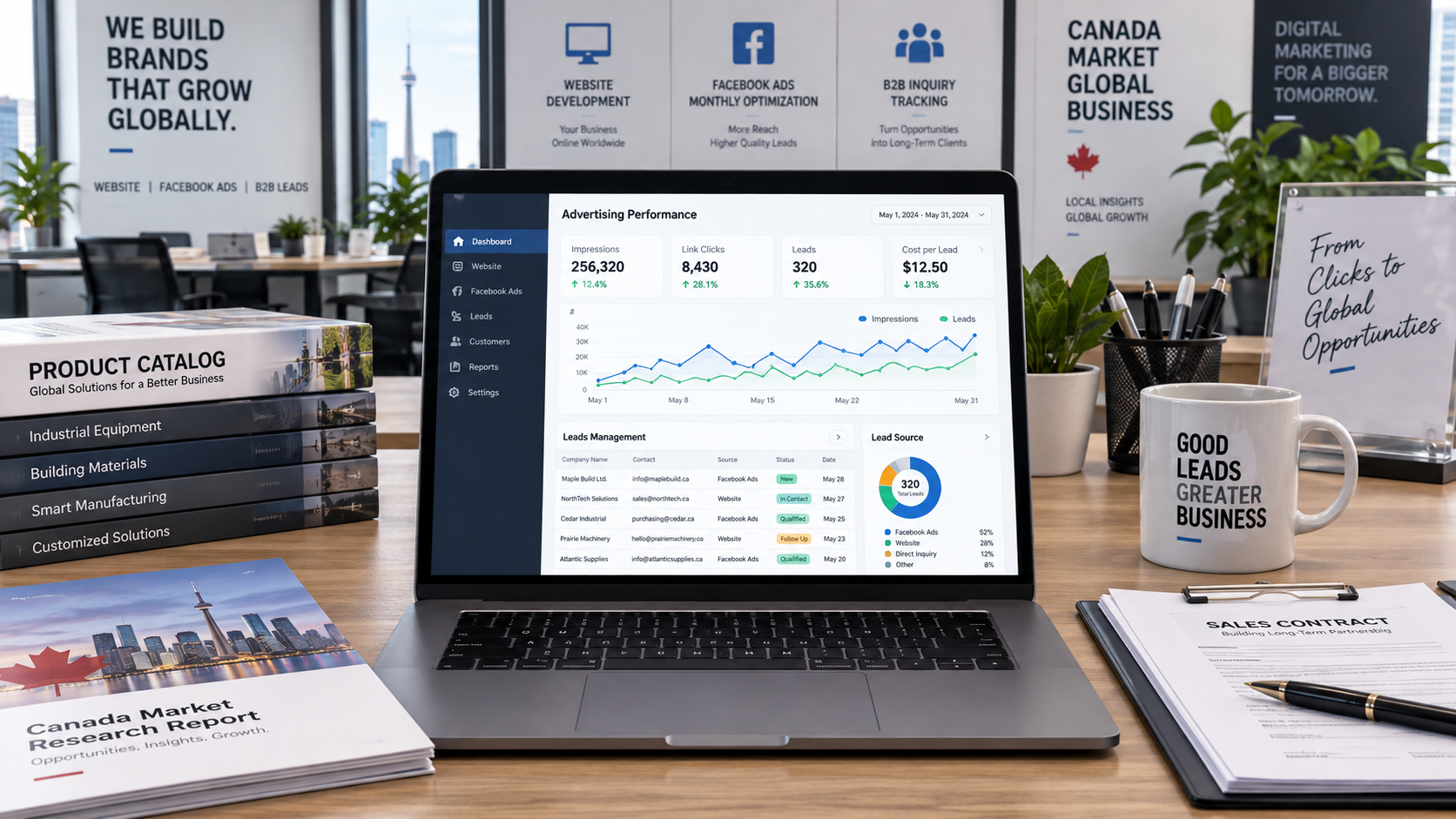
For businesses preparing to enter the Canadian market, choosing monthly Facebook ads management may seem like a comparison of service fees, but it is actually an assessment of whether a customer acquisition investment can be managed on an ongoing basis. This is particularly true for manufacturers, foreign trade B2B companies, and cross-border brands. Ads do not always generate immediate orders; more often, they generate inquiries, sample requests, catalog downloads, consultation bookings, or remarketing audience accumulation. Looking only at the cost per lead in a single month can easily lead to a misjudgment of service value.
Monthly Facebook ads management is generally suitable for the Canadian market, provided that the cooperation period, account ownership, data permissions, and optimization scope are clearly specified. Monthly cooperation does not mean starting over every month; instead, it should involve continuously testing creatives, audiences, landing pages, and conversion paths within the same trackable campaign framework. For businesses newly entering the local market and still validating product positioning, a monthly arrangement also makes it easier to control trial-and-error costs than a one-time package.
First Clarify Whether You Are Buying “Execution” or Ongoing Optimization Capability
The most common procurement misconception is to view managed advertising as simply “opening an account, creating a few ads, and sending a report every month.” The threshold for such services is not high, and it is often difficult to justify differences in fees. What truly affects campaign quality is whether the service provider can adjust the advertising structure based on sales objectives: acquisition campaigns for unfamiliar audiences, remarketing campaigns for website visitors, and outreach to leads that have submitted forms but have not converted all require different strategies and budget logic.
B2B projects in particular should avoid measuring advertising solely by the number of form submissions. A low-threshold form may generate many invalid contact details, while a form with qualifying fields such as product specifications, purchasing cycle, and application industry may receive fewer submissions in the short term but be closer to the sales opportunities the sales team actually needs. Therefore, monthly service deliverables should include a review of lead quality rather than merely displaying impressions, clicks, and total form submissions.
Which Situations Are Suitable for Monthly Cooperation, and Which Do Not Call for Rushing Into a Long-Term Contract?
If a business already has English or French landing pages, clear product selling points, stable personnel to handle inquiries, and the ability to promptly provide feedback on whether leads are valid, monthly cooperation is generally more flexible. The service provider can complete account review, creative testing, and event-tracking checks in the first month, then gradually reduce ineffective directions based on the data. For businesses with strong seasonality or budgets that change with trade shows or inventory, a monthly model also facilitates dynamic adjustments.
However, if the website loads slowly, product pages provide only basic descriptions, pricing rules are confusing, or the sales team cannot follow up on leads within a short period, launching ads first may not be cost-effective. Driving traffic to a page that cannot build trust will only magnify the problem. The Canadian market also includes both English- and French-language communication scenarios. When targeting Quebec and similar regions, whether the page language, creative messaging, and customer service arrangements are appropriate should be confirmed before launch rather than remedied after the budget has been spent.

Costs Are More Than a Monthly Service Fee
When evaluating the cost of managed Facebook ads in Canada, it is advisable to review expenses separately: media ad budget, management service fee, image or video creative production, landing page development and maintenance, data tracking configuration, and any translation and localization adjustments. Consolidating all costs into an “all-inclusive price” may appear easier for procurement, but it can later lead to disputes if the number of creatives, page revisions, or the scope of account maintenance is unclear.
More importantly, attention should be paid to how costs are measured. B2C businesses can more directly assess order value and advertising return, while B2B businesses should at least distinguish between cost per lead, cost per qualified lead, and the cost of leads entering the sales opportunity pipeline. If the product has a high average order value and a long decision-making cycle, campaigns should not be simply dismissed because no sales were closed in the first month, nor should a large volume of low-quality forms be used to prove that advertising is effective. Before cooperation begins, the buyer should ask the service provider to explain which data is provided by the advertising platform and which data requires supplementation through the company’s CRM or sales feedback.
The Four Most Frequently Overlooked Issues in a Contract
Who should own the account, advertising page, pixel, and related data assets? It is generally advisable for the business to retain the core account and administrative permissions, while the service provider receives the necessary operational permissions. This ensures that even if the partnership is adjusted later, historical audiences, ad creatives, and learning data will not be lost.
Second, what actions are actually included in the monthly service? Does it involve weekly optimization of budgets and audiences, or only account monitoring? Does it include new creative testing, copy iteration, landing page recommendations, and remarketing setup? Third, can the report show ad spend, conversion definitions, ad set performance, and explanations of anomalies, rather than merely providing a one-page summary chart? Fourth, how will creatives, pages, and data be handed over after cooperation is paused or terminated? The earlier these issues are confirmed, the more subsequent costs can be reduced.
Purchasing Website and Advertising Services Separately Often Increases Optimization Barriers
The advertising team is responsible for driving traffic, the website supplier is responsible for pages, and the sales team is responsible for follow-up. Each party may complete its own tasks, yet they may not form a closed loop. For example, if ad click-through rates are normal but inquiries are limited, the reason may be a mismatch between the creative promise and page content, an overly long form, poor mobile experience, or a lack of industry proof on the page. When service boundaries are too fragmented, problems are often attributed to “inaccurate traffic.”
Yiyingbao Information Technology (Beijing) Co., Ltd. was established in 2013 and is headquartered in Beijing. It has long provided integrated services centered on intelligent website development, SEO optimization, social media marketing, and advertising. Its AI-driven website development, advertising marketing, and SEO/GEO optimization systems are suitable for businesses that need to manage multilingual websites, advertising landing pages, Facebook campaigns, and subsequent search growth within a single workflow. For buyers, the key is not whether the service names are comprehensive, but whether advertising data can in turn guide page adjustments and whether the content accumulated on pages can continue to support search and remarketing.
Yiyingbao has served more than 100,000 businesses and was selected among China’s Top 100 SaaS Enterprises in 2023. The practical value of this type of platform-based service typically lies in reducing handoff losses between website development, campaign delivery, and content optimization, rather than replacing all customer acquisition methods with a single channel. Facebook ads in Canada can serve as tools for market testing and audience outreach, while Google Ads, SEO, and website content development can address search needs at different stages, with budgets arranged in combination according to business pace.
A Reasonable Starting Point for Monthly Cooperation Is to First Agree on a Validation Period
Choosing monthly managed services should not be understood as “results must be achieved within one month,” nor should trial campaigns continue indefinitely. A more practical approach is to first agree on a validation period that includes testing and review: verify the account and website foundation during the initial stage, then test different selling points, audiences, and page paths, and subsequently decide whether to scale, adjust, or pause based on qualified leads and sales feedback. When making procurement decisions, businesses should require service providers to put expected deliverables, business cooperation requirements, and evaluation criteria into an actionable checklist.
If a business does not yet have Canadian-market pages capable of receiving advertising traffic, first organizing the website language, product information, inquiry paths, and data tracking is often more meaningful than rushing to compare monthly service fees. Advertising budgets can be flexible, but once data assets, website foundations, and lead follow-up mechanisms are established, they become components that can be reused for every subsequent campaign.
Related Articles


Related Products
 Yiyingbao SaaS Intelligent Website Building and Marketing SystemYiyingbao SaaS Intelligent Website Building and Marketing System, AI-powered no-code website building, rapid creation of multilingual B2B international websites in 10 minutes, global server acceleration, AI-powered SEO optimization, helping businesses connect efficiently with global markets. The perfect integration of technology and operation makes building an international trade website remarkably simple
 AI+SEM Intelligent Advertising Marketing SystemAI+SEM drives intelligent ad creation, empowering full-funnel precision advertising marketing. The system automatically generates weekly/monthly reports, AI recommends keywords and target countries, monitors core metrics in real-time with intelligent alerts, and enables one-click high-conversion ad solutions to help quickly acquire customers and improve ROI.
 AI+SEO Dual-Engine System Optimization ServicesYiyingbao’s AI+SEO dual-engine optimization system helps foreign trade enterprises acquire high-quality organic traffic through AI-powered keyword research, content generation, and comprehensive technical optimization, significantly improving search rankings and conversion rates.
 AI+SNS Social Media Marketing SystemYingbao AI+SNS Social Media Marketing System - Precision social capture for the social media era. Supports one-click content synchronization across major platforms like Facebook and LinkedIn. AI intelligently rewrites posts for enhanced relevance. 24/7 AI customer service and user profiling analysis empower businesses to efficiently expand into global markets.
 AI+SEO营销解决方案易营宝AI+SEO营销解决方案,通过AI批量写作、智能生成TDK、精准关键词扩词等功能,全面优化网站SEO效果,提升流量与转化率。助力企业构建高效智能网站新生态。
 AI+SEM Advertising Marketing SolutionsAI+SEM Advertising Marketing Solution leverages AI technology to deeply empower SEM ad campaigns. It automatically generates weekly/monthly reports using AI, presenting account data across multiple dimensions for comprehensive insights into campaign performance and trends. The system precisely recommends keywords and target countries, intelligently generates high-conversion ad copy, and enables one-click activation of efficient campaign plans to help businesses rapidly acquire customers. Simultaneously, it monitors core metrics in real time, intelligently identifies abnormal fluctuations, and issues timely alerts to ensure stable, high-return advertising results.
 Domain Name ServicesEasyWin provides professional domain name services, including intelligent queries, one-stop registration, brand protection, and full lifecycle management, helping businesses build a digital brand image.
 EasyOperate B2C Cross-Border E-Commerce Platform & Independent WebsiteEasyStore B2C Cross-border E-commerce Independent Store is an intelligent website building and cross-border e-commerce integrated solution independently developed by EasyStore Information Technology (Beijing) Co., Ltd. The system is specially designed for small and medium-sized as well as large export enterprises, integrating 'website building, operation, marketing, advertising, and conversion' into one, helping enterprises quickly establish cross-border e-commerce independent stores to achieve brand globalization and global sales growth.
The platform supports multiple languages, multiple currencies, and multi-channel marketing, with built-in AI intelligent translation and SEO optimization systems, suitable for mainstream markets such as Southeast Asia, Europe and America, Latin America, and the Middle East, assisting Chinese manufacturing enterprises in efficiently deploying international e-commerce strategies. SSL证书易营宝提供专业SSL安全证书服务,包括单域名和泛域名证书,确保网站数据传输加密、身份验证和完整性保护,助力企业建立安全可信的在线业务环境。









