









- Which customer acquisition channels will be affected by cross-border marketing trends in 2026?Sep 06, 2026View details
- Which homogenization risks should be considered in an analysis of the AI-powered website building industry?Aug 30, 2026View details
- How Will AI Marketing Trends 2026 Change Advertising Budget AllocationAug 28, 2026View details
- Is the EV SSL certificate market shrinking or upgrading? How should companies assess certificate procurement?Aug 11, 2026View details
- Why the old AMP SEO 2020 practices no longer work and what has changed in current optimization prioritiesAug 02, 2026View details
- How to Choose Topics for an Industry News Section to Attract More Organic Search TrafficJul 29, 2026View details
Multilingual Website Maintenance Costs: Which Areas Usually Account for Them?
The Budget Is Always Insufficient? The Problem Often Isn't the Website Development Fee
When many financial approvers review a multilingual website project for the first time, they tend to focus on the one-time cost at launch. However, what truly drives up the maintenance cost of a multilingual website is usually not how attractive the homepage is, but the series of tasks required whenever content is changed, a new language is added, or a new market is entered: translation, proofreading, page adaptation, SEO optimization, form testing, data tracking, and team coordination.
If the initial review focuses only on the website development quotation, a common situation may arise later: the website has gone live, but content updates cannot keep up, foreign-language pages remain outdated for long periods, and advertising campaigns and SEO cannot use the same set of pages. Eventually, either no one maintains the website or the budget has to be increased continuously. Clearly identifying where the budget will be spent during the procurement stage makes the approval process more reliable.
Where Do Multilingual Website Maintenance Costs Usually Go?
Most of the costs generally fall into four categories: content, technology, traffic, and coordination.
- Content costs: Product pages, case study pages, news, downloadable materials, form prompts, privacy notices, and other content all require ongoing translation and updates.
- Technical costs: URL rules for different language sites, redirection logic, mobile adaptation, loading speed, form submissions, character encoding, and sitemap maintenance.
- Traffic costs: Simply translating a Chinese website into foreign languages does not generate traffic. Multilingual SEO, landing page optimization, keyword placement, and indexing maintenance are also required.
- Coordination costs: Marketing, international sales, product, design, technology, and translation suppliers need to repeatedly confirm details. The time spent internally is also a real cost.
From an approval perspective, the key question is not “Why is the website so expensive?” but “Which parts of this expense are one-time costs, and which will recur every month?” Clarifying this point makes it less likely that the total investment will be underestimated later.
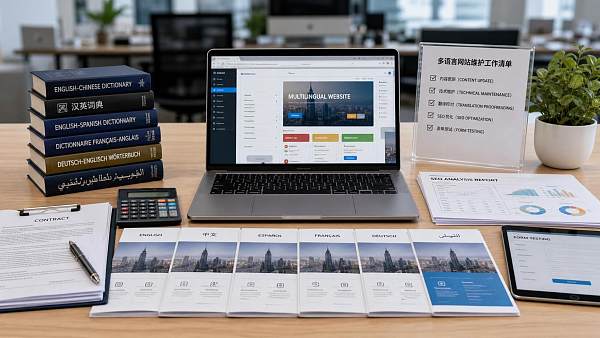
Why Does Translation End Up Being the Most Expensive Part Even Though It Isn't the Most Expensive at First?
Because translation for a multilingual website is never simply a matter of “changing the text into another language.” The actual costs generally arise at three levels.
The first is the initial volume of content. When there are many product models, extensive industry materials, and deep page hierarchies, the translation workload can increase rapidly. The second is ongoing updates. Companies frequently revise product specifications, delivery information, campaign pages, and form fields. Once these changes occur, all corresponding language versions must be updated simultaneously. The third is localization. Literal translation may allow a page to go live, but it does not necessarily generate conversions. Titles, buttons, inquiry copy, and download prompts in particular often need to be adapted to local market habits.
During financial approval, three items can be reviewed directly: the total number of pages, the average monthly revision frequency, and the planned number of languages. If any two of these are high, translation and maintenance costs are unlikely to be low.
Why Doesn't Adding One Language Version Simply Mean Multiplying the Cost by One?
Because some basic modules can be reused while others cannot. For example, the site framework, product data structure, backend permissions, and some media assets often do not need to be rebuilt. However, page copy, keyword strategies, menu length, layout details, search habits, and conversion paths usually cannot be copied completely.
Consider a common situation: an English website is already live, and Spanish is added later. This does not mean that only one translation needs to be added. You also need to check whether the length of Spanish page titles will affect the navigation, whether text in images needs to be recreated, whether form fields need to be adjusted, and whether the search terms in the target market differ from those in the English-speaking market. If all of these elements need to be changed, the cost of adding a new language will be significantly higher than expected.
Therefore, during approval, don't ask only for the “single-language quotation.” Also ask which modules can be reused when adding a language and which will be charged as newly created pages.
Why Is Technical Maintenance Often an Invisible Expense?
Because technical issues often do not appear on the first page of a contract, but continue to consume labor after launch. Common technical maintenance for multilingual websites includes:
The difficulty with these costs is that they do not necessarily appear as a separate invoice. In many cases, they take the form of repeated rework, troubleshooting, and testing. When reviewing the budget, it is best to list “post-launch technical operations and maintenance” as a separate item rather than assuming that it is included in the website development fee.
Why Does SEO Become a Long-Term Item in Multilingual Website Maintenance Costs?
The reason is straightforward: launching multilingual pages does not mean that users in the target market can find them. Websites in different languages require more than translation. They also need page titles, descriptions, keyword placement, internal linking structures, category planning, indexing schedules, and consideration of the fact that different countries may use different search terms for the same product.
Many companies underestimate costs at this stage, believing that replacing Chinese keywords with foreign-language equivalents is sufficient. In practice, search intent often differs. Procurement-oriented keywords, brand-oriented keywords, and problem-oriented keywords correspond to different page structures. If the website is expected to support both lead generation and brand presentation, continuous optimization is required rather than a one-time delivery.
For approvers, a practical way to assess this is to check whether the service provider breaks SEO maintenance down into understandable work items, such as content update frequency, page optimization scope, technical indexing maintenance, and data review cycles. If these points cannot be explained clearly, subsequent costs are usually difficult to control.
Which Costs Are Most Easily Overlooked, Resulting in Repeated Budget Increases?
The most common omissions are four items.
- The charging rules for new pages and additional languages are not clearly specified. The initial project may cover only core pages, but when business departments later add application pages, download pages, or campaign pages, costs increase.
- Recreating text in images and videos is not included. A multilingual website involves more than changing the body copy; many visual assets also need to be updated.
- Supporting overseas marketing is not included. For example, when landing pages, advertising pages, social media traffic-driving pages, and website content are not maintained consistently, two separate cost structures may ultimately emerge.
- Internal coordination time is not included. Legal reviews the copy, product reviews the specifications, and sales reviews the wording. The time spent waiting for confirmations from the supplier can also extend the project schedule.
If you are comparing quotations for procurement, it is recommended that you ask the supplier to list the “standard maintenance scope” and “how services beyond the scope will be charged.” Without these two lines, a low quotation may simply mean low initial costs followed by higher costs later.
Which Cost Indicators Should Be Reviewed During Financial Approval?
Don't focus only on the total price. Pay attention to whether the cost structure is predictable. The following indicators are useful:
- Whether charges are calculated by page, by language, or by a combination of both.
- How many content updates are included in the monthly maintenance, and how additional updates are charged.
- Whether SEO, technical operations and maintenance, and content translation are quoted separately.
- Whether the system supports continued expansion within the same platform when entering new markets.
- Whether the backend allows the marketing team to maintain some content independently, reducing repetitive outsourcing.
If a service provider covers website development, SEO, advertising landing pages, and multilingual content maintenance at the same time, it is generally easier to reduce duplicated investment. This is not because the concept is broader, but because the same system and content assets can be reused repeatedly, reducing communication losses caused by splitting the work among different parties.
Is Maintaining the Website with an In-House Team Really Always Cheaper Than Outsourcing?
Not necessarily. It depends on the update frequency and business complexity. If the pages remain stable for a long time, there are few languages, and content changes are limited, an in-house team may be more cost-effective. However, if the company is promoting its business in multiple markets and the website also needs to support SEO, advertising, and social media traffic generation, the internal team may lack not only personnel but also the capability to coordinate the entire process.
The most easily overlooked cost is “fragmented labor.” Each department may appear to spend only a small amount of time, but the total can be more expensive than outsourcing, while response times may also be slower. During procurement, total annual costs can be calculated, including labor, tools, translation, technical maintenance, revision frequency, and opportunity costs. Calculating only monthly salaries will usually lead to a distorted conclusion.
How Should the Procurement Plan Be Defined in Advance to Control Multilingual Website Maintenance Costs?
A relatively reliable approach is to divide the procurement scope into two parts: “must be handled on an ongoing basis” and “can be expanded in stages.” First, establish the core markets, core product pages, and core conversion paths, and then decide which languages and sections should be included in the second phase. This makes budget control easier than deploying everything from the start.
In addition, it is best to choose a solution that supports ongoing operations rather than one that only addresses launch. Services such as 易营宝, which cover intelligent website development, multilingual website construction, SEO optimization, advertising, and overseas marketing coordination, are more suitable for companies seeking long-term growth. The reason is that a website does not exist in isolation; ultimately, it must support lead generation and conversion. For financial approvers, what is truly worth approving is not “a multilingual website,” but a digital foundation that can continue to be used, updated, and generate leads.
Finally, here is a practical rule of thumb: First ask how much content will be changed in the next 12 months, how many languages will be added, and which markets will be served; then review the quotation. A solution that clearly breaks down costs according to these criteria is generally easier to control. A solution that provides only one bundled total price without clearly defining the maintenance boundaries is more likely to incur additional costs later.
Related Articles

Related Products
 Yiyingbao SaaS Intelligent Website Building and Marketing SystemYiyingbao SaaS Intelligent Website Building and Marketing System, AI-powered no-code website building, rapid creation of multilingual B2B international websites in 10 minutes, global server acceleration, AI-powered SEO optimization, helping businesses connect efficiently with global markets. The perfect integration of technology and operation makes building an international trade website remarkably simple
 AI+SEM Intelligent Advertising Marketing SystemAI+SEM drives intelligent ad creation, empowering full-funnel precision advertising marketing. The system automatically generates weekly/monthly reports, AI recommends keywords and target countries, monitors core metrics in real-time with intelligent alerts, and enables one-click high-conversion ad solutions to help quickly acquire customers and improve ROI.
 AI+SEO Dual-Engine System Optimization ServicesYiyingbao’s AI+SEO dual-engine optimization system helps foreign trade enterprises acquire high-quality organic traffic through AI-powered keyword research, content generation, and comprehensive technical optimization, significantly improving search rankings and conversion rates.
 AI+SNS Social Media Marketing SystemYingbao AI+SNS Social Media Marketing System - Precision social capture for the social media era. Supports one-click content synchronization across major platforms like Facebook and LinkedIn. AI intelligently rewrites posts for enhanced relevance. 24/7 AI customer service and user profiling analysis empower businesses to efficiently expand into global markets.
 AI+SEO营销解决方案易营宝AI+SEO营销解决方案,通过AI批量写作、智能生成TDK、精准关键词扩词等功能,全面优化网站SEO效果,提升流量与转化率。助力企业构建高效智能网站新生态。
 AI+SEM Advertising Marketing SolutionsAI+SEM Advertising Marketing Solution leverages AI technology to deeply empower SEM ad campaigns. It automatically generates weekly/monthly reports using AI, presenting account data across multiple dimensions for comprehensive insights into campaign performance and trends. The system precisely recommends keywords and target countries, intelligently generates high-conversion ad copy, and enables one-click activation of efficient campaign plans to help businesses rapidly acquire customers. Simultaneously, it monitors core metrics in real time, intelligently identifies abnormal fluctuations, and issues timely alerts to ensure stable, high-return advertising results.
 Domain Name ServicesEasyWin provides professional domain name services, including intelligent queries, one-stop registration, brand protection, and full lifecycle management, helping businesses build a digital brand image.
 EasyOperate B2C Cross-Border E-Commerce Platform & Independent WebsiteEasyStore B2C Cross-border E-commerce Independent Store is an intelligent website building and cross-border e-commerce integrated solution independently developed by EasyStore Information Technology (Beijing) Co., Ltd. The system is specially designed for small and medium-sized as well as large export enterprises, integrating 'website building, operation, marketing, advertising, and conversion' into one, helping enterprises quickly establish cross-border e-commerce independent stores to achieve brand globalization and global sales growth.
The platform supports multiple languages, multiple currencies, and multi-channel marketing, with built-in AI intelligent translation and SEO optimization systems, suitable for mainstream markets such as Southeast Asia, Europe and America, Latin America, and the Middle East, assisting Chinese manufacturing enterprises in efficiently deploying international e-commerce strategies. SSL证书易营宝提供专业SSL安全证书服务,包括单域名和泛域名证书,确保网站数据传输加密、身份验证和完整性保护,助力企业建立安全可信的在线业务环境。









