









- Which customer acquisition channels will be affected by cross-border marketing trends in 2026?Sep 06, 2026View details
- Which homogenization risks should be considered in an analysis of the AI-powered website building industry?Aug 30, 2026View details
- How Will AI Marketing Trends 2026 Change Advertising Budget AllocationAug 28, 2026View details
- Is the EV SSL certificate market shrinking or upgrading? How should companies assess certificate procurement?Aug 11, 2026View details
- Why the old AMP SEO 2020 practices no longer work and what has changed in current optimization prioritiesAug 02, 2026View details
- How to Choose Topics for an Industry News Section to Attract More Organic Search TrafficJul 29, 2026View details
- Digital Marketing Shenzhen Market Insights: Why Are Companies Expanding Overseas Looking for Growth Teams in Shenzhen?Jul 31, 2026View details
- Can Zhejiang foreign trade independent websites still be developed today? Look at changes in traffic and lead generationJul 28, 2026View details
At what stage should an entity SEO consultant get involved in a company's growth project?
At What Stage Should an Entity SEO Consultant Get Involved in a Business Growth Project
Many projects view SEO as a way to recover traffic after a website goes live, which is why they repeatedly ask: Is it still possible to bring in an entity SEO consultant for optimization after the pages are completed, the content is published, and the ads are running? This is precisely where the problem lies. If an entity SEO consultant serves merely as a "patching role" after launch, their value is often limited. If they become involved during project planning, mid-stage design, or even channel planning, they serve as a structural role in the growth project, helping the team determine in advance which content can be indexed, which pages can handle inquiries, and which technical solutions may undermine promotional efficiency at a later stage.
The "entity SEO consultant" referred to here is not simply someone who knows how to build backlinks or arrange keywords. Rather, it is someone who can design search visibility around real business entities. For foreign trade companies, manufacturing plants, and cross-border brands, search engines do not see just an advertising slogan, but a complete set of verifiable business information: core products, application scenarios, industry qualifications, delivery capabilities, multilingual page structures, regional market positioning, content topic depth, and the site's technical foundation. The consultant's role is to organize these entity signals into expressions that both search engines and users can understand.
Therefore, determining when an entity SEO consultant should get involved should not depend solely on whether the website is live. Instead, it should depend on whether the growth project has reached an irreversible decision point. Once the information architecture, domain strategy, navigation structure, technical framework, and page templates have been finalized, adding SEO afterward is often the most costly approach.
The Most Suitable Point of Involvement Is Usually Earlier Than the Team Expects
If a project is still at the stage of "preparing to build a website" or "preparing to restructure an overseas website," it is already worthwhile to have an entity SEO consultant join the discussions. The reason is straightforward: SEO is not about adding labels to existing pages. It determines why a page exists, which type of search intent it serves, whether language sites should be separated, and whether product categories should be structured according to search logic or internal organizational logic.
For example, manufacturing companies often organize navigation around internal product lines, but overseas buyers may not search according to the company's internal naming conventions. Some companies prefer to place all products under a single "Products" directory, only to discover later that there are no landing pages to capture long-tail keywords. Some cross-border brands prioritize visual presentation during website development, only to end up with overly complex page structures, poor indexing efficiency, and a disorganized link architecture after a redesign. These are not problems that can be completely resolved by publishing a few articles after launch.
For project managers, the earlier a consultant gets involved, the closer the project is to "preventive correction." The consultant can influence not just an individual title tag, but also the scope of requirements, page priorities, resource allocation, and delivery sequence. At this stage, the value is usually reflected in reduced rework rather than an immediate increase in traffic.
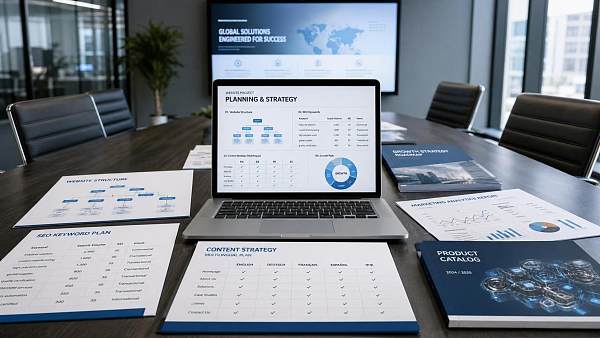
If the Project Has Already Started, Which Milestones Are Still Worth Bringing in a Consultant?
Missing the project-planning stage does not mean that involvement is no longer necessary. An entity SEO consultant can still provide clear value when joining at the following stages, although the focus of the work will differ.
What is most easily overlooked is the "promotion synchronization stage." Many companies treat SEO and advertising as two separate tracks: SEO progresses gradually, while advertising is used first to generate leads. From a project management perspective, however, the two share the same website, the same product information, and the same conversion path. The search terms generated by advertising, landing page bounce rates, and regional market performance can all provide feedback to help SEO determine priorities. When an entity SEO consultant joins at this stage, they are not replacing the advertising team, but helping convert search data into lasting SEO assets.
Why Engineering and Manufacturing Projects Need Earlier Involvement
Engineering project leaders often focus more on timelines, costs, and delivery risks, which does not actually conflict with the work of an SEO consultant. In fact, engineering and manufacturing companies are precisely the types of businesses that need early planning: their products are complex, specifications are numerous, application scenarios are highly specific, and target markets are dispersed. Without preliminary organization, a website can easily become a repository for scattered information. Although it may contain many pages, search engines cannot determine the company's core capabilities, and users may struggle to quickly find the right solution.
In a B2B foreign trade website, for example, buyers care about more than product names. They also search for materials, processes, certification compatibility, application industries, customization capabilities, delivery regions, and problem-solving solutions. After an entity SEO consultant becomes involved, they typically redefine the relationships among "product pages, industry pages, application pages, FAQ pages, and case study pages." The purpose is not to make the site more complex, but to ensure that every type of search need has a suitable landing page instead of forcing a single product detail page to handle every task.
These projects are particularly well suited to being planned together with intelligent website development, content production, and advertising. For a platform such as 易营宝, which integrates website-building systems, SEO/GEO optimization, advertising systems, and multilingual capabilities, the value lies not merely in the accumulation of tools, but in reducing information gaps between projects. For managers, once a consultant is involved at an early stage, it becomes easier to treat website development, indexing, inquiries, and subsequent promotion as one unified growth project rather than four separate steps waiting on one another.
Common Misunderstandings Often Stem from Misjudging the Consultant's Role
One common misunderstanding is that an entity SEO consultant is unnecessary as long as the technical team understands some basic SEO settings. This view often underestimates the threshold for understanding the business. A technical team can address crawling and template issues, but may not be able to determine what type of content hierarchy suits the North American market, which category names match buyers' search habits, which pages are suitable for multilingual duplication, and which pages must be rewritten.
Another misunderstanding is that conversion optimization can be considered after organic rankings have improved. In reality, search visibility and the conversion path are two sides of the same issue. Page titles, content organization, form placement, the presentation of trust information, and the reading rhythm on mobile devices all affect click-through rates, time on page, and inquiry quality at the same time. If an entity SEO consultant is only asked to "get the keywords ranked," their role is being used too narrowly.
There is another, more practical situation: companies assume that an SEO consultant can independently solve every growth problem. This is also inaccurate. SEO is suitable for building long-term, reusable traffic assets, but it cannot replace brand building, advertising testing, social media outreach, or sales follow-up. No matter how early the consultant becomes involved, results will still be limited if the company lacks a clearly defined target market, has unclear product messaging, or fails to invest consistently in content production.
How Project Managers Can Determine Whether to Bring in a Consultant Now
Three signals can be considered.
First, is the project currently making foundational decisions that will affect the following six to twelve months, such as activating a domain, establishing a multilingual architecture, defining the classification system, creating content templates, or designing the inquiry path? Once these decisions are finalized, the cost of making corrections is usually high.
Second, have inconsistent objectives already emerged within the team? The website development team focuses on going live, the marketing team focuses on traffic, the sales team focuses on lead quality, and management focuses on return on investment. If these objectives are not connected through a search strategy, the project will very likely undergo repeated requirement changes as it progresses.
Third, is the company preparing for long-term overseas growth rather than a one-time campaign page or short-term advertising? If the goal is to continuously capture organic search opportunities, build multilingual content assets, and improve visibility on Google and AI search, the earlier an entity SEO consultant becomes involved, the clearer the value will be.
The right time to get involved is not determined by "when the website will be completed," but by "when the project begins to take shape structurally." Once the structure starts to solidify, SEO is no longer an end-stage action. For a growth project, the most valuable stage for an entity SEO consultant is usually not firefighting, but participating in decisions early: which pages are worth creating, which content is worth consolidating, and which technical and operational actions will affect search performance over the coming year. If the project leader understands this clearly, much of the subsequent cost will, in fact, have already been determined at the moment the project is initiated.
Related Articles


Related Products
 Yiyingbao SaaS Intelligent Website Building and Marketing SystemYiyingbao SaaS Intelligent Website Building and Marketing System, AI-powered no-code website building, rapid creation of multilingual B2B international websites in 10 minutes, global server acceleration, AI-powered SEO optimization, helping businesses connect efficiently with global markets. The perfect integration of technology and operation makes building an international trade website remarkably simple
 AI+SEM Intelligent Advertising Marketing SystemAI+SEM drives intelligent ad creation, empowering full-funnel precision advertising marketing. The system automatically generates weekly/monthly reports, AI recommends keywords and target countries, monitors core metrics in real-time with intelligent alerts, and enables one-click high-conversion ad solutions to help quickly acquire customers and improve ROI.
 AI+SEO Dual-Engine System Optimization ServicesYiyingbao’s AI+SEO dual-engine optimization system helps foreign trade enterprises acquire high-quality organic traffic through AI-powered keyword research, content generation, and comprehensive technical optimization, significantly improving search rankings and conversion rates.
 AI+SNS Social Media Marketing SystemYingbao AI+SNS Social Media Marketing System - Precision social capture for the social media era. Supports one-click content synchronization across major platforms like Facebook and LinkedIn. AI intelligently rewrites posts for enhanced relevance. 24/7 AI customer service and user profiling analysis empower businesses to efficiently expand into global markets.
 AI+SEO营销解决方案易营宝AI+SEO营销解决方案,通过AI批量写作、智能生成TDK、精准关键词扩词等功能,全面优化网站SEO效果,提升流量与转化率。助力企业构建高效智能网站新生态。
 AI+SEM Advertising Marketing SolutionsAI+SEM Advertising Marketing Solution leverages AI technology to deeply empower SEM ad campaigns. It automatically generates weekly/monthly reports using AI, presenting account data across multiple dimensions for comprehensive insights into campaign performance and trends. The system precisely recommends keywords and target countries, intelligently generates high-conversion ad copy, and enables one-click activation of efficient campaign plans to help businesses rapidly acquire customers. Simultaneously, it monitors core metrics in real time, intelligently identifies abnormal fluctuations, and issues timely alerts to ensure stable, high-return advertising results.
 Domain Name ServicesEasyWin provides professional domain name services, including intelligent queries, one-stop registration, brand protection, and full lifecycle management, helping businesses build a digital brand image.
 EasyOperate B2C Cross-Border E-Commerce Platform & Independent WebsiteEasyStore B2C Cross-border E-commerce Independent Store is an intelligent website building and cross-border e-commerce integrated solution independently developed by EasyStore Information Technology (Beijing) Co., Ltd. The system is specially designed for small and medium-sized as well as large export enterprises, integrating 'website building, operation, marketing, advertising, and conversion' into one, helping enterprises quickly establish cross-border e-commerce independent stores to achieve brand globalization and global sales growth.
The platform supports multiple languages, multiple currencies, and multi-channel marketing, with built-in AI intelligent translation and SEO optimization systems, suitable for mainstream markets such as Southeast Asia, Europe and America, Latin America, and the Middle East, assisting Chinese manufacturing enterprises in efficiently deploying international e-commerce strategies. SSL证书易营宝提供专业SSL安全证书服务,包括单域名和泛域名证书,确保网站数据传输加密、身份验证和完整性保护,助力企业建立安全可信的在线业务环境。









