









- CBP Finalizes Electronic Rail Export Manifest Rule, Effective October 26, 2026Oct 26, 2026View details
- Amazon’s 2026 peak season surcharge takes effect on October 25Oct 26, 2026View details
- AI Is Eating SaaS: Three Real-World Cases in One AfternoonOct 25, 2026View details
- Exiger CEO: The SaaS Apocalypse Is Real, but It Means Something DifferentOct 25, 2026View details
- Hengqin Cooperation Zone Shares Cross-Border E-Commerce Developments, Focusing on Macao-Hengqin Collaboration and International MarketsOct 24, 2026View details
- A Shenyang study highlights the development of the “cross-border e-commerce + industrial cluster” modelOct 24, 2026View details
How to choose Arabic website development services: First confirm font compatibility and RTL development capabilities
How should you choose an Arabic website development service? First, confirm font compatibility and RTL development capabilities to avoid issues after launch such as misaligned layouts, shifted buttons, mixed-direction numbers, and misinterpreted forms that can directly affect conversion. It is not enough to check whether the page “can be displayed.” What really matters is whether the Arabic script, layout direction, and interaction logic have all been reworked according to right-to-left language conventions.
Start by checking font compatibility. Arabic is not simply a matter of replacing English with Arabic letters; it is highly sensitive to ligatures, contextual forms, font weight, and line height. If the font design is too cramped, long sentences may appear gray and dense; if the strokes are too thin, text can blur into a single mass on dark backgrounds; and if mixed Arabic-English punctuation and numbers are not handled properly, reading interruptions may occur. A common mistake in projects is to keep the default font because it looks “acceptable” on the homepage, only to find that letter spacing and line breaks become difficult to control on product details, specification tables, and form validation messages. When developing an Arabic website, confirm whether the font files support the complete character set, include common variants, and use a loading method that will not affect above-the-fold loading speed.
RTL development capabilities should be tested separately rather than assessed only by checking whether the page has been mirrored. A true right-to-left layout involves text direction, icon orientation, breadcrumbs, pagination, carousel arrows, step indicators, form labels, cursor positioning in input fields, and the placement of error messages. Many websites simply flip the entire page, while numbers, email addresses, product models, and code snippets continue to be read from left to right, making the page feel awkward. When choosing an Arabic website development service, the key is to confirm whether the frontend handles dir="rtl", local ltr nesting, line-breaking rules for mixed Arabic-English content, and separate RTL grid and spacing logic in CSS.
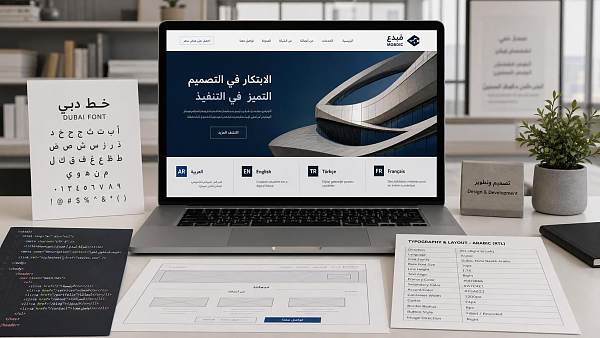
If the website includes product catalogs, engineering specifications, or inquiry forms, tables and data components also need to be reviewed. On Arabic pages, fields such as product models, dimensions, units, and lead times often require a redesigned layout, with labels on the left and content on the right. In multi-column specification tables, columns that are too narrow may break long words, while columns that are too wide may compress the numerical area. For procurement materials, technical descriptions, shipping information, and installation requirements, confirm whether partial bilingual side-by-side display is supported. Otherwise, users may lose context when comparing specifications. For project-based websites, this is more important than visual style because it directly affects whether information can be conveyed accurately.
The directionality of images, icons, and process diagrams should also be checked. Not every visual element can be mirrored. If directional icons, process arrows, wiring diagrams, or map labels are mechanically flipped on an Arabic website, users may misunderstand the intended path. For nameplates, scales, and wiring-port labels in product images, also confirm that the text remains readable after mirroring. If the website includes installation steps or maintenance instructions, the accompanying images and sequence should ideally follow the RTL reading order, rather than making users see the conclusion first and then go back to find the steps.
Localization at the content level should not be overlooked either. Arabic pages need consistent rules for units, dates, telephone numbers, address formats, currency symbols, and form-field order. For example, some forms automatically divide a person’s name into “first name–last name,” which may not be appropriate in an Arabic-language context. Some address fields are structured according to Western conventions, which can significantly increase the effort required to complete them. For shipping, installation, or after-sales contact, field design should reflect actual filling habits as closely as possible. Otherwise, form completion rates may drop during data entry rather than because of the page copy.
For an integrated website and marketing service, the technical foundation should also be evaluated from the perspectives of advertising and search indexing. If an Arabic website is intended to capture search traffic, page titles, descriptions, H tags, canonical links, sitemaps, language switching, and duplicate-content controls must all be properly configured according to multilingual website standards. Many issues are not about whether Arabic has been added, but whether the Arabic version can be correctly identified by search engines. If the same page has both English and Arabic versions, confirm that the URL structure, hreflang, canonical, and internal links are consistent. Otherwise, indexing confusion may occur, and users entering from search results may land on the wrong language version.
Regarding delivery, do not only ask whether the website can go live; ask how it can be updated afterward. Changes to Arabic websites are often not major redesigns, but local adjustments such as changing the font, adding fields, revising button copy, fixing mobile line breaks, or adding an Arabic landing page. If the development structure binds RTL too tightly to the content templates, every minor adjustment may require the styles to be rebuilt, resulting in high maintenance costs. For engineering project websites, whether reusable components, editable fields, and a stable multilingual content structure can be retained often determines how smoothly future iterations can be carried out.
During selection, also pay attention to whether testing covers real devices. An Arabic page that looks normal on desktop does not necessarily work properly on mobile. The issues most easily exposed on mobile include long-word wrapping, overlays blocking content, incorrect button order, and cursor displacement after switching input methods. If the website will be used in the Middle East market, at minimum, check the navigation, inquiry forms, message pop-ups, and download buttons on mainstream mobile browsers to ensure that clickable areas are not compressed under RTL.
A truly reliable Arabic website development service is not about simply reversing a Chinese or English website. It is about reviewing fonts, layout, interactions, search, and content maintenance under one consistent set of rules. First confirm font compatibility and RTL development capabilities, then review forms, specifications, indexing, and ongoing maintenance. This will help avoid most issues that are only discovered after launch.
Related Articles
 Can I learn to use a multilingual content management system without a technical background?
 How can you evaluate a provider’s translation editing capabilities for AI-powered multilingual website services?
 Building a Website for the Russian-Speaking Market: Is Translating the Website Enough?

Related Products
 Yiyingbao SaaS Intelligent Website Building and Marketing SystemYiyingbao SaaS Intelligent Website Building and Marketing System, AI-powered no-code website building, rapid creation of multilingual B2B international websites in 10 minutes, global server acceleration, AI-powered SEO optimization, helping businesses connect efficiently with global markets. The perfect integration of technology and operation makes building an international trade website remarkably simple
 AI+SEM Intelligent Advertising Marketing SystemAI+SEM drives intelligent ad creation, empowering full-funnel precision advertising marketing. The system automatically generates weekly/monthly reports, AI recommends keywords and target countries, monitors core metrics in real-time with intelligent alerts, and enables one-click high-conversion ad solutions to help quickly acquire customers and improve ROI.
 AI+SEO Dual-Engine System Optimization ServicesYiyingbao’s AI+SEO dual-engine optimization system helps foreign trade enterprises acquire high-quality organic traffic through AI-powered keyword research, content generation, and comprehensive technical optimization, significantly improving search rankings and conversion rates.
 AI+SNS Social Media Marketing SystemYingbao AI+SNS Social Media Marketing System - Precision social capture for the social media era. Supports one-click content synchronization across major platforms like Facebook and LinkedIn. AI intelligently rewrites posts for enhanced relevance. 24/7 AI customer service and user profiling analysis empower businesses to efficiently expand into global markets.
 AI+SEO营销解决方案易营宝AI+SEO营销解决方案,通过AI批量写作、智能生成TDK、精准关键词扩词等功能,全面优化网站SEO效果,提升流量与转化率。助力企业构建高效智能网站新生态。
 AI+SEM Advertising Marketing SolutionsAI+SEM Advertising Marketing Solution leverages AI technology to deeply empower SEM ad campaigns. It automatically generates weekly/monthly reports using AI, presenting account data across multiple dimensions for comprehensive insights into campaign performance and trends. The system precisely recommends keywords and target countries, intelligently generates high-conversion ad copy, and enables one-click activation of efficient campaign plans to help businesses rapidly acquire customers. Simultaneously, it monitors core metrics in real time, intelligently identifies abnormal fluctuations, and issues timely alerts to ensure stable, high-return advertising results.
 Domain Name ServicesEasyWin provides professional domain name services, including intelligent queries, one-stop registration, brand protection, and full lifecycle management, helping businesses build a digital brand image.
 EasyOperate B2C Cross-Border E-Commerce Platform & Independent WebsiteEasyStore B2C Cross-border E-commerce Independent Store is an intelligent website building and cross-border e-commerce integrated solution independently developed by EasyStore Information Technology (Beijing) Co., Ltd. The system is specially designed for small and medium-sized as well as large export enterprises, integrating 'website building, operation, marketing, advertising, and conversion' into one, helping enterprises quickly establish cross-border e-commerce independent stores to achieve brand globalization and global sales growth.
The platform supports multiple languages, multiple currencies, and multi-channel marketing, with built-in AI intelligent translation and SEO optimization systems, suitable for mainstream markets such as Southeast Asia, Europe and America, Latin America, and the Middle East, assisting Chinese manufacturing enterprises in efficiently deploying international e-commerce strategies. SSL证书易营宝提供专业SSL安全证书服务,包括单域名和泛域名证书,确保网站数据传输加密、身份验证和完整性保护,助力企业建立安全可信的在线业务环境。









