









- Is the EV SSL certificate market shrinking or upgrading? How should companies assess certificate procurement?Aug 11, 2026View details
- Why the old AMP SEO 2020 practices no longer work and what has changed in current optimization prioritiesAug 02, 2026View details
- How to Choose Topics for an Industry News Section to Attract More Organic Search TrafficJul 29, 2026View details
- Digital Marketing Shenzhen Market Insights: Why Are Companies Expanding Overseas Looking for Growth Teams in Shenzhen?Jul 31, 2026View details
- Can Zhejiang foreign trade independent websites still be developed today? Look at changes in traffic and lead generationJul 28, 2026View details
- What New Signals Are Emerging in Enterprise Services SaaS Marketing ReportsJul 27, 2026View details
What Size of Foreign Trade Enterprise Is the AI+SEM System Suitable for? A Guide Based on Lead Volume and Staffing
What Size of Foreign Trade Enterprises Is the AI+SEM System Suitable for? Judging by Lead Volume and Staffing
When evaluating an AI+SEM system, many companies first look at the budget. The budget is certainly important, but it is not the first indicator to consider. For foreign trade enterprises, whether a system is suitable is often determined by two more specific questions: How many leads do you need to handle each month? And how many people on your team can continuously manage advertising, the website, and sales follow-up?
If the lead volume is small and only one or two people are handling promotion part-time, configuring complex AI automated campaigns, lead scoring, and bulk landing page generation from the outset will usually result in underutilization and higher management costs. Conversely, when a company has entered a stage of acquiring customers across multiple markets, languages, and product lines, manually monitoring accounts, adjusting keywords, and assigning inquiries through spreadsheets can easily cause growth to lose momentum.
Therefore, when discussing what size of foreign trade enterprise an AI+SEM system is suitable for, it is not enough to make a rough distinction based only on annual revenue. A more practical approach is to consider lead volume, staffing, website foundation, and market complexity together.
It Is Not That Larger Companies Need the System More, but That Management Complexity Has Reached a Certain Level
Many manufacturing companies are not small, but their overseas customer acquisition still relies on trade shows, referrals from existing customers, and a small amount of Google advertising. Such companies may not urgently need a complete AI+SEM system, because their promotional activities are not yet intensive enough for the value of automation to be fully realized.
Another type of company may not be very large, but it may already be running campaigns simultaneously in North America, Europe, and the Middle East, operating more than one multilingual website, and managing a large number of product models, while its sales team needs to distinguish between regions and industries. In this situation, even a small team will have a strong need for systematic tools to unify keyword management, ad creative testing, landing page iteration, lead distribution, and data attribution.
In other words, the determining factor is not how “large” the company is, but whether the customer acquisition process has become too complex to maintain reliably through manual work.
Start with Lead Volume: During the Low-Lead Stage, a Heavy System May Not Be Necessary
If the number of qualified inquiries generated each month from Google Ads, organic search, and social media is still relatively small, the management focus is usually not “automation,” but “validating the direction.” For example, whether the target market is correctly selected, whether the keywords reflect purchasing intent, whether the website is sufficiently clear, whether the inquiry form affects conversion, and whether sales follow up promptly.
At this stage, the value of AI is mainly auxiliary: generating ad copy faster, testing multiple versions of landing pages, categorizing keywords, recommending negative keywords, and monitoring basic data. It can help the team work faster, but it is not yet the core factor determining success or failure. When the total number of leads is limited, the priority is to ensure that campaigns are accurately targeted, rather than automating the process to the greatest possible extent.
This is also why some companies feel that the “results are average” even after purchasing a system. It is not that the system is ineffective, but that the business has not yet reached the stage where it needs the system most.
When Lead Volume Starts to Increase, the Value of an AI+SEM System Becomes Clearly Visible
Once foreign trade promotion begins to gain traction, the problem quickly changes from “Are we getting inquiries?” to “How should we handle the inquiries?” On the advertising side, keywords need to be expanded continuously, campaigns segmented by country, time periods adjusted, and invalid clicks controlled. On the website side, new industry pages, product pages, and campaign pages need to be created. On the sales side, the team needs to determine which customers deserve priority follow-up and which inquiries are sample requests, price-comparison traffic, or invalid form submissions.
At this stage, an AI+SEM system can improve not only campaign efficiency, but also collaboration efficiency. For example, it can connect advertising data from different markets with landing page performance, classify inquiries by source, region, and intent, and preserve the structure of high-converting pages, reducing repetitive work that would otherwise have to be started from scratch each time.
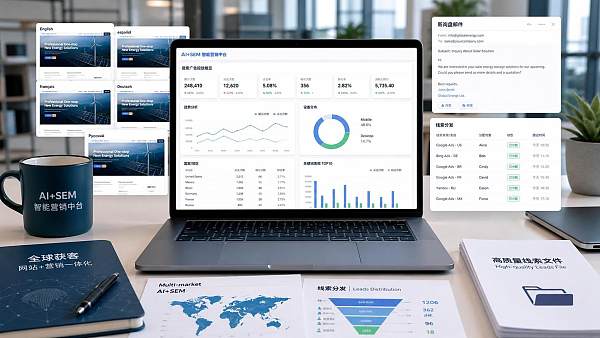
The issue of a “long decision-making cycle,” which is common in B2B foreign trade, is particularly important. Many leads do not convert immediately. Without a system, advertising focuses on clicks, sales focuses on emails, and management focuses on monthly reports; the three sides are not speaking the same language. After introducing an AI+SEM system, the company can at least see more clearly which types of keywords generate customers who are closer to conversion, which is crucial for subsequent budget allocation.
Then Look at Staffing: It Is Not About Replacing People, but Filling Key Gaps
The common staffing problem in foreign trade enterprises is not a lack of people, but incomplete role coverage. Some people understand the products but not campaign management; some can run ads but do not understand page conversion; and some can handle inquiries but cannot conduct data reviews. As a result, each stage can be handled to some extent, but no one can connect the entire process.
At this point, whether to adopt an AI+SEM system can be assessed through three signals:
- More than one person already needs access to the advertising accounts, but there are no unified standards and campaign quality fluctuates significantly;
- The website, advertising, and inquiries are handled by different teams, and information is transferred manually;
- Management wants to scale up advertising but is concerned that adding more people will cause both costs and the risk of losing control to increase.
If a company currently has only one operator responsible for website updates, advertising, and form processing, the focus of adopting a system should not be on creating complex workflows, but on choosing a sufficiently lightweight solution that can be implemented quickly. Conversely, if the company already needs collaboration among dedicated operations, sales, and management teams, systematic development will change from an “optional” choice into “infrastructure.”
A Rough Way to Judge Whether It Is Suitable
When Selecting a System, Do Not Ask Only “Can It Run Campaigns?” Ask “Can It Support the Growth That Follows?”
Many systems emphasize smart bidding, automatic creative generation, and data visualization during demonstrations. These functions are indeed important, but for foreign trade enterprises, the more practical question is whether the website, advertising, and subsequent marketing are integrated. If advertising generates traffic but the website is not conducive to multilingual indexing, or if incoming leads cannot be assigned to the person responsible for the corresponding market, then no matter how intelligent the system is, it will only amplify front-end traffic while amplifying back-end weaknesses at the same time.
This is precisely why many companies later reconsider their system selection. A standalone advertising tool can only solve the problem of “buying traffic.” A solution suitable for long-term use generally needs to cover website building, SEO, landing page iteration, advertising data, and customer outreach. For foreign trade enterprises in particular, search behavior, page preferences, language versions, and social media coordination vary significantly between countries. If a system cannot be integrated with actual business scenarios, its implementation will be less effective.
From this perspective, an integrated website and marketing service is more worthy of careful evaluation than a standalone tool. Platforms such as Yiyingbao, which have long focused on overseas digital marketing, can more easily address the actual needs of foreign trade enterprises not because they offer an excessive number of features, but because they consider intelligent website building, SEO optimization, Google Ads, social media marketing, and AI search visibility as part of the same growth process. For companies seeking to acquire overseas customers continuously, this integration capability is often more useful than a single function.
Several Common Misconceptions to Avoid When Making a Decision
One misconception is to treat an AI+SEM system as a “guarantee of results.” A system can improve management efficiency, speed up testing, and reduce repetitive manual work, but it cannot choose the right market for you or automatically solve problems caused by insufficient product competitiveness.
Another misconception is to look only at short-term advertising returns. B2B foreign trade often involves long decision-making cycles, slow repeat purchases, and complex conversion paths. The value generated by many keywords cannot be assessed solely by the number of form submissions in a given week. If a system only measures front-end clicks without considering the quality of subsequent leads, it is easy to concentrate more and more budget on traffic that merely “looks inexpensive.”
Another common situation is that a company purchases a system without simultaneously organizing its internal processes. For example, sales does not provide feedback on lead quality according to the rules, the operations team does not know which keywords correspond to high-value customers, and management reviews reports every week without anyone adjusting the strategy. Eventually, the problem may be mistakenly attributed to the system, when the actual issue is that organizational collaboration has not kept pace.
If You Are Deciding Whether to Adopt One, Answer These Four Questions First
Is your current inquiry volume low enough that you first need to validate the market, or has it become so large that manual processing is difficult?
Are your promotional activities focused on one country and one product, or are multiple languages and regions operating simultaneously?
Does your company have someone who can continuously understand the relationship among advertising data, page conversion, and sales feedback?
Do you need an advertising tool, or a system that can support website building, optimization, advertising, and subsequent growth?
Once these four questions have been answered clearly, it is usually possible to determine with reasonable confidence whether introducing an AI+SEM system is appropriate.
For most foreign trade enterprises, the right time is not when “the budget is sufficient,” but when leads begin to accumulate, markets begin to expand, and teams begin to divide responsibilities, while the existing manual approach can no longer support the next stage of growth. At that point, evaluating a system is not simply about purchasing a tool, but about building the foundation for the company’s overseas customer acquisition over the coming years. The specific configuration still needs to be assessed together with the website foundation, target markets, lead-handling capacity, and delivery pace; a conclusion should not be based solely on a feature list.
Related Articles
 What Size of Foreign Trade Enterprise Is the AI+SEM System Suitable for? A Guide Based on Lead Volume and Staffing
 Which follow-up scenarios are suitable for social media automation in foreign trade, and which are prone to distortion?
 Reassessing Independent Website Delivery Commitments After the Suez Canal Transit Fee Increase
Related Products
 Yiyingbao SaaS Intelligent Website Building and Marketing SystemYiyingbao SaaS Intelligent Website Building and Marketing System, AI-powered no-code website building, rapid creation of multilingual B2B international websites in 10 minutes, global server acceleration, AI-powered SEO optimization, helping businesses connect efficiently with global markets. The perfect integration of technology and operation makes building an international trade website remarkably simple
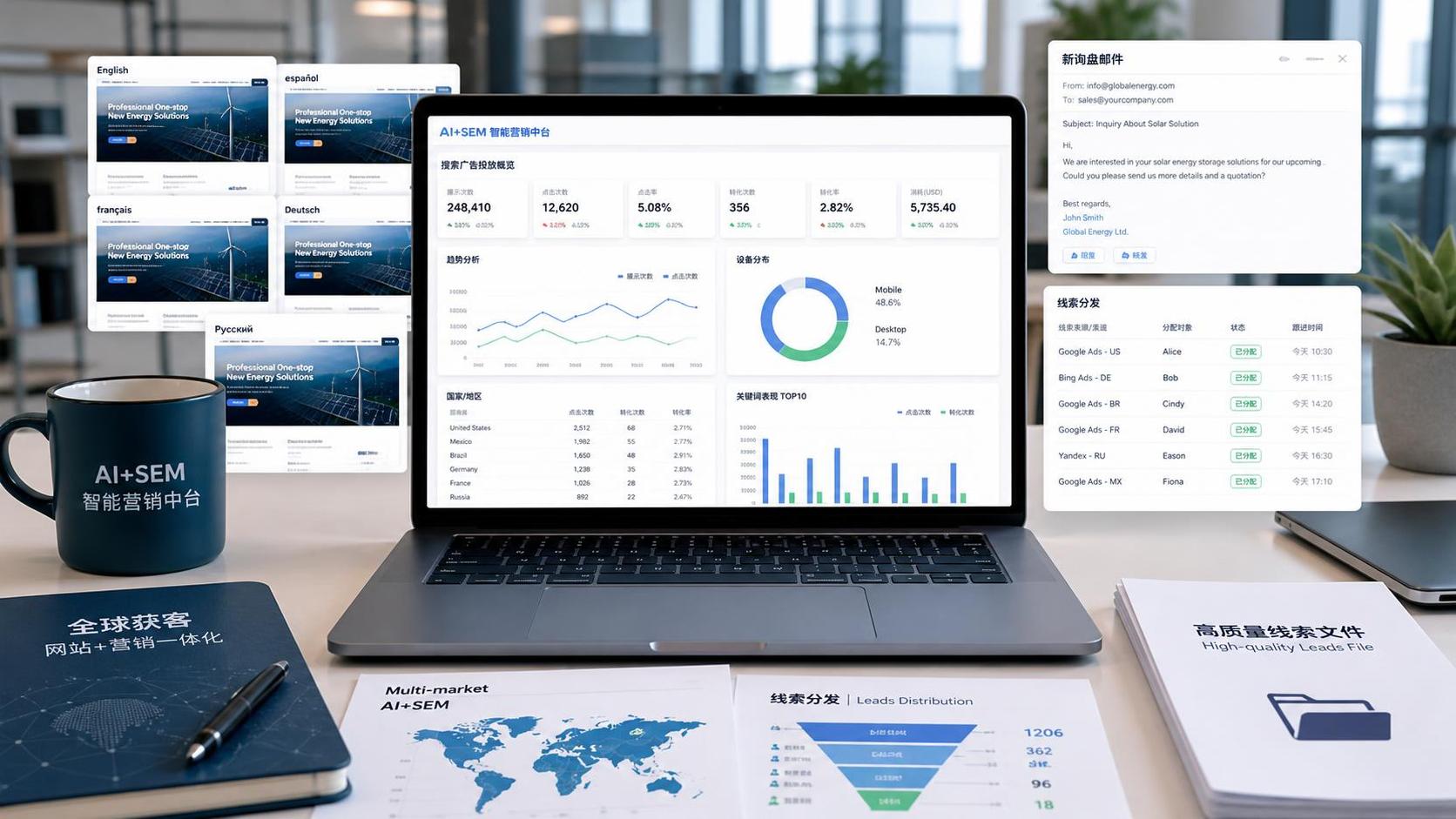
 AI+SEM Intelligent Advertising Marketing SystemAI+SEM drives intelligent ad creation, empowering full-funnel precision advertising marketing. The system automatically generates weekly/monthly reports, AI recommends keywords and target countries, monitors core metrics in real-time with intelligent alerts, and enables one-click high-conversion ad solutions to help quickly acquire customers and improve ROI.
 AI+SEO Dual-Engine System Optimization ServicesYiyingbao’s AI+SEO dual-engine optimization system helps foreign trade enterprises acquire high-quality organic traffic through AI-powered keyword research, content generation, and comprehensive technical optimization, significantly improving search rankings and conversion rates.
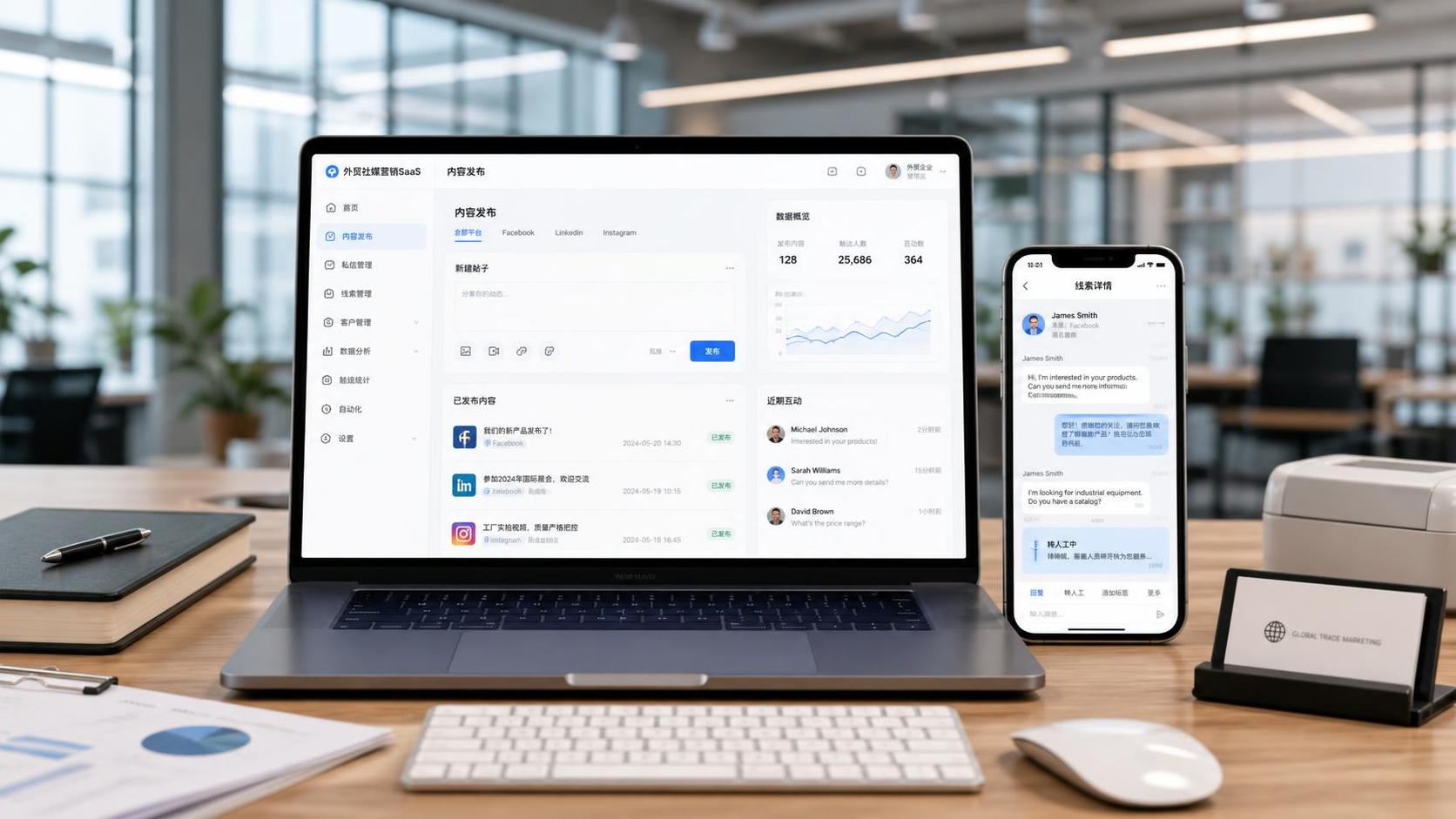
 AI+SNS Social Media Marketing SystemYingbao AI+SNS Social Media Marketing System - Precision social capture for the social media era. Supports one-click content synchronization across major platforms like Facebook and LinkedIn. AI intelligently rewrites posts for enhanced relevance. 24/7 AI customer service and user profiling analysis empower businesses to efficiently expand into global markets.
 AI+SEO营销解决方案易营宝AI+SEO营销解决方案,通过AI批量写作、智能生成TDK、精准关键词扩词等功能,全面优化网站SEO效果,提升流量与转化率。助力企业构建高效智能网站新生态。
 AI+SEM Advertising Marketing SolutionsAI+SEM Advertising Marketing Solution leverages AI technology to deeply empower SEM ad campaigns. It automatically generates weekly/monthly reports using AI, presenting account data across multiple dimensions for comprehensive insights into campaign performance and trends. The system precisely recommends keywords and target countries, intelligently generates high-conversion ad copy, and enables one-click activation of efficient campaign plans to help businesses rapidly acquire customers. Simultaneously, it monitors core metrics in real time, intelligently identifies abnormal fluctuations, and issues timely alerts to ensure stable, high-return advertising results.
 Domain Name ServicesEasyWin provides professional domain name services, including intelligent queries, one-stop registration, brand protection, and full lifecycle management, helping businesses build a digital brand image.
 EasyOperate B2C Cross-Border E-Commerce Platform & Independent WebsiteEasyStore B2C Cross-border E-commerce Independent Store is an intelligent website building and cross-border e-commerce integrated solution independently developed by EasyStore Information Technology (Beijing) Co., Ltd. The system is specially designed for small and medium-sized as well as large export enterprises, integrating 'website building, operation, marketing, advertising, and conversion' into one, helping enterprises quickly establish cross-border e-commerce independent stores to achieve brand globalization and global sales growth.
The platform supports multiple languages, multiple currencies, and multi-channel marketing, with built-in AI intelligent translation and SEO optimization systems, suitable for mainstream markets such as Southeast Asia, Europe and America, Latin America, and the Middle East, assisting Chinese manufacturing enterprises in efficiently deploying international e-commerce strategies. SSL证书易营宝提供专业SSL安全证书服务,包括单域名和泛域名证书,确保网站数据传输加密、身份验证和完整性保护,助力企业建立安全可信的在线业务环境。









