









- Is the EV SSL certificate market shrinking or upgrading? How should companies assess certificate procurement?Aug 11, 2026View details
- Why the old AMP SEO 2020 practices no longer work and what has changed in current optimization prioritiesAug 02, 2026View details
- How to Choose Topics for an Industry News Section to Attract More Organic Search TrafficJul 29, 2026View details
- Digital Marketing Shenzhen Market Insights: Why Are Companies Expanding Overseas Looking for Growth Teams in Shenzhen?Jul 31, 2026View details
- Can Zhejiang foreign trade independent websites still be developed today? Look at changes in traffic and lead generationJul 28, 2026View details
- What New Signals Are Emerging in Enterprise Services SaaS Marketing ReportsJul 27, 2026View details
How to Choose a Cross-Border E-Commerce Store System Service: Key Integration Capabilities and After-Sales Support to Compare
When selecting a cross-border e-commerce platform service, many procurement projects are easily led astray at the outset by the “number of features” and “price level.” At first glance, the demo interfaces provided by different service providers may not appear very different: all can build websites, list products, process orders, connect payment methods, and arrange shipping. However, once cross-border operations begin, the real problems often do not lie in the front-end pages, but in whether the system can connect properly, operate reliably, and provide clear support when issues arise.
For procurement teams, this is not simply a software price-comparison exercise. It is a long-term system selection involving the coordination of transactions, fulfillment, marketing, data, and after-sales service. Especially for companies operating independent websites or expanding their brands overseas, once the e-commerce platform goes live, it will continuously affect payment success rates, inventory accuracy, advertising efficiency, financial reconciliation, and the pace of expansion across different regions. Choosing the wrong service can make the subsequent replacement cost far higher than the initial procurement price difference.
When determining whether a cross-border e-commerce platform service provider deserves to be shortlisted, the key is usually not whether it offers a particular feature, but rather two questions: whether its integration capabilities are sufficiently mature, and whether its after-sales service covers the risks encountered in actual operations.
First clarify: are you procuring a “system” or an “operable foundation for cross-border business”?
Many companies treat an e-commerce platform as an ordinary corporate website project during the selection process. This approach creates significant risks in cross-border business. A corporate website can go live first and be gradually optimized, but a cross-border e-commerce platform directly carries payment, orders, taxes, logistics, memberships, promotions, data tracking, and other processes. Any poorly connected link can quickly affect conversion and repeat purchases.
The first question to clarify during procurement is what type of business the company is currently operating.
- B2C brand independent website: focus on payment, logistics, marketing automation, advertising attribution, and the multilingual user experience.
- B2B + online transaction hybrid model: focus on the coexistence of inquiries and transactions, tiered pricing, customer grouping, payment terms, and offline coordination.
- Multi-site overseas expansion: focus on multiple currencies, multiple warehouses, regional tax and fee management, and unified back-office administration.
- Marketplace seller transitioning to an independent website: focus on the integration cost with existing ERP, order center, and warehousing and distribution systems.
Different business models require completely different integration priorities. If procurement teams do not define the business path first, the proposals they receive later will usually all “appear capable,” while lacking practical comparability.
Payment integration capabilities determine not only whether payments can be collected, but whether transactions can be completed reliably
Payment is one of the most underestimated modules in cross-border e-commerce platform services. Many proposals state that they “support PayPal, credit cards, and local payment methods,” but what procurement teams really need to compare is not a list of payment names, but the depth of integration and the ability to adapt to risk-control requirements.
Key aspects to verify include:
- Whether the system supports major international payment channels and the local payment methods commonly used in target markets.
- Whether remedial mechanisms are available after payment failure, such as retries, switching channels, and reminders to recover abandoned orders.
- Whether refund, chargeback, and risk-control review processes can be synchronized back to the order system.
- Whether the payment page supports multilingual, multicurrency, and localized settlement displays.
- Whether taxes, shipping fees, coupons, and other amounts can be accurately itemized and reconciled.
Many companies only discover after launch that payment is not simply a matter of “connecting the interface.” Consumer payment preferences vary significantly between countries, and payment habits in Europe and North America differ from those in Southeast Asia, the Middle East, and Latin America. If an e-commerce platform only provides standard interfaces but lacks payment routing, failure monitoring, or order callback mechanisms, the final impact will be on both conversion rates and financial efficiency.
During bidding or supplier selection, procurement teams should ask service providers to specify which payment methods are standard integrations and which require custom development, who will investigate payment anomalies, and what the average response time is. Otherwise, the most common situation after launch is that the payment provider, e-commerce platform provider, and the company’s internal operations team shift responsibility to one another.
Logistics and warehousing integration: the key is whether the fulfillment chain is closed-loop
The second major differentiator among cross-border e-commerce platform services is the maturity of logistics and warehousing integration. Many systems can display “logistics tracking support,” but this represents only one part of the front-end experience. What procurement teams really need to examine is whether the entire process from successful payment to delivery confirmation is connected.
The following aspects should be prioritized during comparison:
- Whether the system can connect with different fulfillment models, including international express, dedicated lines, small parcels, overseas warehouses, and local warehouses.
- Whether shipping templates can be refined by country, region, weight, volume, warehouse, and delivery time.
- Whether shipping labels, dispatch status, tracking information, and delivery status can be synchronized automatically.
- Whether abnormal parcels, returned parcels, and refused deliveries have status markings and customer service handling entry points.
- Whether split order allocation, order splitting, order consolidation, and inventory reservation logic are supported across multiple warehouses.
The most common pitfall here is that the process runs smoothly in the demo environment, but once actual business scenarios arise—such as overseas warehouse stockouts, replenishment shipments from domestic warehouses, split shipments for presale orders, or partial refunds—the system’s incomplete rules become apparent. Procurement teams should not only ask whether integration is possible, but also whether the integration can support complex order scenarios.
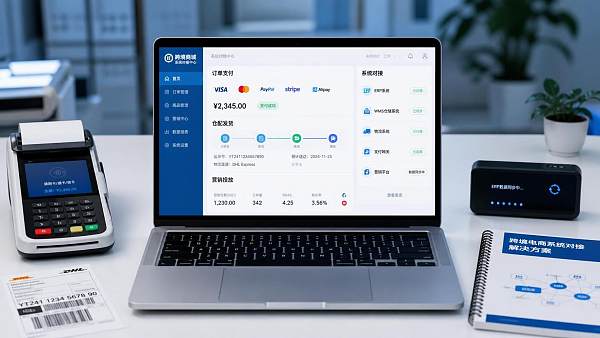
ERP, finance, and product data integration determine long-term management costs
If payment and logistics affect front-end transactions, ERP and financial integration affect the company’s long-term operational efficiency. During the early stages of many cross-border projects, when order volumes are still low, manual synchronization may remain manageable. Once promotion begins, however, products, inventory, orders, refunds, and statements become scattered across multiple back offices, and the team quickly enters a state of “using people to fill the gaps in the system.”
When evaluating cross-border e-commerce platform services, procurement teams should confirm data connectivity at at least three levels.
The first is product data. Does the system support the bulk synchronization of SKUs, variants, specifications, images, languages, prices, and promotion rules? If core product data cannot be synchronized reliably with an ERP or PIM system, multi-site operations will become extremely difficult later.
The second is order and inventory data. Can orders be sent back in real time? Can inventory be deducted accurately by warehouse? Do canceled orders, refund orders, and exchange orders follow consistent status logic? These issues directly affect overselling, incorrect shipments, and customer service workload.
The third is finance and reconciliation. Can the system output details of orders, payments, taxes, refunds, and logistics costs for financial verification? Cross-border business involves multicurrency settlement. If the back office can only display transaction results but cannot break down the cost structure, monthly financial reconciliation will be very costly.
Procurement teams should be particularly cautious about the claim that “having an API means integration is possible.” An open API does not necessarily mean that the business fields are complete or that the interface is stable, nor does it mean that the service provider is willing to cooperate with the company’s existing systems for in-depth adaptation. Experienced service providers can usually clearly explain the scope of standard fields, call limits, typical integration methods used in previous projects, and which interface changes may affect live operations.
Marketing tool integration is more than simply adding a few plugins
When purchasing an e-commerce platform, many companies understand the marketing module as coupons, spending-based discounts, and membership points. For cross-border business, however, the value of marketing tools is not limited to on-site promotions; it also lies in external traffic acquisition and data attribution.
What procurement teams need to compare is whether the system can form a closed loop with advertising, search, social media, email, and other channels. Key points include:
- Whether Google, Meta, and other advertising tracking codes and conversion events can be integrated conveniently.
- Whether basic SEO capabilities are supported, such as URL rules, meta tags, customizable content structures, and multilingual indexing.
- Whether email marketing, remarketing, member segmentation, and abandoned-cart recovery are supported.
- Whether content landing pages, campaign pages, and event pages can be created quickly.
- Whether orders, conversions, and repeat-purchase data from different channels can be tracked.
The importance of this aspect is that a cross-border e-commerce platform does not generate traffic simply because it has been built. Subsequent growth usually depends on continuous investment in search, advertising, and social media. If the system provides limited support for tracking codes, page speed, content management, A/B testing, or conversion attribution, the company may find that its advertising costs continue to rise while advertising efficiency remains difficult to optimize.
The scope of after-sales service often affects procurement results more than the initial quotation
A common procurement mistake is to interpret after-sales service as “having a customer service group and accepting support tickets.” For cross-border e-commerce platform services, after-sales support should cover at least the pre-launch, launch, and operational phases, and the responsibilities at each stage must be clearly defined.
After-sales items worth comparing in particular include:
- Launch support: does it include data migration, domain resolution, payment configuration, logistics testing, and basic SEO setup, or does it only deliver a back-office account?
- Training scope: is training provided only once upon delivery, or are role-specific training sessions offered for operations, products, orders, marketing, and data analysis?
- Response mechanism: are issue classification, response times, resolution deadlines, holiday support, and emergency escalation procedures clearly defined?
- Operations and maintenance assurance: are system monitoring, backups, vulnerability fixes, and version upgrades included in the service?
- Optimization services: does the provider offer performance tuning, conversion issue investigation, and integration expansion support after launch?
Cross-border business has obvious time-zone and holiday characteristics. Overseas promotional events, advertising peaks, and payment risk-control fluctuations often occur outside domestic working hours. If a service provider can only offer support during ordinary working days, the actual operational risk may be far greater than the price difference shown in the contract.
During contract negotiations, procurement teams should clearly specify several issues: which services are included in free after-sales support and which constitute secondary development; who is responsible for adapting to interface changes; whether the service provider will assist in investigating third-party service failures; whether version upgrades will affect existing functions; and how historical data will be backed up and exported. Many later disputes are essentially not technical problems, but the result of unclear responsibility boundaries.
Do not focus only on demonstrations; examine delivery experience and the ability to handle failure scenarios
Cross-border e-commerce platform services may appear increasingly standardized, but delivery results still depend heavily on the service provider’s experience. Procurement teams should distinguish between teams that “can sell a proposal” and those that “have handled complex business operations.”
The assessment methods are not complicated:
- Check whether the service provider has handled regions and business models similar to yours, rather than looking only at the number of case studies.
- Check whether it can proactively identify project risks, such as multilingual SEO conflicts, complex tax rules, and difficulties in synchronizing overseas warehouse inventory.
- Check whether it can provide implementation checklists, testing checklists, and go-live acceptance criteria.
- Examine the project team structure: is there only a sales contact, or are product, implementation, technical, and operations and maintenance personnel involved together?
Truly mature service providers generally do not promise that “everything can be integrated and everything will be done quickly.” Instead, they clearly explain which capabilities are standard, which fall within the scope of customization, and which depend on the stability of third-party interfaces. During due diligence, the more clearly a provider explains its boundaries and limitations, the closer its description is likely to be to its actual delivery capabilities.
An evaluation approach suitable for procurement decisions: prioritize risks instead of maximizing the feature list
If a company is entering overseas markets for the first time or is at the initial stage of developing an independent website, it does not need to pursue the most complex full-featured system from the outset. A more reasonable approach is to set priorities around near-term business objectives: first ensure smooth payments, trackable logistics, order callbacks, marketable campaigns, and responsive after-sales service, and then gradually expand more refined capabilities.
When making the final procurement decision, companies can place candidate service providers in the same evaluation table and score them based on the following questions: Is payment adaptation for the target markets sufficient? Are logistics and ERP integrations mature solutions? Are marketing attribution and basic SEO capabilities complete? Are launch and after-sales responsibilities specific? Will subsequent expansion require costly customization? Can data be migrated, exported, and retained?
Industry practice shows that the most expensive cross-border e-commerce platform service is not necessarily the one with the highest purchase price, and the cheapest is not necessarily the one with the lowest quotation. What truly affects total cost is usually subsequent repeated redevelopment, manually补充 processes, handling payment and logistics exceptions, the inability to track marketing data, and migration losses caused by replacing the system.
For procurement teams, a more prudent conclusion is to regard integration capabilities as the foundation of business continuity and the scope of after-sales service as a risk-control tool. Only after these two aspects have been clearly compared do the feature list and price become meaningful topics for discussion. Otherwise, the budget that appears to have been saved will often be paid several times over through operational friction after launch.
Related Articles
 How to Choose a Cross-Border E-Commerce Store System Service: Key Integration Capabilities and After-Sales Support to Compare
 Red Sea Crisis Drives Up Asia-Europe Freight Rates, Requiring Independent Websites to Update ETA Modules
 Which Industries Are Marketing Websites Suitable for? Start by Looking at the Sales Cycle

Related Products
 Yiyingbao SaaS Intelligent Website Building and Marketing SystemYiyingbao SaaS Intelligent Website Building and Marketing System, AI-powered no-code website building, rapid creation of multilingual B2B international websites in 10 minutes, global server acceleration, AI-powered SEO optimization, helping businesses connect efficiently with global markets. The perfect integration of technology and operation makes building an international trade website remarkably simple
 AI+SEM Intelligent Advertising Marketing SystemAI+SEM drives intelligent ad creation, empowering full-funnel precision advertising marketing. The system automatically generates weekly/monthly reports, AI recommends keywords and target countries, monitors core metrics in real-time with intelligent alerts, and enables one-click high-conversion ad solutions to help quickly acquire customers and improve ROI.
 AI+SEO Dual-Engine System Optimization ServicesYiyingbao’s AI+SEO dual-engine optimization system helps foreign trade enterprises acquire high-quality organic traffic through AI-powered keyword research, content generation, and comprehensive technical optimization, significantly improving search rankings and conversion rates.
 AI+SNS Social Media Marketing SystemYingbao AI+SNS Social Media Marketing System - Precision social capture for the social media era. Supports one-click content synchronization across major platforms like Facebook and LinkedIn. AI intelligently rewrites posts for enhanced relevance. 24/7 AI customer service and user profiling analysis empower businesses to efficiently expand into global markets.
 AI+SEO营销解决方案易营宝AI+SEO营销解决方案,通过AI批量写作、智能生成TDK、精准关键词扩词等功能,全面优化网站SEO效果,提升流量与转化率。助力企业构建高效智能网站新生态。
 AI+SEM Advertising Marketing SolutionsAI+SEM Advertising Marketing Solution leverages AI technology to deeply empower SEM ad campaigns. It automatically generates weekly/monthly reports using AI, presenting account data across multiple dimensions for comprehensive insights into campaign performance and trends. The system precisely recommends keywords and target countries, intelligently generates high-conversion ad copy, and enables one-click activation of efficient campaign plans to help businesses rapidly acquire customers. Simultaneously, it monitors core metrics in real time, intelligently identifies abnormal fluctuations, and issues timely alerts to ensure stable, high-return advertising results.
 Domain Name ServicesEasyWin provides professional domain name services, including intelligent queries, one-stop registration, brand protection, and full lifecycle management, helping businesses build a digital brand image.
 EasyOperate B2C Cross-Border E-Commerce Platform & Independent WebsiteEasyStore B2C Cross-border E-commerce Independent Store is an intelligent website building and cross-border e-commerce integrated solution independently developed by EasyStore Information Technology (Beijing) Co., Ltd. The system is specially designed for small and medium-sized as well as large export enterprises, integrating 'website building, operation, marketing, advertising, and conversion' into one, helping enterprises quickly establish cross-border e-commerce independent stores to achieve brand globalization and global sales growth.
The platform supports multiple languages, multiple currencies, and multi-channel marketing, with built-in AI intelligent translation and SEO optimization systems, suitable for mainstream markets such as Southeast Asia, Europe and America, Latin America, and the Middle East, assisting Chinese manufacturing enterprises in efficiently deploying international e-commerce strategies. SSL证书易营宝提供专业SSL安全证书服务,包括单域名和泛域名证书,确保网站数据传输加密、身份验证和完整性保护,助力企业建立安全可信的在线业务环境。









