









- Which customer acquisition channels will be affected by cross-border marketing trends in 2026?Sep 06, 2026View details
- Which homogenization risks should be considered in an analysis of the AI-powered website building industry?Aug 30, 2026View details
- How Will AI Marketing Trends 2026 Change Advertising Budget AllocationAug 28, 2026View details
- Is the EV SSL certificate market shrinking or upgrading? How should companies assess certificate procurement?Aug 11, 2026View details
- Why the old AMP SEO 2020 practices no longer work and what has changed in current optimization prioritiesAug 02, 2026View details
- How to Choose Topics for an Industry News Section to Attract More Organic Search TrafficJul 29, 2026View details
Which Industries Are Marketing Websites Suitable for? Start by Looking at the Sales Cycle
Meta Title: Which Industries Are Suitable for Marketing Websites? Start by Looking at the Sales Cycle
When determining which industries are suitable for marketing websites, many people first look at whether they are in manufacturing, services, or e-commerce. This judgment is not sufficient. What is more valuable is to first consider whether your sales cycle is long, whether customer decision-making is complex, and whether trust needs to be built repeatedly before a deal is closed. If the answer to two of these three questions is “yes,” a marketing website is probably not optional, but a core part of your customer acquisition system.
Put simply: the slower the sales process, the more important the website becomes. It is not merely used to “display the company”; it also captures search traffic, explains product value, filters potential customers, and reduces the cost of sales communication.
Before Categorizing by Industry, First Understand How Your Customers Make Decisions
Many companies fall into a common misconception when building a website: “My competitors have one, so I need one too.” However, whether a marketing website is worth building does not depend on whether competitors have one. The key is whether your customers search online first, compare repeatedly, review case studies, qualifications, solutions, and delivery capabilities before placing an order.
If customers go through search, consultation, price comparison, internal discussions, management approval, and even cross-departmental evaluations between their first contact and final purchase, the website is not just a façade. It is a tool that continuously persuades customers.
Conversely, if your business relies heavily on offline relationships, immediate transactions, or low-value impulse purchases, the website will play a much smaller role. It is not completely useless, but investing in a marketing website may not be the top priority.
In short: marketing websites are more suitable for industries where customers do not buy after simply taking one look.
Which Industries Are Suitable for Marketing Websites? These Categories Usually Need Them More
The first category consists of typical B2B industries with long decision-making cycles, such as foreign trade, manufacturing, industrial equipment, mechanical components, raw materials, business services, software services, and engineering services. These industries share several characteristics: relatively high order values, infrequent purchasing, cautious customers, and a need to evaluate professionalism and credibility before closing a deal.
At this point, an ordinary corporate website can only tell visitors “who you are.” A marketing website must address questions such as “why choose you,” “what problems can you solve,” “how are you different from others,” and “how should customers contact you next?”
The second category includes industries that need to continuously educate the market, such as customized services, professional solutions, cross-border expansion services, multilingual website development, and outsourced operation of brand websites. Customers may have a need, but they may not fully understand the solution or may not even know what they should purchase. If the website clearly explains common questions, scenario-based solutions, and the logic behind case studies, it can significantly reduce ineffective communication.
The third category consists of industries that rely on online customer acquisition. As long as your customers search for suppliers through Baidu, Google, social media, industry keywords, or related questions, a marketing website has value. Traffic is not the goal; conversion is. Advertising, SEO, and social media content ultimately need a destination. If that destination is merely an information page, the waste will be obvious.
The fourth category includes industries related to overseas expansion. Foreign trade companies, cross-border sellers, companies expanding brands overseas, and multilingual market development teams generally have a greater need for marketing websites. The reason is practical: overseas customers are more accustomed to viewing a website before deciding whether to submit an inquiry, schedule a meeting, or request a quotation. If the website has a confusing structure, loads slowly, provides a poor language experience, or lacks clear trust-building information, many leads will be lost at the first stage.
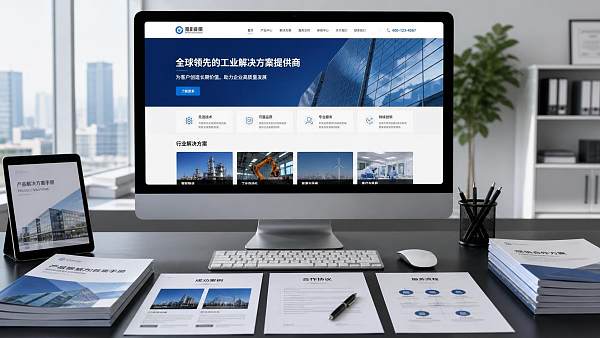
[Image Placeholder 1: An illustrative diagram showing decision-making scenarios for different sales-cycle industries using marketing websites, alt="Illustration of the relationship between suitable industries for marketing websites and sales cycles"]
Not Every Industry Should Prioritize a Marketing Website
This also needs to be made clear. A marketing website is not a universal solution.
If your business mainly relies on referrals from existing customers and very few new customers come from online channels; if your service area is very limited and customers care more about location and immediate response; or if your products are highly standardized and customers make decisions almost entirely based on price, a marketing website may not have a high priority.
For example, for certain community-based local services and highly time-sensitive local businesses, improving map platforms, local short-video traffic, and private-domain conversion may be more direct than building a complete marketing website first.
Another common situation is that a company rushes to launch a website before clarifying its selling points, customer profiles, and conversion path. The result is usually many pages but average lead quality. A website does not “create positioning” for a company; it is more like a tool that amplifies sales logic that has already been proven.
What Really Affects Results Is Not “Whether You Have a Website,” but Whether the Website Can Drive Sales
When choosing a solution, business decision-makers are easily distracted by “design,” “the number of pages,” and “the number of features.” From the perspective of closing deals, however, several other factors are truly important.
First, is the website designed around the customer decision journey? Do customers look at products first or case studies first? Do they care more about price or delivery capabilities? If the order is wrong, even the most attractive website will have difficulty converting.
Second, does the content answer customers’ real questions? Many websites are filled with phrases such as “professional team,” “quality service,” and “extensive experience,” while customers actually want to know which similar projects you have completed, which scenarios you support, how long delivery takes, which markets you serve, how cooperation works, and how you differ from competitors.
Third, does the website support continuous customer acquisition? A marketing website is not a one-time finished product. It needs to account for search indexing, keyword planning, landing-page expansion, multilingual versions, advertising conversion, and form-lead tracking. Otherwise, the website may simply be online without actually becoming part of a marketing system.
This is also why many companies engaged in overseas business eventually tend to choose an integrated service model combining “website development + SEO + advertising + content.” The reason is simple: traffic sources, page conversion, and subsequent optimization are inherently connected. Platforms such as 易营宝, which have long focused on intelligent website development and overseas marketing, are suitable because they do not merely deliver a website. They consider multilingual website development, Google SEO, advertising, and social media lead generation as part of the same growth path. For companies expanding overseas, this approach is usually closer to actual needs than simply creating pages.
If You Are Evaluating This, Ask Yourself These Four Questions First
First, will your customers actively search online?
If the answer is yes, whether they search for product terms, solution terms, brand terms, or industry-related questions, your website should be taken seriously. Search behavior itself shows that customers have a clear need; they are simply still comparing options.
Second, does your sales team often repeat explanations of the same questions?
If sales representatives explain every day “what you do,” “how you charge,” “how you differ from others,” and “whether you have case studies,” this information should have been presented on the website in advance. Moving inefficient communication to the website allows sales representatives to devote more time to highly interested customers.
Third, does closing a deal depend on accumulating trust?
As long as customers review company strength, delivery experience, industry knowledge, customer feedback, and successful case studies, the website is worth investing in. In industries where the threshold for first-time cooperation is high, the website is responsible for making unfamiliar customers feel confident enough to contact you.
Fourth, do you only plan to build a website, or do you want to achieve growth?
If you only need a corporate website, the requirements are not complex. If your goal is continuous customer acquisition, you should consider SEO structure, advertising landing pages, content expansion, and data tracking from the beginning. This will significantly reduce the cost of later rework.
Common Misconceptions That Deserve More Attention Than “Whether to Build One”
A common misconception is equating a marketing website with “adding several more consultation buttons.” Buttons are merely actions. Trust-building, information organization, and persuasive content are the foundation. Without these elements, even highly visible buttons will not generate many qualified inquiries.
Another misconception is focusing only on the homepage. In reality, the pages that truly receive search and advertising traffic are often inner pages, topic pages, product pages, and solution pages rather than the homepage. Customers arriving through different keywords should see different content. This is what reflects a real conversion path.
Some companies also worry that a marketing website must be written in an overly “sales-oriented” way. This is not necessarily true. A good marketing website does not boast about itself; it helps customers determine more quickly whether you are suitable for them. Once this logic is understood, the content direction becomes much clearer.
A Practical Assessment at the End
If you are still asking which industries are suitable for marketing websites, do not start with the industry name. First consider these three factors: whether the sales cycle exceeds one week, whether customers compare repeatedly, and whether extensive explanations are needed before sales can close a deal. As long as the answers tend toward “yes,” you should seriously evaluate a marketing website instead of treating it as an optional showcase page.
Especially for foreign trade, manufacturing, cross-border e-commerce, overseas brands, and various high-value business services, the website is often not the endpoint of marketing activities, but the hub of the entire customer acquisition process. When choosing a solution, focus less on “whether it looks like a corporate website” and more on “whether it can help close deals.” This will lead to a more accurate judgment.
FAQ
1. What is the biggest difference between a marketing website and an ordinary corporate website?
An ordinary corporate website focuses more on presentation, while a marketing website places greater emphasis on the conversion path, search traffic capture, and customer persuasion. Its goal is not merely to be seen, but to encourage suitable customers to leave their contact information.
2. Do small and medium-sized enterprises need marketing websites?
Yes, provided that your customers search and compare options online. If your customers mainly come from online channels, a marketing website is even more important for small and medium-sized enterprises.
3. Should you build a website first or start advertising first?
If you plan to advertise later, the website should ideally be built according to conversion logic first. Otherwise, traffic may arrive before the website is ready to receive it, resulting in significant budget waste.
4. What should foreign trade companies prioritize when building a marketing website?
Multilingual experience, loading speed, product and case-study presentation, inquiry paths, and search friendliness. These factors usually have a greater impact on inquiry quality than visual effects alone.
Image Placeholder List
Image Placeholder 1: Recommended placement after the section “Which Industries Are Suitable for Marketing Websites? These Categories Usually Need Them More”; the image should illustrate how the role of a website varies with the length of the sales cycle across different industries; alt text: “Illustration of the relationship between suitable industries for marketing websites and sales cycles.”
Suggested Internal-Link Anchor Text
- Foreign Trade Marketing Website Development: Link to the foreign trade website development service page
- Multilingual Website Development Solutions: Link to the multilingual website development topic page
- Google SEO Optimization Services: Link to the SEO service introduction page
- How to Create an Advertising Landing Page for an Independent Website: Link to the advertising or landing-page topic page
- Building a Corporate Website for Overseas Brand Expansion: Link to the overseas brand expansion solution page
Suggested External Authoritative Sources
- Official search engine documentation, such as Google Search Central and other search guidelines
- Foreign trade and digital marketing trend reports published by industry associations or official trade promotion institutions
- Official help centers or best-practice documentation from overseas advertising platforms
Related Articles


Related Products
 Yiyingbao SaaS Intelligent Website Building and Marketing SystemYiyingbao SaaS Intelligent Website Building and Marketing System, AI-powered no-code website building, rapid creation of multilingual B2B international websites in 10 minutes, global server acceleration, AI-powered SEO optimization, helping businesses connect efficiently with global markets. The perfect integration of technology and operation makes building an international trade website remarkably simple
 AI+SEM Intelligent Advertising Marketing SystemAI+SEM drives intelligent ad creation, empowering full-funnel precision advertising marketing. The system automatically generates weekly/monthly reports, AI recommends keywords and target countries, monitors core metrics in real-time with intelligent alerts, and enables one-click high-conversion ad solutions to help quickly acquire customers and improve ROI.
 AI+SEO Dual-Engine System Optimization ServicesYiyingbao’s AI+SEO dual-engine optimization system helps foreign trade enterprises acquire high-quality organic traffic through AI-powered keyword research, content generation, and comprehensive technical optimization, significantly improving search rankings and conversion rates.
 AI+SNS Social Media Marketing SystemYingbao AI+SNS Social Media Marketing System - Precision social capture for the social media era. Supports one-click content synchronization across major platforms like Facebook and LinkedIn. AI intelligently rewrites posts for enhanced relevance. 24/7 AI customer service and user profiling analysis empower businesses to efficiently expand into global markets.
 AI+SEO营销解决方案易营宝AI+SEO营销解决方案,通过AI批量写作、智能生成TDK、精准关键词扩词等功能,全面优化网站SEO效果,提升流量与转化率。助力企业构建高效智能网站新生态。
 AI+SEM Advertising Marketing SolutionsAI+SEM Advertising Marketing Solution leverages AI technology to deeply empower SEM ad campaigns. It automatically generates weekly/monthly reports using AI, presenting account data across multiple dimensions for comprehensive insights into campaign performance and trends. The system precisely recommends keywords and target countries, intelligently generates high-conversion ad copy, and enables one-click activation of efficient campaign plans to help businesses rapidly acquire customers. Simultaneously, it monitors core metrics in real time, intelligently identifies abnormal fluctuations, and issues timely alerts to ensure stable, high-return advertising results.
 Domain Name ServicesEasyWin provides professional domain name services, including intelligent queries, one-stop registration, brand protection, and full lifecycle management, helping businesses build a digital brand image.
 EasyOperate B2C Cross-Border E-Commerce Platform & Independent WebsiteEasyStore B2C Cross-border E-commerce Independent Store is an intelligent website building and cross-border e-commerce integrated solution independently developed by EasyStore Information Technology (Beijing) Co., Ltd. The system is specially designed for small and medium-sized as well as large export enterprises, integrating 'website building, operation, marketing, advertising, and conversion' into one, helping enterprises quickly establish cross-border e-commerce independent stores to achieve brand globalization and global sales growth.
The platform supports multiple languages, multiple currencies, and multi-channel marketing, with built-in AI intelligent translation and SEO optimization systems, suitable for mainstream markets such as Southeast Asia, Europe and America, Latin America, and the Middle East, assisting Chinese manufacturing enterprises in efficiently deploying international e-commerce strategies. SSL证书易营宝提供专业SSL安全证书服务,包括单域名和泛域名证书,确保网站数据传输加密、身份验证和完整性保护,助力企业建立安全可信的在线业务环境。









