









- Which customer acquisition channels will be affected by cross-border marketing trends in 2026?Sep 06, 2026View details
- Which homogenization risks should be considered in an analysis of the AI-powered website building industry?Aug 30, 2026View details
- How Will AI Marketing Trends 2026 Change Advertising Budget AllocationAug 28, 2026View details
- Is the EV SSL certificate market shrinking or upgrading? How should companies assess certificate procurement?Aug 11, 2026View details
- Why the old AMP SEO 2020 practices no longer work and what has changed in current optimization prioritiesAug 02, 2026View details
- How to Choose Topics for an Industry News Section to Attract More Organic Search TrafficJul 29, 2026View details
Which Page Types Should Be Confirmed Before Implementing Structured Data
What Page Types Need to Be Confirmed Before Deploying Structured Data
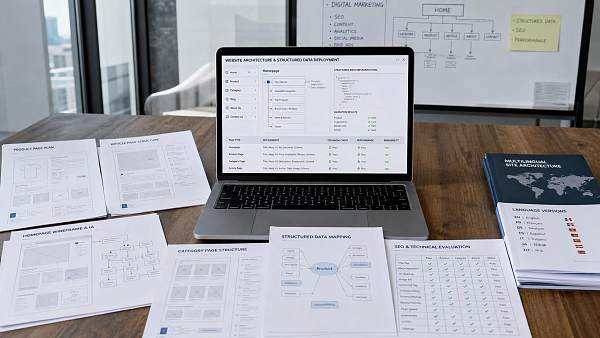
When many teams discuss structured data deployment, their first reaction is to choose a Schema type, write JSON-LD, and run validation tools. In actual projects, the problem often does not lie in how to write it, but in who it is written for. If page types are not clearly distinguished, content boundaries are unstable, and field sources are inconsistent, even properly standardized markup can easily become ineffective work. Especially in integrated website and marketing service projects, pages serve both indexing and conversion purposes. Templates, language versions, advertising landing pages, and blog content pages are often managed within the same system. Without conducting a page inventory at the early stage, structured data deployment can easily become increasingly disorganized.
During a technical evaluation, a more practical starting point is to first confirm which page types have stable, verifiable, and maintainable markup conditions. Product pages, article pages, homepages, and category pages are generally the four highest-priority types, but not every site is suitable for full-scale deployment. For overseas trade websites, cross-border e-commerce stores, and multilingual corporate websites, this assessment must also consider language switching, currencies, regional content differences, template reuse, and the way marketing components are invoked.
Do Not Rush to Deploy; First Divide Page Types into Those That Are Easy and Difficult to Mark Up
Before deploying structured data, the biggest mistake is to use site navigation logic in place of page-type logic. The navigation may appear to contain only Product Center, News Center, About Us, and Contact Us, but from a markup perspective, it may include at least a dozen templates, such as product detail pages, product aggregation pages, article detail pages, article tag pages, brand introduction pages, team pages, and form landing pages. Different templates have different field stability and are suitable for different Schema types.
In a practical assessment, it is recommended to first divide pages into three categories:
- Pages with clear content boundaries and fixed core fields, such as product detail pages and article detail pages;
- Information aggregation pages, such as category pages, search result pages, and topic pages;
- Brand and functional pages, such as homepages, About Us pages, Contact Us pages, and form pages.
The first category is generally the most suitable for priority deployment. The second category is not impossible to implement, but depends on whether the aggregation logic is stable. The third category is easily overestimated. Many teams immediately want to make the homepage very complete, adding Organization, WebSite, Breadcrumb, FAQ, Product, and even Review to the homepage. Although this may appear comprehensive, it can actually create considerable semantic conflicts.
Product Pages: The Most Worthwhile, but Also the Pages Most Prone to Field Problems
If a site has standard product detail pages, they should be the first focus when prioritizing structured data deployment. The reason is simple: product pages generally have a clear subject and relatively complete attribute fields, such as name, image, description, brand, model, SKU, price, and stock status. The problem is that many B2B websites do not have complete versions of these fields.
A common situation on overseas manufacturing websites is that a page is called a product page but actually functions more like a capabilities showcase page. It may contain only several images, an application scenario description, and an inquiry button, without a price or inventory information and without distinguishing specific models. Such a page can of course use Product-oriented markup, but it should be done with restraint. Information that does not exist on the site must not be added arbitrarily. In particular, fields such as price, rating, and reviews should not be filled in merely for the sake of completeness if they are not clearly displayed on the frontend page.
For cross-border e-commerce stores or independent websites, product page assessment should also focus on three points: first, the variant logic—whether color, size, or region-specific pricing changes the core fields; second, whether currencies correspond one-to-one with country sites; and third, whether inventory and promotional information are synchronized in real time. If the field update mechanism cannot keep up, even the best structured data will soon become inaccurate.
This is also why many integrated website-building and marketing platforms now link product fields, template fields, and frontend markup. For platforms such as Yiyingbao, which provide long-term services for multilingual corporate websites, B2B overseas trade websites, and cross-border e-commerce stores, the real challenge is not whether Schema is supported, but whether backend product information, language versions, page templates, and search visibility rules can be connected. During technical evaluations, it is recommended to make whether the field source is unique a mandatory checklist item.
Article Pages: They Look Simple, but Actually Test the Content System More
Article detail pages are usually the second priority because their structure is relatively stable. Fields such as the title, publication date, author, cover image, and main body can generally be obtained. For corporate websites that conduct SEO over the long term, article pages are also a type of page that is relatively suitable for continuous maintenance.
However, there are two common misconceptions. One is treating all content as Article. Press releases, knowledge articles, case studies, downloadable documents, and event pages may all be placed under a News or Information Center, but their actual content attributes differ considerably. The other misconception is entering the author field arbitrarily. Corporate websites often directly enter the company name or a system default name. This is not necessarily unacceptable, but if the site itself has no author system, editorial information, or explanation of content responsibility, subsequent maintenance may become passive.
Another point that is easy to overlook is that the breadcrumbs, category affiliation, and related-article modules on an article page should preferably match the actual page hierarchy. Some sites place the same article in multiple categories for marketing purposes, resulting in unstable URLs, titles, and aggregation relationships. In such cases, even if the markup on an individual page is correct, the overall semantics may become dispersed.
A Homepage Can Be Marked Up, but It Should Not Be Treated as a Universal Container
A homepage is suitable for carrying brand-level and site-level information, such as Organization or WebSite markup, provided that it genuinely serves as the main brand entry point. For advertising-focused or campaign-focused websites, the homepage may be only a temporary aggregation page: one day it promotes a store, and the next day it features a new-product topic. In such cases, the stability of the homepage fields is often lower than that of a brand introduction page.
Another practical issue is that the homepages of a multilingual website may not contain the same content. The English site may emphasize product solutions, the Japanese site may focus on corporate qualifications, while the Middle East site may highlight local service information. Technically, a unified template can be used, but at the markup level it is best not to simply copy the same brand description. If the page language, contact information, social media accounts, or service regions differ, the structured data should be adjusted accordingly.
This point is especially important for companies engaged in overseas marketing. A website is not sufficient merely because it can be opened and contains code. Brand pages, homepages, landing pages, and product pages have different roles in the search system. Platforms such as Yiyingbao, which cover website building, SEO, advertising, and multilingual content operations, are more suitable for structured governance not because they have more modules, but because they can separate the responsibilities of different page types instead of applying one template to every scenario.
Category and Aggregation Pages: The Type Most Likely to Be Overestimated
Whether a category page is worth implementing depends on whether it is an aggregation list or a category page with a clear subject. If it merely automatically retrieves several products or articles according to system rules, has a mechanically generated title, and contains little introductory text, it is more like a browsing page than a strongly semantic page. Even if such a page has breadcrumbs or an item list, it is not suitable for heavy markup.
Conversely, if a category page has a clear category description, stable filtering logic, a clear URL hierarchy, and consistently serves a particular search need, it is worth including in the assessment. For example, some industrial product websites have pages categorized by application scenario, while cross-border e-commerce stores may have brand collection pages. These pages themselves play an important role in information organization.
In a Technical Evaluation, the Real Question Is Not Whether It Is Supported, but How It Is Maintained
Many projects can produce structured data during the demonstration stage. The difficult part is keeping it accurate six months after launch. During a technical evaluation, it is recommended to focus on four maintenance issues.
The first is the field source. Do fields come from the CMS, product database, manual entry, or frontend assembly? The more dispersed the sources, the higher the probability of errors. The second is the scope of template reuse. Does one template serve the corporate website, store, and landing pages at the same time? If so, the conditional logic must be clearly defined. The third is the multilingual mechanism. Are translated content, currencies, brand names, and regional contact information maintained separately? The fourth is the publishing process. When content changes, is the structured data updated at the same time, or does it require a second round of manual processing?
This is also the difference between integrated website and marketing service projects and traditional single-site development. In the former, pages are updated more frequently, there are more advertising campaigns, and content, technical, and operations teams all interact with site data. Without an underlying governance approach, structured data can easily become invalid after several rounds of redesign.
Some Pages Are Better Implemented Later Than Implemented Incorrectly First
FAQ pages, review pages, video pages, event pages, and download pages are often prioritized as value-adding features. However, based on project experience, these pages often depend more on content standards than on the technical integration itself. For example, if the questions on an FAQ page are not questions users genuinely care about but sentences split from marketing copy; if a review page has no public and traceable source for its reviews; or if a video page merely embeds a link to a third-party player, these pages are not suitable for urgent implementation.
The essence of structured data deployment is to provide search systems with clearer page semantics, not to label a site simply to increase the quantity of markup. When page types are identified correctly, subsequent markup becomes meaningful. When page types are identified incorrectly, being overly proactive can instead create technical debt.
If one practical action must be retained for pre-deployment assessment, it is to first create a list of site templates and mark the content boundaries, field sources, update owners, and multilingual differences for each template. Pages that can answer these questions clearly can then proceed to markup design; for pages that cannot, the page itself should be governed first. This order may appear slightly slower, but in practice it saves more rework.
Related Articles



Related Products
 Yiyingbao SaaS Intelligent Website Building and Marketing SystemYiyingbao SaaS Intelligent Website Building and Marketing System, AI-powered no-code website building, rapid creation of multilingual B2B international websites in 10 minutes, global server acceleration, AI-powered SEO optimization, helping businesses connect efficiently with global markets. The perfect integration of technology and operation makes building an international trade website remarkably simple
 AI+SEM Intelligent Advertising Marketing SystemAI+SEM drives intelligent ad creation, empowering full-funnel precision advertising marketing. The system automatically generates weekly/monthly reports, AI recommends keywords and target countries, monitors core metrics in real-time with intelligent alerts, and enables one-click high-conversion ad solutions to help quickly acquire customers and improve ROI.
 AI+SEO Dual-Engine System Optimization ServicesYiyingbao’s AI+SEO dual-engine optimization system helps foreign trade enterprises acquire high-quality organic traffic through AI-powered keyword research, content generation, and comprehensive technical optimization, significantly improving search rankings and conversion rates.
 AI+SNS Social Media Marketing SystemYingbao AI+SNS Social Media Marketing System - Precision social capture for the social media era. Supports one-click content synchronization across major platforms like Facebook and LinkedIn. AI intelligently rewrites posts for enhanced relevance. 24/7 AI customer service and user profiling analysis empower businesses to efficiently expand into global markets.
 AI+SEO营销解决方案易营宝AI+SEO营销解决方案,通过AI批量写作、智能生成TDK、精准关键词扩词等功能,全面优化网站SEO效果,提升流量与转化率。助力企业构建高效智能网站新生态。
 AI+SEM Advertising Marketing SolutionsAI+SEM Advertising Marketing Solution leverages AI technology to deeply empower SEM ad campaigns. It automatically generates weekly/monthly reports using AI, presenting account data across multiple dimensions for comprehensive insights into campaign performance and trends. The system precisely recommends keywords and target countries, intelligently generates high-conversion ad copy, and enables one-click activation of efficient campaign plans to help businesses rapidly acquire customers. Simultaneously, it monitors core metrics in real time, intelligently identifies abnormal fluctuations, and issues timely alerts to ensure stable, high-return advertising results.
 Domain Name ServicesEasyWin provides professional domain name services, including intelligent queries, one-stop registration, brand protection, and full lifecycle management, helping businesses build a digital brand image.
 EasyOperate B2C Cross-Border E-Commerce Platform & Independent WebsiteEasyStore B2C Cross-border E-commerce Independent Store is an intelligent website building and cross-border e-commerce integrated solution independently developed by EasyStore Information Technology (Beijing) Co., Ltd. The system is specially designed for small and medium-sized as well as large export enterprises, integrating 'website building, operation, marketing, advertising, and conversion' into one, helping enterprises quickly establish cross-border e-commerce independent stores to achieve brand globalization and global sales growth.
The platform supports multiple languages, multiple currencies, and multi-channel marketing, with built-in AI intelligent translation and SEO optimization systems, suitable for mainstream markets such as Southeast Asia, Europe and America, Latin America, and the Middle East, assisting Chinese manufacturing enterprises in efficiently deploying international e-commerce strategies. SSL证书易营宝提供专业SSL安全证书服务,包括单域名和泛域名证书,确保网站数据传输加密、身份验证和完整性保护,助力企业建立安全可信的在线业务环境。









