









- Which customer acquisition channels will be affected by cross-border marketing trends in 2026?Sep 06, 2026View details
- Which homogenization risks should be considered in an analysis of the AI-powered website building industry?Aug 30, 2026View details
- How Will AI Marketing Trends 2026 Change Advertising Budget AllocationAug 28, 2026View details
- Is the EV SSL certificate market shrinking or upgrading? How should companies assess certificate procurement?Aug 11, 2026View details
- Why the old AMP SEO 2020 practices no longer work and what has changed in current optimization prioritiesAug 02, 2026View details
- How to Choose Topics for an Industry News Section to Attract More Organic Search TrafficJul 29, 2026View details
How to Evaluate Whether Planning and Development Are Misaligned in Wuxi Website Construction
Meta Title: How to Evaluate Whether Planning and Development Are Aligned in Wuxi Website Construction
When developing a website in Wuxi, many projects do not fail because of technical difficulties, but because the planning sounds comprehensive while the development results do not match it. The consequences are usually immediate: the launch is repeatedly delayed, the pages do not correspond to the requirements, and extensive rework is needed later. The most troublesome part is that although the website appears to be completed, it is not practical to use and does not support conversions. To properly evaluate whether planning and development are disconnected, there is no need to focus on who sounds more professional. The key is to examine three things: whether the requirements have been accurately translated, whether the process has remained aligned, and whether there are executable acceptance criteria.
If your project is currently stuck during implementation, remember one key principle: if the planning documents cannot directly guide development, or if the development results cannot be validated against business objectives, the project has most likely already become disconnected.
Common Signs of a Disconnect Between Planning and Development in Wuxi Website Construction
Many project managers do not initially realize that a problem has emerged because there are plenty of early-stage meetings and documents, making everything appear very “formal.” However, once execution begins, the disconnect becomes visible through specific symptoms.
For example, the planning stage may emphasize lead generation, while the development stage produces only a presentation-style corporate website. The planning documents may specify multilingual support, an SEO structure, form tracking, and landing-page logic, but the delivered website may include only the front-end pages without implementing these capabilities in the backend, URL structure, page templates, or data tracking. Another typical situation is that the prototype is highly detailed, but the developers say, “The functional logic was never mentioned.” In the end, both sides believe they are right.
These problems are not uncommon in Wuxi website construction projects, especially for corporate websites, marketing websites, and international independent websites that need to balance brand image and lead generation. These projects are not complete simply because the pages have been created. They must also take content structure, search indexing fundamentals, conversion paths, and ongoing operations into account.
Project managers can quickly check for several warning signs:
- The requirements document is mainly descriptive and lacks field definitions, rules, priorities, and explanations of exceptional situations.
- The prototype and development specifications are separate documents with no unified version.
- Planning, design, front-end, back-end, and testing teams each interpret the business differently, with no shared acceptance criteria.
- SEO, forms, tracking codes, and mobile responsiveness are not discussed until just before launch.
- Every meeting is spent “re-explaining the requirements” rather than confirming progress and risks.
If two or three of these signs are present, it is worth becoming more cautious.
Before Looking at the Pages, Check Whether the Requirements Have Been Successfully Translated
When evaluating a project, many people first look at the visual designs, homepage results, or feature demonstrations. From a project-control perspective, however, the first thing to check should be whether the requirements have been smoothly translated from “business language” into “development language.”
Here is a simple example. The business team may say, “I want a website that can generate leads.” For planners, this is a direction; for developers, it is not actionable. A truly implementable requirement should be broken down further: Who are the target customers? What are the main entry pages? What actions generate inquiries? How are form submissions processed? Which pages are responsible for SEO indexing? Which pages are intended for advertising conversions? Should mobile users receive priority? Who will maintain the backend?
If these questions are not clearly defined, even the most diligent development team can only work according to its own interpretation. The final problem is not necessarily development capability; the input itself may have been ambiguous.
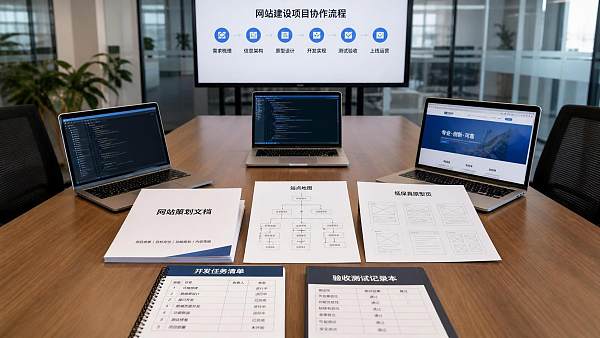
I recommend that project managers focus on these three documents:
- Requirements specification: Does it clearly define the functional boundaries instead of merely stating “support,” “implement,” or “configurable”?
- Page list or sitemap: What is the purpose of each page, and does it correspond to a business process?
- Acceptance criteria: What does “complete,” “usable,” and “ready for launch” mean?
If the planning team delivers a logically polished PPT but the developers still need to confirm many details verbally, this indicates that the intermediate layer of “executable translation” is weak.
[Image Placeholder 1: Illustration comparing planning documents, prototypes, and the development process for a website project, alt="Illustration of the Alignment Process Between Wuxi Website Construction Planning and Development"]
Much of the Rework Is Not a Technical Problem but a Missing Alignment Mechanism
In Wuxi website construction projects, the disconnect between planning and development is often not caused by a single incorrect step. Instead, the process itself has failed to treat alignment as a formal activity. Many teams assume that “holding a requirements meeting means everyone is synchronized.” This may be barely sufficient for a simple presentation website, but once marketing objectives, SEO fundamentals, content management, and data tracking are involved, relying on the memory of a single meeting creates significant risks.
A relatively reliable process should include at least four alignment checkpoints.
The first is project initiation confirmation. The project should not begin simply because the contract has been signed. It is necessary to clarify whether the website is intended for brand presentation, inquiry generation, or overseas marketing campaigns. Different objectives require completely different information architectures and technical implementations.
The second is prototype confirmation. The purpose is not to determine whether the design “looks good,” but to confirm the page logic, content sections, conversion path, and module reuse relationships.
The third is pre-development confirmation. The front-end, back-end, SEO, and operations teams should jointly clarify dynamic fields, URL rules, form logic, tracking requirements, and backend permissions. Many projects omit this step and only discover during testing that “this backend cannot be edited” or “this page cannot generate an independent title.”
The fourth is joint testing and acceptance. The goal is not merely to check whether the website opens, but whether business actions form a complete loop. For example, whether an inquiry notification is triggered after submission, whether the mobile form is easy to complete, and whether page loading and basic indexing settings are complete.
If any of these steps is missing, later work may turn into patchwork repairs.
How to Determine Whether Development Results Have Deviated from the Planning Objectives
A disconnect cannot be identified solely through subjective impressions. Project managers should place their checkpoints on whether the objectives have been achieved, rather than whether the pages look “more or less right.”
If the objective of your project is lead generation, examine the following areas:
- Does the above-the-fold area clearly communicate the business and provide an action entry point?
- Do the core product or service pages address user problems instead of containing only company information?
- Are conversion entry points such as forms, WhatsApp, telephone calls, and online communication arranged appropriately?
- Are the page titles, descriptions, URLs, and category hierarchy suitable for future SEO?
- Does the backend support ongoing updates, or is developer assistance required for every change?
If the objective is brand presentation, the focus is different. You should examine consistency, content accuracy, case-study presentation, loading experience, and device compatibility. Even a presentation website, however, should not neglect basic marketing capabilities. Many companies add promotion activities later. If the site structure is not properly established from the beginning, adding SEO or advertising landing capabilities later will usually cost more.
This is why many companies now place greater emphasis on a provider’s integrated “website + marketing services” capabilities. For example, an integrated service platform such as 易营宝, which has long focused on intelligent website construction, SEO optimization, and overseas marketing, can serve as a reference. The value is not whether the name is well known, but whether its service logic views website construction, indexing, promotion, and conversion as one connected process. For project managers, this integrated perspective can generally reduce situations in which the planning team and development team work from completely different interpretations. Whether it is suitable for your project still depends on your budget, business scenario, and team collaboration model, so it should not be applied without assessment.
Some Deliverables That Look Professional Can Actually Mislead Your Assessment
Here are several common misconceptions.
First, a complete prototype does not mean that development will not deviate from the plan. A prototype addresses page presentation, but many backend processes, data rules, permission settings, and tracking solutions do not automatically appear in it.
Second, a long feature list does not mean that the project is mature. The longer the list, the more important it is to examine whether the features have priorities, which are essential for launch, and which can be handled in a second phase. Otherwise, development is most likely to get out of control.
Third, a page that looks like a “premium corporate website” does not mean the project is successful. Project managers should pay more attention to whether the website will be easy to maintain after launch, whether it can support future promotion, and whether visitors can complete an inquiry smoothly.
Fourth, testing should not be understood as simply checking “whether there are errors.” A genuinely experienced acceptance process examines whether the business journey works. For example, is the path from an advertising landing page to content consumption and then inquiry submission smooth? After switching between multilingual pages, are the URLs and SEO tags still reasonable? Will images, code, and third-party plugins slow down the page experience? These factors directly affect the results.
If You Are Taking Over a Project Already Underway, Start with These 5 Tasks
Many project managers take over an engineering project when it is already halfway complete. The biggest risk at this stage is continuing to move forward with ambiguous information. My advice is not to rush to push for launch, but to first identify the key control points.
- Place the current requirements, prototype, and development specifications in one unified document and confirm which version is effective.
- Ask the development team to explain, page by page, “what has been completed, what remains incomplete, and what dependencies exist.”
- List the items that must be included at launch and those that can be postponed to prevent scope expansion.
- Prepare an acceptance checklist covering at least pages, functions, forms, mobile devices, basic SEO, and analytics tools.
- Confirm who will maintain the content and who will handle technical issues so that the website does not immediately become unmanaged after launch.
These five tasks may not sound complicated, but they can expose many hidden risks. The fourth task is especially important. Many projects previously had no proper acceptance criteria, leaving the team to launch based on “good enough,” which can cause serious problems later.
A Practical Assessment Before the Conclusion
If, in a Wuxi website construction project, the planning documents cannot guide development and the development results cannot be validated against business objectives, the project is disconnected. Do not be distracted by attractive pages, lengthy meetings, or complicated terminology. What you should really focus on is whether the requirements have been accurately broken down, whether the process has remained aligned, and whether acceptance can be tied to pages, functions, and conversion results.
For project managers, the core issue is not whether they understand code, but whether they can move the project from a concept to something deliverable, operable, and capable of supporting growth. The stability of Wuxi website construction often depends on this layer.
FAQ
1. Can you determine whether planning and development are disconnected just by looking at the website mockups?
No. Mockups only show the visual direction. Many elements that truly affect launch results, such as backend management, form logic, SEO structure, and data tracking, cannot be identified from mockups.
2. The project is already halfway through development. Is it still possible to make adjustments after discovering that the requirements are not aligned?
Yes, but you should first freeze new requirements and reconfirm the current version and the items that must be included at launch. The later the issue is addressed, the higher the rework cost.
3. What is the difference between marketing websites and ordinary presentation websites in terms of evaluation criteria?
Marketing websites place greater emphasis on conversion paths, content structure, SEO fundamentals, and data tracking. Presentation websites focus more on brand presentation, but they should not completely ignore their ability to support future promotion.
4. How can you reduce the likelihood of a disconnect between planning and development when selecting a service provider?
Focus on whether the provider can incorporate planning, development, SEO, and operational requirements into the same process instead of outsourcing them separately and allowing each party to interpret the requirements independently.
Image Placeholder List
- Image Placeholder 1: Recommended placement after the section “Before Looking at the Pages, Check Whether the Requirements Have Been Successfully Translated”; content should illustrate the correspondence between planning documents, prototypes, development tasks, and acceptance checkpoints; alt="Illustration of the Alignment Process Between Wuxi Website Construction Planning and Development"
Suggested Internal Link Anchor Text
- Wuxi website construction solutions: Suggested link to the website construction service page
- How to build a marketing website: Suggested link to the marketing website construction topic page
- Basic SEO settings for corporate websites: Suggested link to the SEO optimization knowledge page
- Website project acceptance checklist: Suggested link to the website construction guide or download page
- Considerations for multilingual website construction: Suggested link to the international website construction content page
Suggested Authoritative External Sources
- Official search engine documentation, such as materials related to website indexing, page experience, and structured data standards
- Materials published by governments or industry associations concerning enterprise digital transformation and compliant website development
- Official documentation from major analytics tools or technology platforms, such as website analytics, performance testing, and usability standards
Related Articles



Related Products
 Yiyingbao SaaS Intelligent Website Building and Marketing SystemYiyingbao SaaS Intelligent Website Building and Marketing System, AI-powered no-code website building, rapid creation of multilingual B2B international websites in 10 minutes, global server acceleration, AI-powered SEO optimization, helping businesses connect efficiently with global markets. The perfect integration of technology and operation makes building an international trade website remarkably simple
 AI+SEM Intelligent Advertising Marketing SystemAI+SEM drives intelligent ad creation, empowering full-funnel precision advertising marketing. The system automatically generates weekly/monthly reports, AI recommends keywords and target countries, monitors core metrics in real-time with intelligent alerts, and enables one-click high-conversion ad solutions to help quickly acquire customers and improve ROI.
 AI+SEO Dual-Engine System Optimization ServicesYiyingbao’s AI+SEO dual-engine optimization system helps foreign trade enterprises acquire high-quality organic traffic through AI-powered keyword research, content generation, and comprehensive technical optimization, significantly improving search rankings and conversion rates.
 AI+SNS Social Media Marketing SystemYingbao AI+SNS Social Media Marketing System - Precision social capture for the social media era. Supports one-click content synchronization across major platforms like Facebook and LinkedIn. AI intelligently rewrites posts for enhanced relevance. 24/7 AI customer service and user profiling analysis empower businesses to efficiently expand into global markets.
 AI+SEO营销解决方案易营宝AI+SEO营销解决方案,通过AI批量写作、智能生成TDK、精准关键词扩词等功能,全面优化网站SEO效果,提升流量与转化率。助力企业构建高效智能网站新生态。
 AI+SEM Advertising Marketing SolutionsAI+SEM Advertising Marketing Solution leverages AI technology to deeply empower SEM ad campaigns. It automatically generates weekly/monthly reports using AI, presenting account data across multiple dimensions for comprehensive insights into campaign performance and trends. The system precisely recommends keywords and target countries, intelligently generates high-conversion ad copy, and enables one-click activation of efficient campaign plans to help businesses rapidly acquire customers. Simultaneously, it monitors core metrics in real time, intelligently identifies abnormal fluctuations, and issues timely alerts to ensure stable, high-return advertising results.
 Domain Name ServicesEasyWin provides professional domain name services, including intelligent queries, one-stop registration, brand protection, and full lifecycle management, helping businesses build a digital brand image.
 EasyOperate B2C Cross-Border E-Commerce Platform & Independent WebsiteEasyStore B2C Cross-border E-commerce Independent Store is an intelligent website building and cross-border e-commerce integrated solution independently developed by EasyStore Information Technology (Beijing) Co., Ltd. The system is specially designed for small and medium-sized as well as large export enterprises, integrating 'website building, operation, marketing, advertising, and conversion' into one, helping enterprises quickly establish cross-border e-commerce independent stores to achieve brand globalization and global sales growth.
The platform supports multiple languages, multiple currencies, and multi-channel marketing, with built-in AI intelligent translation and SEO optimization systems, suitable for mainstream markets such as Southeast Asia, Europe and America, Latin America, and the Middle East, assisting Chinese manufacturing enterprises in efficiently deploying international e-commerce strategies. SSL证书易营宝提供专业SSL安全证书服务,包括单域名和泛域名证书,确保网站数据传输加密、身份验证和完整性保护,助力企业建立安全可信的在线业务环境。









