Should You Revise the Title or the Product Detail Page Structure First for Product Page SEO?
When optimizing product page SEO, many people instinctively revise the title first, believing that adding keywords will improve both rankings and clicks. In practice, however, another situation often occurs: after the title is revised, the page is still not indexed, or it receives impressions but no clicks, and visitors even leave shortly after entering. The problem is not that the title is unimportant, but that the most critical issue on the current page has not been identified first: whether it is being understood by search engines or whether users are willing to continue reading.
If you are working on product page SEO, especially for product detail pages on corporate websites, foreign trade websites, or cross-border e-commerce stores, this sequence will directly affect the efficiency of your optimization work. Deciding what to change first is not merely an editing preference; it also determines whether the search entry point, page relevance, and conversion path can connect effectively.
Why Is It Always Difficult to Decide Whether to Revise the Title or the Structure First?
This dilemma is common because both the title and the detail page structure appear important, and both are related to search performance. The title determines what users see first in search results, while the detail page structure determines whether search engines can quickly understand the page topic. It also affects whether users are willing to continue reading after entering the page.
Many teams switch back and forth between the two: today they feel the title is too ordinary, and tomorrow they discover that the body content is too scattered, with specifications and selling points mixed together. As they continue making changes, they lose sight of priorities. The result is frequent page adjustments, while the core issue is never truly resolved.
From a product page SEO perspective, the first step is not to choose between the two, but to determine which type of problem the current page has: has the search engine not yet understood the page accurately, or has the search engine already provided an opportunity while the user and the page content fail to match?
First Identify Where the Page Is Currently Stuck
Before deciding what to change first, do not rush to revise the copy. A practical approach is to examine the problem from two levels.
The first level is search engine understanding. For example, the page title may be vague, the H1 may not match the title, the body content may contain almost no information centered on the product keywords, specifications, uses, and application scenarios may not be organized into clear sections, or the entire page may contain only images and a short introduction. Even if such a page is crawled, it is difficult for search engines to establish a clear topic. In this situation, the priority is usually the detail page structure rather than simply changing the title.
The second level is the search-result click and landing-page experience. For example, the page may already be indexed and receive some impressions, but have a low click-through rate, or visitors may leave shortly after clicking through. This often indicates that the title is inaccurate or insufficiently appealing, or that the content promised by the title does not match the page's above-the-fold content and main information. In this situation, title optimization should come earlier, but it still cannot be handled separately from the page structure.
In simple terms, if the page is not understood, improve the structure first; if it has an opportunity but fails to capitalize on it, refine the title. This is more reliable than blindly changing one element first.
Common Mistake: Treating the Title as the Only Lever for Product Page SEO
When performing product page SEO, many operators focus most of their attention on the title because it is inexpensive to modify and its path to results appears more straightforward. However, the title is only the entry point to the page topic, not the topic itself.
If the detail page structure is confusing, even a precise title may lead search engines to conclude that the page content provides insufficient support. If the above-the-fold information, parameter modules, application scenarios, FAQ, and inquiry entry are not logically connected, users may also find it difficult to take the next step after entering the page. This is especially true for B2B foreign trade websites, manufacturing product websites, and multilingual corporate websites, where users are often not looking for a slogan but want to quickly confirm whether the product is what they need.
Another common mistake is making major changes to the title, URL, H tags, and body content all at once. This makes it difficult to determine which change produced the effect. A more practical approach is to proceed in the order of establishing a clear structure, refining the title wording, and then observing the data feedback.
A More Reliable Approach: In Most Cases, Organize the Detail Page Structure Before Optimizing the Title
If your page is still at a relatively basic stage, it is generally advisable to put the detail page structure in order before changing the title. The reason is straightforward: the structure determines whether the page fully communicates the product topic, while the title distills that topic.
A detail page suitable for product page SEO should enable both search engines and users to quickly answer several questions: What product is this? Who is it for? In what scenarios is it used? What are its key specifications or functions? What differentiates it from similar products? Should the visitor make an inquiry or place an order next? If this information is not presented systematically, it is difficult for the title to work effectively on its own.
This step is particularly important for teams using an intelligent website-building system or continuously managing multiple product pages. Platforms such as Yiyingbao, which cover intelligent website building, SEO optimization, and overseas marketing management, are well suited to standardizing page templates, module hierarchies, multilingual content, and keyword placement. Product page SEO is not simply about revising the copy on one page; it also requires pages to remain consistent and scalable over the course of long-term maintenance.
You Can Use These Steps to Assess and Handle the Problem
- First check indexing and impression data. If the page has not been indexed for a long time, or has received almost no relevant impressions after being indexed, first check whether the structure clearly communicates the product topic, including the H1, body content hierarchy, parameter modules, application scenarios, and related questions and answers.
- Then check whether the title matches the main page content. If the title contains a core product keyword but the body content mainly discusses the company profile and service advantages, relevance will decline. In this case, do not first replace the title with something more eye-catching; instead, ensure that the page content is built around the title.
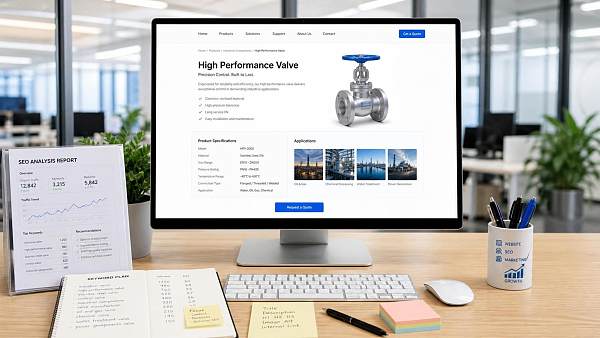
- Organize the order of the detail page modules. A common and reasonable order is: product definition or core selling points, applicable scenarios, specifications and parameters, functional features, frequently asked questions, and action entry. This makes it easier for search engines to identify key points and for users to scan the page.
- Supplement the page with the actual language used in searches. Users commonly search by terms related to use, model, material, and applicable industry rather than by the terms used internally by a company. During product page SEO, these terms should be naturally incorporated into the title, H2 headings, short descriptions, and FAQ.
- Refine the title last. Once the page structure is stable, adjust the title length, keyword position, and wording. This provides clearer direction and makes the results easier to assess.
When Can You Revise the Title First?
Not every page needs to have its structure changed first. If the main content of your detail page is already relatively complete, the modules are clear, and the product information and application scenarios are all present, but the title is too broad or does not include the core search keyword, revising the title first is reasonable.
Common problems include the following: the title contains only the product model and not the product category; the title is written as a brand slogan, making it unclear what the page sells; the title and H1 are completely different, dispersing the topic signals; or the titles of multiple product pages on the same site are highly repetitive, causing them to compete with one another. In these cases, prioritizing the title often produces faster results.
Even when revising the title first, it is advisable to perform a quick check at the same time: can the above-the-fold description, H1, first two paragraphs, and core modules support the title? Otherwise, after the title brings users to the page, the page may fail to meet their expectations, and clicks may not turn into inquiries or meaningful engagement.
How Should the Detail Page Structure Be Adjusted Specifically?
Many people know that they need to change the structure but do not know where to start. In fact, there is no need to carry out a complex redesign at the beginning. It is enough to first transform the page from an “accumulation of information” into a page with a clear decision path.
First, clearly explain what the product is above the fold instead of opening with a brand slogan or a broad introduction. Second, do not combine product features and specifications into one long paragraph; display them in separate sections whenever possible. Third, present application scenarios separately, because this not only supplements search relevance but is also closest to the user's decision-making process. Fourth, do not add an FAQ merely to fill space; answer questions that users are genuinely likely to ask, such as delivery time, material, applicable scope, customization methods, and compatibility. Fifth, provide a clear next step at the bottom of the page. Whether it is making an inquiry, obtaining a solution, or viewing related products, users should know where to go next.
If the website supports template-based management, multilingual page synchronization, and module reuse, structural optimization will be more efficient. For foreign trade companies and brands expanding overseas, a website often contains more than one product page. Manually patching pages one by one can easily lead to inconsistencies. In such cases, a unified website-building and SEO management tool is more suitable for long-term execution.
Frequently Asked Questions
Do I have to include the complete keyword in the title when optimizing product page SEO?
There is no need to mechanically copy the complete phrase, but the core product keyword should preferably appear naturally. The key is not to force keywords into the title, but to make it immediately clear to both users and search engines what the page is about.
After changing the detail page structure, do I need to revise the title immediately?
It is advisable to first confirm that the structure is stable, then fine-tune the title according to the actual page content. This makes the title more accurate and helps keep it consistent with the page content.
Are the optimization sequences the same for product pages on corporate websites and product pages on cross-border e-commerce stores?
The principles are similar, but the focus differs slightly. Corporate websites place greater emphasis on information completeness and the inquiry path, while cross-border e-commerce stores focus more on product attributes, purchase decisions, and managing pages at scale. Neither should focus only on the title while ignoring the structure.
If a page already ranks but receives few inquiries, should I continue working on product page SEO?
Yes. Rankings are only the entry point. Inquiries and conversions also depend on whether the page clearly communicates the product value, applicable users, and action path. At this point, you should generally review how the detail page content is organized rather than focusing only on keyword placement.
Conclusion
Returning to the original question, there is no universal answer that is independent of the current page situation as to whether you should revise the title or adjust the detail page structure first for product page SEO. However, for most basic pages, putting the structure in order first is usually the higher priority because the structure determines whether the page can be correctly understood and whether subsequent title optimization has a solid foundation.
A more practical approach is to first determine whether the page is stuck at indexing, impressions, clicks, or conversions, and then decide what to change first. For teams that maintain multiple products and multilingual pages over the long term, managing website building, content structure, and SEO within the same workflow is often more efficient than revising titles individually, and it makes it easier to accumulate improvements in page performance over time.