









- The U.S. has ended the $800 de minimis exemption for non-postal shipments; express courier packages must be formally declared.Nov 16, 2026View details
- ASEAN Signs Digital Economy Framework Agreement, Moving Toward Harmonized Cross-Border E-Commerce RulesNov 15, 2026View details
- Shenzhen Becomes the First City in Mainland China to Exceed RMB 5 Trillion in Foreign TradeNov 15, 2026View details
- Fujian Announces the First Batch of Provincial-Level Cross-Border E-Commerce Industrial Parks and Key Brands for CultivationNov 14, 2026View details
- Amazon Global Store Announces the Launch of the 2026 Black Friday Global Shopping SeasonNov 14, 2026View details
- CCTV.com Examines APEC’s Role in China’s Foreign TradeNov 12, 2026View details
How to Promote a Website on Google in France: From French Keywords to Local Link Building
How do you promote a website on Google in France? From French keyword research to local link building, successful продвижение сайтов во французском гугле is not about simply translating an English website. It is about helping French buyers find your products, assess your ability to supply them, and submit an inquiry in ways they are familiar with. The following sections break down practical search promotion methods for the French market.
Find the terms buyers use in French instead of translating keywords literally
Keyword research can start with three areas: product names, applications, and purchasing requirements. For industrial equipment, for example, buyers may search for the name of the equipment, or use terms such as “equipment type + supplier,” “equipment application + technical requirements,” or “product name + quotation.” These searches reflect different needs and should not all lead to the homepage.
First, compile your existing English product terms and terminology used in customer inquiries. Then use Google France search results, search suggestions, and keyword planning tools to identify French equivalents. Check whether top-ranking pages are product pages, category pages, or selection guides to help determine search intent. For specialist terminology, ask someone familiar with the French market to review it, rather than assuming a literal translation reflects how buyers search.
When creating a keyword list, record the French term, corresponding product, search intent, target page, and current ranking. Prioritize terms that match your core products and existing delivery capabilities. Even if they attract visits, high-volume searches related to retail, recruitment, or other irrelevant needs may not generate qualified inquiries.
Make French pages discoverable and ensure they answer buyers’ questions
A French-language site can use a separate domain, a subdomain, or a French-language directory within the existing website. For companies that need to manage several markets centrally, a directory structure is often easier to maintain. The right choice also depends on your existing systems, brand plans, and operational resources. Whatever structure you choose, French pages should have their own stable URLs, and be accessible through navigation and internal links—not only after clicking a language-switch button in search results.
Use hreflang annotations on multilingual pages to specify language and region, and ensure that the language versions correspond to one another. French pages should include a self-referencing annotation and have consistent reciprocal references to other versions; pages targeting France can use fr-FR. After submitting a sitemap, check indexing in Google Search Console and look for issues such as incorrect redirects, blocked crawling, and inconsistent canonical URL settings. Annotations only help search engines understand the relationships between pages; they do not guarantee rankings.
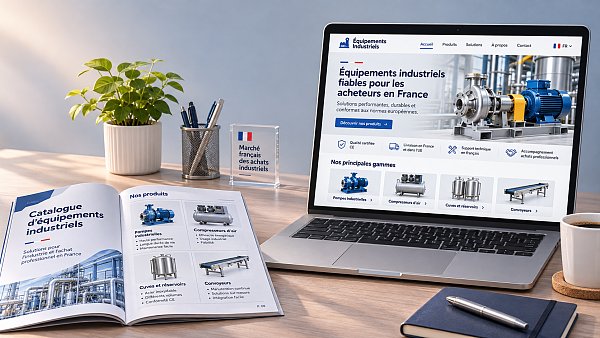
When it comes to content, product pages should offer more than a translated specification table. Buyers often also need information about operating conditions, available specifications, customization options, delivery coordination, and after-sales support. For certifications or declarations of conformity, only display information that you can substantiate and that applies to the relevant product and market. Do not apply general company credentials to every model.
French inquiry forms should also be localized: field labels, error messages, and submission confirmations should all be in French, and explain how you will respond. Whether to display prices depends on whether the product requires a specification-based quotation. If prices cannot be published, clearly state the quantities, models, and application details needed for a quotation to reduce back-and-forth.
Local link building: prioritize relevance over quantity
Local links in France do not mean buying a batch of backlinks from French websites. For manufacturers and international trade companies, more valuable prospects include websites related to their products, application industries, or buyer groups, such as industry associations, trade publications, exhibitor directories, distributors, and genuine business partners. Whether readers can understand the relationship between your company and the linking website matters more than whether the page displays a French address.
Before conducting outreach, prepare a French-language media kit with a company profile, product images, technical materials, contact details, and information that can be quoted publicly. Then check each target website to see whether it is regularly updated, whether its content is relevant, and whether the link points to a genuine business page. If a partnership involves advertising or paid placement, use appropriate link attributes to reflect the actual relationship; do not ask the publisher to conceal its commercial nature.
Cross-industry citations should also have a clear connection. For example, when discussing overseas customers in the property sector, Strategies for integrating and optimizing the operations of property company mergers and acquisitions can serve as background reading. However, it cannot replace information about the French property market, and should not be placed on an unrelated product page just to add a link.
Use data to distinguish visibility from business opportunities
After launch, use Google Search Console to review search impressions, clicks, and indexing status in France by country, query, and page. Then combine this with website analytics to monitor traffic paths on French pages, form submissions, and clicks on key buttons. If rankings improve but inquiries do not, first check whether search terms match buyer intent and whether the page explains the scope of delivery, rather than rushing to publish more articles.
Agree with your sales team in advance on what counts as a qualified inquiry—for example, whether it comes from a target industry, includes a clearly stated requirement, and matches your supply capabilities. A form submission is not automatically a qualified business opportunity. Mark duplicate inquiries, job applications, and irrelevant purchasing requests separately. Ads can be used to test keywords and landing pages, but paid click results are not directly equivalent to organic search rankings.
When using visitor analytics, forms, and ad tracking, review applicable privacy and user-consent requirements in light of how data is actually processed. Do not simply copy settings used in other markets. For implementation, consult the public guidance of France’s data protection authority and seek professional advice where necessary.
Bring website development, content, and promotion together in one delivery checklist
The challenge in many projects is not a lack of promotional channels, but the fact that website development, translation, advertising, and sales follow-up are handled separately: French page titles cannot be edited, ad landing pages have no tracking, and form leads do not enter the sales process. Before starting, confirm who has access to manage URLs and content, which pages can be edited, how tracking will be configured, who owns the leads, and who is responsible for ongoing maintenance.
Yingyingbao provides services including multilingual website development, search optimization, and advertising. Companies looking to integrate their websites with overseas marketing can discuss specific deliverables around French page development, keyword mapping, and inquiry tracking. French content review, local link resources, and data access permissions should be confirmed item by item before the project begins.
In practice, you do not need to wait until all website content is complete before testing. Select a group of core products, complete keyword research, French pages, technical checks, and inquiry tracking, then make adjustments based on search terms and sales feedback. This usually makes it easier to identify issues than translating a large number of pages all at once.
Related Articles
 How to Add Structured Data to Product Pages with JSON-LD
 How Long Does It Take to See an Increase in Inquiries from SEO for Your Website?
 How to Promote a Website on Google in France: From French Keywords to Local Link Building

Related Products
 Yiyingbao SaaS Intelligent Website Building and Marketing SystemYiyingbao SaaS Intelligent Website Building and Marketing System, AI-powered no-code website building, rapid creation of multilingual B2B international websites in 10 minutes, global server acceleration, AI-powered SEO optimization, helping businesses connect efficiently with global markets. The perfect integration of technology and operation makes building an international trade website remarkably simple
 AI+SEM Intelligent Advertising Marketing SystemAI+SEM drives intelligent ad creation, empowering full-funnel precision advertising marketing. The system automatically generates weekly/monthly reports, AI recommends keywords and target countries, monitors core metrics in real-time with intelligent alerts, and enables one-click high-conversion ad solutions to help quickly acquire customers and improve ROI.
 AI+SEO Dual-Engine System Optimization ServicesYiyingbao’s AI+SEO dual-engine optimization system helps foreign trade enterprises acquire high-quality organic traffic through AI-powered keyword research, content generation, and comprehensive technical optimization, significantly improving search rankings and conversion rates.
 AI+SNS Social Media Marketing SystemYingbao AI+SNS Social Media Marketing System - Precision social capture for the social media era. Supports one-click content synchronization across major platforms like Facebook and LinkedIn. AI intelligently rewrites posts for enhanced relevance. 24/7 AI customer service and user profiling analysis empower businesses to efficiently expand into global markets.
 AI+SEO营销解决方案易营宝AI+SEO营销解决方案,通过AI批量写作、智能生成TDK、精准关键词扩词等功能,全面优化网站SEO效果,提升流量与转化率。助力企业构建高效智能网站新生态。
 AI+SEM Advertising Marketing SolutionsAI+SEM Advertising Marketing Solution leverages AI technology to deeply empower SEM ad campaigns. It automatically generates weekly/monthly reports using AI, presenting account data across multiple dimensions for comprehensive insights into campaign performance and trends. The system precisely recommends keywords and target countries, intelligently generates high-conversion ad copy, and enables one-click activation of efficient campaign plans to help businesses rapidly acquire customers. Simultaneously, it monitors core metrics in real time, intelligently identifies abnormal fluctuations, and issues timely alerts to ensure stable, high-return advertising results.
 Domain Name ServicesEasyWin provides professional domain name services, including intelligent queries, one-stop registration, brand protection, and full lifecycle management, helping businesses build a digital brand image.
 EasyOperate B2C Cross-Border E-Commerce Platform & Independent WebsiteEasyStore B2C Cross-border E-commerce Independent Store is an intelligent website building and cross-border e-commerce integrated solution independently developed by EasyStore Information Technology (Beijing) Co., Ltd. The system is specially designed for small and medium-sized as well as large export enterprises, integrating 'website building, operation, marketing, advertising, and conversion' into one, helping enterprises quickly establish cross-border e-commerce independent stores to achieve brand globalization and global sales growth.
The platform supports multiple languages, multiple currencies, and multi-channel marketing, with built-in AI intelligent translation and SEO optimization systems, suitable for mainstream markets such as Southeast Asia, Europe and America, Latin America, and the Middle East, assisting Chinese manufacturing enterprises in efficiently deploying international e-commerce strategies. SSL证书易营宝提供专业SSL安全证书服务,包括单域名和泛域名证书,确保网站数据传输加密、身份验证和完整性保护,助力企业建立安全可信的在线业务环境。









