









- Which customer acquisition channels will be affected by cross-border marketing trends in 2026?Sep 06, 2026View details
- Which homogenization risks should be considered in an analysis of the AI-powered website building industry?Aug 30, 2026View details
- How Will AI Marketing Trends 2026 Change Advertising Budget AllocationAug 28, 2026View details
- Is the EV SSL certificate market shrinking or upgrading? How should companies assess certificate procurement?Aug 11, 2026View details
- Why the old AMP SEO 2020 practices no longer work and what has changed in current optimization prioritiesAug 02, 2026View details
- How to Choose Topics for an Industry News Section to Attract More Organic Search TrafficJul 29, 2026View details
Which Teams Are AI Website-Building Training Courses Suitable For? Check These 3 Implementation Thresholds Before Enrolling
The AI website-building training course is suitable for teams that have clearly decided to operate their website as a lead-generation entry point, content asset, and conversion tool. If the only goal is to “get a website online as quickly as possible,” the course may not be the highest priority. However, if the website will require continuous updates, multilingual expansion, SEO support, advertising landing pages, social media traffic generation, or AI search visibility management, the training is not simply about learning how to operate an interface. It establishes a repeatable working methodology.
Teams that are truly suited to this type of course usually share several characteristics: they already have product information, factory information, service descriptions, or case-study materials; the website is intended for long-term iteration rather than one-time delivery; and content updates need to be coordinated with inquiry quality, keyword planning, and page structure. For an export-oriented website, the homepage, product pages, application pages, FAQ pages, download pages, and inquiry form pages are not simply assembled together. Each page serves a different purpose. Field settings, button placement, URL hierarchy, image naming, title tags, and the alignment of multilingual versions all determine whether future indexing and conversion will proceed smoothly. This is why some teams still struggle to achieve stable results even after learning how to operate the tools.
First threshold: determine whether the content foundation is sufficient to support training and launch
The first common misunderstanding about AI website-building training is viewing it as “learning how to generate pages.” In actual implementation, the first obstacle is often not page building, but insufficient source content. AI can organize, rewrite, summarize, and assist with content generation, but the prerequisite is that the original materials must be usable. If the product specifications themselves are unclear, even comprehensive training will make it difficult to turn the website into an asset capable of handling traffic.
Common gaps include inconsistent product model naming, with the same specification written differently in quotations, catalogs, and packaging labels; material information available only as verbal descriptions without standardized text; missing key parameters such as dimensions, weight, voltage, power, load capacity, temperature resistance range, surface treatment, packaging method, and minimum order requirements; and application scenarios described only in general terms, without installation conditions, operating environments, or maintenance cycles. During website development, these issues appear directly in the page content. For example, the same product page may use both “stainless steel” and “metal body,” making it difficult for buyers to match their searches accurately. Alternatively, a multilingual page may mistranslate “spraying” and “electroplating” as the same term, resulting in inaccurate technical information.
If the goal of the training is to enable the team to maintain the website independently, a set of structured materials should be prepared first, including product categories, core specification tables, application industries, frequently asked questions, delivery processes, shipping and packaging information, and after-sales service boundaries. “Structured” here does not mean making the text longer; it means ensuring that fields can be reused consistently. For example, packaging methods should distinguish between wooden cases, cartons, pallets, and customized inserts. Shipping information should ideally specify suitability for sea freight, air-freight restrictions, and whether oversized or overweight items are involved. Installation instructions should clearly state whether pre-embedding is required, whether a power or air supply connection is needed, and whether on-site commissioning is required. When the training progresses to page design, content generation, and multilingual expansion, these foundational materials will directly determine efficiency.
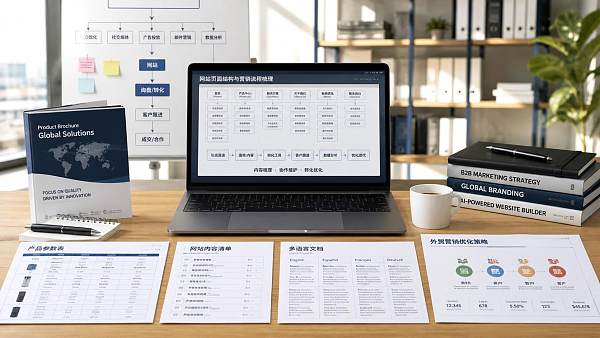
Teams with a weak content foundation are not unable to learn. They simply need to accept one reality: a significant amount of time in the early stage may be spent organizing materials rather than “launching a website quickly.” This threshold is not high, but it is essential. Ignoring it most commonly results in pages that look complete but contain vague and superficial information after the course is finished.
The second threshold is not technical; it lies in the collaboration process
Whether AI website-building training is suitable also depends on whether someone internally can connect content, design, technology, and marketing activities. In an integrated website and marketing services scenario, a website never exists in isolation. A page may use a shortened structure today for advertising, then require additional SEO content tomorrow. A product page may initially serve only inquiry generation, but later need downloadable materials, regional language versions, and more specific long-tail keywords aligned with search intent. Without a collaboration mechanism, the methods learned during training can quickly break down during actual execution.
This breakdown usually occurs in three areas.
- Unclear page ownership. Who initiates copy changes, who confirms technical details, who reviews images, and who is responsible for final publication? Many teams encounter no problems during the course, but once they begin practical work, repeated disagreements arise. As a result, pages are delayed or information becomes inconsistent after publication.
- Overly lengthy revision procedures. Website content should be updated frequently, but if every title change, application image replacement, or new form field requires multiple levels of approval, the efficiency gains from training will be offset by the process.
- Frequently changing website objectives. The focus may be brand image today, rapid lead generation tomorrow, and search indexing the day after. When objectives shift constantly, page structure, content length, button layout, and internal linking methods also change, making it difficult for the team to turn the course methods into stable standards.
Collaboration issues are particularly amplified on multilingual websites. When the source language is updated, is the change synchronized across other languages? Are units standardized across languages, such as millimeters, inches, kilograms, and pounds? Do shipping terms and installation instructions require localization adjustments? Some markets may focus more on certification documents, while others care more about lead times and spare parts. These issues cannot be solved simply by learning how to “generate pages.” The course is suitable for teams that already understand that website operations require collaboration across roles, rather than for teams that treat the website as a temporary task assigned piecemeal to different people.
The third threshold is whether the team is prepared for ongoing maintenance after training
When registering for AI website-building training, many people assume that the website will naturally enter a stable state after the course is completed. In reality, once a website takes on marketing responsibilities, maintenance work will continue to arise, and much of it involves detailed tasks.
For example, when a product is updated, should the old page retain its URL or use a 301 redirect? After an image is replaced, should the file name and alt text also be updated? Should certain advertising landing pages have navigation disabled to reduce bounce rates? Will too many form fields affect the submission rate? Will the mobile above-the-fold area load slowly because a large image has not been compressed properly? Should a technical document download page distinguish between PDF previews and direct downloads? Do internal links on article pages actually point to relevant products rather than merely creating superficial connections? These details determine whether a website can operate sustainably. The course primarily provides methods and decision-making frameworks; it does not replace subsequent operational work.
The maintenance threshold is often underestimated because it is less visible than website development. Once the homepage is completed, it already “looks like a website.” However, the factors that truly affect performance are often the small adjustments made over the following months. If a product page does not add information about applicable materials, machining accuracy, surface roughness, common faults, and maintenance tips, it may still struggle to match more in-depth search needs even with good formatting. Conversely, if materials are updated promptly, long-term visibility and inquiry relevance may be more stable even when the page design is simple.
Therefore, teams suited to this type of course are generally willing to accept three things: launching the website is not the end; content must be continuously supplemented; and technical and marketing signals require periodic adjustment. If the internal expectation is “one training session, followed by no changes for the long term,” the actual results will often fall short of expectations.
Which teams are more likely to achieve results from the course
Based on actual work patterns, the following situations are usually a better match. The first is a team that already has a basic corporate website, but whose existing site has a confusing section structure, outdated content, or difficulty expanding quickly after new products are added. In this case, the focus is often not building from scratch, but rebuilding the information architecture, standardizing page templates, and establishing update procedures. The second is a team that also conducts SEO, advertising, or social media traffic generation and needs to frequently produce topic pages, campaign pages, and landing pages. The third is a business with a broad product line, complex specifications, and multilingual communication needs, because these websites depend more heavily on content structure and templating capabilities.
Situations that are less suitable for immediate investment in the course are also clear: core products have not yet been finalized, with names and selling points changing every week; materials have long been scattered across chat records and personal computers; no one is responsible for maintaining the website after launch; and there is no internal consensus about inquiry sources, conversion pages, or content priorities. This does not mean the team cannot learn. It means that material governance and process organization are generally more effective first steps than rushing into training.
Another common misunderstanding is treating AI website-building training as a shortcut that “replaces professional judgment.” The course can shorten the learning curve, but it cannot replace an understanding of industry terminology, application conditions, and delivery details. For example, on an industrial product page, “suitable for high-temperature environments” should at least be supplemented with the temperature range, continuous operating conditions, and installation limitations. If a furniture page states “customization available,” it is also best to explain the available material options, dimensional tolerances, packaging method, and changes in shipping volume. Without these details, the page may appear complete but will have difficulty building trust.
Reviewing these three implementation thresholds before learning is not intended to raise the barriers themselves. It is intended to prevent problems from being incorrectly attributed to the course. In many cases, the difficulty lies not in whether the team knows how to use AI, but in whether the materials are systematically organized, collaboration is smooth, and someone is responsible for ongoing maintenance. Once these three areas are understood, the decision about whether to invest will be more closely aligned with actual business needs.
Related Articles
Related Products
 Yiyingbao SaaS Intelligent Website Building and Marketing SystemYiyingbao SaaS Intelligent Website Building and Marketing System, AI-powered no-code website building, rapid creation of multilingual B2B international websites in 10 minutes, global server acceleration, AI-powered SEO optimization, helping businesses connect efficiently with global markets. The perfect integration of technology and operation makes building an international trade website remarkably simple
 AI+SEM Intelligent Advertising Marketing SystemAI+SEM drives intelligent ad creation, empowering full-funnel precision advertising marketing. The system automatically generates weekly/monthly reports, AI recommends keywords and target countries, monitors core metrics in real-time with intelligent alerts, and enables one-click high-conversion ad solutions to help quickly acquire customers and improve ROI.
 AI+SEO Dual-Engine System Optimization ServicesYiyingbao’s AI+SEO dual-engine optimization system helps foreign trade enterprises acquire high-quality organic traffic through AI-powered keyword research, content generation, and comprehensive technical optimization, significantly improving search rankings and conversion rates.
 AI+SNS Social Media Marketing SystemYingbao AI+SNS Social Media Marketing System - Precision social capture for the social media era. Supports one-click content synchronization across major platforms like Facebook and LinkedIn. AI intelligently rewrites posts for enhanced relevance. 24/7 AI customer service and user profiling analysis empower businesses to efficiently expand into global markets.
 AI+SEO营销解决方案易营宝AI+SEO营销解决方案,通过AI批量写作、智能生成TDK、精准关键词扩词等功能,全面优化网站SEO效果,提升流量与转化率。助力企业构建高效智能网站新生态。
 AI+SEM Advertising Marketing SolutionsAI+SEM Advertising Marketing Solution leverages AI technology to deeply empower SEM ad campaigns. It automatically generates weekly/monthly reports using AI, presenting account data across multiple dimensions for comprehensive insights into campaign performance and trends. The system precisely recommends keywords and target countries, intelligently generates high-conversion ad copy, and enables one-click activation of efficient campaign plans to help businesses rapidly acquire customers. Simultaneously, it monitors core metrics in real time, intelligently identifies abnormal fluctuations, and issues timely alerts to ensure stable, high-return advertising results.
 Domain Name ServicesEasyWin provides professional domain name services, including intelligent queries, one-stop registration, brand protection, and full lifecycle management, helping businesses build a digital brand image.
 EasyOperate B2C Cross-Border E-Commerce Platform & Independent WebsiteEasyStore B2C Cross-border E-commerce Independent Store is an intelligent website building and cross-border e-commerce integrated solution independently developed by EasyStore Information Technology (Beijing) Co., Ltd. The system is specially designed for small and medium-sized as well as large export enterprises, integrating 'website building, operation, marketing, advertising, and conversion' into one, helping enterprises quickly establish cross-border e-commerce independent stores to achieve brand globalization and global sales growth.
The platform supports multiple languages, multiple currencies, and multi-channel marketing, with built-in AI intelligent translation and SEO optimization systems, suitable for mainstream markets such as Southeast Asia, Europe and America, Latin America, and the Middle East, assisting Chinese manufacturing enterprises in efficiently deploying international e-commerce strategies. SSL证书易营宝提供专业SSL安全证书服务,包括单域名和泛域名证书,确保网站数据传输加密、身份验证和完整性保护,助力企业建立安全可信的在线业务环境。









