









- Is the EV SSL certificate market shrinking or upgrading? How should companies assess certificate procurement?Aug 11, 2026View details
- Why the old AMP SEO 2020 practices no longer work and what has changed in current optimization prioritiesAug 02, 2026View details
- How to Choose Topics for an Industry News Section to Attract More Organic Search TrafficJul 29, 2026View details
- Digital Marketing Shenzhen Market Insights: Why Are Companies Expanding Overseas Looking for Growth Teams in Shenzhen?Jul 31, 2026View details
- Can Zhejiang foreign trade independent websites still be developed today? Look at changes in traffic and lead generationJul 28, 2026View details
- What New Signals Are Emerging in Enterprise Services SaaS Marketing ReportsJul 27, 2026View details
Red Sea Crisis Drives Up Asia-Europe Freight Rates, Requiring Independent Websites to Update ETA Modules
On August 9, 2026, the ongoing conflict in the Red Sea once again intensified shipping disruptions, putting both ocean freight rates and transit times on the Asia-Europe route under pressure. For foreign trade independent websites, cross-border procurement, supply chain service providers, and companies that rely on delivery commitments for Nordic routes, these changes affect more than costs—they directly determine whether buyers can still trust the “estimated delivery time.”
Freight Rates and Transit Times on Major Asia-Europe Routes Face Simultaneous Pressure
According to the latest data from the Shanghai Shipping Exchange, during August 9–12, 2026, spot freight rates on major routes from China to Northern Europe, such as FE2 and AE10, rose 37.2% week over week, with quotations for some container slots exceeding $4800/TEU. At the same time, as delays in transiting the Suez Canal become normalized, the average ocean transit time has been extended by 5–8 days.
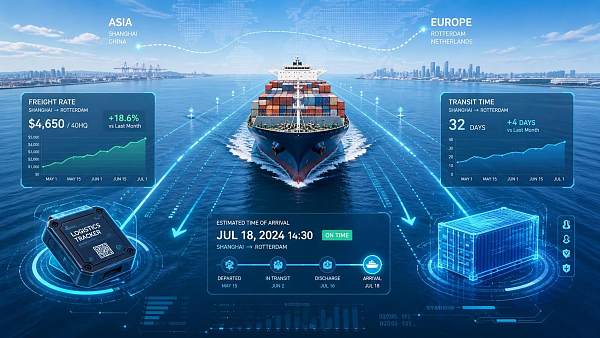
This information indicates that volatility on the Asia-Europe route is no longer limited to freight rate changes. It is also prompting a comprehensive reassessment of slot availability, arrival times, and delivery commitments. Overseas buyers are becoming increasingly sensitive to suppliers’ delivery reliability as a result of these changes.
What Pressures Are Different Business Roles Experiencing?
Direct Trading Companies Are Finding It More Difficult to Maintain Stable Quotations
For trading companies that ship directly from China to Northern Europe, rapidly rising freight costs are first passed on to quotation validity periods and profit margins. If transportation arrangements were locked in at an earlier stage while actual booking prices and transit times have already changed, the cost of explaining fulfillment conditions will increase significantly, especially for businesses that must continuously commit to delivery dates externally.
Buyers Are Rechecking Delivery Reliability
Overseas buyers typically map changes in transit times directly to a supplier’s execution capabilities. What is receiving greater attention now is not a single delay itself, but whether suppliers can continue to provide verifiable and updateable arrival expectations. For orders with fixed procurement schedules or high sensitivity to delivery dates, this will affect inquiry, price comparison, and ordering decisions.
Independent Websites and Supply Chain Service Providers Face System Update Pressure
For companies that rely on independent websites to generate inquiries, if the “estimated delivery time” displayed on a page remains static, buyers will quickly identify the gap between it and actual shipping volatility. For supply chain service providers, whether transit-time information can connect to a carrier’s real-time ETA API is shifting from an experience enhancement to a fundamental capability that affects conversion rates.
What Should Receive Greater Attention Now?
Delivery Commitments Must Be Synchronized with Actual Shipping Data
The analysis indicates that companies should first verify whether logistics information displayed on their websites, sales messaging, and actual booking schedules are consistent. Under current conditions of volatility, fixed “estimated delivery times” carry significant risks, particularly on inquiry pages, order pages, and quotations for Northern European routes.
Communication of Delivery Dates in Key Markets Should Include Buffer Time
From an industry perspective, procurement, documentation, and customer communications need to be adjusted in parallel. For business that has already entered the order negotiation stage, delivery-date explanations, shipping milestones, and exception notification mechanisms should all be made more detailed to prevent front-end commitments from becoming disconnected from back-end execution.
System Integration Is More Important Than Manual Explanations
What deserves greater attention now is whether the “estimated delivery time” module on an independent website can connect to a carrier’s real-time ETA API, rather than relying solely on operations personnel to make manual corrections. When freight rates and transit times change simultaneously, buyers value an updateable and traceable information chain more than a one-time verbal explanation.
Is This More of a Temporary Signal or a Long-Term Variable?
Based on current observations, this information is better understood as a strengthening industry signal rather than merely a short-term price fluctuation. The combination of rising freight rates, longer ocean transit times, and buyers reassessing delivery commitments has already moved “logistics transit-time display” from supplementary information to the forefront.
However, this does not mean that all companies will be affected in the same way. What truly requires continued observation is whether freight rate and transit-time volatility on the Asia-Europe route will become further normalized amid the ongoing Red Sea conflict, and whether independent websites and foreign trade systems will include real-time ETA capabilities as a standard configuration.
How Should This Information Be Understood at Present?
A more reasonable assessment is that this is an industry change signal affecting costs, fulfillment, and front-end conversion at the same time. It has already affected procurement decisions and the credibility of delivery commitments, but whether it will develop into a longer-term change in business rules still requires continued observation of subsequent freight rates, voyage durations, and buyer feedback on the Asia-Europe route.
Scope of Public Information Used as the Basis for This Article
This article was generated based on the information title, event date, and event summary provided by the user, without adding any unverified information. Source types typically associated with this kind of information include the Shanghai Shipping Exchange, carrier announcements, industry association information, corporate announcements, and reports from authoritative media. No specific official source link was provided in the input, so the relevant data and changes in shipping transit times still require continuous verification.
Related Articles
 Red Sea Crisis Drives Up Asia-Europe Freight Rates, Requiring Independent Websites to Update ETA Modules
 Which Industries Are Marketing Websites Suitable for? Start by Looking at the Sales Cycle
 How should foreign trade companies choose an overseas marketing solution? Should they prioritize lead quality or channel coverage?


Related Products
 Yiyingbao SaaS Intelligent Website Building and Marketing SystemYiyingbao SaaS Intelligent Website Building and Marketing System, AI-powered no-code website building, rapid creation of multilingual B2B international websites in 10 minutes, global server acceleration, AI-powered SEO optimization, helping businesses connect efficiently with global markets. The perfect integration of technology and operation makes building an international trade website remarkably simple
 AI+SEM Intelligent Advertising Marketing SystemAI+SEM drives intelligent ad creation, empowering full-funnel precision advertising marketing. The system automatically generates weekly/monthly reports, AI recommends keywords and target countries, monitors core metrics in real-time with intelligent alerts, and enables one-click high-conversion ad solutions to help quickly acquire customers and improve ROI.
 AI+SEO Dual-Engine System Optimization ServicesYiyingbao’s AI+SEO dual-engine optimization system helps foreign trade enterprises acquire high-quality organic traffic through AI-powered keyword research, content generation, and comprehensive technical optimization, significantly improving search rankings and conversion rates.
 AI+SNS Social Media Marketing SystemYingbao AI+SNS Social Media Marketing System - Precision social capture for the social media era. Supports one-click content synchronization across major platforms like Facebook and LinkedIn. AI intelligently rewrites posts for enhanced relevance. 24/7 AI customer service and user profiling analysis empower businesses to efficiently expand into global markets.
 AI+SEO营销解决方案易营宝AI+SEO营销解决方案,通过AI批量写作、智能生成TDK、精准关键词扩词等功能,全面优化网站SEO效果,提升流量与转化率。助力企业构建高效智能网站新生态。
 AI+SEM Advertising Marketing SolutionsAI+SEM Advertising Marketing Solution leverages AI technology to deeply empower SEM ad campaigns. It automatically generates weekly/monthly reports using AI, presenting account data across multiple dimensions for comprehensive insights into campaign performance and trends. The system precisely recommends keywords and target countries, intelligently generates high-conversion ad copy, and enables one-click activation of efficient campaign plans to help businesses rapidly acquire customers. Simultaneously, it monitors core metrics in real time, intelligently identifies abnormal fluctuations, and issues timely alerts to ensure stable, high-return advertising results.
 Domain Name ServicesEasyWin provides professional domain name services, including intelligent queries, one-stop registration, brand protection, and full lifecycle management, helping businesses build a digital brand image.
 EasyOperate B2C Cross-Border E-Commerce Platform & Independent WebsiteEasyStore B2C Cross-border E-commerce Independent Store is an intelligent website building and cross-border e-commerce integrated solution independently developed by EasyStore Information Technology (Beijing) Co., Ltd. The system is specially designed for small and medium-sized as well as large export enterprises, integrating 'website building, operation, marketing, advertising, and conversion' into one, helping enterprises quickly establish cross-border e-commerce independent stores to achieve brand globalization and global sales growth.
The platform supports multiple languages, multiple currencies, and multi-channel marketing, with built-in AI intelligent translation and SEO optimization systems, suitable for mainstream markets such as Southeast Asia, Europe and America, Latin America, and the Middle East, assisting Chinese manufacturing enterprises in efficiently deploying international e-commerce strategies. SSL证书易营宝提供专业SSL安全证书服务,包括单域名和泛域名证书,确保网站数据传输加密、身份验证和完整性保护,助力企业建立安全可信的在线业务环境。









